
Results
-
 £189.99
Rienzi Overture - Richard Wagner
Estimated dispatch 7-14 working days
-
 £81.90
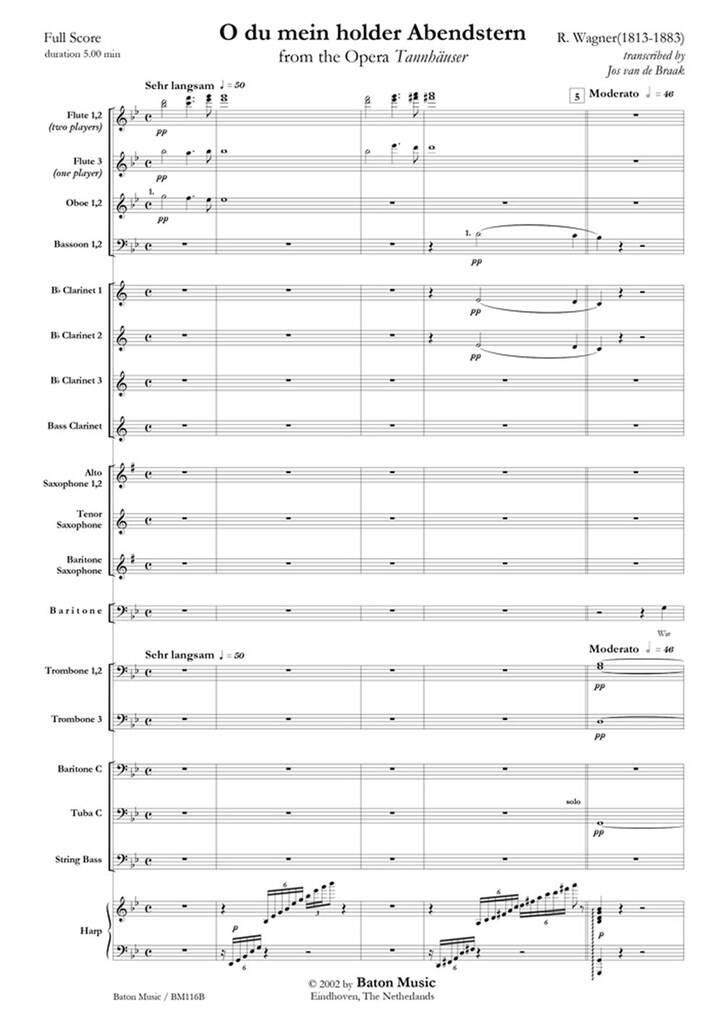
O du mein holder Abendstern - Richard Wagner
Estimated dispatch 7-14 working days
-
£78.20
Liebestod - Richard Wagner
Estimated dispatch 7-14 working days
-
 £123.20
3 Letzte Motetten (Concert Band - Score and Parts) - Bruckner, Anton - Doss, Thomas
Anton Bruckner (b. 4.9.1824, Ansfelden, d. 11.10.1896, Vienna) didn't have it easy. Throughout his life, the Austrian composer was plagued by self-doubt. Anton Bruckner came from a simple, rural background. After the death of his father, he was accepted as a choirboy at the monastery of Sankt Florian in 1837. After several years as a school assistant and his own organ and piano studies, he first worked as organist in St. Florian, then from 1855 as cathedral organist in Linz. Introduced to music theory and instrumentation by Simon Sechter and Otto Kitzler, he discovered Richard Wagner as an artistic role model, whom he admired throughout his life and also visited several times in Bayreuth. In 1868 Anton Bruckner became professor of basso continuo, counterpoint and organ at the Vienna Conservatory; ten years later court organist; and in 1891 finally honorary doctor of the University of Vienna. He was considered an important organ virtuoso of his era, but had to wait a long time for recognition as a composer. It was not until Symphony No.7 in E major, composed between 1881 and 1883, with the famous Adagio written under the effects of Wagner's death, that he achieved the recognition he had hoped for, even if he was reluctant to accept it given his inclination towards scepticism and self-criticism. Anton Bruckner was a loner who did not want to follow a particular school or doctrine. He composed numerous sacred vocal works, such as his three masses, the Missa Solemnis in B flat minor (1854), the Te Deum (1881-84) and numerous motets. As a symphonic composer, he wrote a total of nine symphonies and many symphonic studies from 1863 onwards, tending to revise completed versions several times over. Bruckner's orchestral works were long considered unplayable, but in fact were merely exceptionally bold for the tonal language of their time, uniting traditions from Beethoven through Wagner to folk music, on the threshold between late Romanticism and Modernism. Anton Bruckner composed about 40 motets during his lifetime, the earliest a setting of Pange lingua around 1835, and the last, Vexilla regis, in 1892. Thomas Doss has compiled some of these motets in this volume for symphonic wind orchestra. These motets show many characteristics of personal expression, especially Bruckner's colourful harmony in the earlier works, which is in places aligned with Franz Schubert (changes between major and minor; and movements in thirds). Later works are characterised by many components which, in addition to the expanded stature of the movements, include above all a sense of the instrumentation as an outward phenomenon and the harmony as a compositional feature that works more internally. Some aspects of Bruckner's work are the result of his long period of study, which familiarised him not only with the tradition of his craft, but also gave him insights into the "modernity" of his time in such composers as Wagner, Liszt and Berlioz. From this developed his personal standpoint, which always pursues the connection between the old and the new.Duration: 14.00
Estimated dispatch 7-14 working days
-
 £256.00
14 Motetten (Concert Band - Score and Parts) - Bruckner, Anton - Doss, Thomas
Anton Bruckner (b. 4.9.1824, Ansfelden, d. 11.10.1896, Vienna) didn't have it easy. Throughout his life, the Austrian composer was plagued by self-doubt. Anton Bruckner came from a simple, rural background. After the death of his father, he was accepted as a choirboy at the monastery of Sankt Florian in 1837. After several years as a school assistant and his own organ and piano studies, he first worked as organist in St. Florian, then from 1855 as cathedral organist in Linz. Introduced to music theory and instrumentation by Simon Sechter and Otto Kitzler, he discovered Richard Wagner as an artistic role model, whom he admired throughout his life and also visited several times in Bayreuth. In 1868 Anton Bruckner became professor of basso continuo, counterpoint and organ at the Vienna Conservatory; ten years later court organist; and in 1891 finally honorary doctor of the University of Vienna. He was considered an important organ virtuoso of his era, but had to wait a long time for recognition as a composer. It was not until Symphony No.7 in E major, composed between 1881 and 1883, with the famous Adagio written under the effects of Wagner's death, that he achieved the recognition he had hoped for, even if he was reluctant to accept it given his inclination towards scepticism and self-criticism. Anton Bruckner was a loner who did not want to follow a particular school or doctrine. He composed numerous sacred vocal works, such as his three masses, the Missa Solemnis in B flat minor (1854), the Te Deum (1881-84) and numerous motets. As a symphonic composer, he wrote a total of nine symphonies and many symphonic studies from 1863 onwards, tending to revise completed versions several times over. Bruckner's orchestral works were long considered unplayable, but in fact were merely exceptionally bold for the tonal language of their time, uniting traditions from Beethoven through Wagner to folk music, on the threshold between late Romanticism and Modernism. Anton Bruckner composed about 40 motets during his lifetime, the earliest a setting of Pange lingua around 1835, and the last, Vexilla regis, in 1892. Thomas Doss has compiled some of these motets in this volume for symphonic wind orchestra. These motets show many characteristics of personal expression, especially Bruckner's colourful harmony in the earlier works, which is in places aligned with Franz Schubert (changes between major and minor; and movements in thirds). Later works are characterised by many components which, in addition to the expanded stature of the movements, include above all a sense of the instrumentation as an outward phenomenon and the harmony as a compositional feature that works more internally. Some aspects of Bruckner's work are the result of his long period of study, which familiarised him not only with the tradition of his craft, but also gave him insights into the modernity of his time in such composers as Wagner, Liszt and Berlioz. From this developed his personal standpoint, which always pursues the connection between the old and the new.Duration: 39.00
Estimated dispatch 7-14 working days
-
 £80.00
Siegfrieds Funeral Music (Concert Band - Score and Parts) - Wagner, Richard - Whear, Paul W.
A classic Wagner selection in a enhanced arrangement. A perfect way to expose your students to the exceptional music of Wagner!
Estimated dispatch 7-14 working days
-
 £95.99
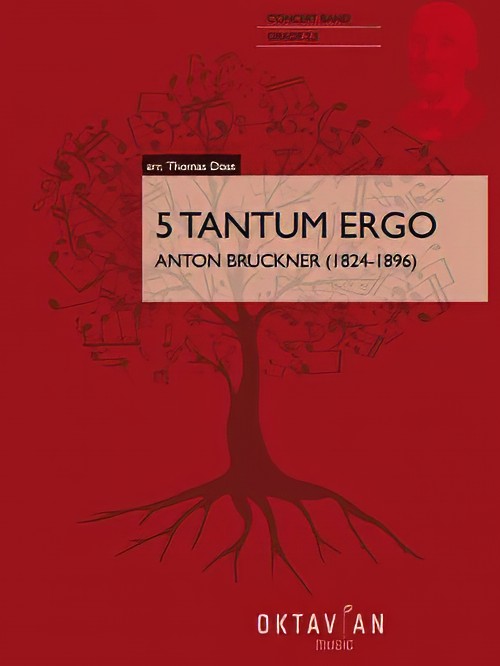
5 Tantum Ergo (Concert Band - Score and Parts) - Bruckner, Anton - Doss, Thomas
Anton Bruckner (b. 4.9.1824, Ansfelden, d. 11.10.1896, Vienna) didn't have it easy. Throughout his life, the Austrian composer was plagued by self-doubt. Anton Bruckner came from a simple, rural background. After the death of his father, he was accepted as a choirboy at the monastery of Sankt Florian in 1837. After several years as a school assistant and his own organ and piano studies, he first worked as organist in St. Florian, then from 1855 as cathedral organist in Linz. Introduced to music theory and instrumentation by Simon Sechter and Otto Kitzler, he discovered Richard Wagner as an artistic role model, whom he admired throughout his life and also visited several times in Bayreuth. In 1868 Anton Bruckner became professor of basso continuo, counterpoint and organ at the Vienna Conservatory; ten years later court organist; and in 1891 finally honorary doctor of the University of Vienna. He was considered an important organ virtuoso of his era, but had to wait a long time for recognition as a composer. It was not until Symphony No.7 in E major, composed between 1881 and 1883, with the famous Adagio written under the effects of Wagner's death, that he achieved the recognition he had hoped for, even if he was reluctant to accept it given his inclination towards scepticism and self-criticism. Anton Bruckner was a loner who did not want to follow a particular school or doctrine. He composed numerous sacred vocal works, such as his three masses, the Missa Solemnis in B flat minor (1854), the Te Deum (1881-84) and numerous motets. As a symphonic composer, he wrote a total of nine symphonies and many symphonic studies from 1863 onwards, tending to revise completed versions several times over. Bruckner's orchestral works were long considered unplayable, but in fact were merely exceptionally bold for the tonal language of their time, uniting traditions from Beethoven through Wagner to folk music, on the threshold between late Romanticism and Modernism. Hymns for four-part mixed choir a cappella (1846, St. Florian) No. 1 in E flat major (WAB 41/3): Quite Slow No. 2 in C major (WAB 41/4): Andante No. 3 in B flat major (WAB 41/1): Slow No. 4 in A flat major (WAB 41/2): Slow Hymn for five-part (SSATB) mixed choir and organ No. 5 in D major: Solemnly They are simple works, completely subordinate to their liturgical use, which nevertheless already show numerous characteristics of personal expression. These small pieces were able to stand up to the harsh scrutiny of the mature master: in 1888, Bruckner subjected them to a revision in which he made only minor corrections.Duration: 11.00
Estimated dispatch 7-14 working days
-
 £60.00
Die Meistersinger Themes (Concert Band - Score and Parts) - Wagner, Richard - Daehn, Larry
All the sweep and grandeur of Wagner's music encapsulated in a symphonic miniature for young band. Two of his noblest themes are joined in a concert piece that will inspire, yet not fatigue, young players. High quality educational music! Duration: 2.15
Estimated dispatch 7-14 working days
-
 £84.95
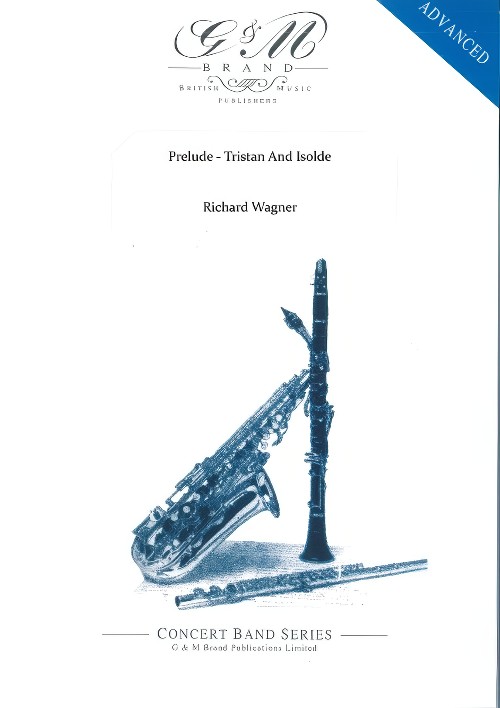
Prelude - Tristan And Isolde (Concert Band - Score and Parts) - Wagner, Richard - Brand, Geoffrey
Wagner finished the first act of 'Tristan and Isolde' on the last day of 1857 and two years later he finished the entire opera. Yet it was not until 1865, after various disasters had prevented the piece being performed, that it was heard in public and the sensational opening of the?Prelude?at a stroke created a different harmonic framework for late 19th century music and beyond.
Estimated dispatch 7-14 working days
-
£16.95
Prelude - Tristan And Isolde (Concert Band - Score Only) - Wagner, Richard - Brand, Geoffrey
Wagner finished the first act of 'Tristan and Isolde' on the last day of 1857 and two years later he finished the entire opera. Yet it was not until 1865, after various disasters had prevented the piece being performed, that it was heard in public and the sensational opening of the?Prelude?at a stroke created a different harmonic framework for late 19th century music and beyond.
Estimated dispatch 7-14 working days
 View Music