
Results
-
 £87.00
Besinnliche Weihnachtszeit
Alle Jahre wieder, Ihr Kinderlein kommet, O du frhliche, Ser die Glocken nie klingen and Stille Nacht, heilige Nacht, (Silent Night Holy Night), all well-known traditional German songs, are presented in a new and most tuneful varied medley. Thanks to the cue notes, the passages intended for large band can also be performed by smaller ensembles in a most satisfactory way. The alternative orchestral strengths are clearly indicated in the score. The piece can easily be performed without saxophones and without (French) horns. Of the four percussion parts (timpani, percussion with triangle, rattles and tambourine, drum set and mallets with (tubular bells), the combined percussion is indispensable.
Estimated dispatch 7-14 working days
-
 £75.60
Rocking 4 Elise - Ludwig van Beethoven
In this fresh new arrangment of Fur Elise, arranger Anton Burger has created a version in slow rock!
Estimated dispatch 7-14 working days
-
 £92.00
Medieval Hymn Variations - Naoya Wada
Guido d'Arezzo(992 - 1050) was an Italian music theorist of the Medieval era. He developed new techniques for teaching, such as staff notation and the use of ut-re-mi-fa-so-la (later, ut became do). The original monophonic melody is written in organum in the first part, then developed in 3 modern variations, to end with a passionate finale. After the premire in 2015, the piece was revised drastically, and was performed in its final edition in 2016.
Estimated dispatch 7-14 working days
-
£106.50
Heinzelmnnchens Wachtparade - Kurt Noack
This is a new edition of the well-known popular character piece. Its technical and musical demands should not be under-estimated!
Estimated dispatch 7-14 working days
-
 £292.00
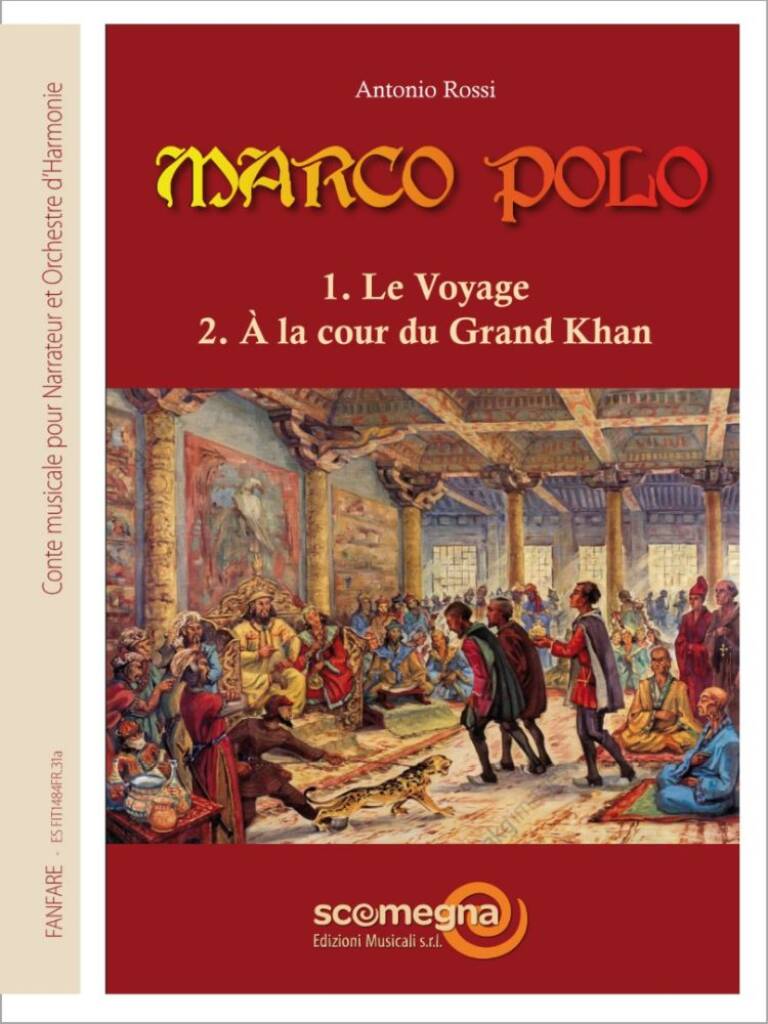
Marco Polo (French text) - Antonio Rossi
Marco Polo (Venice, 1254), son of Venetian merchants, left in 1271 with his father Niccol and his uncle Matteo, towards the distant China at the court of the Mongol emperor Kublai Khan. The long journey, which lasted three and a half years, led the Polos to cross Turkey, Central Asia, the Pamir, and the Gobi desert. The intelligence of the young Marco and his curiosity towards new customs and languages raises the interest of the emperor so much that he decides to keep him at his court by appointing him ambassador. This assignment takes him to newly conquered southern China and other parts of southern Asia. In 1292, the Great Kublai Khan agrees, albeit reluctantly, to let him go.Marco, after 17 years at his service, can finally return to Venice, but not before completing a last mission for the Grand Khan: accompanying his niece, Princess Kokachin, to Persia, where she would marry. A few years after his arrival in Venice, Marco finds himself involved in a naval battle against the Genoese people in which the Venetians are defeated. Consequently, Marco is captured and taken to prison in Genoa. There, he meets the storyteller Rustichello da Pisa to whom he tells the story of his adventurous journey. After his release, Marco returned to Venice and led a comfortable life until his death in 1324.
Estimated dispatch 7-14 working days
-
£123.95
Elegy for A Young American - Ronald Lo Presti
Written to honor the memory of President John F. Kennedy, this somber work has been a staple in the repertoire for many years and is on most lists as one of the top pieces in literature. It is our hope that by this re-promotion, a new generation of band directors and musicians will become familiar with this classic work.
Estimated dispatch 7-14 working days
-
 £104.50
Novo Lenio - Samuel Hazo
This is Samuel Hazos 2001 National Band Association award-winning composition, a continuous three-movement work offering various styles and much to keep your interest. Based on a school alma mater, the sections are varied in mood yet cohesive in thematic material. The first movement, Remembrance, is somewhat somber in tone, followed by the more dissonant Qui Non Proficit Deficit; the work closes with the full and proud-sounding A New Beginning.
Estimated dispatch 7-14 working days
-
 £70.00
Anniversary Overture - Malcolm Arnold
Anniversary Overture was commissioned in 1968 as a twenty-first birthday piece for Hong Kong Philharmonic Society, and is a four-minute firework display for orchestra. Within the framework of a two-four Allegro giubiloso,Arnold alternates two major themes, one breezy, the other tender, developing them extensively and landing resoundingly in F major. This new transcription brings an exuberant work to the field of symphonic wind band for the firsttime.
Estimated dispatch 7-14 working days
-
£92.50
Invictus - Brian Balmages
A serious concert or festival piece, Invictus was written in memory of the composer's grandfather and based on a poem of the same title by William Ernest Henley. This extensive, emotional composition will thrill performers and audiences alike with interesting effects and textures. A new musical masterpiece!
Estimated dispatch 7-14 working days
-
£53.95
In Quest of Excellence - Robert Longfield
A great new march in cut time from Robert Longfield, one of America's brightest concert composers. The march begins in B and moves up to E at the trio strain. Modest ranges throughout. In your quest for that winning contest opener, take a look at this excellent selection!
Estimated dispatch 7-14 working days
 View Music