Results
-
 £91.99
Peer Gynt Suite #1 - Edvard Grieg
Introduce important orchestral literature to your younger band with this masterful arrangement by James Curnow. This four movement arrangement contains the familiar Morning Mood and In The Hall Of The Mountain King, as well as two exotic themes, Death Of Ase and Anitra's Dance.
Estimated dispatch 7-14 working days
-
 £84.99
Introtus - Traditional
The Latin word "Introitus" means 'entry'. Originally, this was a psalm sung to accompany the entrance of a bishop, priest or celebrant into the church. Later it was incorporated into the mass with alternating sung and spoken text, reflecting the mood of the liturgy. Jacob de Haan's Introitus, in which he has arranged the hymns Puer natus est nobis and Lobt Gott, Ihr Christen alle gleich, is a wonderful introduction to the Christmas season and can be performed with any instrumental combination with mixed choir and organ ad libitum.
Estimated dispatch 7-14 working days
-
 £109.99
Gate 11 - John Emerson Blackstone
Gate 11 is a piece by John Emerson, inspired by the mood of a bustling airport in which passengers dream quietly of the loved ones that await at the end of their journey. Equally accessible to young and old alike, Gate 11 is an atmospheric piece ideal for concert performance.
Estimated dispatch 7-14 working days
-
£144.99
Vents Catalans - Ferrer Ferran
Vents Catalans (Catalan Winds) is a symphonic fantasy which, while it does no directly reference any melody or song from Catalonian folk music, still manages to convey all the life, beauty and energy of this charming region in southern Spain. After a triumphant and majestic introduction, reminiscent of folksongs and lively dances, the mood calms down with an elegant, yet playful, melody, followed by the Sardana, the traditional Catalonian dance par excellence.
Estimated dispatch 7-14 working days
-
 £134.99
Fanfare And Funk - Oliver Waespi
This work by Swiss composer Oliver Waespi was one of the highlights at the 2006 Eidgenssische Musikfest in Lucerne. The piece opens with a festive fanfare featuring the brass section. The mood changes to a funk passage which develops and grows into a James Brown-like groove. It also includes an ad libitum drum solo. A slow blues lends a calmer feel and the piece culminates with striking interwoven fanfare and funk styles. This work is highly recommended for concert programmes but it can also make a spectacular, unconventional choice for a competition.
Estimated dispatch 7-14 working days
-
 £79.99
Passages - Michael Sweeney
The term passage can variously describe a passageway of travel, a musical phrase, or perhaps the soul's moving on from this world to the next. In this work for band, dark and rich sonorities are contrasted with a lilting,Celtic-flavored melody as it alternates with striking passages from the brass. Later, an alto sax soloist adds a haunting quality to the mood followed by a return of the ethnic drumming heard earlier. This unique and rewardingcomposition is beautifully paced and skillfully orchestrated using every section of the band. Dur: 7:00 (Grade 4)
Estimated dispatch 7-14 working days
-
 £57.50
Ave Maria - Kevin A. Memley
Originally a composition for chorus by Kevin A. Memley, this adaptation by Preston Hazzard makes expert use of the various tone colors available for band. Cascading waterfall effects are represented in the mallet percussion andwoodwinds, while an underlying rhythmic texture provides a flowing background for the lyric melody. The piece builds nicely to a full band climax before returning to a quiet and delicate mood for the close. Dur: 4:10
Estimated dispatch 7-14 working days
-
 £89.99
Remembrance Day - Morton Gould
G. Schirmer Concert Band - Grade 3-5Premiered by the University of Connecticut Wind Ensemble in the presence of President Clinton, Gould's last large work for wind ensemble is a striking mood piece that conveysa melancholic feeling. A haunting Marimba solo opens this work that challenges players with its spare exposed textures and wide dynamic range. President Clinton called it a treasure. (Grade 5) (9:00)
Estimated dispatch 7-14 working days
-
£125.00
Danceries (Set II) - Kenneth Hesketh
Danceries Set II was commissioned by Keith Allen and Birmingham Symphonic Winds, supported by PRS for Music Foundation and the RVW Trust. The world premire of this work was given by Birmingham Symphonic Winds, conducted by Keith Allen, at the CBSO Centre, Birmingham in 2011. This second set of Danceries continues the format established in Danceries (Set I), namely in using material taken from Playford's Dancing Master, a collection of folk and popular tunes published in the seventeenth century, to form the basis of an extended dance suite. In this set, the melodies have been more abstracted and project only a distant echo of their original forms, but as before, each movement is self-contained, colourful and direct, with its own distinct mood.The outer movements - Jennie's Bawbee and Peascod's Galliarda - share a use of driving percussion writing with a military air. Tom Tinker's Toye and Heart's Ease (movements two and three) are both settings of original melodies. All movements are more extended than in the first set, with a freer use and approach to the material; melodies now occur in various keys and are supported by a greater variety of harmonic colouring. The result is a richer, even more exhilarating set of dances. Danceries has come of age!
In stock: Estimated delivery 1-3 days
-
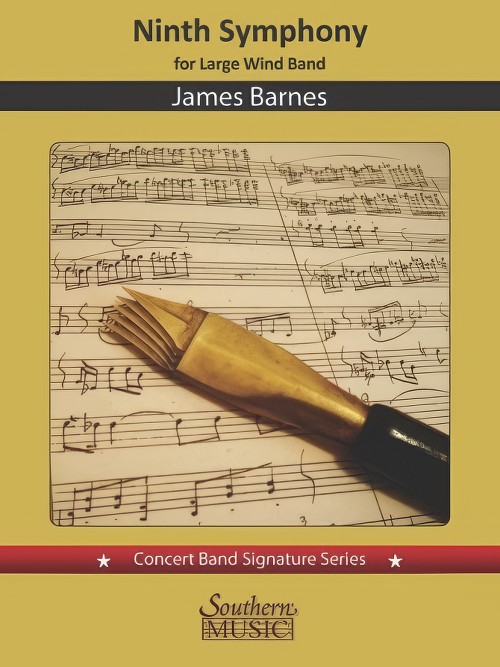 £309.99
Ninth Symphony (Concert Band - Score and Parts) - Barnes, James
Premiered on 21 September, 2018 in Lawrence, Kansas by The University of Kansas Wind Ensemble (Dr. Paul Popiel, conducting), James Barnes' Ninth Symphony was composed between January and late June of that same year. This large work was commissioned by a consortium of twenty-one college bands, community bands, professional bands and individuals to help mark the 70th birthday of the composer (b. 1949). It is an expansive forty-minute work in four movements, of which the composer writes, "This is my last symphony...this work represents a compendium of all that I have learned during the fifty years of composing and scoring for this wonderful new medium: the modern wind band." The first movement, subtitled Elegy, is based around G minor. It is the longest movement of the symphony. Tragic and despondent in character, it is cast in sonata-allegro form. The second movement is entitled Scherzo. Barnes claims that "I have always wanted to write a waltz," and that is how this movement is cast, in a modified rondo form in D minor. In contrast to the mood of the first movement, the scherzo is a delightful posy of expansive melody, splashy color, humor and rhythm. The third movement, which is in a modified tertiary form, is entitled Night Music. In contrast to the scherzo, this movement begins with a mysterious incantation, first displayed by solo Alto Flute. The music becomes even darker and more mysterious, while overall the movement effectively expresses an "otherworldly" mood, ending with a solo soprano offstage which suddenly emerges, eerily singing a modified version of the opening incantation. Cast in sonata-allegro form, the fourth movement is most definitely a rousing Finale, beginning with a brilliant fanfare and undergoing several mood transformations before emerging into the final coda, ending the symphony with an energetic splash of color. Duration: 40.00
Estimated dispatch 7-14 working days
 View Music