
Results
-
£43.00
Dis & Co. - Leslie Searle
Dis & Co. has different musical themes to 'Chips in a bag', but there are also similarities so that it could be played as an alternative or an extension.
Estimated dispatch 7-14 working days
-
 £113.30
Caleidoscopio - Lorenzo Pusceddu
The incommunicability between different cultures and worlds and the confusion that this generates lie at the heart of this work: the fanfare-like themes that characterise the introduction, together with the "Arabian" melodies of the Presto, represent these differences. The bare theme of the Andante, while offering a glimpse of hope, also describes the impossibility of a meeting and the pain this situation causes. The empty fifth and dissonance of the minor second are elements that feature throughout this work. In the Coda, moreover, all these ideas reappear "kaleidoscopically", amidst a convulsive and excitingly chaotic atmosphere.
Estimated dispatch 7-14 working days
-
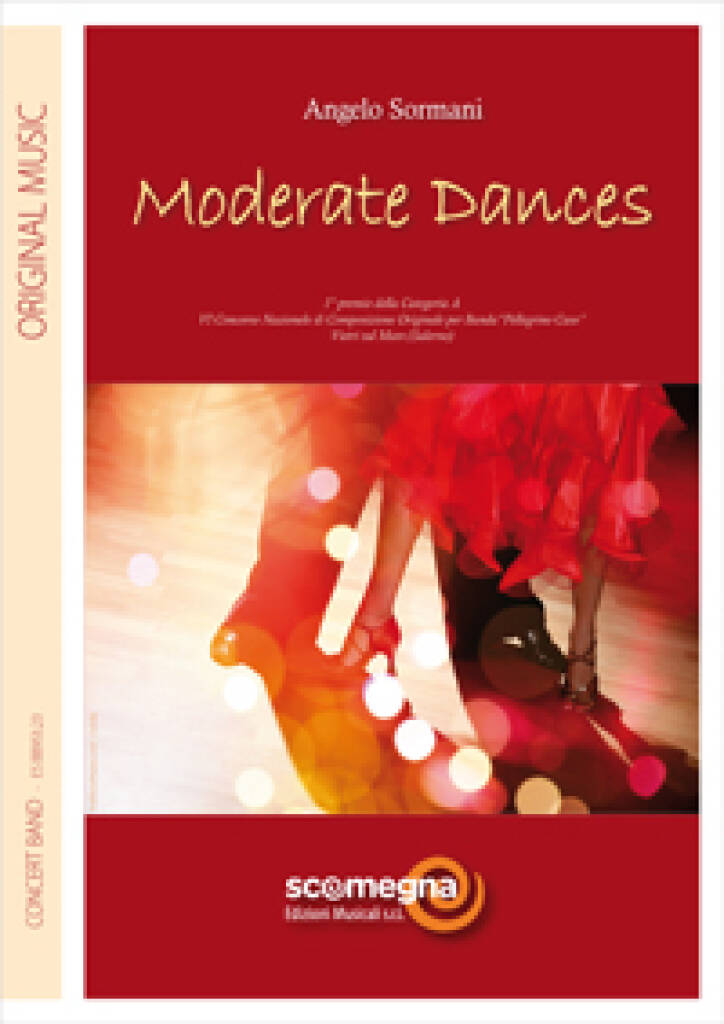 £113.30
Moderate Dances - Angelo Sormani
This piece is a tribute to dance music, especially passionate, intense and meditative dance music. "Moderate Dances" is divided into three movements: a "Tango", a "Slow Waltz" and a "Bossa Nova". Each movement and each dance has its own particular characteristics but, when combined, these different rhythmic beats and times give the piece a feeling of completeness and uniformity. The Tango started to flourish in the suburbs of Buenos Aires in around 1880. There is still some doubt as to its origins, which may be Cuban (Habanera) but are probably African. It was most popular in Argentina and Brazil: here the male protagonist was originally the "gaucho" with his inseparable guitar, later to be replaced by the proud, elegant "compadre". By around 1910 the Tango had spread to Italy and France. New clubs opened, where the upper classes could watch and dance the Tango. Here the dance also underwent some rapid transformations. The exaggerated and extravagant gestures and body movements disappeared. Slow, gliding steps replaced the old rotational movements. The women's red ankle-boots and the partners "staring into each other's eyes" accentuated the erotic nature and sensuality of this dance. So much so that, in 1913, the German government banned soldiers from dancing the Tango. Those who broke the law were immediately discharged from the army. From a strictly musical perspective, the basic instruments were a flute, a harp (the diatonic harp typically played by the Indians of Paraguay) and a violin, or flute, guitar and violin or even clarinet, guitar and violin. These instruments were easy to transport, ideal for playing at parties, in the streets and in courtyards. The musicians played by ear, frequently improvising: there were no scores, no records, which is the main reason why it is impossible to trace the Tango back to its exact origins. However, the Tango's evolution (and growing popularity) was once again fostered by its fundamental ability to absorb "other" cultures, languages and sounds. And it was the arrival of the "bandoneon" (an accordion-like instrument that was invented in Germany and brought to Rio de la Plata by some immigrant), which replaced the flute, that marked the beginning of the Tango's huge success outside Argentina. A number of talented composers, above all the great Astor Piazzola (1921-1992), transformed the bandoneon from a simple accompanying instrument to a solo instrument that was to become the distinguishing feature of the 20th century Tango. The Slow Waltz originated from the Waltz, the typical dance of the Bavarian and Tyrolese peasants in the 1700s. It was composers like Johann Strauss, father and son, who carried the Waltz to its zenith in the 1800s, creating the sensual and melancholy yet joyful and charming dance we are all familiar with. When the Waltz first became popular in Germany, the members of respectable society were shocked at the closeness of the dancing partners, who had always previously danced apart. The main difference between the Waltz and Slow Waltz is that the latter has a slower, more expressive rhythm: the men wear tails and the women wear ball gowns decorated with beads and feathers and couples dance in graceful rotational movements. "Bossa Nova" is the title of the last movement in the piece. Jobim, the great Brazilian musician, described this musical genre as a combination of modern Jazz and Samba. Bossa Nova means "new wave". This was the name of the artistic and musical movement that evolved in Brazil in the late Fifties and was extremely popular throughout the Sixties. The songs are usually about love or social matters, drawing inspiration from the slums of Rio De Janeiro and the lives of their inhabitants. Bossa Nova, with its original compositions and the artistic talent of its musicians, also became hugely popular in the United States and Europe, and top Jazz musicians (Ella Fitzgerald, Stan Getz, Bob Cooper, Charlie Bird, Sonny Rollins, Dexter Gordon, Dizzy Gillespie) started to include Bossa in their repertoires.
Estimated dispatch 7-14 working days
-
Elegie - Peter Meechan
The opening unaccompanied passage of this work was originally written as a short memorial piece for saxophone, but was later adapted as the basis of this more developed work for solo euphonium or trombone.The work uses a variation structure, with both the soloist and the accompaniment changing throughout the piece; the harmony, rhythm and melodic lines leading somewhere new and different each time they are heard - similar to the way our memories of a person often wander in different directions, but are still always focused on that person.
Estimated dispatch 5-14 working days
-
Fragile Oasis - Peter Meechan
Fragile Oasis is the name of a collective who describe themselves as "...a grass-roots participatory initiative that connects the shared perspective of astronauts from different countries and cultures with people on Earth, encouraging all to work together so that our planet is not only visibly beautiful, but beautiful for all".Many involved in the project are astronauts on the International Space Station (I.S.S.), who post, on their website (http://www.fragileoasis.org) many different details of their experiments, photos from space, and some incredible video footage of our Earth.One such time lapse video (a video made up many still images) was posted on their website by astronaut Ron Garan (http://www.fragileoasis.org/blog/2011/11/coming-back-down-to-our-fragile-oasis-2/) in 2011. It is made up of images taken from the I.S.S. of what Garan described as "...a couple of laps around our Fragile Oasis before coming back down [to Earth]" and features all kinds of amazing views from space.Each of the five sections of this work relate to an aspect of the video - either something literal or something more metaphorical. The opening section, i: The lights from Above, is a musical description of the view of the Aurora Australis from above the lights. The second section, ii: The Storm from Above (part i), is also a musical portrayal of portions of the video clip - in this case the many lightning storms we see from above. The storms that are so powerful on Earth appear as small bolts of electricity dancing through the clouds.The third section, iii: Freya, has its roots in personal family tragedy. The name Freya derives from a Norse goddess who was associated with both beauty and love, and in this central section I wanted to write music that not only acknowledged how fragile life itself is, but that every day of it counts and should be celebrated.iv: The Storm from Above (part ii) is a again a reference to the lightning storms, but also to the huge hurricanes we see in the video. It leads us to the final section, v: The Oasis from Above - a description of the size and grandeur of Earth, our Fragile Oasis.Fragile Oasis is dedicated to Natalie Youson, in friendship.The original wind orchestra scoring was completed in 2014, and was revised in 2017 with the editorial advice of Robert Ambrose whose support of this work I am eternally grateful for.This wind orchestra scoring was completed in 2014 and was commissioned by a consortium of the following bands:Agrupacin Msico-Cultural "Las Musas" de Guadalupe (Murcia) - Dr. Jos Ibez Barrachina - SpainBand of the Coldstream Guards - Major Darren Wolfendale - UKBorge Musikkorps - Sverre Stakston Olsrud - NorwayThe Brooklyn Wind Symphony - Jeff W. Ball, Artistic Director - USADunshan Symphonic Wind Orchestra - Adrian Schneider - ChinaKoninklijke harmonie Ste. Cecilia Zele - Bart Picqueur - BelgiumMusikgesellschaft Emmen - Manuel Imhof - SwitzerlandUniversity of Saskatchewan Wind Orchestra - Dr. Darrin Oehlerking - Canada
Estimated dispatch 5-14 working days
-
 £74.31
Temperamental (Concert Band) Fendall Hill
This work by Fendall Hill was the set test for the 2021 National Brass Band Championships of New Zealand, B Grade. Here it has been adapted for Concert Band.The composer writes: 'J.S. Bach (1685-1750) is deemed by many to be the 'Ulimate Composer'. He added an incredible proportion to the DNA of western music, and his influence is heard in the music of today. Like many artists, he was not overly recognised as a composer during his lifetime, and it took an 1829 performance of the St Matthew Passion by Mendelssohn to ignite a recognition of his place in the music world, a place he has maintained ever since.This piece starts with a similar spark of rediscovery of the music of Bach. It contains arrangements of various works, interspersed with composition based on Bach's chord structures, sections in the style of Bach, and original sections inspired by the moods created along the way.The first section explores the Toccata, and great organ works. This leads into an exploration of his choral works, and a finale based on the Preludes. The word 'Tempered' has different meanings, and all seem to apply to the music of Bach, and these appeal to the musical, engineering and spiritual aspects of my personal life.His music reaches to the humanity and divinity, it has strength, structure and order that creates frameworks in which incredible complexity reigns; and the complexity leads to a wildness, a kind of craziness that represents a range of human moods, and can change without warning. The same piece of music affects people in very different ways.I don't know if it's Bach's music, or us, but it can seem out of control and under control at the same time - the combination is highly temperamental.To view a follow-the-score video of the work please visit: https://youtu.be/6CtYZmCoWIcSheet music available from:UK: www.wind-band-music.co.ukUSA: www.solidbrassmusic.comDifficulty Level: AdvancedInstrumentation:Instrumentation:PiccoloFlute 1-2OboeBassoonClarinet in Bb 1-3Bass Clarinet in BbAlto Saxophone 1-2Tenor SaxophoneBaritone SaxophoneTrumpet in Bb 1-3Horn in F 1-4Trombone 1-2Bass TromboneEuphoniumTubaDouble BassTimpaniPercussion 1-3
In stock: Estimated dispatch 1-3 days
-
£34.95
Dreaming of Dreams - Thomas Kelly
Dreaming of Dreams is a slow-paced and 'feel-good' piece, written for grade 2 Wind Band. After a short reflective introduction, the light and delicate main melody is introduced by the first clarinets followed by a broad and nostalgic counter melody at letter B played by the tenor saxophone, bassoon, first trombone and euphonium. At section D the main melody returns in the first clarinets, this time augmented by the first trumpets and at E we hear the main melody and counter melody together. After a repeat of the opening material, a new melody is featured at letter G played by the first flutes in a new key. The main melody and counter melody are then heard for one final, triumphant time, back in the home key. Fragments of the main melody are then heard throughout different sections of the band as the piece fades away to the final chord.
Estimated dispatch 7-14 working days
-
£59.95
Where Eagles Sing - Paul Lovatt-Cooper
The inspiration for this piece came when the composer visited Florida and the Bird Sanctuary in Walt Disney World's Animal Kingdom. He was in the audience to see the rare bird's show where he witnessed some fabulous looking and endangered birds that were trained to perform different tricks that wowed the audience. The highlight for him was the conclusion of the show where the most awesome sight greeted us as an American Bald Eagle soared over the audience. That particular breed of Eagle has been a very rare bird of late. With so few in numbers, it nearly became a member of the sad group of animals that are extinct.The host of the show took great delight in informing the audience that the fantastic creature is now officially safe and no longer classed as endangered. This made a great impact on the composer as the Eagle is an amazing bird, huge in size and power and yet so graceful in flight. This piece is everything associated with the Eagle; bold, powerful and graceful and now free to soar and sing in the American homelands.Where Eagles Sing has been hugely successful as a curtain-raiser (or finale) with brass bands around the world and it is hoped that this version for wind band will be just as popular.
Estimated dispatch 7-14 working days
-
 £48.00
Danza De Espaa
This flexible arrangement of Danza de Espaa, from Carol Brittin Chambers, can be played with as few as five wind or string players. It is a Spanish style piece in a lilting 3/4 time that will get your developing band off to a great start at your next concert. This Carol Brittin Chambers piece has flowing melodic lines and lots of interplay between the percussion and winds. Carol also explores different colors and textures in the winds to make the piece a more interesting addition to the repertoire for developing band.
Estimated dispatch 12-14 working days
-
 £74.00
Homecoming - Amy Austria
Homecoming is a warm, lyrical piece that conveys the universal experience of returning, physically or emotionally, to a place we call home. With hummable melodies and rich harmonies, the music invites audiences into the feelings of nostalgia and gratitude. The colorful display of the different timbres of the wind band, melodic gestures, and climactic conclusion make this work an ideal programming choice for directors seeking a heartfelt concert work..
Estimated dispatch 12-14 working days
 View Music