
Results
-
 £104.20
The Nutcracker Swing - Pyotr Ilyich Tchaikovsky
Pjotr Iljitch Tchaikovsky is not only famous for his poignant symphonies and virtuoso concertos, but is also popular thanks to his romantic ballet music. The Nutcracker Ballet was inspired by the fairy tale The Nutcracker and the King of the Mice in which the little girl Mary receives a nutcracker that looks like a strange little man as a Christmas gift. Contains: Miniature Overture, Characteristic Dance, Dance of the Sugar Plum Fairy, Russian Dance, Arabian Dance, Dance of the Scullery Maids and Waltz of the Flowers.
Estimated dispatch 7-14 working days
-
 £159.00
Greek Folk Song Suite No. 2 - Franco Cesarini
After the great success of the Greek Folk Song Suite that has lasted for over twenty years, Franco Cesarini once again ventures into the long and rich tradition of Greek folk music. In his Greek Folk Song Suite No. 2, the three movements that form the piece are named after the three dances reworked by the composer.The first movement, Samiotissa is a kalamatianos, whose most distinctive feature is the irregular 7/8-time signature. It is a festive dance, today considered the Greek national dance, which has roots dating back to antiquity.The second movement, Kato sto jalo is a zeibekiko, a slow-paced dance performed by only one man at a time which was apparently originated among the warriors of Ancient Anatolia.The third and last movement, Chasaposerviko, is the fast part of the hasapiko dance and is characterized by its more extensive form.A new journey into the Greek folk tradition that will delight both performers and audience.
Estimated dispatch 7-14 working days
-
 £156.30
Simoon Concert - Ferrer Ferran
The Simoon Concerto is a two part composition for alto saxaphone and wind orcehstra. The first part, Dance of the Dunes, describes how the sand dunes form and alter their shape due to the scorching desert winds. In the following section, Dance of the Tuaregs, the snare drum signals the start of the dance of the legendary nomadic desert dwellers. The proud Tuareg people dance according to the ancient traditional rhythms of their ancestors
Estimated dispatch 7-14 working days
-
 £349.99
Symphonic Dances - Yosuke Fukuda
Symphonic Dances for Wind Ensemble was commission by the Central Band of the Japan Air Self Defense Force. The suite's five movements present "dances of the world". While the energetic quality and spirituality of each dance should be captured, the collection is still intended to entertain. Each movement is complete and can be performed accordingly.I. Renaissance DancesAn homage to European flavor and style from the time of Gervaise, Susato and Praetorius, after the introduction, the steps of courante, pavane, galliard, and branle appear. Please perform with vigor and contrast!II. TangoThis section is more an earthy and piquant Argentine romance than an elegant continental tango. Perform the alto saxophone theme and solis for each section very passionately!III. HoedownHere is the scene of the rodeo and a free-spirited western swing feel. The introductory clarinet solo can be done ad libitum. Maintain the mood by swinging slightly throughout. Present this movement playfully!IV. Spirituals (Bon-Odori-Uta)This is a requiem on the Bon-Okuri ceremony guiding ancestors back to the spiritual world. The initial piccolo motif repeats a chant in the rhythm of bon odori (a bon dance) and develops as a variation on Owara-bushi, a beautiful folk song from Toyama prefecture. The traditional bon odori have evolved into summer festival entertainment.V. Belly DanceThe belly dance is typically Arabic, its music performed by strings and drums.All should play with passion and flamboyance and a sense of bacchanalia and abandon. Employ a heavy sense of rhythm, also with a "Darbuka" (traditional Turkish goblet drum) if possible. Additionally, a "big-bang" coda is not only allowed, but encouraged!(Yosuke Fukuda)
Estimated dispatch 7-14 working days
-
 £119.99
The African Connection - Carl Wittrock
Carl Wittrock's wide interest in global folk-music resulted in this concert-piece based on original African rhythms. Obviously, the percussion section has a conspicious role to play, but the band too may indulge itself in moments of thoroughly delightful excitement. The introduction depicts the awakening of nature, and develops into a dance. The (main) motif of this dance is from a dance entitled Apollo and comes from Gambia. Its accompaniment consists of an ostinato pattern by balaphon-master Maudo Susa. The quiet middle movement is based on the rhythm of the 'gigbo' : a traditional dance from Ghana. In the final movement -which also bears a slight resemblanceto a theme from 'The Lion King'- the so-called 'Kono' rhythm is used. The work is played most advantageously using djembes. Challenge and please your percussion section with 'The African Connection'. Carl Wittrock's brede interesse voor de wereldmuziek resulteerde in dit op originele Afrikaanse ritmes gebaseerde concertwerk. Het slagwerk speelt uiteraard een opvallende rol, maar ook het orkest kan zich op een heerlijke manier uitleven. De inleiding schildert het ontwaken van de natuur, welke overgaat in een dans. Het motief van deze dans (Apollo) is afkomstig uit Gambia. De begeleiding bestaat uit een ostinaatpatroon van de balafon-meester Maudo Susa. De basis van het rustige middendeel is gelegen in het ritme van de Gigbo, een traditionele dans uit Ghana. Het laatste deel (met enige gelijkenis met The Lion King) maakt gebruik van het zogenaamde Kono ritme. Het werk komt het best tot zijn recht als er gebruik wordt gemaakt van djembes.Daag uw percussie sectie uit en doe ze een groot plezier met: The African Connection!
Estimated dispatch 7-14 working days
-
£184.99
Rubicon - Bert Appermont
The Rubicon is a river in Northern Italy which Julius Caesar crossed with his army in 49 BC in defiance of the leaders of Rome, who feared his power. A civil war against rival Pompey ensued, which culminated in Caesar seizing power as the absoluteruler of Rome. The phrase "crossing the Rubicon" therefore refers to any person committing himself irrevocably to a risky, decisive and irrevocable of course of action.The work consists of three parts that deal with this important moment in history.Part 1 (Meditation) symbolises Caesars request to the Gods to assist him in his difficult choice. In a slow introduction we hear the melancholy and beseeching sounds of the duduk (alternatively, this part can be played by a soprano saxophone)and of the soprano solo singer over the bourdon accompaniment. The soprano solo singer then sings "dona tibi pacem" (give him rest) in a melodious and probing theme.In Part 2 (Battle of Pharsalus) trumpets and trombones resound alternately ina stately Roman fanfare, producing a stereophonic effect. This develops into a martial theme in which Caesars impressive army goes to battle against the army of rival Pompey. While the theme of Caesars army fades away, Pompeys theme emerges as anaive dance in six-eight time. His army is definitely in the majority and it believes it can easily defeat the enemy. Suddenly trumpets and trombones clash on two sides of the orchestra: Caesars army advances and attacks. A fierce battle ensues inwhich the two themes are played alternately as well as simultaneously. Thanks to his shrewd battle tactics, Caesar manages to win this legendary battle after all: his theme resounds ever louder in trumpets and horns until everything dies out andchanges into a kind of reconciliation between the soldiers of the two armies. The melancholy "dona tibi pacem" from part 1 now serves as a reconciliation theme.Caesar is now the sole ruler of the New Roman Empire, which would be destined to leave itsmark on our Western civilisation to this day. The third part is a sparkling succession of dance music (Dance) with many Greek and Roman elements in which Caesars victory is praised and celebrated. It is common knowledge that the culture(arts, gods, etc.) of the Romans drew heavily on Greek culture. I have therefore used an authentic Greek theme (the Seikolos song) several times in this part (bar 17 in the euphonium, bar 60 in the base section, bar 68 in the sopranosaxophone) to suggest the music of that era and to evoke the right atmosphere. After a gradual increase in tempo in the entire orchestra, the opening melody gloriously resounds once more, surrounded by virtuoso dance music. The work ends withbombastic brass fanfares in which Caesars theme triumphs once more.NOTE FOR THE CONDUCTOR:The Armenian duduk and the monochord that are used in the introduction give a special tone to the music, but could be substituted (soprano saxophone instead ofthe duduk) or left out (monochord). The soprano solo is also doubled within the orchestra and could therefore also be left out if necessary, although it does provide the work with an extra dimension. The male voices in the introduction and the finalecould possibly be replaced with a synthesizer with choral setting.As a visual and acoustic element in part 2, the trumpets, the e-flat cornet, the small drum and trombones can be stood up and placed at two sides of the orchestra (bar 80).Seen fromthe point of view of the conductor, put the trumpets, the e-flat cornet and the small drum in the left section and the trombones in the right section of the orchestra. This also helps to create a visual contrast between the two themes of the secondpart. The players can be seated again at bar 97 or bar 121. The soprano soloist can be placed in or in front of the orchestra, depending on what gives the best result. For the conclusion of the work the soprano solo can be sung from afar (from thewings) to create additional atmosphere.This work was composed especially for the "St Joseph" brass band from Pey/Echt (Belgium) with conductor Mark Prils.
Estimated dispatch 7-14 working days
-
 £89.99
Symphonic Dances from Fiddler on the Roof - Jerry Bock
This landmark Broadway musical includes marvelous dance sequences with unique ethnic stylings. From the rousing To Life and Tradition to the tender Chava Sequence and Perchik and Hodel Dance to the signature Wedding Dance #1 (Bottle Dance) this is a magnificent work for the mature ensemble.
Estimated dispatch 7-14 working days
-
 £66.95
A Nutcracker Assortment
A Nutcracker Assortment, arranged by Michael Story, contains six memorable themes from one of Tchaikovsky's greatest works. "The March," "Dance of the Sugar Plum Fairy," "Waltz of the Flowers," "Dance of the Reed Flutes," "Arabian Dance," and "Trepak" are all presented here in rapid succession. This piece will be an audience favorite at your holiday concert and serve your students as a great introduction to some of the most memorable melodies from a significant composer. (2:35) The PerformancePlus+ series is an innovative addition to the ever-expanding MakeMusic Cloud interactive library. These engaging selections are presented with educational resources designed to enrich the rehearsal process and create outstanding performances. Including:Assignment, recording, and assessment tools within MakeMusic CloudPiece-specific exercises focused on skills and techniquesPrintable sheet music (with a standard MakeMusic Cloud subscription)Educational tips and suggestions to support learningAvailable in print and digital formats.
Estimated dispatch 7-14 working days
-
 £149.40
Storsltt - Øystein Olsen Vadsten
"Storsltt" or in English "Grand Nordic Tune" is one of many original pieces written by composer ystein Olsen Vadsten. "Sltt" is a general term for music played to traditional Norwegian dances."Grand Nordic Tune" was a commissioned work for the Rlingen Musikklag's 70-year anniversary concert in 2022, where the piece was premiered. They wanted something a little pompous, and preferably something in the style of Nordic folk music, which the composer is known for. The title in Norwegian then was obvious, "Storsltt", which in Norwegian has a double meaning, both a big tune and, in a double meaning, pompous or magnificent.As usual, the starting point is a traditional Nordic dance form, and this time the choice fell on the distinctive Swedish "polska", which is played in . The dance, despite its name, reportedly has no connection to Poland, but is entirely of Scandinavian origin. It has been danced for centuries, and has also been called the devil's dance, because it had a hypnotizing effect on people, so that they could not stop, but danced themselves to death. Hence people thought that it must have been the devil who caused it.Traditionally, there is a lot of repetition in this type of music, which contributes to this hypnotic effect.
Estimated dispatch 7-14 working days
-
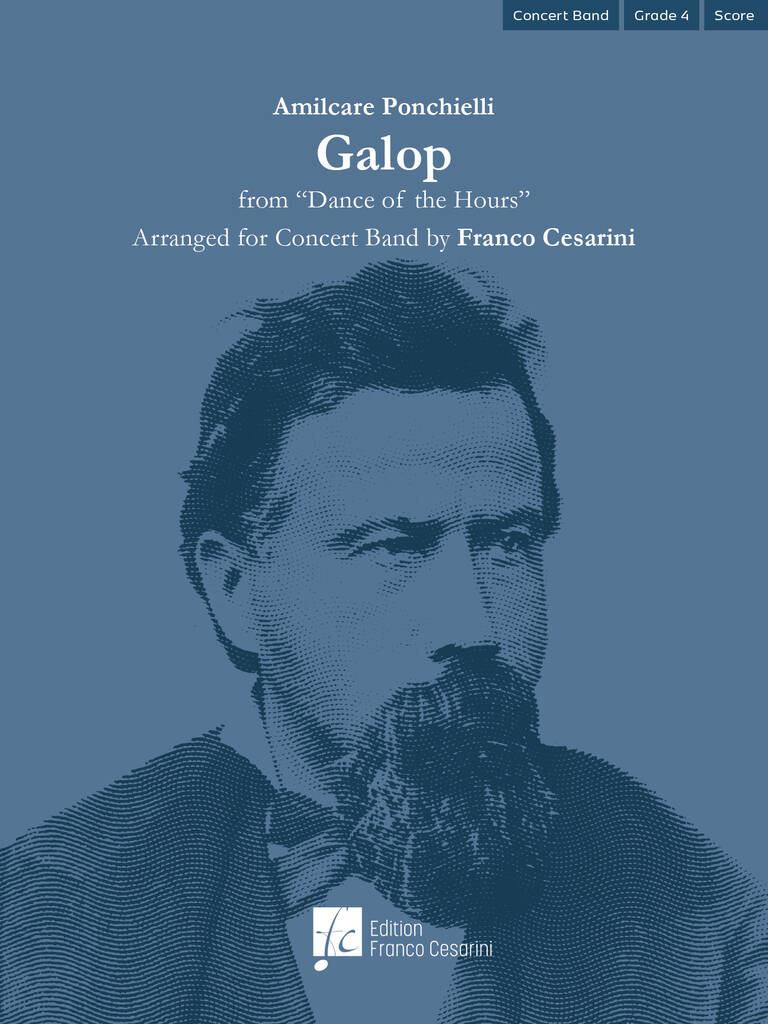 £74.00
Galop - Amilcare Ponchielli
La Gioconda, with a libretto by Arrigo Boito, is the most successful theatrical work by Amilcare Ponchielli (1844-1886). In this work there are two dance pieces: the Furlana at the conclusion of the 1st act and the Danza delle ore in the 3rd act. The Dance of the Hours has a precise choreographic outline: it is a masked ball which includes the "hours" of dawn, day, evening and night successively, and ends with a wild finale of galop. The latter is a sort of fast polka, in binary rhythm and unbridled pace. A French variant of it is the can-can. The finale in galop time of the Dance of the Hours recalls certain playful dances by the composer Jacques Offenbach, such as the famous Can-can that concludes the overture of the operetta Orphe au enfers.
Estimated dispatch 7-14 working days
 View Music