
Results
-
 £69.95
SYMPHONIC DANCE NO: IV (Music for Concert Band) - Grieg, Edvard - Martinsen, Kjell
American Grade 4.5. Duration: 11:55
Estimated dispatch 7-14 working days
-
 £39.95
The Floral Dance (Military Band Set) - Moss, Katie - Broadbent, Derek
Single Page Conductor part
Estimated dispatch 7-14 working days
-
£44.55
Witch's Dance
A rare new young band piece by master arranger/composer Warren Barker. "Witch's Danse" is a delightful descriptive piece which uses musical materials not usually found in compositions at this grade level. Challenging, yet quite accessible, your students will love the spooky sounds and unique percussion effects in this creative arrangement. A perfect choice for any developing band performance! VERY HIGHLY RECOMMENDED!
Estimated dispatch 7-14 working days
-
 £94.30
ZORBA'S DANCE (Intermediate Concert Band) - Theodorakis, Mikis - Woodfield, Ray
From Zorba the Greek. Grade: Medium.
Estimated dispatch 7-14 working days
-
 £36.95
Chorale and Dance (Concert Band - Score and Parts) - Feldstein & O'Reilly
Duration: 2.30
Estimated dispatch 7-14 working days
-
 £113.30
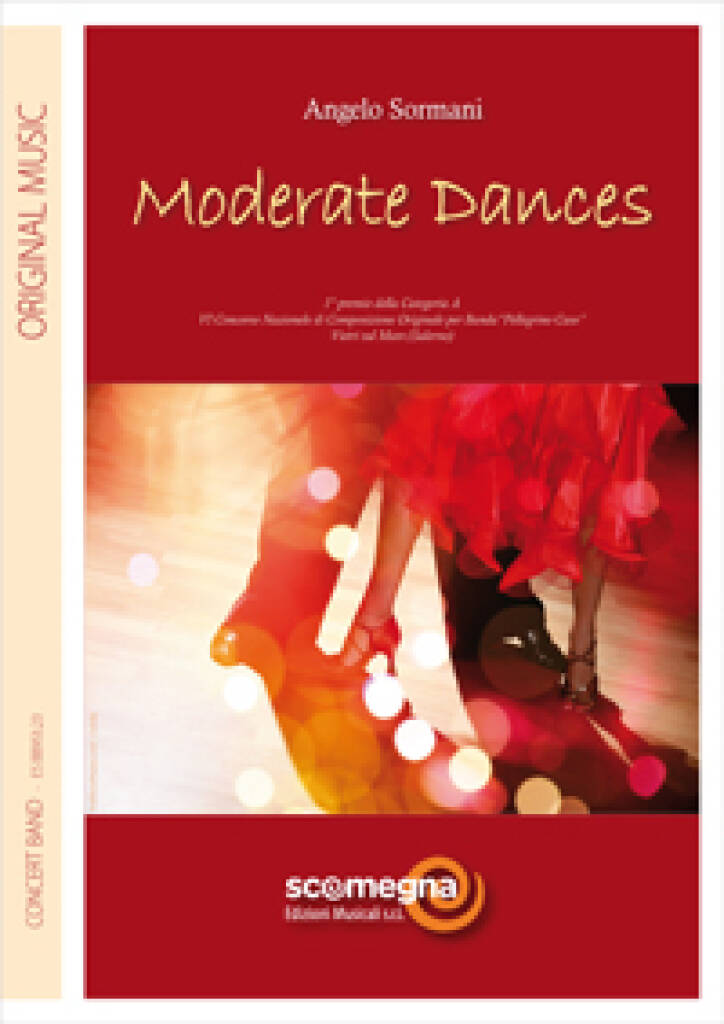
Moderate Dances - Angelo Sormani
This piece is a tribute to dance music, especially passionate, intense and meditative dance music. "Moderate Dances" is divided into three movements: a "Tango", a "Slow Waltz" and a "Bossa Nova". Each movement and each dance has its own particular characteristics but, when combined, these different rhythmic beats and times give the piece a feeling of completeness and uniformity. The Tango started to flourish in the suburbs of Buenos Aires in around 1880. There is still some doubt as to its origins, which may be Cuban (Habanera) but are probably African. It was most popular in Argentina and Brazil: here the male protagonist was originally the "gaucho" with his inseparable guitar, later to be replaced by the proud, elegant "compadre". By around 1910 the Tango had spread to Italy and France. New clubs opened, where the upper classes could watch and dance the Tango. Here the dance also underwent some rapid transformations. The exaggerated and extravagant gestures and body movements disappeared. Slow, gliding steps replaced the old rotational movements. The women's red ankle-boots and the partners "staring into each other's eyes" accentuated the erotic nature and sensuality of this dance. So much so that, in 1913, the German government banned soldiers from dancing the Tango. Those who broke the law were immediately discharged from the army. From a strictly musical perspective, the basic instruments were a flute, a harp (the diatonic harp typically played by the Indians of Paraguay) and a violin, or flute, guitar and violin or even clarinet, guitar and violin. These instruments were easy to transport, ideal for playing at parties, in the streets and in courtyards. The musicians played by ear, frequently improvising: there were no scores, no records, which is the main reason why it is impossible to trace the Tango back to its exact origins. However, the Tango's evolution (and growing popularity) was once again fostered by its fundamental ability to absorb "other" cultures, languages and sounds. And it was the arrival of the "bandoneon" (an accordion-like instrument that was invented in Germany and brought to Rio de la Plata by some immigrant), which replaced the flute, that marked the beginning of the Tango's huge success outside Argentina. A number of talented composers, above all the great Astor Piazzola (1921-1992), transformed the bandoneon from a simple accompanying instrument to a solo instrument that was to become the distinguishing feature of the 20th century Tango. The Slow Waltz originated from the Waltz, the typical dance of the Bavarian and Tyrolese peasants in the 1700s. It was composers like Johann Strauss, father and son, who carried the Waltz to its zenith in the 1800s, creating the sensual and melancholy yet joyful and charming dance we are all familiar with. When the Waltz first became popular in Germany, the members of respectable society were shocked at the closeness of the dancing partners, who had always previously danced apart. The main difference between the Waltz and Slow Waltz is that the latter has a slower, more expressive rhythm: the men wear tails and the women wear ball gowns decorated with beads and feathers and couples dance in graceful rotational movements. "Bossa Nova" is the title of the last movement in the piece. Jobim, the great Brazilian musician, described this musical genre as a combination of modern Jazz and Samba. Bossa Nova means "new wave". This was the name of the artistic and musical movement that evolved in Brazil in the late Fifties and was extremely popular throughout the Sixties. The songs are usually about love or social matters, drawing inspiration from the slums of Rio De Janeiro and the lives of their inhabitants. Bossa Nova, with its original compositions and the artistic talent of its musicians, also became hugely popular in the United States and Europe, and top Jazz musicians (Ella Fitzgerald, Stan Getz, Bob Cooper, Charlie Bird, Sonny Rollins, Dexter Gordon, Dizzy Gillespie) started to include Bossa in their repertoires.
Estimated dispatch 7-14 working days
-
 £159.60
Sci-Fi Suite of Dances - Bernhard Bogisch
1. Harvest Dance - Phoeboia II Like many of the inhabited planets Phoebia II was first colonized by the survivors of a spaceship crash. There is no certainty as to where these survivors originated from. In the late 21st century many spaceship were launched manned by people who were looking for a new future, away from an over-populated Earth. Some succeeded, some managed to return, some were never heard of again. In 2311 a survey ship had to make an emergency landing on Phoebia II and they found a triving colony there. Although the early history of the colony is shrouded in antiquity, certain aspects of the language, as well as physical features, seem to point to a south-east European origin. The harvest dance, in the aspects of rhythm, melody and harmony has many things in common with the music of what once were the countries of Macedonia, Greece and Turkey, little of which has unfortunately, been left due to primitive recording methods of the period.2. Ritual Seduction Dance - Rugel VWhen first discovered Rugel V was already a very civilized planet populated by a humanoid race and governed by a class of superior females. The first settlers from Earth were held as slaves but gained freedom over the years. It is assumed that this happened because the Earth people were all male and considered very attractive by the native females in comparison with the aboriginal males. The Earth males were evidently very attractive to the native women, who on their part used all their womanly wiles to entice them. We all know that Rugel V is now a very advanced and totally integrated society. The people have not forgotten their roots, and these Ritual Seduction Dances are performed on a regular basis in commemoration of the original Grand Seduction. Musically speaking Romanian origin influenced by native characteristics is virtually certain.3. Attack Dance - Planet Khi't'onThis is the only dance in this suite that is purely native. The natives people know as Khi't'och are now very civilized, but initial contact was difficult due to the difference in physical make-up between the two peoples. Suffice it to say that in the early stages Earth people referred to the Khi't'och as 'mosquito people'. We still don't know very much about them, other then that they have a history of violence but are now quite peaceful although they love to relive their past in a stylised way, not unlike the Maories of the former New Zealand, whose fearsome tattoos were later only painted on. This Attack Dance is, at best, an imitation due to the lack native instruments, and it was a very happy occasion for this composer when, at a concert at the House of Culture on Khi't'on, the Khi't'och showed their appreciation by clicking their feeding tubes and emitting loud shouts.4. Wedding Dance and Prayer - Planet B'lGarThere is little doubt that the people of this planet originate in the former country of Bulgaria. Several examples of similar pieces featuring the quaint 11/8 time signature have been found in old archives and recordings. Russian influence is also noticeable in the prayer the style of which is reminiscent of that of the now extinct sect of Raskolniky.
Estimated dispatch 7-14 working days
-
£113.30
Rumanian Folk Dances - Béla Bartók
Bla Bartk (1888 - 1945) showed from the beginning of his career an interest in popular music. He began studying music at the age of five and eventually focused on composition and piano. He collected a lot of popular songs, especially during his studies in Hungary, but also music from Romania and Slovakia. This had a lot of influence on his style. In his compositions, Bartk uses many Hungarian popular themes and rhythms, and even his own original works always refer to the same rhythmic and melodic folk character. At the beginning of the twentieth century, Bartk detached himself from romanticism and began to delineate his style on harmonic procedures based on diminished and augmented intervals, on bitonality, and on marked percussiveness, characteristics that are at the core of popular music.The Romanian Dances are a collection of seven folk dances, originally composed for piano (1915, the first six) and then transcribed for a small symphonic orchestra (1917). Of purely modal language, like almost all Bartk's music, each dance comes from a different area of Romania (Stick Dance, Sash Dance, In One Spot, Horn Dance, Romanian Polka, Fast Dance of Belnyes, and Fast Dance of Nygra).
Estimated dispatch 7-14 working days
-
 £116.40
Telemark Fantasy - Kees Vlak
While the mountains are still covered with a thick snow cloth and many passroads are still closed, the fruitblossoms next to the fjords are in full bloom and the days are growing longer and warmer. This is Springtime in Norway. The love of the Telemark people of their native country is sounding in the 'Norges Hymn'. The joy of Spring is expressed by means of a 'Springdans', a kind of Norwegian country dance. The variety of the changing Norwegian landscapes is matched by that of the changing tone colours of this dance. In memory of the famous playwright Henrik Ibsen (born in Skien, the capital of Telemark), the composer included in this fantasy a song similar to the theatre music Edvard Grieg wrote for Ibsen's play 'Peer Gynt'. This 'Hagars-Sang' is full of melancholy and romanticism. The Final consists of a 'Halling Dance'. This cheerful dance music was originally played on the fiddle, just like the American square dance. The work closes with a thrilling panoramic view on the Hardangervidda highland from the Gausta mountain, the highest peak in Telemark.
Estimated dispatch 7-14 working days
-
 £67.99
Dances Fantastique - David Shaffer
This exciting work for concert band is a set of three delightful dances. Opening with a bold fanfare statement, the first dance reveals the melodic material that is the basis for all three movements. The title of this movement, Double Dance, is derived from the second statement of the melody, appearing in doubled rhythmic values. The second movement, Round Dance, the melody is written as a three part round. You could not have a Round Dance without a Square Dance, which is the title of final movement. Lots of fun percussion instruments add interesting timbres throughout. This interesting and clever composition is perfect for contest and festival.
Estimated dispatch 7-14 working days
 View Music