
Results
-
 £102.99
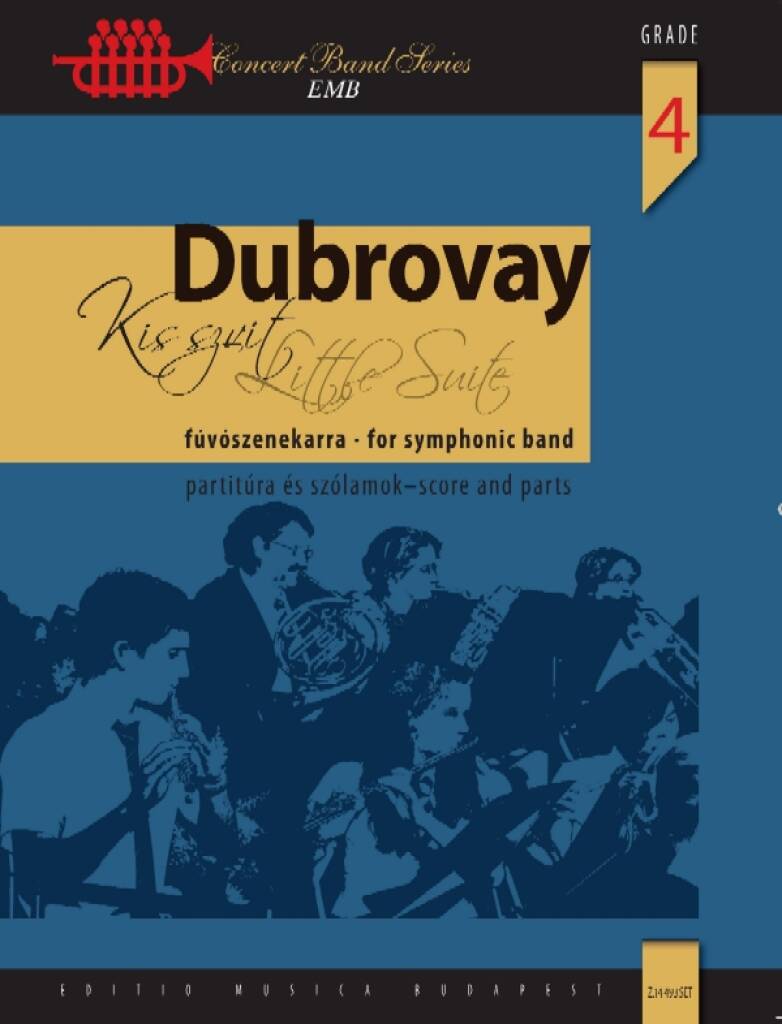
Little Suite - László Dubrovay
This work was written in 2005, prompted by the composer's determination that young members of junior, music school and conservatoire wind ensembles should not be limited to transcriptions for lack of original compositions, especially contemporary ones. The new devices used in the Little Suite are suitable for student players to try out. Indeed, they enjoy them - for instance, purring or whistling into the instrument. Each of the three-or-four-minute movements of this four-movement work can also be performed separately. The titles of the movements are the following: 1. In cheerful mood, 2. Song, 3. Joke, 4. March. This music in modern idiom, full of interesting new effects, offers young players an opportunity for enjoyable music-making together, and at the same time prepares them for playing more difficult contemporary works.
Estimated dispatch 7-14 working days
-
 £102.99
Gospel Revival - Traditional
This selection of gospel songs has been brought together in an original suite, the separate parts of which are joined together seamlessly. Gospel Revival is the result of extensive research in the rich gospel culture.
Estimated dispatch 7-14 working days
-
 £104.99
A Little Irish Suite (Concert Band - Score and Parts) - Putz, Marco
A Little Irish Suite is an original work composed specifically for the Compact Band Series. This series offers smaller ensembles the opportunity to perform original, high-quality works. A Little Irish Suite consists of three movements, all based on Irish folk tunes. Clear structure and crisp harmonies complemented by plain, comprehensible melodies, are characteristic of this piece. It offers conductors the opportunity to work on tone, balance, phrasing as well as on technique with their ensemble. As with all works in the Compact Band Series, A Little Irish Suite features optional parts for instruments that are played less frequently. Conductors can pick and choose the parts needed to best fit the music and the musicians available, to determine the best possible instrumentation for their own ensemble. The duration of six minutes and the large variety and contrast of material played in A Little Irish Suite also make it an ideal selection for competitions or festivals.Duration: 6:15
Estimated dispatch 7-14 working days
-
 £450.00
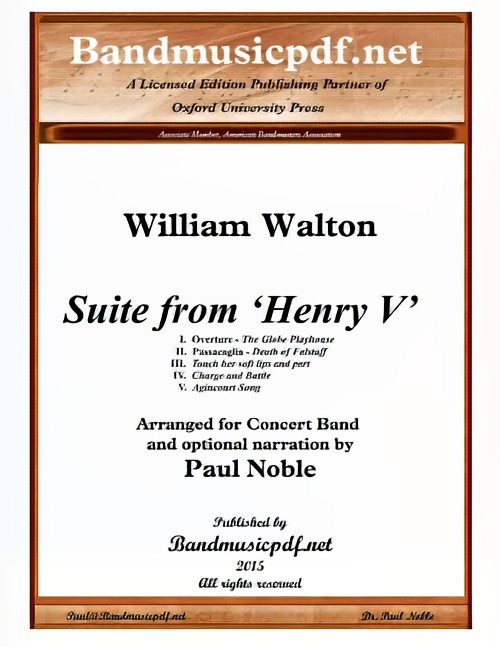
Henry V, Suite from (Concert Band with Optional Narrator - Score and Parts) - Walton, William - Noble, Paul
The Suite from Henry V is an arrangement for Concert Band and optional narrator, adapted from the 1963 orchestral arrangement of William Walton's musical score from the 1944 film Henry V. The suite, originally arranged for orchestra by Muir Mathieson, is in five movements, and occupies a very significant role in the history of music and of Shakespearean studies. Performances exist in a variety of formats because the adaptation of the narration to a film suite is subject to choice. To be chronologically correct, the order of movements from the original suite has been altered to adhere to the narration of the play. And the choice of speeches has required considerable research by classicists who are familiar with the writings of Shakespeare. It has been the endeavour of this arranger to research and present this suite in as authentic a manner as possible, understanding that it might well become the standard by which Concert Bands of the future will adapt and present this music. The arranger is indebted to Anna Warren, a resident of Twickenham and a graduate in Modern Languages (French and Italian) and History from the University of Bristol and a postgraduate from The Institute of Education, the University of London, for her knowledge and insight into the formation of the narration.
Estimated dispatch 7-14 working days
-
 £173.00
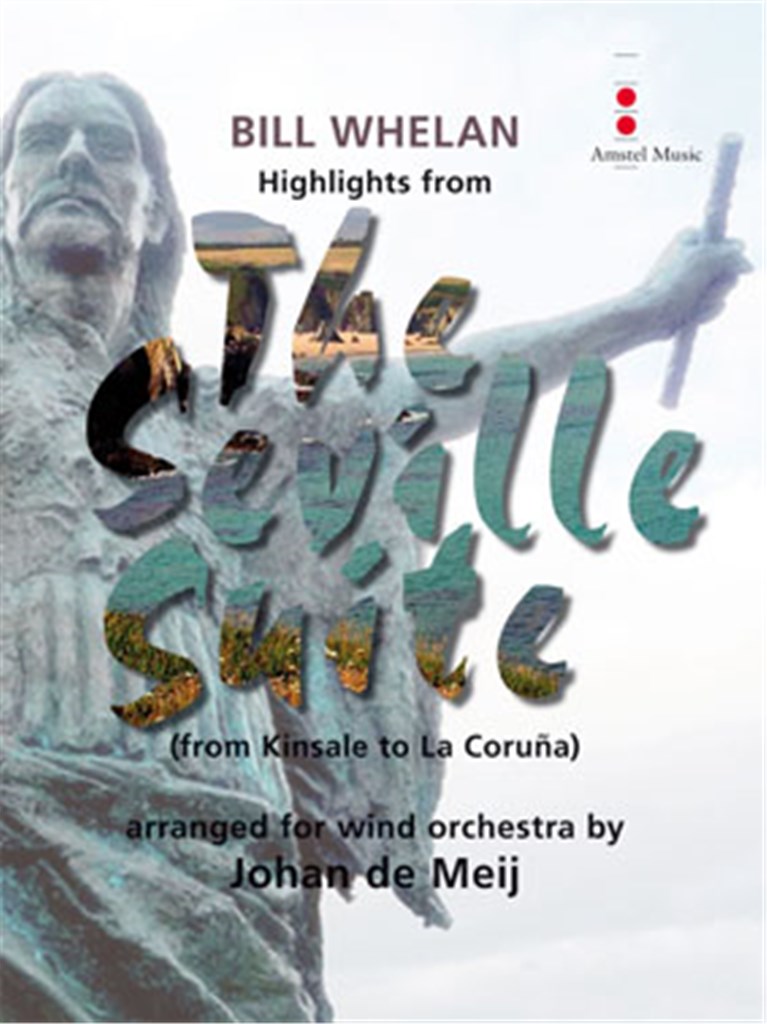
The Seville Suite, Highlights from (Concert Band - Score and Parts) - Whelan, Bill - De Meij, Johan
The success of Bill Whelan's Riverdance evolved from a concept for music and dance that he established earlier with The Seville Suite, his first major orchestral composition. The Seville Suite was commissioned for Ireland's National Day at the World Expo 1992 in Seville, Spain. Through the score, Whelan tells the story of legendary Irish war hero Red Hugh O'Donnell. At a mere 21 years of age, O'Donnell successfully led a rebellion against the English government in 1593. Johan de Meij's arrangement is an adaptation featuring highlights from the original suite. Duration: 13.15
Estimated dispatch 7-14 working days
-
 £32.95
SUITE OF ENGLISH FOLKDANCES (Symphonic WB Extra Score) - Tomlinson, Ernest
Extra score only. In 1951 Ernest Tomlinson, at the invitation of his sister Freda, attended a Festival of Dance and Song presented by the English Folk Dance and Song Society. He was so captivated by the tunes danced to, that he resolved to write an orchestral suite based on some of them. The composer's arrangement for wind band follows closely the textures and colour contrasts of the orchestral original. The Suite, which is dedicated to his sister, is in six movements, all the tunes being selected from the first edition of John Playford's The English Dancing Master. Includes: Jenny Pluck Pears; Ten Pound Lass; Dick's Maggot; Nonesuch; Hunt the Squirrel; Woodicock. Duration: 12 mins.
Estimated dispatch 7-14 working days
-
£164.95
SUITE OF ENGLISH FOLKDANCES (Symphonic WB) - Tomlinson, Ernest
Score & Parts. In 1951 Ernest Tomlinson, at the invitation of his sister Freda, attended a Festival of Dance and Song presented by the English Folk Dance and Song Society. He was so captivated by the tunes danced to, that he resolved to write an orchestral suite based on some of them. The composer's arrangement for wind band follows closely the textures and colour contrasts of the orchestral original. The Suite, which is dedicated to his sister, is in six movements, all the tunes being selected from the first edition of John Playford's The English Dancing Master. Includes: Jenny Pluck Pears; Ten Pound Lass; Dick's Maggot; Nonesuch; Hunt the Squirrel; Woodicock. Duration: 12 mins.
Estimated dispatch 7-14 working days
-
 £495.00
English Dance Suite (Concert Band - Score and Parts) - Gardner, John - Noble, Paul
Original Scoring. Arranged for the modern Concert/Wind Band, scored for three trumpets, reasonable doubling of parts where the original musical effect is not altered so that players can have a more responsible and enjoyable experience, more legible parts with less doubling on one staff, etc. The piece is offered either as a complete suite of seven movements, and also as seven individual movements which may be purchased independently. The English Dance Suite was originally composed by John Gardner for Wind Band, and has been re-set for the modern Concert Band instrumentation. Both the original version, edited and type-set by Paul Noble, and this arrangement are first editions now available for purchase to bands around the world. The set of seven Renaissance dances depict John Gardner's love of Scottish music, the Renaissance heritage, and some of his own mischievous approach to music. The first movement, Chacony on a Golden Theme, reminiscent of the Allegro movement of Purcell's Golden Sonata, is much used as a vehicle for variation on a repeated short harmonic progression, often involving a fairly short repetitive bass-line which offered a compositional outline for variation, decoration, figuration and melodic invention. In this it closely resembles the passacaglia. The Alman originated in the 16th century as a duple metere dance of moderate tempo, already considered very old, with a characteristic double-knocking upbeat of one or occasionally three sixteenth notes. It appears to have derived from a German dance but no identifiable dance and no German dance instructions from this era survive. The Hornpipe, usually in 3/2 dance rhythm, is an Irish, Scottish and English dance. It is done in hard shoes, which are used to help keep track of how the dancer keeps in time. There are two variations of the hornpipe dance: fast and slow. Usually, more experienced dancers will do the slow hornpipe but younger dancers will start out with the fast hornpipe and then switch in later years. The Corranto is a 16th-century court dance characterized by short advances and retreats, in quick triple time. The Volta (Italian: the turn or turning) is an anglicised name from the later Renaissance. Its main figure consisted of a turn and lift in a sort of closed position. The Pavan is a slow processional dance common in Europe during the 16th century. The Reel, indigenous to Scotland, consists largely of quaver (eighth note) movement with an accent on the first and third beats of the bar.
Estimated dispatch 7-14 working days
-
 £125.00
English Dance Suite - I. Chacony on a Golden Theme (Concert Band - Score and Parts) - Gardner, John - Noble, Paul
Arranged for the modern Concert/Wind Band, scored for three trumpets, reasonable doubling of parts where the original musical effect is not altered so that players can have a more responsible and enjoyable experience, more legible parts with less doubling on one staff, etc. The piece is offered either as a complete suite of seven movements, and also as seven individual movements which may be purchased independently. The English Dance Suite was originally composed by John Gardner for Wind Band, and has been re-set for the modern Concert Band instrumentation. Both the original version, edited and type-set by Paul Noble, and this arrangement are first editions now available for purchase to bands around the world. The set of seven Renaissance dances depict John Gardner's love of Scottish music, the Renaissance heritage, and some of his own mischievous approach to music. The first movement, Chacony on a Golden Theme, reminiscent of the Allegro movement of Purcell's Golden Sonata, is much used as a vehicle for variation on a repeated short harmonic progression, often involving a fairly short repetitive bass-line which offered a compositional outline for variation, decoration, figuration and melodic invention. In this it closely resembles the passacaglia. The Alman originated in the 16th century as a duple metere dance of moderate tempo, already considered very old, with a characteristic double-knocking upbeat of one or occasionally three sixteenth notes. It appears to have derived from a German dance but no identifiable dance and no German dance instructions from this era survive. The Hornpipe, usually in 3/2 dance rhythm, is an Irish, Scottish and English dance. It is done in hard shoes, which are used to help keep track of how the dancer keeps in time. There are two variations of the hornpipe dance: fast and slow. Usually, more experienced dancers will do the slow hornpipe but younger dancers will start out with the fast hornpipe and then switch in later years. The Corranto is a 16th-century court dance characterized by short advances and retreats, in quick triple time. The Volta (Italian: the turn or turning) is an anglicised name from the later Renaissance. Its main figure consisted of a turn and lift in a sort of closed position. The Pavan is a slow processional dance common in Europe during the 16th century. The Reel, indigenous to Scotland, consists largely of quaver (eighth note) movement with an accent on the first and third beats of the bar.
Estimated dispatch 7-14 working days
-
 £75.00
English Dance Suite - II. Alman (Concert Band - Score and Parts) - Gardner, John - Noble, Paul
Arranged for the modern Concert/Wind Band, scored for three trumpets, reasonable doubling of parts where the original musical effect is not altered so that players can have a more responsible and enjoyable experience, more legible parts with less doubling on one staff, etc. The piece is offered either as a complete suite of seven movements, and also as seven individual movements which may be purchased independently. The English Dance Suite was originally composed by John Gardner for Wind Band, and has been re-set for the modern Concert Band instrumentation. Both the original version, edited and type-set by Paul Noble, and this arrangement are first editions now available for purchase to bands around the world. The set of seven Renaissance dances depict John Gardner's love of Scottish music, the Renaissance heritage, and some of his own mischievous approach to music. The first movement, Chacony on a Golden Theme, reminiscent of the Allegro movement of Purcell's Golden Sonata, is much used as a vehicle for variation on a repeated short harmonic progression, often involving a fairly short repetitive bass-line which offered a compositional outline for variation, decoration, figuration and melodic invention. In this it closely resembles the passacaglia. The Alman originated in the 16th century as a duple metere dance of moderate tempo, already considered very old, with a characteristic double-knocking upbeat of one or occasionally three sixteenth notes. It appears to have derived from a German dance but no identifiable dance and no German dance instructions from this era survive. The Hornpipe, usually in 3/2 dance rhythm, is an Irish, Scottish and English dance. It is done in hard shoes, which are used to help keep track of how the dancer keeps in time. There are two variations of the hornpipe dance: fast and slow. Usually, more experienced dancers will do the slow hornpipe but younger dancers will start out with the fast hornpipe and then switch in later years. The Corranto is a 16th-century court dance characterized by short advances and retreats, in quick triple time. The Volta (Italian: the turn or turning) is an anglicised name from the later Renaissance. Its main figure consisted of a turn and lift in a sort of closed position. The Pavan is a slow processional dance common in Europe during the 16th century. The Reel, indigenous to Scotland, consists largely of quaver (eighth note) movement with an accent on the first and third beats of the bar.
Estimated dispatch 7-14 working days
 View Music