
Results
-
 £149.99
Moretus - Bart Picqueur
Jan Moretus (1543-1610) was a book printer and publisher in his native city of Antwerp. He worked as assistant to his father-in-law, the renowned master printer and publisher Christoffel Plantijn. After Plantijn's death in 1589 Moretus took over the business.The composition Moretus consists of four parts that draw on the remarkable personality of Jan Moretus aswell as the printing business. In both the titles of the movements and the thematic structure we can see a certain symmetry: a playful allusion to the process of printing.Part 1, A Celebrated Gentleman, describes the illustrious figure of Moretus in a festive chorale. In the second part, ExpressiveImpressions, the printing press itself is brought to life in repeated motifs - despite the industrial, mechanical nature of the process, the product always has an artistic and cultural dimension. In the third part, Impressive Expression, the wind band is invited (or challenged), to intone the slow theme with a poignant expressiveness. Part 4, A Gentle Celebration, is a celebratory finale with a fresh theme.
Estimated dispatch 7-14 working days
-
 £144.99
Festa Paesana - Jacob de Haan
Lunteren, a village on the Veluwe (a wooded region in the Netherlands), sets the scene annually for a village festival dominated by folklore. Festa Paesana (Italian for village festival) is set to music by several folkloric sketches. The theme in Festa Paesana is partly based on a Dutch anthem (Wien Neerlands bloed); when other lyrics are used it is also known as the Lunteren anthem.The work begins with a festive introduction, completed by chimes and drums, in which pieces of the Lunteren anthem are heard. The music then transitions to represent a horse auction. We hear horses run their first rounds in the auction ring while being whipped. The following theme is partly basedon the anthem. The tension of the traditional auction is amplified by an ever-increasing cadence, reaching its climax when the word ?Sold!? is shouted. The night ends with a majestic variation on the Lunteren anthem.The next morning, when the tower clock hits seven times, the village is awaked by the reveille of the heralds. In a fugatic version of the anthem, we can hear the village slowly come to life. This evolves with the chiming of all towers in the village; the celebration can begin. Carriages drawn by horses rumble through the village and thus, it is easy to hear when a horse hesitates or runs amuck. A traditional folk dance group then dances a whirling waltz while the audience shares their pleasure. Musicians march along the scene and take over the waltz theme in their march. Until deep in the night, the musicians are still heard playing in the streets. Meanwhile, we hear the anthem theme being played in a choral variation (in minor). The first time it is played quietly, as a preparation for Sunday. Then it is played in a celebrating way, enabling the devout village residents to remember the past pleasant celebration with satisfaction.
Estimated dispatch 7-14 working days
-
 £97.00
Syrille - Marc Jeanbourquin
In 2009 Marc Jeanbourquin was a trombonist in the harmony orchestra 'La Gerinia' from Marly (Switzerland). To commemorate the 20th anniversary of the summer music camp of its music school, he was commissioned to write a musical fairy tale for the band. Marc Jeanbourquin was inspired by stories written by his wife Lise Jeanbourquin, and so 'Syrielle the story of a fairy who wanted to catch a star', came into being. The theme of Syrielle is presented in the opening bars as a sequence of two chords, which convey the fairy like feeling of calm and mystery. She lives in a forest and is looking for friends. Then she comes across an ogre who also lives alone. When she sees him, she panics and hurts herself. The ogre takes her and cares for her, and the two end up becoming friends. One by one the themes for the two main characters are stated, and eventually evolve into a festive samba. At the end the theme from Syrielle returns, but this time in a major key, so to make a happy end to this musical fairy tale.
Estimated dispatch 7-14 working days
-
 £144.99
Ross Roy - Jacob de Haan
Jacob de Haan was commissioned to compose this concert piece by the "St. Peters Wind Symphony" from Brisbane, Australia. "Ross Roy" is the monumental late 19th century villa where St. Peters Lutheran College was founded in 1945. The villa has always remained the school symbol. In this composition, Jacob de Haan sees the "Ross Roy" as a metaphor for the years spent at school (a monument in time), where one's personality is formed. So, the opening theme the artist calls the Ross Roy theme initially has monumental characteristics.The rhythmic motion, which strides along in the lower register and percussion at the beginning of the next section is typical of "Tempo di Marcia". Thismovement, accompanied by repetitions of sound, is a metaphor for the structure and discipline in school. This is the introduction to a march theme, symbolic of "passing through" the classes up to the final examinations.Then, the Ross Roy theme is dealt with again, now in a playful, humorous variation. As if the composer is saying there should also be time for a smile in school. The same theme can be heard in major key and a slower tempo in the following section, expressing pride and self-confidence. This is also the introduction to the expressive middle section that represents love, friendship and understanding.We then return to the march theme in a slightly altered construction. The oriental sounds, constituting the modulation to the final theme, are symbols of the diversity of cultures in the school. The characteristic final theme first sounds solemn, but turns into a festive apotheosis. It is no coincidence that the final cadence is reminiscent of the close to a traditional overture, for the school years can be considered the "overture" to the rest of one's life. The premiere of "Ross Roy" was conducted by Jacob de Haan in Brisbane, on August 22, 1997.
Estimated dispatch 7-14 working days
-
 £70.00
Vicennium - Gauthier Dupertuis
Vicennium (Latin for"twenty years") by Gauthier Dupetuis, is a vibrant and uplifting march for concert band, perfectly suited for both concert performance and parade.Bursting with energy from the very first notes, an energetic motif establishes a light and spirited atmosphere that carries the entire first section. The trio, calmer and more expressive, reveals a lyrical theme with rich modulations, before a majestic return brings the work to a brilliant conclusion.Commissioned in 2026 by the Musikgesellschaft Alphorn Plaffeien in the Swiss Canton of Fribourg to celebrate the 20th anniversary of conductor Michel Stempfel, Vicenniumis both a festive tribute and an exciting addition to any concert band repertoire.
Estimated dispatch 7-14 working days
-
 £144.99
Tetraktys - Klaas Coulembier
Tetraktys, named after a mathematical concept of Pythagoras, is a festive and varied work, composed for the tenth anniversary of the Ghent University Wind Band. A mysterious introduction paves the way for a driving allegro, in which all sections of the orchestra are featured. The slow middle part offers a moment of repose, introduced by a lyrical theme presented by the clarinet section. After a brief recollection of the fast movement, the mood shifts into a swinging big band-style passage, that leads directly into the finale.
Estimated dispatch 7-14 working days
-
 £76.99
Happy Harmony - Jacob de Haan
Happy Harmony is a cheerful composition that puts wind music in the spotlight. The word 'harmony' can be interpreted in different ways. In countries like France, Belgium and the Netherlands, 'harmony' is the name given to a symphonic wind band. Secondly, the term generally refers to a feeling of unity, which is very much present amongst band musicians, owing to the communal connection that is created when playing together. Thirdly, there is of course the harmony that you find in music itself.This 'harmonious' work opens with a festive introduction leading to a catchy pop theme. The middle movement is a lyrical ode to wind music. Then the cheerful theme returns, followed by the perfect finale as the icing on the cake.
Estimated dispatch 7-14 working days
-
 £159.00
Greek Folk Song Suite No. 2 - Franco Cesarini
After the great success of the Greek Folk Song Suite that has lasted for over twenty years, Franco Cesarini once again ventures into the long and rich tradition of Greek folk music. In his Greek Folk Song Suite No. 2, the three movements that form the piece are named after the three dances reworked by the composer.The first movement, Samiotissa is a kalamatianos, whose most distinctive feature is the irregular 7/8-time signature. It is a festive dance, today considered the Greek national dance, which has roots dating back to antiquity.The second movement, Kato sto jalo is a zeibekiko, a slow-paced dance performed by only one man at a time which was apparently originated among the warriors of Ancient Anatolia.The third and last movement, Chasaposerviko, is the fast part of the hasapiko dance and is characterized by its more extensive form.A new journey into the Greek folk tradition that will delight both performers and audience.
Estimated dispatch 7-14 working days
-
 £87.99
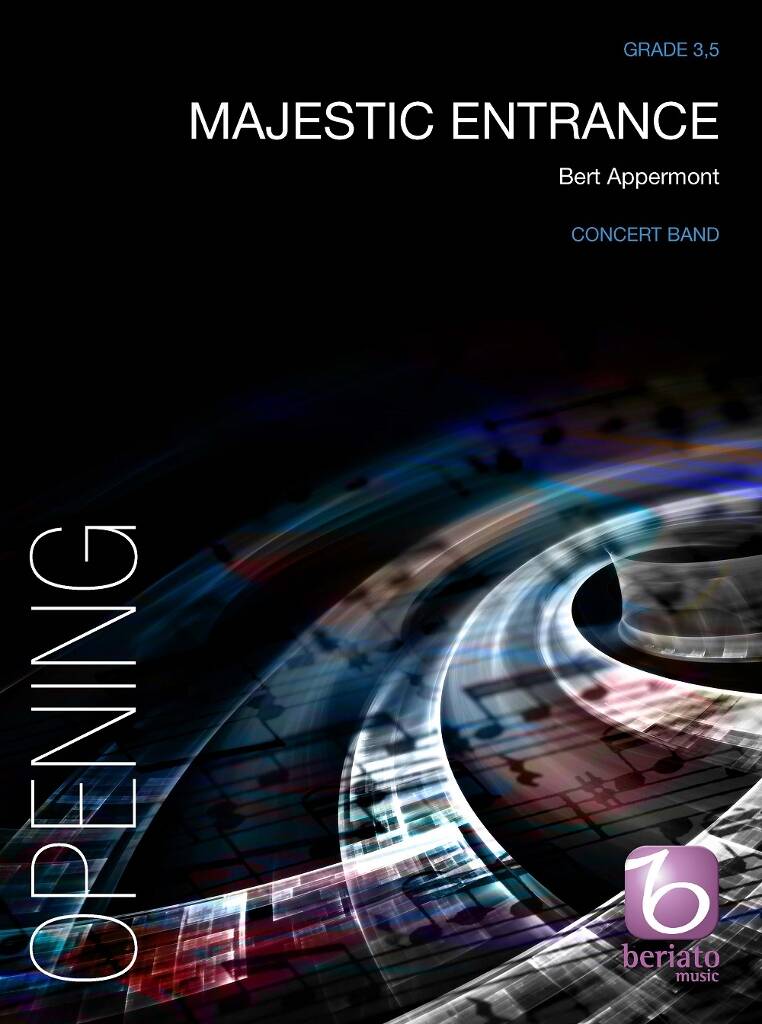
Majestic Entrance - Bert Appermont
Majestic Entrance is a festive opening work with cinematic influences. It was written for the Swiss Musikverein Muttenz; this music society celebrated its 125th anniversary in 2021 - more than enough reason for a commissioned composition. The work consists of three movements: a heroic opening passage, a lyrical middle movement and a return to the opening. All in all a composition of majestic charm!
Estimated dispatch 7-14 working days
-
 £159.99
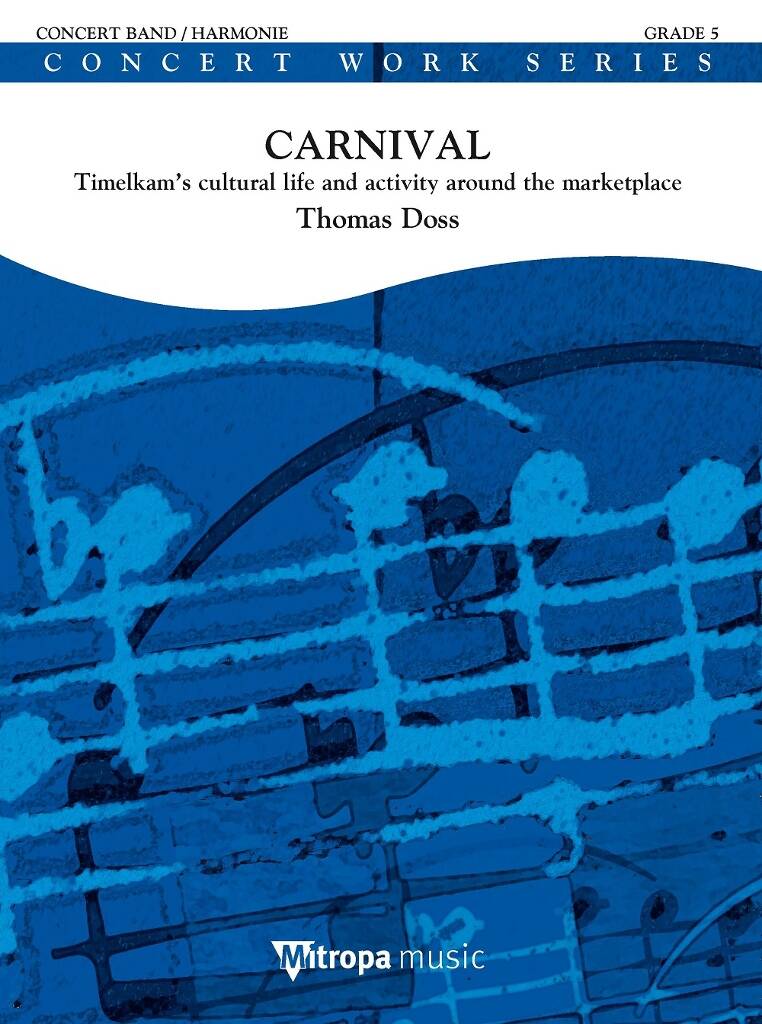
Carnival - Thomas Doss
This work was commissioned by Marktmusik Timelkam to celebrate its 170th anniversary. It describes the cultural life and hustle and bustle of the band's home base, the Austrian town of Timelkam. Carnival pictures a festive procession starting at the marketplace and lasting well into the night. The work features many 'carnivalesque' elements and is a joy for players to perform. There is a lot of merry activity going on in the music; people cheerily chatting in the inn; singing and dancing together and having fun. There is also room for a melancholy mood, accompanied by reminiscences about eternal goodbyes and searching for love. With the added musical representation of children's playing and pranks, a beautiful sunrise as well as a depiction of the churches and societies in town, this composition is not just an account of a carnival parade but a small portrayal of life.
Estimated dispatch 7-14 working days
 View Music