
Results
-
 £53.50
God Bless America - Irving Berlin
Exemplifying pride in our country, Irving Berlin's beloved classic continues to be the standard bearer of patriotic anthems. This concert band arrangement was designed to accompany the well-known choral arrangement by Joyce Eilers, however, it can also be effectively performed by concert band alone. Hal Leonard Corporation is proud to announce that a portion of the proceeds from this publication will go to the God Bless America Fund to assist victims of the September 11th terrorist attack. 08743061 SATB $1.60 40207012 2-Part $1.50 04490209 String Pak $35.00 08551584 ShowTrax CD $22.95.
Estimated dispatch 7-14 working days
-
 £42.50
Rock-a-My Sax
Discovery Series - Grade 1.5 Based on the spiritual Rock-a-My Soul, Eric has created a clever feature for your saxophones. Using a medium swing style with a touch of gospel, this will be a great motivational piece for your young players and a favorite with the parents. (1:30)
Estimated dispatch 7-14 working days
-
 £38.50
Freedom's Song - James Curnow
It has been difficult to find mature sounding arrangements of patriotic music for the Grade 1 band. The stately tempo and carefully controlled ranges and rhythms in this one makes James Curnow's skillful interpretation of TheBattle Hymn of the Republic accessible to young bands while sounding sophisticated enough for groups that normally play more difficult music. Freedom's Song belongs in every music library. (Grade 1)
Estimated dispatch 7-14 working days
-
 £47.50
Rattlesnake! - Paul Lavender
Performer Level (correlates with Book 1, p. 24) SSSSSSS....watch out for this dangerous varmint as the sound of its rattle travels throughout your band unseen! This clever novelty number for beginning bands will delight yourplayers and keep the audience guessing. Dur: 1:30
Estimated dispatch 7-14 working days
-
£184.99
Rubicon - Bert Appermont
The Rubicon is a river in Northern Italy which Julius Caesar crossed with his army in 49 BC in defiance of the leaders of Rome, who feared his power. A civil war against rival Pompey ensued, which culminated in Caesar seizing power as the absoluteruler of Rome. The phrase "crossing the Rubicon" therefore refers to any person committing himself irrevocably to a risky, decisive and irrevocable of course of action.The work consists of three parts that deal with this important moment in history.Part 1 (Meditation) symbolises Caesars request to the Gods to assist him in his difficult choice. In a slow introduction we hear the melancholy and beseeching sounds of the duduk (alternatively, this part can be played by a soprano saxophone)and of the soprano solo singer over the bourdon accompaniment. The soprano solo singer then sings "dona tibi pacem" (give him rest) in a melodious and probing theme.In Part 2 (Battle of Pharsalus) trumpets and trombones resound alternately ina stately Roman fanfare, producing a stereophonic effect. This develops into a martial theme in which Caesars impressive army goes to battle against the army of rival Pompey. While the theme of Caesars army fades away, Pompeys theme emerges as anaive dance in six-eight time. His army is definitely in the majority and it believes it can easily defeat the enemy. Suddenly trumpets and trombones clash on two sides of the orchestra: Caesars army advances and attacks. A fierce battle ensues inwhich the two themes are played alternately as well as simultaneously. Thanks to his shrewd battle tactics, Caesar manages to win this legendary battle after all: his theme resounds ever louder in trumpets and horns until everything dies out andchanges into a kind of reconciliation between the soldiers of the two armies. The melancholy "dona tibi pacem" from part 1 now serves as a reconciliation theme.Caesar is now the sole ruler of the New Roman Empire, which would be destined to leave itsmark on our Western civilisation to this day. The third part is a sparkling succession of dance music (Dance) with many Greek and Roman elements in which Caesars victory is praised and celebrated. It is common knowledge that the culture(arts, gods, etc.) of the Romans drew heavily on Greek culture. I have therefore used an authentic Greek theme (the Seikolos song) several times in this part (bar 17 in the euphonium, bar 60 in the base section, bar 68 in the sopranosaxophone) to suggest the music of that era and to evoke the right atmosphere. After a gradual increase in tempo in the entire orchestra, the opening melody gloriously resounds once more, surrounded by virtuoso dance music. The work ends withbombastic brass fanfares in which Caesars theme triumphs once more.NOTE FOR THE CONDUCTOR:The Armenian duduk and the monochord that are used in the introduction give a special tone to the music, but could be substituted (soprano saxophone instead ofthe duduk) or left out (monochord). The soprano solo is also doubled within the orchestra and could therefore also be left out if necessary, although it does provide the work with an extra dimension. The male voices in the introduction and the finalecould possibly be replaced with a synthesizer with choral setting.As a visual and acoustic element in part 2, the trumpets, the e-flat cornet, the small drum and trombones can be stood up and placed at two sides of the orchestra (bar 80).Seen fromthe point of view of the conductor, put the trumpets, the e-flat cornet and the small drum in the left section and the trombones in the right section of the orchestra. This also helps to create a visual contrast between the two themes of the secondpart. The players can be seated again at bar 97 or bar 121. The soprano soloist can be placed in or in front of the orchestra, depending on what gives the best result. For the conclusion of the work the soprano solo can be sung from afar (from thewings) to create additional atmosphere.This work was composed especially for the "St Joseph" brass band from Pey/Echt (Belgium) with conductor Mark Prils.
Estimated dispatch 7-14 working days
-
 £60.50
Achievement - Sandy Feldstein
Your developing musicians will achieve valuable fundamental and ensemble performance skills with this uplifting overture. This piece can be performed after completing page 17 in "The Yamaha Advantage" Book 1.
Estimated dispatch 7-14 working days
-
 £54.99
Prestige - Sandy Feldstein
Composers Larry Clark and Sandy Feldstein wrote this work as a brilliant introduction to March form and style for developing bands, using only seven notes, with no eighth notes (even in the Snare part)! This piece can be performed after completing page 13 of "The Yamaha Advantage" Book 1.
Estimated dispatch 7-14 working days
-
 £54.99
Primus - Sandy Feldstein
"Primus," by Sandy Feldstein and Larry Clark, is a minor piece that uses only five of the first notes that beginning Band students learn! This foreboding-sounding work is great for first concerts, and can be performed after completing page 15 of "The Yamaha Advantage Primer," or after page 9 in Book 1.
Estimated dispatch 7-14 working days
-
 £60.50
The Ash Grove - Sandy Feldstein
Designed to give your best Trumpet, Trombone, Euphonium, or Tuba player an opportunity to play a solo with Band accompaniment. It should serve as the culmination of study for the soloist upon completion of "The Yamaha Advantage" Book 1, or any comparable method. The piece has all of the solo material cued in the Band, so if a soloist is not available, the piece can be performed with Band alone.
Estimated dispatch 7-14 working days
-
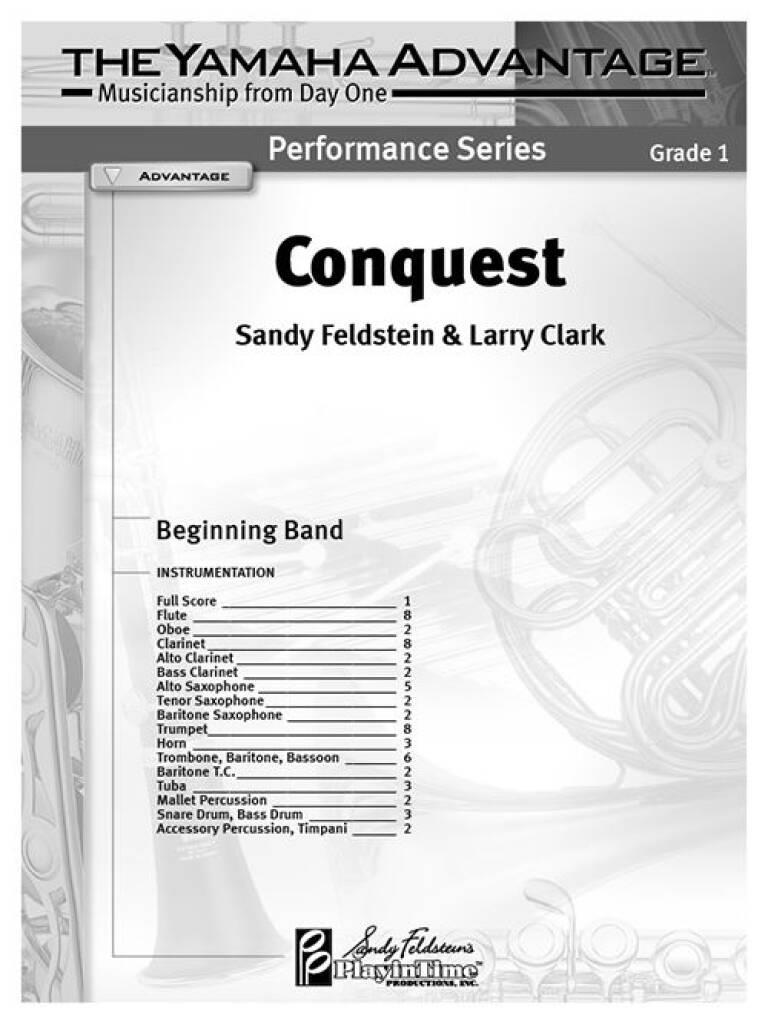 £60.50
Conquest - Sandy Feldstein
This true festival-style piece for beginning Band uses limited notes and rhythms, but is very creatively written. Your youngest students will feel like they are playing serious music, as the piece is bold, aggressive, and sounds far more difficult than it plays. This piece is correlated to "The Yamaha Advantage" band method book 1, but can be used with any program of study.
Estimated dispatch 7-14 working days
 View Music