
Results
-
 £104.99
The Spirit of Youth - Thomas Doss
Europe`s broad cultural heritage is a valuable possession that should be protected.We stand before the enormous challenge of creating a unity of East and West while at the same time maintaining the long established cultural diversity. After all, the wealth of Europe lies within its variety of traditions - this is what the future should be built upon. This hymn, written within the context of the Austrian EU Presidency 2006, is dedicated to all of Europes young people and will add a wonderfully uplifting feel to any performance.
Estimated dispatch 7-14 working days
-
 £137.99
The Baltic Way (Concert Band - Score and Parts) - De Haan, Jan
In 1989, the demonstration named the Baltic Way, also known as the Baltic Chain, was held in the Baltic states of Estonia, Latvia and Lithuania by its citizens in a call for independence from the Soviet Union. On 23rd August 1989, some two million participants formed a human chain, hand-in-hand all the way from the Estonian capital of Tallinn its Latvian counterpart, Riga, through to the Lithuanian capital of Vilnius - six hundred kilometres long. It became the longest human chain ever created and turned out to be the final push needed for much sought-after independence. This historic event became the source of inspiration for this composition. The introduction of the first movement, 'Struggle for Independence', is based on a nocturne for piano by the renowned Lithuanian composer and painter Mikalojus Konstantinas Ciurlionis (1875-1911), thematic material from which has been incorporated throughout the whole composition. The melancholic beginning is followed by a powerful theme which reflects the resolve of the Baltic people. The sudden aggressive, dissonant chords and a dominant and, in rhythmic terms, contrary bass drum announce that the resistance is not going smoothly. Just for a moment, we hear the anthem of the Soviet Union in the lower brass, but this is relentlessly pushed to the background by the rest of the band playing the Lithuanian national anthem, 'Tautiska giesm?' (Lithuania, our homeland). The second movement, 'Decades of Suffering', echoes life under the Soviet Union's thumb. In the pursuit of independence, a peaceful protest is planned in which a human chain is formed across the Baltic states of Estonia, Latvia and Lithuania. This 'Chain of Freedom' is depicted in the final movement of the work. Duration: 10.30
Estimated dispatch 7-14 working days
-
 £54.95
Siyahamba (We Are Marching) (Concert Band - Score and Parts) - Wagner, Douglas E.
A traditional song of the Zulu people originating in the KwaZulu province of South Africa, "Siyahamba" is built upon persistent ostinatos with a driving percussion contribution as a background setting the stage for the charming theme. You'll hear several call-and-response patterns which are characteristic of traditional African music. An engaging addition to the beginning band literature with enticing multicultural roots. Duration: 1.30
Estimated dispatch 7-14 working days
-
 £53.95
Along the Western Trail (Concert Band - Score and Parts) - Ployhar, James D.
From radio to motion pictures to television, all have glamorised what we know as "The Wild West," but the folk songs from that era have lived on in an unaltered state. They tell stories of the lives, loves, and losses of the brave souls who ventured into a then uncharted landscape. Here is a musical salute to that time and its people, featuring:Sweet Betsy from PikeThe Streets of LaredoThe Lone PrairieLittle Brown JugDuration: 2:00
Estimated dispatch 7-14 working days
-
 £154.99
The Power of the Megatsunami Wind Band Set (Score & Parts)
The word 'tsunami' is of Japanese origin. When you look it up in a dictionary, you will find that it means 'a great sea wave produced by submarine earth movement or volcanic eruption'. A megatsunami is the superlative of this awesome expression of power that nature can create, and has catastrophic consequences. When Carl Wittrock completed this composition not many such big earth movements had occurred, but since then we have become all too familiar with the disastrous consequences which a tsunami may have. On the 26th of December 2004 a heavy seaquake took place near the Indonesian island of Sumatra. Tidal waves 10 meters in height ravaged the coastal regions of many countries for miles around. The tsunami took the lives of thousands of people and destroyed many villages and towns. There are more areas which run the risk of being struck by a tsunami, such as the island of La Palma, one of the Canary Islands. This island is based on oceanic crust at a fracture zone and as such is one of nature's time bombs. The consequences of a natural calamity like a megatsunami are immense. In the case of La Palma, the tidal wave will move in the direction of South America, where it may reach 50 km inland, destroying everything on its way. In his composition Wittrock describes an ordinary day which will have an unexpected ending. Right from the beginning there seems to be something in the air, the music creating an oppressive atmosphere of impending disaster. Themes are interrupted, broken off suddenly, followed by silence, suggesting the calm before the storm. Suddenly a short climax (glissandi in the trombone part) indicates the seaquake, and the megatsunami is a fact. Hereafter follows a turbulent passage symbolising the huge rolling waves. After nature's force has spent itself, resignation sets in and the composition ends with a majestic ode to nature. 10:30
Estimated dispatch 7-14 working days
-
 £134.99
Philadelphia - Dirk Brossé
In the summer of 2010 Dirk Bross was appointed music director of The Chamber Orchestra of Philadelphia. During his inauguration concert in September that year he brought a musical surprise to the city in which he would work for the next ten years. Philadelphia, an American Overture is dedicated to the people of America's first capital city. We hear the energy, the power, the freedom and the vitality of the multi-ethnic 'City of Brotherly Love.'
Estimated dispatch 7-14 working days
-
£84.99
Bread and Games Wind Band Set (Score & Parts)
Panem et Circenses', Bread and Games were essential for keeping the citizens of ancient Rome in check. While the bread was meant for the poorest among the Romans, the Games were Popular Pastime Number One for everybody.There were different kinds of games, such as chariot races (especially popular with female spectators), or wild-beast fights, where lions, tigers, bulls or bears were set on one another or even on human beings. Most popular, however, were the Gladiator fights. In 'Bread and Games' William Vean depicts one of the many fights in the antique Colosseum. 1. Entrance of the Gladiators: By powerful bugle-calls the attention of the people was asked for, after which the Gladiators entered the Arena at the sound of heroic marching-music.2.Swordfight: We can hear that the fights were not mere child's play in this part.On the contrary, they were a matter of life and death and were fought accordingly.3.Mercy of the Emperor: Sometimes a wounded gladiator could be fortunate, depending on the mercy of the audience. Waving one's handkerchief meant mercy, a turned-down thumb meant no pardon. The Emperor had the right to take the final decision, but he usually complied with the wish of the majority of the public. 4.Lap of Honour: Gladiators were mainly selected among slaves, convicted criminals, or prisoners of war. Consequently, winning was very important, as it would mean fame, honour and sometimes even wealth. A lap of honour, therefore, was the winner's due reward. 06:00
Estimated dispatch 7-14 working days
-
 £119.99
Quarantine - Thomas Doss
Like a dark veil, an ominous sense of foreboding takes hold across the world. A looming danger, one previously unknown to mankind, slowly approaches, bringing our daily lives to a grinding halt. A perilous virus gives us no choice other than to stay in our homes, leaving us unable to work in our offices or even visit family and friends. Something that has only been talked about in history books is coming to pass: a pandemic! The invisible danger expands more and more, and we feel paralysed by fear and fright. The distance between us and our fellow human beings increases. At the same time, we start to better understand something crucial: we have time again! People help each other out. Neighbourly assistance and support within one's own family becomes more apparent. We stand by each other. Suddenly we have the time for things that we did not have before. Time for reflection... A new era commences. Finally, hope reappears. We leave our houses, but nothing is quite the same anymore. With renewed strength, people begin to perceive the future in a positive and optimistic way once again. With greater attention and awareness of the here and now, we feel that, despite it all, we can be happy.Recorded by the Kobe College Wind Orchestra and its conductor Satoshi Yagisawa
Estimated dispatch 7-14 working days
-
 £119.99
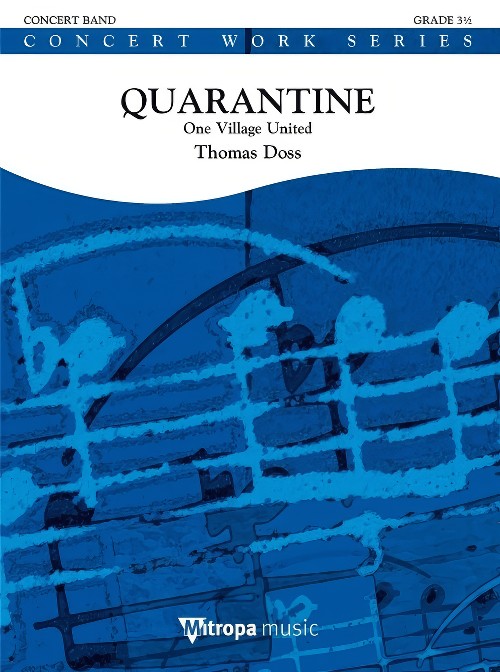
Quarantine (One Village United) (Concert Band - Score and Parts) - Doss, Thomas
Like a dark veil, an ominous sense of foreboding takes hold across the world. A looming danger, one previously unknown to mankind, slowly approaches, bringing our daily lives to a grinding halt. A perilous virus gives us no choice other than to stay in our homes, leaving us unable to work in our offices or even visit family and friends. Something that has only been talked about in history books is coming to pass: a pandemic! The invisible danger expands more and more, and we feel paralysed by fear and fright. The distance between us and our fellow human beings increases. At the same time, we start to better understand something crucial: we have time again! People help each other out. Neighbourly assistance and support within one's own family becomes more apparent. We stand by each other. Suddenly we have the time for things that we did not have before. Time for reflection... A new era commences. Finally, hope reappears. We leave our houses, but nothing is quite the same anymore. With renewed strength, people begin to perceive the future in a positive and optimistic way once again. With greater attention and awareness of the here and now, we feel that, despite it all, we can be happy. Duration: 8.00
Estimated dispatch 7-14 working days
-
 £99.00
Postcards from Tomorrow - Gauthier Dupertuis
During their childhood, some people have the tradition to put their toys, drawings and wishes for the future into a timebox that they bury somewhere to dig up when they are adults. This has inspired Gauthier Dupertuis for the title of this work: Postcards from tomorrow. What wishes would we put in those boxes for the future; what kind of postcards would we send to our grandchildren? To compose this work, Gauthier Dupertuis was also inspired by three pictures that have some symbolic meaning linked to the question above and that give the names to the three movements that make up this piece.The first movement, Abandoned Blockhouses, refers to war and other horrors in the history of humanity, while Pagoda at the Lake, the second movement, was inspired by the pagoda, a religious building whose function is to house the relics of holy people in Asian worship. The third and last movement, Building Bridges, is a call for hope. In July 221, Postcards from Tomorrow was awarded the first prize at the "La Bacchetta d'Oro" international composition contest in Italy.
Estimated dispatch 7-14 working days
 View Music