
Results
-
 £113.30
Moderate Dances - Angelo Sormani
This piece is a tribute to dance music, especially passionate, intense and meditative dance music. "Moderate Dances" is divided into three movements: a "Tango", a "Slow Waltz" and a "Bossa Nova". Each movement and each dance has its own particular characteristics but, when combined, these different rhythmic beats and times give the piece a feeling of completeness and uniformity. The Tango started to flourish in the suburbs of Buenos Aires in around 1880. There is still some doubt as to its origins, which may be Cuban (Habanera) but are probably African. It was most popular in Argentina and Brazil: here the male protagonist was originally the "gaucho" with his inseparable guitar, later to be replaced by the proud, elegant "compadre". By around 1910 the Tango had spread to Italy and France. New clubs opened, where the upper classes could watch and dance the Tango. Here the dance also underwent some rapid transformations. The exaggerated and extravagant gestures and body movements disappeared. Slow, gliding steps replaced the old rotational movements. The women's red ankle-boots and the partners "staring into each other's eyes" accentuated the erotic nature and sensuality of this dance. So much so that, in 1913, the German government banned soldiers from dancing the Tango. Those who broke the law were immediately discharged from the army. From a strictly musical perspective, the basic instruments were a flute, a harp (the diatonic harp typically played by the Indians of Paraguay) and a violin, or flute, guitar and violin or even clarinet, guitar and violin. These instruments were easy to transport, ideal for playing at parties, in the streets and in courtyards. The musicians played by ear, frequently improvising: there were no scores, no records, which is the main reason why it is impossible to trace the Tango back to its exact origins. However, the Tango's evolution (and growing popularity) was once again fostered by its fundamental ability to absorb "other" cultures, languages and sounds. And it was the arrival of the "bandoneon" (an accordion-like instrument that was invented in Germany and brought to Rio de la Plata by some immigrant), which replaced the flute, that marked the beginning of the Tango's huge success outside Argentina. A number of talented composers, above all the great Astor Piazzola (1921-1992), transformed the bandoneon from a simple accompanying instrument to a solo instrument that was to become the distinguishing feature of the 20th century Tango. The Slow Waltz originated from the Waltz, the typical dance of the Bavarian and Tyrolese peasants in the 1700s. It was composers like Johann Strauss, father and son, who carried the Waltz to its zenith in the 1800s, creating the sensual and melancholy yet joyful and charming dance we are all familiar with. When the Waltz first became popular in Germany, the members of respectable society were shocked at the closeness of the dancing partners, who had always previously danced apart. The main difference between the Waltz and Slow Waltz is that the latter has a slower, more expressive rhythm: the men wear tails and the women wear ball gowns decorated with beads and feathers and couples dance in graceful rotational movements. "Bossa Nova" is the title of the last movement in the piece. Jobim, the great Brazilian musician, described this musical genre as a combination of modern Jazz and Samba. Bossa Nova means "new wave". This was the name of the artistic and musical movement that evolved in Brazil in the late Fifties and was extremely popular throughout the Sixties. The songs are usually about love or social matters, drawing inspiration from the slums of Rio De Janeiro and the lives of their inhabitants. Bossa Nova, with its original compositions and the artistic talent of its musicians, also became hugely popular in the United States and Europe, and top Jazz musicians (Ella Fitzgerald, Stan Getz, Bob Cooper, Charlie Bird, Sonny Rollins, Dexter Gordon, Dizzy Gillespie) started to include Bossa in their repertoires.
Estimated dispatch 7-14 working days
-
£137.99
Three Onegin Dances - Pyotr Ilyich Tchaikovsky
Tchaikovsky is best known for his purely instrumental compositions. However, we must not underestimate him as a composer of operas. Many of his operas such as Pique Dame and Eugene Onegin are still performed regularly throughout the world. Eugene Onegin (also called Jevgeny Onegin), composed in 1877-1878, was not called an opera by Tchaikovsky himself, but "lyric scenes". The work is entirely dominated by lyricism. However, there are two moments that contrast sharply with this lyricism: two ball scenes, for which Tchaikovsky wrote a waltz and a polonaise.After opening with a less well-known allegro dansant, this arrangement features the aforementioned waltz, which can beconsidered a beautiful Russian equivalent of the Faust Waltz by Charles Gounod. In the opera, this waltz is actually played by a military band. The arrangement concludes with the pompous polonaise (also mentioned above) which opens the last act: the ideal music to characterize high aristocracy in the salon of a palace in St. Petersburg.
Estimated dispatch 7-14 working days
-
 £60.99
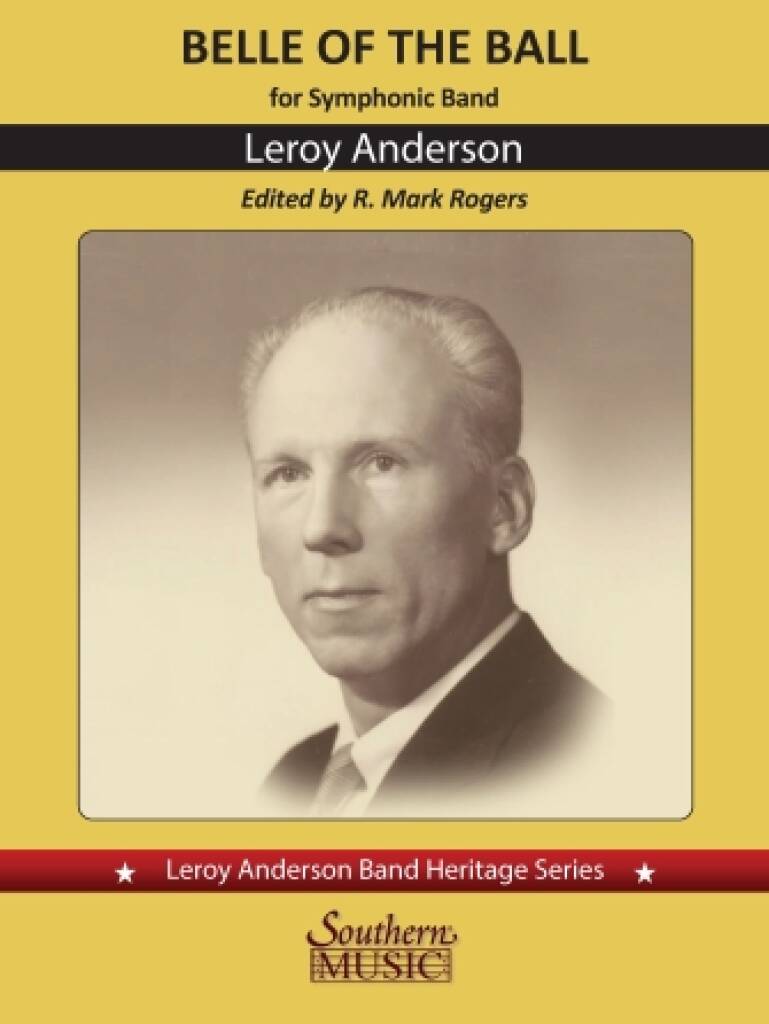
Belle of the Ball - Leroy Anderson
Like most of Leroy Anderson's efforts, Belle of the Ball is light, effervescent, and devoid of conflict or disharmony. Anderson looked upon the piece as a modern-day American revival -- or revitalization -- of the Viennese waltz tradition. Having said that, the main theme sounds rather unlike a Strauss waltz, but the voice of Tchaikovsky is evident in its playful, fantasy-like character. The melody is rhythmic and comes in short groups of notes, beginning with two notes, then three, then expanding further; the music skates along elegantly. The middle section features a delightful variation on the theme, in which Anderson's gentle-belled sonorities impart a playful innocence. This exclusive Southern band edition by Mark Rogers reintroduces Anderson's enchanting work to new generations of audiences.
Estimated dispatch 7-14 working days
-
£121.00
Acceleration - Johann Strauss
From the "Waltz King," Johann Strauss comes this magnificent and lavish concert waltz. Arranged exclusively for BOVACO by master musician Erik Leidzen. Beautiful!
Estimated dispatch 7-14 working days
-
 £60.50
The Gathering - Brooke Pierson
Brooke Pierson's The Gathering is a creepily inspired Waltz in 3/4 time for young bands. A great choice for Halloween performances, this Waltz has plenty of excellent learning opportunities, especially if you want to work on accidentals!
Estimated dispatch 7-14 working days
-
 £159.60
La Derniere Valse - Evzen Zamecník
The Czech composer Evzen Zmecnk, born in 1939, is not only known as adjudicator at the World Music Contest in Kerkrade. He is one of the most important wind band music composers in his country. His music is often inspired by Moravia, the area he is now living in. Here is a waltz with a typical East-European character, expressing a great melancholy. Both the origin and the theme of this 'Last Waltz' are very well rendered by the nostalgic and compelling nature of this composition with some surprising descriptive moments.
Estimated dispatch 7-14 working days
-
 £121.70
The Highlights from Elisabeth - Michael Kunze
The life of the Austrian empress Elisabeth (1837-1898) which started as a fairy tale but ended as a tragedy, inspired the librettist Michael Kunze and the composer Silvester Levay to write a musical based on the life of the popular 'Sissi'. The musical was premiered in Vienna on 3 September 1992 and was very successful for many years. The story is told by Luigi Lucheni, Elisabeth's murderer. So death, represented by a mysterious and seductive young man, is omnipresent throughout the musical. Several songs have become hits and, of course, you can hear them in this fine selection by Peter Kleine Schaars who gathered various music and dance styles such as the rock shuffle, the jazz waltz and the classical Viennese waltz.
Estimated dispatch 7-14 working days
-
 £108.40
Das Romantische Mittelrheintal - Manfred Schneider
The concert waltz 'Das Romantische Mittelrheintal' (the romantic Middle Rhine valley) was composed by Manfred Schneider (who passed away on 18 November 2008) at the request of the mayor of his dwelling-place Kestert, in the neighbourhood of the famous Loreley cliff alongside the Rhine. The composition describes both the romantic atmosphere of this 60 kilometres long valley of the Middle Rhine as the dangers for the navigation in the neighbourhood of the world famous Loreley cliff. This classical waltz is extremely well suited for your next New Year's concert.
Estimated dispatch 7-14 working days
-
 £53.50
Lake Shore Drive - Sarah Siegler
The 3/4 meter is deceptive. This isn't a waltz! It_x001A_s a driving, syncopated tour de force that will keep your band on its toes and counting like the dickens! Never a dull moment!
Estimated dispatch 7-14 working days
-
 £189.99
Masked - Alex Shapiro
Masked by Alex Shapiro is composed in the exact shape of a Classical Minuet and Trio waltz, though the music--a whimsical if somewhat demented masked ball (or, balls, in this case)--bears little connection to that of Mozart or Haydn. Historically, third movement Minuets gave way to the joke-like Scherzo, and the Trio section tips its hat to some welcome levity. This is one of four movements in Suspended, a piece is composed in the tradition of an 18th century Classical symphony: four contrasting movements which serve specific functions and reveal a story. The work begins in absolute rage and chaos, then alternates between moments of grief and bleakness. Grim reality shifts to a macabre, circus-like insanity, and by the end, flickers of genuine hope contrast a pervasive sense of dread, and finally arrive at more optimistic possibilities. To perform the piece, you'll need an audio system capable of playing the prerecorded audio tracks from a laptop computer via a small digital audio interface connected to an audio mixer. Download information is provided in the printed piece.
Estimated dispatch 7-14 working days
 View Music