
Results
-
 £70.50
Folk Songs from the British Isles (Concert Band - Score and Parts) - Wagner, Douglas E.
In four contrasting traditional themes, Douglas Wagner has captured the essence in his Folk Songs from the British Isles. Including "A-Rovin'," "Early One Morning," "Barbara Allen" and "The Lincolnshire Poacher," the variety of these cherished melodies flow from the fanfare-like introduction to emotionally charged-lilting charm. Solidly scored for contemporary concert band in a most musical fashion, this is sure to be a frequent selection for contest, festival, and band concerts.Duration: 4:00
Estimated dispatch 7-14 working days
-
 £104.99
Friedensmarsch (Concert Band - Score and Parts) - Wagner, Richard - Van der Beek, Wil
Rienzi remains one of the most popular works from the master of romantic opera, Richard Wagner. The Friedensmarsch from the fourth act (scene 2) of Rienzi is subdued and solemn in character: in the sounds of this march, Rienzi strides to a stately church service. This is sure to be a very popular addition to any performance and is one not to be missed.Duration: 6:15
Estimated dispatch 7-14 working days
-
 £1.75
£1.75Give Me Your Tired, Your Poor (SATB Choral Octavo) - Wagner, Douglas E.
The classic words of American poet Emma Lazarus appear on a plaque at the base of the Statue of Liberty in New York harbor. The immigrant spirit of our nation lives on in her words and in the spirit of every American. Doug Wagner has created this wonderful work for band and chorus that captures the true sense of our nation. If you're looking for a special patriotic addition to your next concert, consider this one! Duration: 3.45
Estimated dispatch 7-14 working days
-
 £58.50
Give Me Your Tired, Your Poor (Concert Band with Choir - Score and Parts) - Wagner, Douglas E.
The immigrant spirit of our Nation lives on in the hearts of all Americans through the words of Emma Lazarus that appear at the base of the Statue of Liberty. Doug Wagner has created this wonderful work for concert band with strings and chorus. It is perfect for any event and allows participation of the entire music department! Duration: 3.30
Estimated dispatch 7-14 working days
-
 £64.50
To Reap the Blessings of Freedom (Concert Band - Score and Parts) - Wagner, Douglas E.
This beautiful medley arranged by Douglas Wagner is constructed from the hymns of the United States Armed Forces. The flowing musical lines are reinforced throughout the ensemble. To Reap the Blessings of Freedom is a wonderful setting that will be well-received on any program to add a patriotic flavour. Duration: 4.00
Estimated dispatch 7-14 working days
-
 £60.00
Pilgrim's Chorus (from Tannhauser) (Concert Band - Score and Parts) - Wagner, Richard - Bullock, Jack
From the pen of Jack Bullock is this energetic arrangement of the favorite Richard Wagner melody. With characteristic dynamic shadings, this glorious work is sure to please your band and audience alike. Duration: 3.30
Estimated dispatch 7-14 working days
-
 £77.50
The Dam Busters (Concert Band - Score and Parts) - Coates, Eric - Wagner, Douglas E.
Eric Coates' musical genius is celebrated in this new arrangement from Douglas E. Wagner. From the film of the same name, The Dam Busters was an instant classic and was named after a string of successful bombings on the Ruhr River which brought World War II to a more rapid end. This new arrangement of the classic march celebrates the fiftieth anniversary of the composition. Duration: 3.45
Estimated dispatch 7-14 working days
-
 £66.95
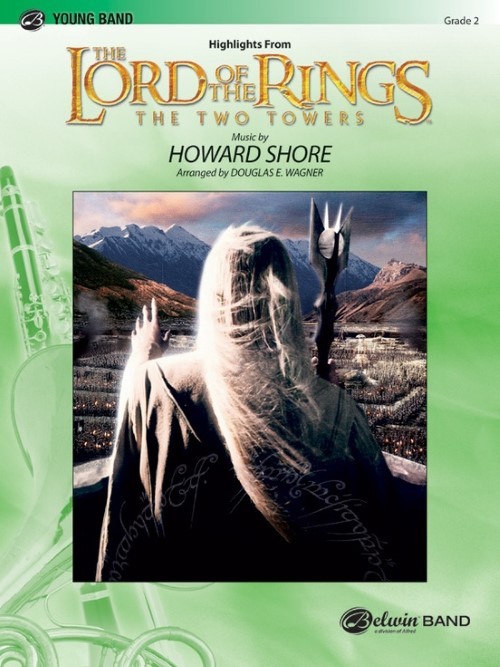
The Lord of the Rings: The Two Towers, Highlights from (Concert Band - Score and Parts) - Shore, Howard - Wagner, Douglas E.
All of the familiar themes from the blockbuster hit are contained in this dynamic medley including "Rohan," "Forth Eorlingas," "The March of the Ents," "Evenstar," and "Gollum's Song." A seamless characterisation from the pen of Douglas E. Wagner, this medley is sure to capture the imagination of your entire audience.Duration: 6.00
Estimated dispatch 7-14 working days
-
 £72.00
Children's March (Concert Band - Score and Parts) - Grainger, Percy Aldridge - Wagner, Douglas E.
A true classic in every sense of the word, this delightful Percy Grainger work continues to be an audience favourite. Douglas Wagner has scored this brilliant abridged version while retaining Grainger's original compositional integrity. The wonderful vitality of Grainger's unique tonal colours and whimsical rhythms guarantee a superior experience for your concert and contest performances.Duration: 4:00
Estimated dispatch 7-14 working days
-
 £53.95
Annabel Lee (Concert Band - Score and Parts) - Wagner, Douglas E.
Based on the exquisitely beautiful poem of the same name, by Edgar Allan Poe, Annabel Lee by composer Douglas Wagner is a charismatic work, with the main thematic material reoccurring as a dialogue between the two lovers in counterpoint in both the first and last section. The middle segment paints a musical picture of a cold, desolate, windswept shoreline . . . a place where this portrait might have been discovered. Wonderfully flowing lines with fascinating harmonic colouration. Duration: 4.30
Estimated dispatch 7-14 working days
 View Music