
Results
-
 £132.00
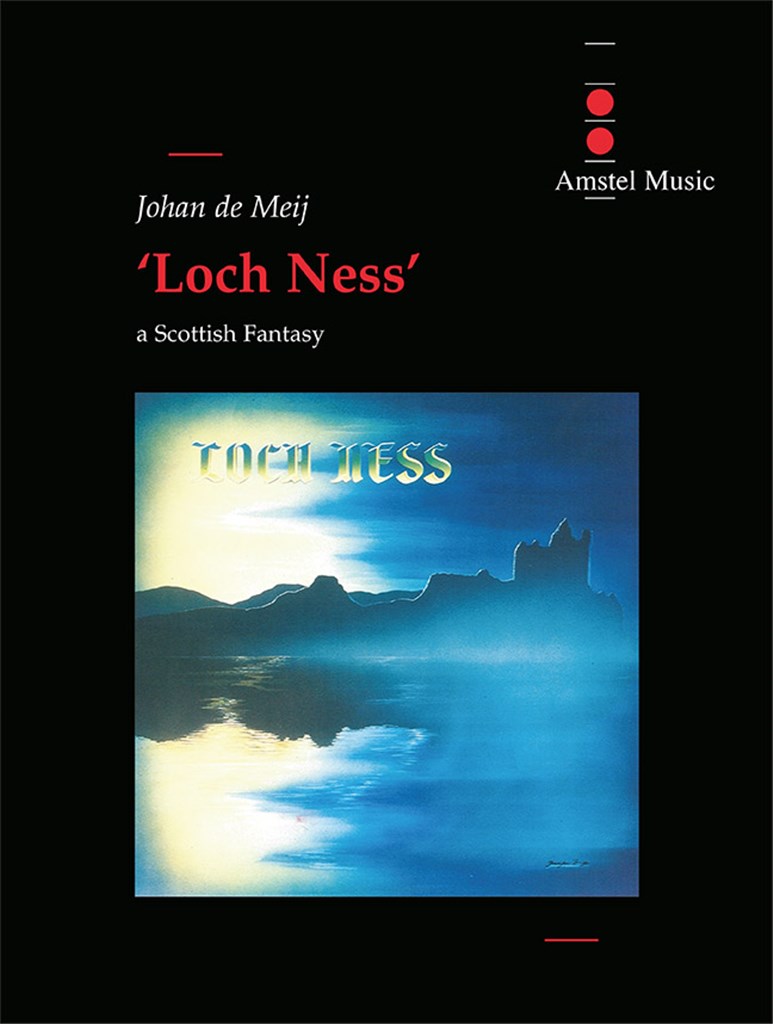
Loch Ness (Concert Band - Score and Parts) - De Meij, Johan
A Scottish Fantasy. The symphonic poem Loch Ness consists of five through-composed impressions of this mysterious Scottish Lake. I) The Lake at Dawn - calm, static, sonorous blocks depict the troubled opaque water surface and the enormous depth of the Lake at daybreak. II) Slowly the rising early-morning mist reveals the distant ruins of Urquhart Castle, represented by a solemn theme in the trombones which is taken over by the full band, thus evoking the illustrious past of this fortress besieged so many times. III) Inverness: Bagpipes and Tourists - the music takes us down to the town of Inverness where the first tourists mark the slow but steady start of a new season to the sound of a Scottishmelody. IV) Storm - suddenly a heavy wheater breaks: fierce gusts of wind and heavy showers transform the erstwhile calm surface into an obscure and whirling mass of water, and clouds rapidly passing over offer an eery scene. V) Conclusion - storm and rain gradually decrease and when everything is quiet again we are granted a last view of the Lake in its full glory. Duration: 12.15
Estimated dispatch 7-14 working days
-
 £118.99
Donna Diana Wind Band Set (Score & Parts)
Emil Nikolaus V. Reznicek was born on May 4,1860. Though he was originally destined for ajudicial career, his nature (that of a true musician)soon pointed him in the direction of music. As anorchestral conductor and a highly regarded musicteacher he made his mark in a number of cities,including Mannheim and Berlin. As a composer hesprang to fame with his opera Donna Diana(1894), a lasting success which placed him in theforefront of German composers. The overture toDonna Diana is unique in its freshness and sunnycheerfulness. Wil van der Beek, who has alreadywritten many arrangements of classical pieces forwind band, has maintained the spirit of theoriginal composition. 0:05:30
Estimated dispatch 7-14 working days
-
 £169.95
JOURNEY TO THE CENTRE OF THE EARTH (Concert Band) - Graham, Peter
Journey to the Centre of the Earth is one of Verne's best known works. The novel takes the form of a sequence of diary entries by Axel, nephew of Professor Otto Lidenbrock. The pair follow coded instructions in a old document guiding them to Iceland where, together with their guide Hans, they enter the open crater of an extinct volcano Sn?fells and pursue a trail to the centre of the earth. There follows hair-breadth escapes and ventures perilous as the intrepid explorers encounter a vast interior world. Peter Graham has taken some of the key scenes .from the book and set them as a sequence of symphonic extracts. The subtitles are; (I) Sn?fells, (II) Descent, (III) The Wonders of the Terrestrial Depths, (IV) The Day of Rest, (V) Lost in the Labyrinth, (VI) The Whispering Gallery, (VII) Rescue from the Abyss, (VIII) Battle of the Antediluvian Creatures and Ascent, (IX) Homecoming
Estimated dispatch 7-14 working days
-
 £54.95
PASTIME WITH GOOD COMPANY (Programme Concert Band) - Wiffin, Rob
Rob Wiffin has taken this classic work - attributed to King Henry V - and given it an exciting yet delicate percussion feel which make for a great opener - or closer! (Grade 3) Performance time c. 3 minutes
Estimated dispatch 7-14 working days
-
 £164.95
The Kings Go Forth (Concert Band - Score and Parts) - Gregson, Edward
This work was commissioned jointly by the Royal Air Force Music Service and an American Universities Consortium and received its world premiere during the 1996 RAF British Tour. It is scored for large symphonic wind band, with the addition of voices.The work is a sequel to the highly successful The Sword and the Crown which was premiered in 1991 by the mass bands of the RAF (and also was an RAF commission). That work was based on music written for the Royal Shakespeare Company productions of The Plantagenets and Henry IV, parts 1 and 2 (for productions between 1988 and 1991).The Kings go Forth is similarly based on musical material for those productions. It uses different thematic elements and incorporates them into a three-movement suite entitled: The Church; The People; The State.This reflects the fact that in Henry IV Parts 1 and 2, Shakespeare introduces The People as an important element in the dramatic structure. The Church and The State are, of course, both leitmotivs throughout the entire plays. An Agnus Dei is heard at the outset from a solo voice. The ensuing Dies Irae is a fast and, at times, quite violent dance. The two sections which form the basis of the second movement, The People, concentrate on popular elements and reflect to some extent the tavern scenes in the plays. The two ideas presented are a harvest hymn reflecting the country scenes set in Gloucestershire, and a jazzy, 'up-tempo' dance based on the medieval song, Sumer is icumen in. The third movement, The State, deals with the Kings theme in the title of the piece. The juxtaposition of battle music with funeral music for Henry IV and Henry VI leads to a reworking of the leitmotif from the beginning of the work. The final section is Coronation music for Henry V, eventually leading to a triumphant climax.- Edward GregsonDuration: 17.15Recorded on QPRM 125D Festival of Music 1996, Massed Bands of the Royal Air ForceRecorded on QPRM 134D The Kings Go Forth, Royal Northern College of Music Wind Orchestra
Estimated dispatch 7-14 working days
-
 £94.00
Altheim - Gauthier Dupertuis
This concert march with a solemn and festive character was commissioned to Gauthier Dupertuis by the the Musikkapelle Altheim e.V (Germany) to celebrate its 100th anniversary. The thematic material of the first section of the march is based on a three-note motif, proclaimed by the brass in the first measure. The second part of this theme presents a recurring motif throughout the piece. This first section has a festive and resolutely giocoso character. The trio presents a new, more lyrical and solemn theme. After a short divertimento based on the material from the first section, the theme returns in a majestic way, leading to a climactic finale. Altheim: a concert march perfect for a festive occasion!
Estimated dispatch 7-14 working days
-
 £127.30
Takk - Edvard Grieg
"Gratitude" is one of Grieg's beautiful lyrical pieces, Op. 62 No. 2.Eva Knardahl made a beautiful recording that I well remember was used as background for a picture cavalcade by the Norwegian Broadcasting Corporation during the passing of His Majesty King Olav V of Norway in 1991.In this arrangement for band, I have tried to vary the instrumentation, both for the sake of more colours and to emphasize the drama.This piece should be played rubato with elastic phrasing. The form can be described as AABACoda. The most dramatic section is the B part from measure 25, which peaks just before measure 38. The last four measures (from measure 53) can be done a bit 'meno' in tempo.Reid Gilje
Estimated dispatch 7-14 working days
-
 £129.99
The White Deer - Thomas Doss
This composition for concert band was commissioned by Orchesterverein Wadgassen e. V. (Saarland/Germany) and its conductor Holger Jakobs. Thomas Doss has depicted the legend of the knight Maldix vom Litermont, a fierce hunter and an excessive drinker who, despite the warnings of his mother, was killed during a driven hunt in the woods, in a magnificent way. With the portrayal of various characters, the work offers a lot of variation.
Estimated dispatch 7-14 working days
-
 £124.99
Black Gold - Thierry Deleruyelle
Black Gold was commissioned by Musikverein 1891 "Harmonie" Saarwellingen e.V. (Germany) to mark its 130th anniversary. This composition pictures the history of the mining industry in the town of Saarwellingen and its surrounding region, where the life of the miners as well as their families revolved around coal, or black gold, for centuries on end. The piece is based on motifs from the famous song "Glck auf, Glck auf, der Steiger kommt..." ("Good luck, good luck, the mining foreman comes"), a veritable anthem for miners the world over.
Estimated dispatch 7-14 working days
-
 £134.99
Gollum (from The Lord of the Rings) - Johan de Meij
Johan de Meij's first symphony The Lord of the Rings is based on the trilogy of that name by J.R.R. Tolkien. This book has fascinated many millions of readers since its publication in 1955. The symphony consists of five separate movements, each illustrating a personage or an important episode from the book. The movements are: I. GANDALF (The Wizard) II. LOTHLORIEN (The Elvenwood) III. GOLLUM (Smagol) IV. JOURNEY IN THE DARK a. The Mines of Moria b. The Bridge of Khazad-Dm V. HOBBITS The symphony was written in the period between March 1984 and December 1987, and had its premire in Brussels on 15th March 1988, performed by The Royal Band of the Belgian Guides under the baton of Norbert Nozy. In 1989, the Symphony The Lord of the Rings was awarded first prize in the Sudler International Composition Competition in Chicago. In 2001, the orchestral version was premiered by the Rotterdam Philharmonic Orchestra and was recorded by the London Symphony Orchestra.
Estimated dispatch 7-14 working days
 View Music