
Results
-
£96.00
The Croods (CB) - Alan Silvestri - Jan De Maeseneer
The Croods is a 2013 American 3D computer-animated adventure comedy film produced by DreamWorks Animation and distributed by 20th Century Fox. It stars the voices of Nicolas Cage, Emma Stone, Ryan Reynolds, Catherine Keener, Clark Duke, and Cloris Leachman. The film is set in a fictional prehistoric Pliocene era known as "The Croodaceous" (a prehistoric period which contains fictional prehistoric creatures) when a caveman's position as a "Leader of the Hunt" is threatened by the arrival of a prehistoric genius who comes up with revolutionary new inventions as they trek through a dangerous but exotic land in search of a new home.
Estimated dispatch 7-14 working days
-
 £109.99
Boreas Wind Band Set (Score & Parts)
In Greek mythology, Boreas is the God of the North Wind. When thinking of the north wind we particularly think of the bleak wind coming from the freezing cold north, but in Homers' work we see a more varied picture. As shown in the following two stories, Boreas often does play the role of a storm wind that blows forth heavy dark clouds while whipping up the dark waves of the tempestuous sea to mountainous heights. When the stake of the fallen Patroclos refuses to burn, Achilles begs for some wind. When Iris, the swift messenger of the Gods, asks the winds for assistance, they raise themselves up with tremendous roaring and rush to Troy. Upon their arrival they blow the divine fire of Patroclos' stake far up into the sky. When Troy was destroyed, the Greeks returned home. After many wanderings, Odysseus, however, ends up with the beautiful nymph, Calypso, who keeps him as a prisoner. As ordered by Zeus, Calypso frees him and sends him off on a handmade wooden raft. At sea, Odysseus is threatened by the aggressive sea god, Poseidon, who stirs up the winds and thrashes the waves with his trident. The goddess, Athena, stems the violence of all the winds except for the north wind, and thus it is Boreas, who sends Odysseus to the land of the hospitable Phaiakes. Jan Bosveld composed Boreas for OLTO, a music association in Loenen, The Netherlands, for which he had served as conductor for many years. Turbulent movement in both tempo and dynamics characterize this composition. The result is a whirling piece that races by in a positive manner. Boreas is in de Griekse mythologie de god van de noordenwind. Bij noordenwind denken wij vooral aan de gure wind uit het ijskoude noorden, bij Homerus echter zien we een meer gevari?erd beeld. Natuurlijk speelt Boreas, zoals uit de twee onderstaande verhalen blijkt, meestal de rol van de stormwind die de zware zwarte wolken voor zich uit blaast en de donkere golven van de onstuimige zee torenhoog opzwiept. 05:00
Estimated dispatch 7-14 working days
-
 £49.00
Greater Steps to Success (Concert Band - Score and Parts) - Benson & Swearingen
Create a routine that will instill a lifelong understanding of why warming up is important and carry over from group to individual practice. This quick, yet highly efficient warm up is a perfect way to start your rehearsal. Students will instantly become more focused as you transition into your valuable rehearsal/teaching time. Kim Benson and James Swearingen, two well-respected music educators, have teamed up to make your instruction more effective, your musicians stronger and your program highly successful. A must-have for today's approach to teaching instrumental music!
Estimated dispatch 7-14 working days
-
 £248.99
Odysseia (Concert Band - Score and Parts) - Aulio, Maxime
Washed up on the Phaeacian shore after a shipwreck, Odysseus is introduced to King Alcinous. As he sits in the palace, he tells the Phaeacians of his wanderings since leaving Troy. Odysseus and his men fi rst landed on the island of the Cicones where they sacked the city of Ismarus. From there, great storms swept them to the land of the hospitable Lotus Eaters. Then they sailed to the land of the Cyclopes. Odysseus and twelve of his men entered the cave of Polyphemus. After the single-eyed giant made handfuls of his men into meals, Odysseus fi nally defeated him. He got him drunk and once he had fallen asleep, he and his men stabbed a glowing spike into the Cyclop's single eye, completely blinding him. They escaped by clinging to the bellies of some sheep. Once aboard, Odysseus taunted the Cyclop by revealing him his true identity. Enraged, Polyphemus hurled rocks at the ship, trying to sink it. After leaving the Cyclopes' island, they arrived at the home of Aeolus, ruler of the winds. Aeolus off ered Odysseus a bag trapping all the strong winds within except one - the one which would take him straight back to Ithaca. As the ship came within sight of Ithaca, the crewmen, curious about the bag, decided to open it. The winds escaped and stirred up a storm. Odysseus and his crew came to the land of the cannibalistic Laestrygonians, who sank all but one of the ships. The survivors went next to Aeaea, the island of the witch-goddess Circe. Odysseus sent out a scouting party but Circe turned them into pigs. With the help of an antidote the god Hermes had given him, Odysseus managed to overpower the goddess and forced her to change his men back to human form. When it was time for Odysseus to leave, Circe told him to sail to the realm of the dead to speak with the spirit of the seer Tiresias. One day's sailing took them to the land of the Cimmerians. There, he performed sacrifi ces to attract the souls of the dead. Tiresias told him what would happen to him next. He then got to talk with his mother, Anticleia, and met the spirits of Agamemnon, Achilles, Patroclus, Antilochus, Ajax and others. He then saw the souls of the damned Tityos, Tantalus, and Sisyphus. Odysseus soon found himself mobbed by souls. He became frightened, ran back to his ship, and sailed away. While back at Aeaea, Circe told him about the dangers he would have to face on his way back home. She advised him to avoid hearing the song of the Sirens; but if he really felt he had to hear, then he should be tied to the mast of the ship, which he did. Odysseus then successfully steered his crew past Charybdis (a violent whirlpool) and Scylla (a multiple-headed monster), but Scylla managed to devour six of his men. Finally, Odysseus and his surviving crew approached the island where the Sun god kept sacred cattle. Odysseus wanted to sail past, but the crewmen persuaded him to let them rest there. Odysseus passed Circe's counsel on to his men. Once he had fallen asleep, his men impiously killed and ate some of the cattle. When the Sun god found out, he asked Zeus to punish them. Shortly after they set sail from the island, Zeus destroyed the ship and all the men died except for Odysseus. After ten days, Odysseus was washed up on the island of the nymph Calypso.
Estimated dispatch 7-14 working days
-
 £48.95
More Cowbell (Cowbell Feature with Concert Band - Score and Parts) - Williams, Mark
More Cowbell was inspired by the famous television skit featuring a rock band, a record producer, and an over-zealous cowbell player. If the cowbell player is good at hamming it up (and rocking out!), you could try the following staging suggestions: Cowbell player plays with intensity and lots of movement, and starts moving in measure 17 toward the front of the band, ending up next to the conductor in measure 24, bowing to the audience on beat 4. Conductor gives a stern look and gestures to student to get back in the percussion section (possibilities: "slit throat" gesture with side of first finger followed by pointing forcefully to the back, or similar gestures). Student slinks back, starts playing cowbell again, but quietly this time. Playing gradually picks up intensity, and player starts again toward the front in measure 41, reaching the front by measure 48. In measure 48, either A) Conductor waves hands violently for student to stop, or B) have a couple of students place a large blanket over the cowbell player. This works, but only for one measure (player quits and doesn't move in bar 49). Cowbell player resumes playing with a vengeance in measure 50 (either in spite of the teacher or under the blanket!). Make sure your new "rock star" takes another bow at the end of the piece. Have fun, and may your life always have more cowbell! Duration: 2.00
Estimated dispatch 7-14 working days
-
 £102.99
Predator (Concert Band - Score and Parts) - Deleruyelle, Thierry
The Chase BeginsThe peace of a mountain village is shattered by a dreadful rumour: whether animal or something more disturbing, a creature is said to be prowling the area. After a quiet beginning, the music builds up with tense, nervous lines: fear sets in. The soundscape becomes fantastical, almost like a Halloween night.The villagers gather to hunt down the beast, with the orchestra conveying their determination through clear and energetic writing. The chase accelerates, breathless and spectacular, up to an uncertain outcome: the creature vanishes, without anyone having seen it. The initial chorale returns, calmer but not reassuring. The village regains its tranquillity, while retaining the memory of a mystery that has never been solved.Duration: 11.45
Estimated dispatch 7-14 working days
-
 £183.99
Keystone (Concert Band - Score and Parts) - Deleruyelle, Thierry
Keystone tells the story of the Odeon of Vriezenveen, a town in the Netherlands. "Odeon" is the name of ancient Greek and Roman buildings used for activities such as singing, music and poetry. This was the name chosen in 1998 by several members of the 'Vriezenveense Harmonie' for the cultural centre they decided to have built. The piece starts slowly with the bass instruments, then speeds up in a counterpoint passage where the main motif moves from one set of instruments to another. After a slower section, the music speeds up again to reach a majestic chorale symbolising the splendid Odeon.Duration: 16.30
Estimated dispatch 7-14 working days
-
 £50.50
Megawatt Rock (Concert Band - Score and Parts) - Sheldon, Robert
Robert Sheldon's Megawatt Rock will light up your next concert. This high-energy rock-style piece with its rhythmic drive and power chords is sure to amp up the spirit in the performance level of the students. Using only the first seven notes that most beginning band students learn, it is written in Mixolydian mode, with the key signature including the added flat. The rhythms, dynamics, articulation, key, and style provide electrifying teachable moments that occur throughout the piece at no extra charge! Duration: 2.00
Estimated dispatch 7-14 working days
-
 £100.80
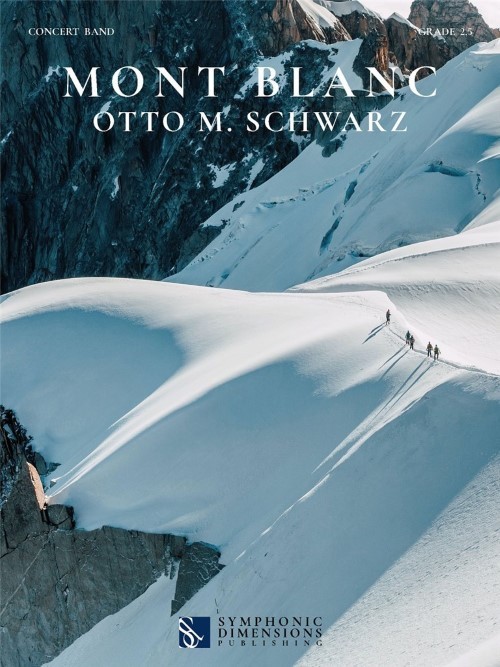
Mont Blanc (Concert Band - Score and Parts) - Schwarz, Otto M.
With its height of 4,808 meters, Mont-Blanc is called the roof of Europe. The highest mountains on our planet have been insurmountable for a long time. Only in the past 250 years have those giants been mounted. Crystal-hunter Jacques Balmat and Michel-Gabriel Paccard, a doctor, were the first to climb Mont-Blanc, in 1786. Many paths lead to Mont-Blanc's peak: the regular ascent goes through the magnificent voie royale of Saint-Gervais-les- Bains, which was opened in August 1855 by the Englishmen Hudson, Kennedy, and Smythe. Today's most common route to climb up, starting from Saint-Gervais via Aiguille du Gouter (3,863m), Dome du Gouter (4,304m), and Arete des Bosses (4,547m), was first used in 1861. Otto M. Schwarz composed this work inspired by the roof of Europe with its luminous and huge glaciers. Early in the morning, mountain-climbers set off to the peak; they witness the sunrise, and experience the hazards that the journey up to the summit brings along. A snowstorm and falling rocks at Arete des Bosses aggravate their journey. A sudden change of weather, however, enables them to reach the top after a strenuous ascent. This piece invites you to an imaginary journey from Saint-Gervais-les-Bains via the voie royale to the top of Mont-Blanc.Duration: 6.45
Estimated dispatch 7-14 working days
-
 £141.99
Pulcinella (Euphonium Solo with Concert Band - Score and Parts) - Sparke, Philip
Pulcinella was commissioned by the Taiwanese euphonium player Tzu-Hsiang Lin. Lin is a renowned soloist and teacher and a Besson Euphonium Artist. He teaches euphonium at Taipei National University of the Arts, National Taiwan University of Arts, Shih Chien University and National Kaohsiung Normal University. Lin gave the premiere of Pulcinella in both its concert band and brass band versions in January 2021. Pulcinella continues Sparke's series of euphonium solos named after characters of the Italian commedia dell'arte and opens with a long and expressive minor melody for the soloist over a brooding accompaniment. This is taken up briefly by the full band and is extended by the soloist after a change of key. A cadenza, accompanied by fragments of the main melody leads to a complete change of mood, tempo and tonality, introducing a Vivo section starting with a perky syncopated tune for the soloist. The band then uses elements of this new tune to introduce a change of key, where the soloist introduces a more lyrical second subject over a pulsing accompaniment. The band then takes this up and changes key to reintroduce the original Vivo melody, which leads to a short and acrobatic coda to bring the work to a spectacular close. Duration: 6.45
Estimated dispatch 7-14 working days

 View Music