
Results
-
 £164.95
Amphibiosity (Concert Band - Score and Parts) - Ellerby, Martin
Amphibiosity was commissioned by the Royal Marines Band Service with funds made available by the Royal Navy and Royal Marines Charities for the 2014 Mountbatten Festival of Music held at the Royal Albert Hall in London.The work was written in celebration of the 350th Anniversary of the Royal Marines Corps and utilises many familiar tunes associated with them. Although the piece is cast in one continuous movement it falls into an introductions, ten sections and a coda.The Introduction sets the tone with the Amphibiosity mofif - a call to attention, it is of serious intent. During the course of the work it returns as a point of reference. The first section makes use of The Globe and Laurel (Original Regimental Slow March of the Royal Marines, the tune (Early One Morning) making an apt appearance, it has been played in the minor and like much of the quotational material in the piece is of a referenced nature being symbolic in meaning. However it soon turns to the major to provide a less sombre aspect to the introduction proper. There follows an interlude, the Amphibiosity motif returning rather like a ritornello to give cohesion to the structure and act as a point of change.Section two presents Sarie Marais (Regimental March Past of the Royal Marine Commandoes), the first half of the tune used as a fugal subject (placed in the minor) and as such providing the impression of a building up of activity. The ensuing third section is light-hearted commencing with an original hornpipe leading into the fourth section, Seascape, representing the fleet at sea. Another interlude follows, the Amphibiosity motif reappearing as a woodwind fanfare making way for the fifth section. Anticipation, serious matters lie ahead, there is trouble in the papers, the Corps will be placed on standby.Section six is subtitled Preparation, all hands-on deck, time to get set: A Life on the Ocean Wave (Regimental March of the Royal Marines) is alluded to. On reaching section seven, Assault, the landing goes ahead. Within this section there is an internal interlude reflecting on things past: other men have been in this position before. It is a taut and trying situation, training must pay off!Section eight is named Victory, but not gung-ho, and here the Seascape music is revisited. The penultimate ninth section is called Rememberances, although all made it this time, it was not always the case in times past and the Naval Hymn (Eternal Father) provides a moment of tribute to the fallen of previous generations.The Finale (section ten) delivers By Land and Sea (Slow March of the Royal Marines) in a bright and positive orchestration, the mood being celebratory. In a brief Code, the Amphibiosity motif makes a last triumphant appearance.Duration: 10.30
Estimated dispatch 7-14 working days
-
 £74.95
Songs of the Great War (Concert Band - Score and Parts) - Wiffin, Rob
A Medley of Popular Songs, 1914-1918Music of the Great War is a five year project to use music of the period to educate and engage schools, colleges, town bands, and the wider public across the UK and the world to learn in a positive way about the events, the experience of the troops involved from all sides, and how music played its part.To commemorate the centenary of the Great War a specially arranged medley Songs of the Great War has been created. The medley has been arranged for bands to rehearse and was first performed on the 11 November 2015. It brings together some of the most popular tunes played, sung and performed by the men and women of the time - in the trenches and on the various home fronts.The medley includes:It's a Long Way to TipperaryYour King and Country Want YouGood Bye-eeOh! It's a Lovely WarHello! Hello! Who's Your Lady FriendTake Me Back to Dear Old BlightyMademoiselle from ArmentieresThere's a Long, Long Trail A-windingIf You Were the Only Girl in the WorldPack Up Your Troubles (In Your Old Kit Bag)Old Soldiers Never Die/Last Post
Estimated dispatch 7-14 working days
-
 £125.00
Danceries (Set II) (Concert Band - Score and Partss) - Hesketh, Kenneth - Littlemore, Phillip
Danceries Set II was commissioned by Keith Allen and Birmingham Symphonic Winds, supported by PRS for Music Foundation and the RVW Trust. The world premi?re of this work was given by Birmingham Symphonic Winds, conducted by Keith Allen, at the CBSO Centre, Birmingham in 2011. This second set of Danceries continues the format established in Danceries (Set I), namely in using material taken from Playford's Dancing Master, a collection of folk and popular tunes published in the seventeenth century, to form the basis of an extended dance suite. In this set, the melodies have been more abstracted and project only a distant echo of their original forms, but as before, each movement is self-contained, colourful and direct, with its own distinct mood. The outer movements - Jennie's Bawbee and Peascod's Galliarda - share a use of driving percussion writing with a military air. Tom Tinker's Toye and Heart's Ease (movements two and three) are both settings of original melodies. All movements are more extended than in the first set, with a freer use and approach to the material; melodies now occur in various keys and are supported by a greater variety of harmonic colouring. The result is a richer, even more exhilarating set of dances. Danceries has come of age! Duration: 15.00
Estimated dispatch 7-14 working days
-
 £48.95
Salsa and Chips (Concert Band - Score and Parts) - Stein, Alan
Salsa and Chips is a delightful latin-flavored treat for your audience. With a catchy rhythm and melody, this charming toe-tapper sets itself apart from many other novelty tunes in this grade level due to the well-crafted and colorful scoring, as well as the unexpected twists and turns that can't help but make you smile. This is the one your students will be begging you to play again and again! Duration: 2.45
Estimated dispatch 7-14 working days
-
 £44.95
Two Susato Dances (Concert Band - Score and Parts) - Susato, Tielman - Ellerby, Martin
Around 1540 Tielman Susato, the Belgium trumpet player and composer, established himself in Antwerp as a printer of music. In 1551 he brought out The Third Little Music Book, a collection of instrumental dances. Most of these are arrangements, possible by Susato himself, of popular dance tunes. In keeping with sixteenth-century practice, this book details no specific instrumentation; something to be worked out by the players with whatever available means. Doubtless many of the dances were performed on wind instruments at festive outdoor events. The date of Susato's birth is unknown but estimated to be around 1500. The same applied to his death, which is thought to be somewhere between 1561-64.The third Little Music Book gives several examples of the traditional sixteenth-century genre, the dance pair, a predecessor of the Baroque suite. In such a pair the first dance was often in slow or moderate duple time, the second in quick triple time. This is the case in the pair presented here, which consists of a lively round dance followed by a Hop Up or saltarello.Titles in the Prelude Series are specifically scored for bands with few, if any, bass instruments but will sound well on larger ensembles. The bass line is playable by any combination of bass clarinet, bassoon, baritone saxophone, trombone, euphonium or tuba; in the event that none of these is available, the part for trombone/euphonium (B flat TC) can be played by tenor saxophone. The tuned percussion part is entirely optional and can be played by any available instrument(s). Each piece also includes a preliminary exercise. This is always in the same key as the accompanying piece and consists of a scale and chord progression that can be used for improving ensemble, balance, intonation and instrumental facility by changing tempo, articulation and dynamics.Duration: 2.00
Estimated dispatch 7-14 working days
-
 £74.95
Joyeuse Marche (Concert Band - Score and Parts) - Brand, Geoffrey
In spite of displaying remarkable musical gifts Chabrier (1841-1894) was sent by his father to study law and in due course, having taken a law degree, went to work in his native French Ministry of the Interior, stay there for eighteen years. During the whole of this time he was developing his real interests in music and painting, including composing operettas and music for the piano. Following a holiday in Spain in 1883, Chabrier wrote a rhapsody for orchestra based on Spanish tunes he had heard. This became Espana; it achieved immediate acclaim and is still his most performed work. Joyeuse Marche (originally called Marche Francaise) was written in 1888. It exudes Chabrier's rhythmical exuberance, spontaneity and wit, bringing pleasure and joy to performers and listeners alike. Truly a march which lives up to its title.
Estimated dispatch 7-14 working days
-
 £149.99
Suite Provencale (Concert Band - Score and Parts) - Van der Roost, Jan
This 4-movement suite is based on authentic folk tunes from the beautiful southern province in France: the "Provence". The composer used an harmonic language respecting the popular characteristics, but on the other hand also contains some "spicy" notes (...just like the well known "Provencal sauce"!...). The instrumentation is very colourful, paying a lot of attention to the different timbres of both brass and wood winds as well as to the percussion section. Every movement has its own character: "Un Ange a fa la crido" (= An angel brought the creed/credo) is like a bourree, "Adam e sa Coumpagnou" (= Adam and his companion) is an old love song, "Lou Fustie" (= the carpenter) a fast dance and finally "Lis Escoubo" (= a whistle tune / popular ballad) is a farandole. In the latter, the old tradition of folk musicians who play a whistle with one hand and a drum with the other hand, is clearly represented during the first presentations of the one and only theme)Although this piece is not too demanding, a well balanced band is necessary to perform it successfully. Thanks to the contrasts and the varying colours, it keeps on holding the attention.Duration: 7:15
Estimated dispatch 7-14 working days
-
 £179.99
Austrian Overture (Concert Band - Score and Parts)
Austria is an industrious country. During the last century--which was characterized by extreme changes--the hard-working and ambitious people achieved a great deal, enduring two world wars and numerous political skirmishes. Despite all the problems involved in a change from a dual monarchy to a small state, Austria has found its independence. With his Austrian Overture, Thomas Doss looks toward the future. The first part of the composition provides an optimistic outlook; along with the happiness and energy, some musical humor is also present: while the horns powerfully express joy, small yodeling melodies sound throughout. As the rhythm continues in search of new ways to go, catchy tunes compete to be heard. However, in addition to the energetic, diligent Austria, there's also the quiet landscape where one can enjoy repose and beauty. These aspects - as well as the freedom of spirit and cultural life -are conveyed in the second part of the work through the surprising linking of chords, romantic phrasing, and tender melodies. But life never stands still: creativity, ambition, and work are the driving forces of our existence. Embracing this thought, a reprise of the first part provides a compelling ending. 10:26
Estimated dispatch 7-14 working days
-
 £105.00
Danceries (Set I) (Concert Band - Score and Parts) - Hesketh, Kenneth
The term 'Danceries' can be found in a copy of Playford's Dancing Master, an extensive collection of folk and popular tunes of the seventeenth century (and no doubt earlier). This publication was used by master fiddle players to teach the various dance steps of the day to a nobleman's house or a king's court. Whilst this present set of 'Danceries' cannot be said to be an aid to terpsichorean agility, it will at least set feet tapping! The melodies themselves are a mixture of new and old--well, nearly. Where the old occurs it has been adapted in mood and composition and is often interspersed with completely new material. The harmonies and rhythms bring a breath of the new into these themes and add to the drama of the set.Movement 1: Lull me beyond thee. Gentle and lilting, almost a barcarole, this movement is very much a reverie. The original tune had the name 'Poor Robin's Maggot' - a rather disconcerting title; maggot, however, in seventeenth-century parlance meant whim or fancy. This theme can also be found in The Beggar's Opera by John Gay (first performed in 1728) under the title 'Would you have a young lady' (Air 21).Movement 2: Catching of Quails. A colourful, buoyant scherzo on an original melody. The thematic material is shuttled around the band to contrast with full-bodied tuttis. The last few bars fade away to almost nothing before a final surprise!Movement 3: My Lady's Rest. A tender pavane, also on an original theme, with Moorish leanings. Solos for principal winds and brass contrast with warmer tutti passages. The movement culminates with a final presentation of the theme before evaporating in held flute and trumpet chords.Movement 4: Quodling's delight. The final movement to the set combining one of the melodies from Playford's Dancing Master ('Goddesses') with an original contrasting melody. A dramatic and exuberant ending to the set of 'Danceries'.Duration: 12.00
Estimated dispatch 7-14 working days
-
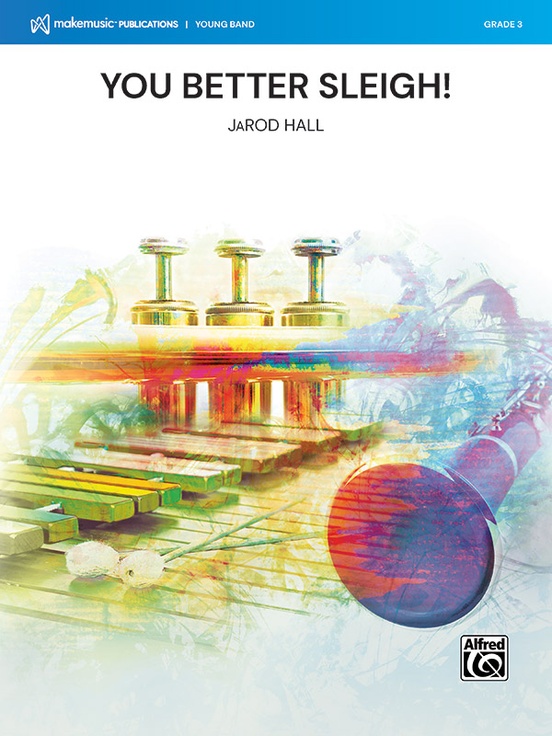 £73.50
You Better Sleigh! (Concert Band - Score and Parts) - Hall, JaRod
Let JaRod Hall bring some funk with a sassy attitude to your winter concert! This remarkably smooth and fun musical scavenger hunt includes a wealth of holiday tunes with an incredible groove! Influenced by jazz, R&B, soul, and dance music, You Better Sleigh! is guaranteed to be the hit of the season.Duration: 2.30
Estimated dispatch 7-14 working days
 View Music