
Results
-
 £165.60
How to Train Your Dragon - John Powell
The music from How to Train Your Dragon by composer John Powell is possibly the best film score in the last ten years. This beautiful animation film is sublimely supported by this music. Including the titles: This is Berk, The Downed Dragon, See You Tomorrow, Romantic Flight, Battling the Green Death and Coming Back Around, this is a spectacular selection for both Harmony and Fanfare Band. This will be a joy for the band to play!Download european parts 1st horn in Eb2nd horn in Eb3rd horn in Eb4th horn in Eb1st trombone in Bb (TC)1st trombone in Bb (BC)2nd trombone in Bb (TC)2nd trombone in Bb (BC)3rd trombone in Bb (TC)3rd trombone in Bb (BC)4th trombone in Bb (TC)4th trombone in Bb (BC)Download MERGED PERCUSSIONMerged percussion (ZIP)
Estimated dispatch 7-14 working days
-
 £106.99
Sambezi - Philip Sparke
Sambezi is the last movement of Philip Sparke's Trombone Concerto. It starts in a joyful and outgoing mood with the soloist playing a carefree samba tune. A jazz-influenced central tune explores the higher ranges of the trombone before the samba rhythms set up a 'contest' between the soloist and the band's trombone section. The soloist is the eventual 'winner' and he celebrates by reintroducing the samba melody before bringing the work to a virtuosic close. A real treat for your trombone soloist.
Estimated dispatch 7-14 working days
-
 £119.99
Tango for Joe - Philip Sparke
Tango for Joe explores the lyrical properties of the trombone. A long introduction builds to the first entry of the soloist, who plays the main tango melody over a rhythmic accompaniment. In this work, the band and solo trombone parts alternate. A cadenza-like passage leads to a faster 'tango nuevo', which makes up the majority of the work. After a climax and extended cadenza by the trombone, the piece ends with a flourish for concert band and soloist.
Estimated dispatch 7-14 working days
-
£69.99
Mondo Glissando - Mike Hannickel
Slip-slidin' trombone smears in this rip-snortin' ragtime setting are sure to tickle your ears and put some tap in your toes. The trombone glissando is the happiest sound around! Dedicated to, and premiered by, the Westchester Middle School Band of Westchester, Illinois, Mr. Jason Kluge, director, MONDO GLISSANDO targets that most critical of wind sections. When was the last time you featured your trombones? When was the last time they felt like STARS? Section feature pieces are one of the most important techniques available for keeping a section strong and well represented. MONDO GLISSANDO can even be used as a trombone SOLO piece, by having the non-solo trombones play from thetechnically simpler euphonium part.Either way, section or solo, there's nothing like an exposed part on an upcoming performance to reinvigorate a musician's interest and encourage that all-important PRACTICE!
Estimated dispatch 7-14 working days
-
 £128.80
Brass Rock Suite - Tohru Kanayama
This work contains three parts. The first part is a rock tune with 8 beat. There are written or improvisation solos on Trombone, Trumpet and Alto saxophone (order of appearance). The second part is a pop ballad featuring trombone solo. And the last part is a dance tune with 16 beat. The first performance of this work was in a version that added three soloists, Alto Saxophone, Trumpet and Trombone. Then I've rewrote to current version for publication.
Estimated dispatch 7-14 working days
-
 £75.00
Sonata - Derek Bourgeois
This work, composed in 1998, was commissioned by the American trombonist Don Lucas as a work for trombone and piano and first performed by him in Birmingham on 19th May 2000. Subsequently, I arranged the music for both solo trombone and brass band and solo trombone and wind band so that it now exists in three formats. The first movement, in B flat major, is brisk and energetic, and is cast in sonata form. The second subject is gentler and more lyrical. The second movement, a scherzo in C major, is the most complex of the four. Basically the structure is a rond. For a long time the music remains in the opening 5/8 time until a new theme introduces more broken rhythms in a more jazzy idiom. After a return of the opening theme the following episode is more tonally ambiguous. Finally, the main theme returns to round off the movement. The third movement, a lyrical adagio, is really one long extended melodic flow. The harmonies are lush and the textures simple and direct. The tonal center is A minor, but the music meanders through so many keys, that this key centre is heavily disguised. The finale is a fiery affair. G minor is really its home key, but throughout the movement the music moves about a lot and the second subject is first heard in A flat minor. The movement's underlying sonata structure is masked not only by its loose tonality but also by its frequently changing time signatures. Like the first movement the second subject is more lyrical in nature and for a while it seems that the music will end peacefully, but a final flurry heralds a triple forte unison on the home note of the first movement - B flat. Derek Bourgeois
Estimated dispatch 7-14 working days
-
 £149.95
Stargazer
Conceived in the late-1990's, Jonathan Dove's Concerto for Trombone "Stargazer" is now available to buy as an arrangement for trombone and wind ensemble by James Kazik. Written for Ian Bousfield, this new arrangement received its world premiere at the Kodak Theatre, Rochester, NY as part of the International Trombone Festival on Saturday, 7th June 2014. Bousfield was accompanied by the Eastman Winds, conducted by Mark Scatterday.
Estimated dispatch 7-14 working days
-
 £66.00
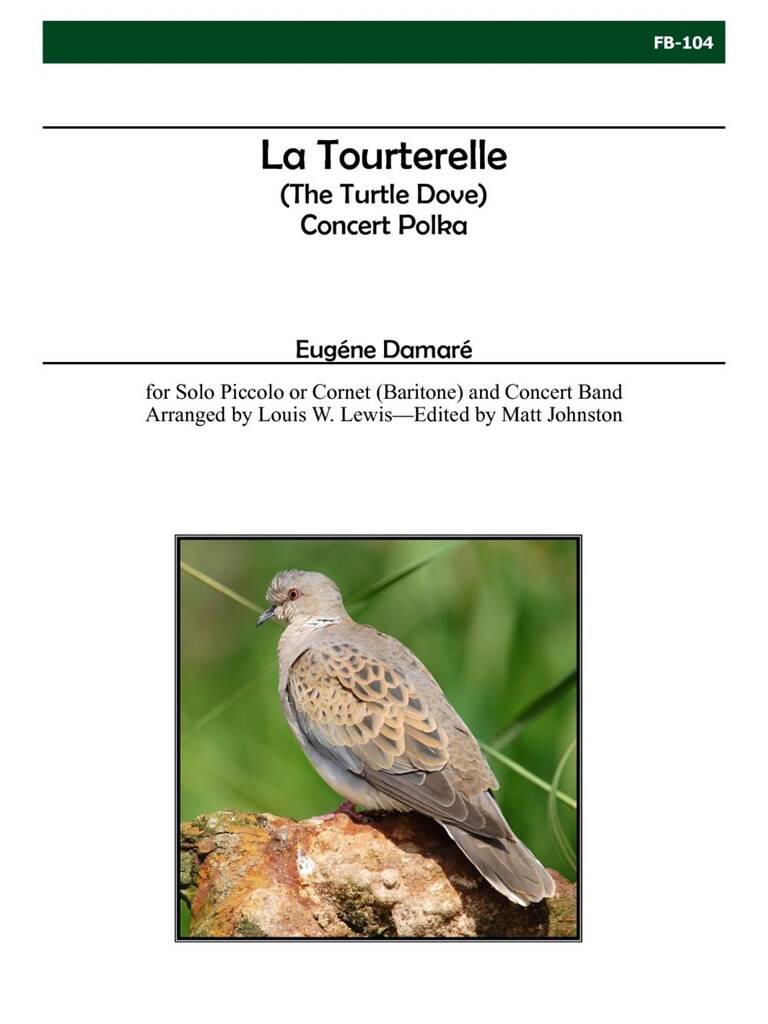
La Tourterelle - Eugène Damare
A delightful polka from the "Golden Age" era which features the piccolo in all its glory. This arrangement by Louis W. Lewis will delight any audience and is a great way to introduce the smallest member of the flute family to the audience. Instrumentation: Solo D-flat (or C) Piccolo or Solo Cornet (Baritone), C Flute 1/2, Oboe 1/2, Bassoon, E-Flat Clarinet, Clarinet 1, Clarinet 2/3, Alto Saxophone 1/2, Tenor Saxophone, Baritone Saxophone, Cornet 1, Cornet 2, Cornet 3/4, Horns 1/2, Horns 3/4, Trombone 1/2, Trombone 3/Bass Trombone, Baritone (T.C. and B.C.), Basses (Tuba), Percussion (Snare Drum, Bass Drum, Triangle)
Estimated dispatch 7-14 working days
-
 £96.40
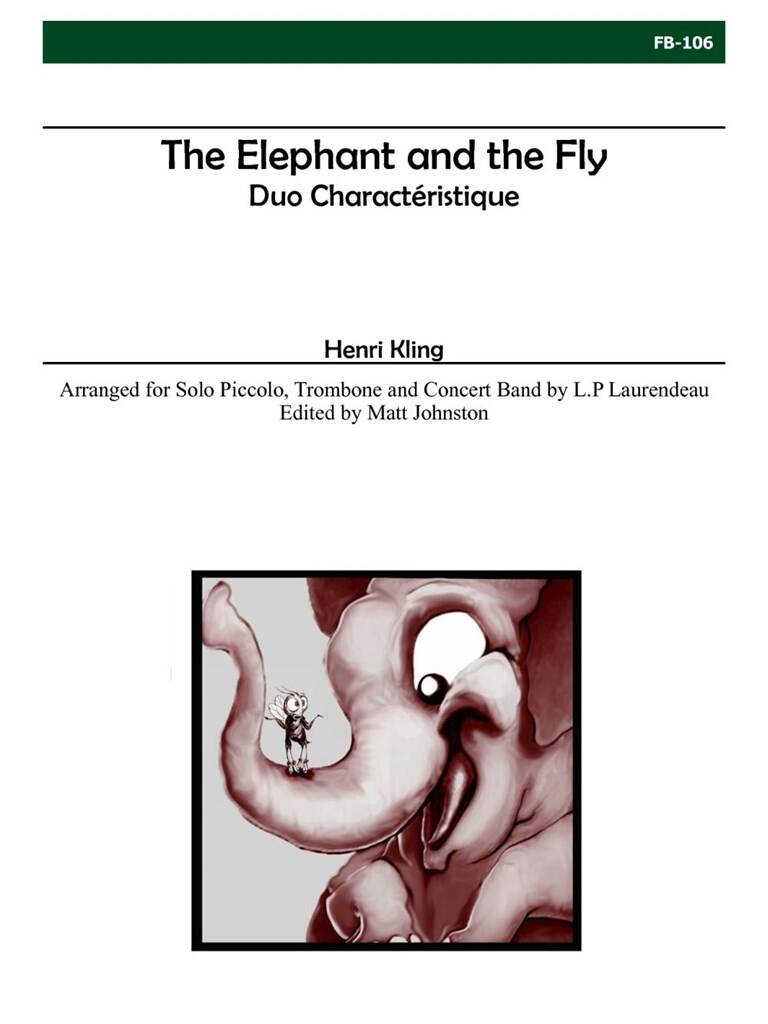
The Elephant and the Fly - Henri Kling
This newly revised edition of perennial favorite "The Elephant and the Fly" is based on the original parts published in 1918. This updated version includes a full score, in addition to a few adaptations/transpositions to accommodate modern band instruments. Lastly, each of the solo parts is transposed into a variety of keys, such that a variety of soloist combinations are now possible. Instrumentation: Solo Piccolo (or Flute/Clarinet/Trumpet), Solo Trombone (or Bassoon/Bass Clarinet/Tuba), Flute 1, Flute 2, Oboe 1/2, E-Flat Clarinet, Clarinet 1, Clarinet 2/3, Bass Clarinet, Soprano Saxophone (or alternate Alto Saxophone), Alto Saxophone, Tenor Saxophone, BaritoneSaxophone, Bassoon, Horn 1/3, Horn 2/4, Solo Cornet, Cornet 1, Cornet 2/3, Trombone 1/2, Bass Trombone, Euphonium, Tuba, Percussion
Estimated dispatch 7-14 working days
-
 £39.99
Jubilation, An Overture - Robert Ward
Complete Band Set includes a full score, condensed score and parts:1 - Piccolo2 - Flute I2 - Flute II1 - Oboe I1 - Oboe II1 - Eb Clarinet1 - Solo Bb Clarinet3 - Bb Clarinet I3 - Bb Clarinet II3 - Bb Clarinet III1 - Eb Alto Clarinet1 - Bb Bass Clarinet1 - Bb Contrbass Clarinet1 - Bassoon I1 - Basson II1 - Eb Alto Saxophone I1 - Eb Alto Saxophone II1 - Bb Tenor Saxophone I1 - Bb Tenor Saxophone II1 - Eb Baritone Saxophone2 - Solo Bb Cornet I1 - Bb Cornet II1 - Bb Cornet III1 - Trumpet I1 - Trumpet II1 - F Horn I1 - F Horn II1 - F Horn III1 - F Horn IV1 - Trombone I1 - Trombone II1 - Trombone III1 - Bass Trombone1 - Bb Baritone TC1 - Bb Baritone BC3 - Basses2 - Percussion (Drum, Cymbals, Xylophone)1 - Timpani
Estimated dispatch 7-14 working days
 View Music