
Results
-
 £61.95
All is Calm (Flexible Solo with Concert Band - Score and Parts) - Smith, Robert W.
Here's a moving holiday work based on "Silent Night." Incorporating his technique for providing a soloist experience for any member of the ensemble (or a combination of players), Robert W. Smith has staged a master work for young band. This very touching arrangement will be a Christmas classic you can use from year to year.Duration: 3:15
Estimated dispatch 7-14 working days
-
 £58.50
A Child Is Born (Concert Band - Score and Parts) - Del Borgo, Elliot
This energetic arrangement of the 15th-century English carol makes full use of the colours and sonorities of the concert band. The modal nature of the tune combined with contrapuntal textures, strong melodic lines and driving eighth-note rhythms will keep your entire band focused. An energetic holiday offering with plenty of sparkle and drive!Duration: 3.00
Estimated dispatch 7-14 working days
-
 £45.54
Joyful Is The Morning Sun (Concert Band - Score and Parts)
This exuberant and uplifting chorale by Matt Conaway will make bands of all ages sound fantastic. The melodies are simple and memorable, and the full, rich scoring will help even bands with reduced instrumentation sound warm and complete. An excellent addition to your next concert or festival program.
Estimated dispatch 7-14 working days
-
 £159.60
Sculptures Of An Exhibition - Kees Vlak
This composition was commissioned by the village of Midden-Beemster to commemorate the 375th anniversary of the polder of the same name. It was premiered in august 1987 by the Beemster Fanfare Band. On this occasion some twenty sculptors were invited to create a work of art. Those sculptures were set up at the most picturesque areas of the polder. On a 40 km long bicycle route one can admire the curious statues wile enjoying the beautiful scenery as well. The compostition is based on two themes: a main theme and the promenade theme.1.Introduction: After the grandiose presentation of the main theme, on the dominant, we leave the village to the sound of some pretty music.2.Promenade and Watchman: After some time, we discover a dark statue hidden in the bushes; it is shaped like a square standing on one of its corners. It is called "Watchman". We hear the promenade theme as a solo and all next themes will be variations.3.A Building of Willow-trees: Far away on a dike, we discover the huge skeleton of a kind of house. It is a construction of skilfully interwoven willow-branches. The musical themes are also interwoven. The sculpture is called "Construction of wood used by the farmers".4."Die Flsse, ah die Flsse"and Promenade: We continue our trip and see now a horn of plenty, made of brown ceramics and set up on the green slope of an old fortress. The sun shines on the sheep being at pasture under the willow-trees. No doubt, this scene will have something to do with abundance.5.Cardplayers in front of the Nightingale: A statue in cast iron, representing two carplayers, has been erected in front of the windmill called "The Nightingale". This sculpture suggests a rather animate atmosphere. The opponents with the trumpets and the trombones suggest the cardgame. The trumpets are constantly changing from players. At a certain moment the trumpet gets hold of the decisive trick and starts a victorious blow. The trombone, however, repeats this shout of joy with quite some perverse delight and in a completely wrong pitch. The game continues and after a climax all cards are finally thrown on the table.6.Autumn and Promenade: The trip now brings us a white sculpture in ceramics, decorated with some autumn leaves. Is this a seated man or a chair? Anyway, it looks very nostalgic. This is the time for a moment of reflection with the oboe or the saxophone. It is called "Autumn".7. The Powerlifter: Somewhat hidden in a ditch, we discover a small statue in cast iron, representing a powerlifter who is going to give way under the weight. The music uses the main theme with powerlifting euphoniums, saxophones and clarinets.8.The Bull: Here we have another cast iron sculpture, but this time it is a really powerful figure. This "Bull" statue uses the same theme as that of the powerlifter, but it gets a stronger foundation from the bass insturments.9.Mirror and Promenade: While strolling alongside the channel we suddenly see four mirrors. They not only reflect themselves, but also mirror in the water of the channel. These reflections are suggested by the use of tuned percussion. The promenade theme is also used in mirror image.10.Reflictions or...?: On top of the dike we have a nice view on a farmyard with its orchard. A very big net, coverd with sparkling tin plates, has been stretched between the trees. This sculpture is called "Reflections of ...?. Of what? Yes, of course, reflections of the times when the polder was a lake and the sun was reflecting in the wild waves.11.Willpower: Finally we discover a big statue in cast iron. It is not clear whether it is a man or a woman. Anyway the enormous bundles of muscles in the legs and the thighs are striking. This sculpture is called "Willpower". The idea of determination is musically suggested by a very long preamble to the promenade theme in one great stringendo, leading to the conclusion of the trip.12.The beautiful country: Here we have the most beautiful picture. The magnificent Beemster Polder in bloom. We see a nice windmill with decorated wings. We hear the main theme, now on the tonic.
Estimated dispatch 7-14 working days
-
 £214.80
Skies - Oliver Waespi
Program notes by Oliver Waespi on his composition Skies:Skies is the plural of Sky. We may wonder are there several skies? Is the sky we all long for not the same for everybody? While travelling on foot and "in the open air" I have observed the firmament often in quite different shapes, so that I can say I have indeed experienced the sky in different ways. Years ago I already wanted to portray "my sky" in music; I finally have been able to realise this long-cherished dream.This composition deals with the sky, more precisely with my sensual and emotional experience of the sky in all its aspects. Two point of views are combined in this composition: one showing the sky as it presents itself to me, the other showing the sky as I observe it. The music was bom simultaneously by intemal and extemal inspiration: it describes nature but also the emotional and spiritual experience of nature. To me, the experience of nature is not abstract, but it is connected with concrete ages, places or people from my neighbourhood. This is why I have combined several parts of this composition with certain landscapes.The sky presents itself in different landscapes in the most varied ways: for the sensual experience, there is no sky as such. The indications of places spread all over the score, are primarily clues for myself; they represent certain atmospheres, which I have experienced especially in England and Scotland. They can however also be useful to the musicians and the audience, providing they know those landscapes and the celestial atmospheres linked to them.The music is independent from the atmospheres described in the subtitles, as those are rather connected to a tragic nature, and so the music is not based on any program. Musically spoken, the composition has a symphonic structure, which means that the complete musical material is derived from three contrasting main themes. In the first part, the description of a noctumal sky ("Night") two themes are developed in an organic way; the first, rather "dusky", is to be found with the horns, the second, "in bright daylight", with the oboe and flute, the third, "more quiet" , with the brass instruments. In the next part, we have clouds and rain over the Isle of Skye (one of the Hebrides islands in Scotland) and here several elements of the first theme are still more developed. Then we get an increasingly dark mood, which is released, in heavy chords. Then suddenly, the sun breaks through and the music gets a majestic character. We have a new shape of the initial theme, first with the French horns and then with the trombones. The music gets a quicker tempo and flows into a quick movement describing the winds and waves at sea ("Wind and Waves"). Three themes are gathering and some variations are developed. The music gets more and more energetic and, after a climax, calms down again. Then we have a kind of "summer pastoral" which suggests summer at the South coast of Cornwall ("South Coast of Penwith Peninsuia in Summer"). This is certainly not the hotte st summer in Europe, but still it is beautiful in this country that is blessed with so much rain. In the "pastoral" , the sea is already sketched in broad outlines in the French horn solo. The magnificence of an aftemoon at the seaside is developed at the end of the composition ("Noon at Treen Cliff', a rock protruding in the sea next to Porthcumo at the South Coast of Cornwall); here the music gets stronger and stronger and after a majestic climax it vanishes completely.
Estimated dispatch 7-14 working days
-
 £118.99
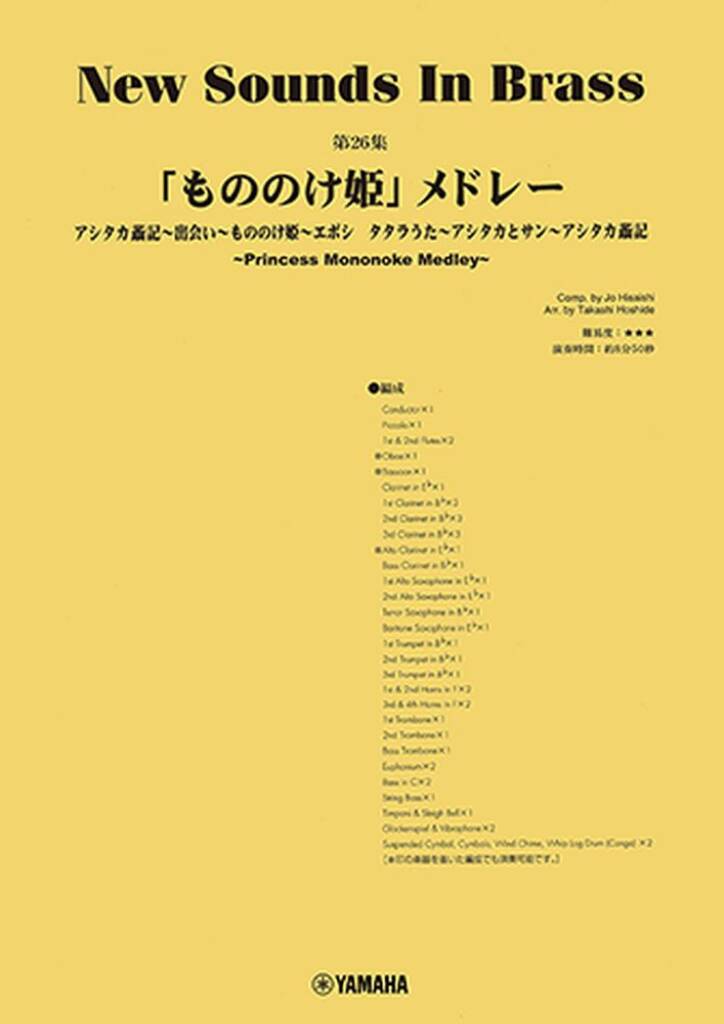
Princess Mononoke, Medley - Joe Hisaishi
Series: New Sounds in Brass (NSB); Duration: approx.8'50"; Composed by Joe Hisaishi; Arranged by Takashi Hoshide. Arranger Takashi Hoshide says, "I have selected beautiful melodies from the soundtrack of 'Princess Mononoke' (1997, directed by Hayao Miyazaki) and arranged them into a medley. What can be said about these songs as a whole is that they combine a grand continental scale with the delicacy that reflects Japanese emotions. Since there are no upbeat songs in this selection, I had to work hard on the arrangement, but this allowed for creating contrasts and transitions between each scene in the performance. 'Ashitaka Sekki (English title: The Legend of Ashitaka)' - 'Sekki' means a story that is not recorded but passed down orally. In this anime, this can be considered a sub-main theme. The song starts with a feeling that the story is about to begin and, once the theme kicks in, aim for a grand performance to convey its scale. 'Encounter' - This is the music that plays during the scene where the protagonist Ashitaka meets San. Interestingly, the motif of the main theme 'Princess Mononoke' is used in this melody. Here, let's pursue the shifts in the timbre of individual phrases, creating a beautiful and aesthetic soundscape. 'Princess Mononoke' - This is the main title of the anime. The melody line is carried by horns and trumpets."
Estimated dispatch 7-14 working days
-
 £435.40
Goldberg 2012 - Svein H. Giske
The first time I heard Bach's Goldberg Variations was in the movie Silence of the lambs, in the early 1990s. I noticed the beautiful background music in one of the scenes, but at that time I didn't know what it was. A few years later, when I was studiying at the Grieg Academy, I got to know the entire piece. For me, this is a piece of music which I can listen to countless times. I think it sounds as fresh today as it did more than 15 years ago and it never ceases to inspire me. Both Bach's composition and Glenn Gould's famous 1955 recording (which was the first one I heard) still makes a great impression on me. Before Gould recorded it at age 22, it wasn't a highly ranked piece amongst pianists and Bach was by many viewed as a bit old-fashioned. The young Canadian turned all this around. He managed to portray Bach in a reformed way, producing fine nuances in phrasing and making the many layers in Bach's music more transparent than anyone before him. Thus he plunged both himself and Bach (back) onto the international music scene. When The Norwegian Band Federation (NMF) asked me to write the test piece for NM in 2012, it was only natural for me to use the Goldberg Variations as a starting point and inspiration for my work. Since I was a teenager at NMF's summer courses in the mid eighties I've always listened to many different styles of music. Growing up in Sunnmre with the Brazz Brothers as teachers and mentors, jazz-, pop/rock- and folk music were early on a natural part of my musical background. I also have my classical education from the Grieg Academy on trumpet. As the title of my piece implies, I've wanted to bring Bach to the present and put his music into various modern musical landscapes. I think you can bring about a special kind of energy when music from different genres are mixed and I've tried to do this by mixing Bach with artists and musical styles from the present. In Goldberg 2012, the music is often constructed by several layers, which in a way are living parallel musical lives. They are seemingly moving or floating freely, almost unaware of each other, but bound together by the same basic pulse. The rythms, however, are often notated on a different rythmic subdivision level than the usual 8th- or 16th note levels. By doing this, I hope to achieve transparent sounds that rythmically are perceived as more free and detached from each other. In large sections of the piece, pop/jazz is fusioned with elements from Bach. I guess you could have this little scene as a synopsis for the piece: picture a group of musicians meeting: some are classical performers, some are jazz. They start to improvise together, each in their own voice or musical dialect and I'm sort of in the middle, trying to write down what they are playing. This is what I feel much of Goldberg 2012 is about. The foundation of the piece, in addition to Bach and references from pop/jazz music, lies also in my own material. This material, basically two chords, is heard in it's purest form in the 1st movement. I use these chords to create scales, new chords and different motifs which contribute to blend together the different moods of the piece. It has not been my intention to copy Bach's form (theme and 30 variations), but rather to use the bits and pieces that I like the most as an inspiration for my own variations. The 1st movement, Aria 2, is for my 3rd son, Olav, who was born on the 21st of April 2011, and the 5th movement, From long ago, is dedicated to the memory of my father, Svein J. Giske, who passed away on the 6th of June 2011. -Svein H. Giske, January 2012-
Estimated dispatch 7-14 working days
-
 £211.80
Karneval i Paris - Johan S. Svendsen
Johan Svendsen (1840-1911) composed "Carnival in Paris" in 1872, inspired by the energy and vibrancy of the Parisian carnival celebrations. The piece showcases a variety of moods and orchestral colours, ranging from jubilant and playful sections to more lyrical and elegant passages. It is a lively and colourful work that reflects Svendsen's skill in orchestration and his ability to capture vivid, festive atmospheres in music. In "Carnival in Paris", his Nordic musical roots meet the cosmopolitan influences he encountered while living and working in major European cities. The work has become one of Svendsen's most popular and is frequently performed in concert halls and festivals. About My Transcriptions for Wind Bands Ever since I started playing the clarinet at 8 or 9 years old in the school band "Blveisene" in my hometown of Gjvik, playing transcriptions of orchestral music has been a natural part of the repertoire. In regional bands, Norway's National Youth Band, and during my 10 years in a Military band, I played many such transcriptions. These transcriptions often included handwritten parts, masterfully crafted by colleagues in a time when music notation software didn't exist. Similarly, the scores were often incomplete, typically featuring just a solo clarinet part and condensed score in Bb. The transcriptions also contained parts for instruments like the Eb cornet and multiple tenor horns, but no saxophones, which made them less suitable for modern wind bands. The rise of many skilled Concert Bands and the increasing demands for scores and accessibility made me realize that someone needed to preserve this tradition. The reason I've transcribed these works is to ensure that you can play or conduct a repertoire that I believe has a rightful place in Norwegian Wind Band tradition. These transcriptions are my contribution to preserving some of the unique works in Norwegian music literature. Creating a transcription is a complex task, and I believe the score of "Carnival in Paris" is one of the most intricate I've undertaken. The first part of the process involves entering the entire orchestral score into music notation software. This is time-consuming and requires meticulous work. The next step is to check several editions to see if there are any discrepancies. Mistakes are often found in orchestral material, which can lead to further errors in the transcription. After that, I listen to many different recordings while following along with the score, paying attention to how different conductors emphasize balance and timbre. Gradually, I begin to note down passages I believe will work well for wind bands. One particular challenge in this piece is that the woodwinds and strings operate in the same register. In the original, the tonal difference between the strings and winds helps to clarify the individual musical lines. In the transcription, I've tried to address this by separating the lines, for example through octave adjustments, and highlighting them without compromising other aspects. I've also used some mallet percussion to broaden the tonal palette. There are countless decisions to be made to create a product that will hopefully allow future generations of wind band musicians to play this repertoire. - Stig Nordhagen -
Estimated dispatch 7-14 working days
-
 £138.00
The Saints And the Royal - Eric Swiggers
The Saints and the Royal was composed on behalf of Royal brass band St. Willibrord Heeswijk on the occasion of its 200th anniversary in 2023.When the marching band was founded in 1823, it was given the name "Harmonie Sint Cecilia," referring to Saint Cecilia, the patron saint of music. Around 1904, the name was changed to 'Kerkelijke fanfare Willibrord', strongly emphasizing the connection with the church in Heeswijk, of which Saint Willibrord is the patron saint. In 1973, at its 150th anniversary, the band received the predicate 'royal'. From that time on one speaks of the Royal brass band Saint Willibrord.The composition musically depicts both Saints Saint Cecilia and Saint Willibrord and the jubilee royal brass band. Although one of the oldest musical societies in the Netherlands, this fanfare is alive and kicking and will celebrate its 200th anniversary in 2023. The composition therefore opens festively and energetically. The alto saxophone plays a recitative, the Gregorian "Cantantibus organis Caecilia virgo in corde suo soli domino decantabat" from the vespers of the feast day of Saint Caecilia, the patron saint of music. This is taken over by the full wood and soft brass group. After a brief, playful interlude, this chant is played by the full orchestra, like an organ, larded with circumambulations.St. Willibord was born in England but made the crossing to the Netherlands in 690 to preach the gospel as a missionary. This was far from harmless and he faced frequent uprisings. After his death he was buried in Echternach in Luxembourg. In this place he is commemorated to this day with the annual "Spring Procession" or "Dance Procession". This procession of Echternach went as follows until 1947: 3 steps forward, 2 steps backward. Hence we hear this procession back in a 5/8 measure: 3 + 2.After this procession, the Gregorian vesper of Sint Caecilia sounds one more time, leading the composition to a reprise of the opening: The jubilee Royal Fanfare Sint Willibord Heeswijk.
Estimated dispatch 7-14 working days
-
£149.40
Dancing Trolls [Norwegian Dance] - Øystein Olsen Vadsten
"Dancing Trolls" is a sequel to "The Battle of the Hats", which was published in 2015. Like "The Battle of the Hats", "Dancing Trolls" is a piece of music based on Norwegian traditional dances. This time around,its the reinlender dance which takescentre stage.The music is composed by ystein Olsen Vadsten who keeps the strong melodic and tempo, which is dear to this kind of dance. Admittedly given a make-over with a more rhythmic accompaniment and more excitingharmonization.This makes it a fun piece, both to Listen to and play. The reinlender dance derives from the Rhineland in Germany,and is also known as the German Polka.To the conductor:Because this is a dance form whichisdependent on the right "swing", it is of great importance to keep as close to the metronome mark as possible. A steady groove, primarily specified by the drum set, is also essential for a good result. Remember to keep a good balance between themelody carrying instruments and the accompaniment. Good luck and have fun with this "crazy" little tune.
Estimated dispatch 7-14 working days
 View Music