
Results
-
 £202.99
Gloriosa - Symphonic Poem for Band Movement 1 - Yasuhide Ito
A new acquisition by Bravo Music, this fresh printing of the 1990 masterwork by Yasuhide Ito features a newly engraved score, improved parts, good availability and value. This stirring and powerful homage to early Christianity in Japan profoundly and eloquently states the case of cross-cultural conflict and resolution.I. OratioThe Gregorian chant "Gloriosa" begins with the words, "O gloriosa Domina excelsa super sidera que te creavit provide lactasti sacro ubere." The first movement Oratio opens with bells sounding the hymn's initial phrases. The movement as a whole evokes the fervent prayers and suffering of the Crypto-Christians.II. CantusIII. Dies FestusCommissioned in 1989 and premiered in 1990 by the Sasebo Band of the Maritime Self-Defense Force of Kyushu, southern Japan.Gloriosa is inspired by the songs of the Kakure-Kirishitan (Crypto-Christians) of Kyushu who continued to practice their faith surreptitiously after the ban of Christianity, which had been introduced to that southern region in the mid-16th century by Roman Catholic missionary Francisco Xavier. The worship brought with it a variety of western music.Though Christianity was proscribed in 1612 by authority of the Tokugawa Shogunate in Edo (today Tokyo), Kakure-Kirishitan continued advocating sermons and disguised songs. Melodies and lyrics such as Gregorian chant were obliged to be "Japanized". For example, the Latin word "Gloriosa" was changed to "Gururiyoza." This adaptation of liturgy for survival inspired Ito to write this piece in order to reveal and solve this unique cultural mystery.The composer explains:"Nagasaki district in Kyushu region continued to accept foreign culture even during the seclusion period, as Japan's only window to the outer world. After the proscription of Christianity, the faith was preserved and handed down in secret in the Nagasaki and Shimabara areas of Kyushu region. My interest was piqued by the way in which the Latin words of Gregorian chants were gradually `Japanized' during the 200 years of hidden practice of the Christian faith. That music forms the basis of Gloriosa."Gloriosa, fusing Gregorian chant and Japanese folk music, displays the most sophisticated counterpoint yet found in any Japanese composition for wind orchestra.
Estimated dispatch 7-14 working days
-
£209.99
Gloriosa - Symphonic Poem for Band Mvt 2 & 3 - Yasuhide Ito
A new acquisition by Bravo Music, this fresh printing of the 1990 masterwork by Yasuhide Ito features a newly engraved score, improved parts, good availability and value. This stirring and powerful homage to early Christianity in Japan profoundly and eloquently states the case of cross-cultural conflict and resolution.I. OratioThe Gregorian chant "Gloriosa" begins with the words, "O gloriosa Domina excelsa super sidera que te creavit provide lactasti sacro ubere." The first movement Oratio opens with bells sounding the hymn's initial phrases. The movement as a whole evokes the fervent prayers and suffering of the Crypto-Christians.II. CantusIII. Dies FestusCommissioned in 1989 and premiered in 1990 by the Sasebo Band of the Maritime Self-Defense Force of Kyushu, southern Japan.Gloriosa is inspired by the songs of the Kakure-Kirishitan (Crypto-Christians) of Kyushu who continued to practice their faith surreptitiously after the ban of Christianity, which had been introduced to that southern region in the mid-16th century by Roman Catholic missionary Francisco Xavier. The worship brought with it a variety of western music.Though Christianity was proscribed in 1612 by authority of the Tokugawa Shogunate in Edo (today Tokyo), Kakure-Kirishitan continued advocating sermons and disguised songs. Melodies and lyrics such as Gregorian chant were obliged to be "Japanized". For example, the Latin word "Gloriosa" was changed to "Gururiyoza." This adaptation of liturgy for survival inspired Ito to write this piece in order to reveal and solve this unique cultural mystery.The composer explains:"Nagasaki district in Kyushu region continued to accept foreign culture even during the seclusion period, as Japan's only window to the outer world. After the proscription of Christianity, the faith was preserved and handed down in secret in the Nagasaki and Shimabara areas of Kyushu region. My interest was piqued by the way in which the Latin words of Gregorian chants were gradually `Japanized' during the 200 years of hidden practice of the Christian faith. That music forms the basis of Gloriosa."Gloriosa, fusing Gregorian chant and Japanese folk music, displays the most sophisticated counterpoint yet found in any Japanese composition for wind orchestra.
Estimated dispatch 7-14 working days
-
 £274.99
Symphony No. 2: States Of Mind, Opus 87 - Teo Aparicio-Barberán
I- Logos (reason)II- Pathos (emotion)III- Ethos (credibility)The ancient Greeks believed that music shaped the character of man. In Egyptian temples, music was an essential part of the magical rites to alter the course of nature or to treat illness.And today we know that sound can actually alter matter. The secret of music lies in harmony and mathematics, as many great musicians and experts have always known.One of the most important qualities of music is that it enables the listener to focushis attention inwards instead of on what is around him. It is indisputable that music can inspire emotion. Music leads us into a universe of emotions that are difficult to put into words. In short, music reaches into corners of our soul and thoughtsthat words cannot reach and makes it possible to more clearly describe these different States of mind.The composer of this symphony also believes that each "musical argument" must be constructed so that it will induce the desired reaction in thelistener.Music: more than wordsIn recent times, most orchestral symphonies have been based on a story, a text or something similar so that their composition must be structured accordingly.The intention of this work by Teo Aparicio-Barbern is quitedifferent. The composer describes the three elements of the argument as the only formal structure of the work. Since certain philosophers in world history were able to subdivide grammatical argument, why shouldnt that also be possible for the musicalargument?Since ancient times the power of the spoken word has captivated mankind. How can an argument move people and mobilise the masses? Where does the power of words come from today? The answer lays not so much in what people say but in how theysay it.Rhetoric is one of the oldest humanist disciplines in Western civilisation. Aristotle, in the 4th century BC, called it the art of persuasion. Indeed, the terms rhetoric and persuasion are mutually interchangeable.More than 2000 years agoAristotle structured his rhetoric according to the following three elements: the logos, the pathos and the ethos.Logos (words, reason) is the reasoning that gives freedom to the structure of the text by expressing what one wishes to say usingspecialist terms. With logos we create arguments to receive public approval and to defend our ideas.Pathos, the second element, refers to the effective use of public psychology. Pathos can be considered as the capacity to induce the desired emotionalresponse in the public, by creating an emotional connection with the public so that they accept our message.The third element, ethos (credibility), refers to the character of the speaker and is perhaps the most important of the three elements.Aristotle based his concept of ethos upon his belief that truth and justice will always have the upper hand over anger. He believed that what was true and good was easier to prove and was more persuasive.This second orchestral symphony from thecomposer from Enguera follows these three parameters of the argument according to Aristotle. Each movement tries to summon a different state of mind in the listener so that the message itself can be better understood and appreciated. Apart from thesethree general concepts the music is only structured, as Claude Debussy would say, in a "formative way".The first movement, logos, is based on a scherzo melody that undergoes various changes in rhythm and harmony. The arguments are presented by meansof conventional techniques of composition. The second movement, pathos, is characterised by suggestions of sound. It is subdivided into two large parts. The first part is based on a five seven sequence with five sounds that are repeated in differentenvironments, structures and dynamics. The second part, which is largely tonal, brings out more directly the emotional overtones that each argument must have. The third movement, ethos, is a faithful rendition of the composers personality. In thislast part, clear rhythmic sequences stand out, there are large dynamic contrasts and lots of tone variation. In addition, and this is quite in keeping with the composers earlier work, the harmony in States of Mind is handled in a manner that is bothoriginal and efficient, as a result of which Aparicio-Barberns message is well understood by the listener.This second symphony by Teo Aparicio-Barbern is devoted to "my dear Henrie Adams, a guiding light in this eternally dark musical world. Thankyou for everything."
Estimated dispatch 7-14 working days
-
 £349.99
Gloriosa - Symphonic Poem for Band (Complete) - Yasuhide Ito
A new acquisition by Bravo Music, this fresh printing of the 1990 masterwork by Yasuhide Ito features a newly engraved score, improved parts, good availability and value. This stirring and powerful homage to early Christianity in Japan profoundly and eloquently states the case of cross-cultural conflict and resolution.I. OratioThe Gregorian chant "Gloriosa" begins with the words, "O gloriosa Domina excelsa super sidera que te creavit provide lactasti sacro ubere." The first movement Oratio opens with bells sounding the hymn's initial phrases. The movement as a whole evokes the fervent prayers and suffering of the Crypto-Christians.II. CantusIII. Dies FestusCommissioned in 1989 and premiered in 1990 by the Sasebo Band of the Maritime Self-Defense Force of Kyushu, southern Japan.Gloriosa is inspired by the songs of the Kakure-Kirishitan (Crypto-Christians) of Kyushu who continued to practice their faith surreptitiously after the ban of Christianity, which had been introduced to that southern region in the mid-16th century by Roman Catholic missionary Francisco Xavier. The worship brought with it a variety of western music.Though Christianity was proscribed in 1612 by authority of the Tokugawa Shogunate in Edo (today Tokyo), Kakure-Kirishitan continued advocating sermons and disguised songs. Melodies and lyrics such as Gregorian chant were obliged to be "Japanized". For example, the Latin word "Gloriosa" was changed to "Gururiyoza." This adaptation of liturgy for survival inspired Ito to write this piece in order to reveal and solve this unique cultural mystery.The composer explains:"Nagasaki district in Kyushu region continued to accept foreign culture even during the seclusion period, as Japan's only window to the outer world. After the proscription of Christianity, the faith was preserved and handed down in secret in the Nagasaki and Shimabara areas of Kyushu region. My interest was piqued by the way in which the Latin words of Gregorian chants were gradually `Japanized' during the 200 years of hidden practice of the Christian faith. That music forms the basis of Gloriosa."Gloriosa, fusing Gregorian chant and Japanese folk music, displays the most sophisticated counterpoint yet found in any Japanese composition for wind orchestra.
Estimated dispatch 7-14 working days
-
 £116.40
Petite Suite Provencale - Werner van Cleemput
I. Quiet but not strolling - This part is based on two folk songs 'Digo Janeto' and 'Avn un bu Castu' played on a bourdon accompaniment with an incorporated canonic theme.II. Alert - This part is based on the popular song 'Sur le Pont d'Avignon'.III. Slightly rocking - An original lullaby with flexible instrumentation.IV. Lively and Cheerful - This part is based on the beautiful folksong 'Lou roussigno que volo'; the composer uses the band as if it were one big tambourin.This work obtained a Second Prize at the International Composition Contest at Hilvarenbeek, The Netherlands in 1976.
Estimated dispatch 7-14 working days
-
 £159.60
Evocazioni (1985) - Paul Huber
This work, composed in 1985, wants to shake you up and put a spell on you at the same time. Today, humanity is threatened by many dangers, many of which we are not able to banish. We need help from a higher power. The Chorale "Aus tiefer Not schrei' ich zu dir" (from deep distress I cry to you) illustrates this. This motif appears in diverse variations. But, in his arrogance the wicked man does not believe in the rule of evil demons in the world.With the Gregorian melody in the sequence "Dies irae" (day of wrath) from the requiem mass, the nearing of disaster is announced: without God man goes astray. He falls into ruin.To deepen the poignancy of this composition, Paul Huber cited a dramatic episode from his symphony "The nostraie aetatis angoribus" (from the anxiety of our time).
Estimated dispatch 7-14 working days
-
 £174.99
Et in terra Pax - Jan Van der Roost
This piece was commissioned by the 'Concert Band Vlamertinge' and is a plea for peace: the title translates as 'Peace on Earth'. This is expressed by means of the vocal contribution expected from the performers. In various places of the piece you can recognize, the words 'Et In Terra Pax' - an appeal for peace - at first jumbled together but later more rhythmically structured, developing into synchronized massed voices.The work starts with a pentatonic theme based on the notes D, E, G, A and C (taken from 'ConCErtbAnD VlAmErtinGE' and the name of the conductor, NiCk VAnDEnDriessChe). A somewhat sad melody is developed during an orchestral climax which leads to the firstexplosion of sound (measure 62 onwards). Suddenly the opening measures are recaptured, albeit with a differently colored sound: the words 'Et In Terra Pax' bring the first movement to a close. A restless Allegro follows which abruptly stops and is replaced by a calming cho-rale-like passage. A narrator reads aloud the poem 'Sonnet' by the young poet Charles Hamilton Sorley, who was killed during World War I. This poem fittingly puts into words the cruelty and senselessness of war. After the expanded recapitulation of the allegro, the broad, almost infinite atmosphere of the beginning returns. Clarinet and English horn play the pentatonic opening theme once more, this time broadly, while the words 'Et In Terra... Pax' are repeated again and again by the rest of the orchestra.The composer has purposely avoided all forms of aggression and bombastic sounds regularly used in works about war. Fear of violence and destruction can be heard and felt during the allegro passages. The charged opening makes way in the end for hope: May peacefulness replace cruelty in everyday life, too.
Estimated dispatch 7-14 working days
-
 £245.50
Seven Wonders of the Ancient World - Alex Poelman
In the Ancient World the seven most beautiful monuments were called 'The seven Wonders of the World'. In his Symphony nr.1, The Seven Wonders of the Ancient World' the young Dutch composer Alex Poelman has made a musical portrait of these splendid human realizations which are now, but for one, all destroyed. The symphony is masterly and lavishly orchestrated and portrays both the power of the sovereigns of ancient times and the splendour of the most beautiful buildings and works of art they have had built. Moreover, neither the seducing Eastern charm nor the mysterious exotic atmosphere are failing.Alex Poelman (Arnhem, 1981) studied informatics at the Twente University and plays French horn in several top amateur bands. Under the guidance of David Rowland he wrote his first composition for wind band 'Volcano'. This was followed by 'Theseus', 'Symphony nr. 1 'The Seven Wonders of the Ancient World', 'D-Day' and 'Aquila Chrysaetos'. This symphony was premiered on 28 May 2004 at Enschede. One year later, it was recorded on CD by the new Dutch military band KMKJWF conducted by Norbert Nozy.I. THE TEMPLE OF ARTEMIS.The Greek goddess Artemis, daughter of Zeus and Leto and twin sister of Apollo, was the goddess of the hunt and was especially worshipped in Arcadia. In the town of Ephesus, an Ionic colony in Asia Minor, a splendid temple was built in honour of Artemis which was destroyed in 356 B.C. when Herostratos set fire to it. Some years later it was reconstructed.II. THE GREAT PYRAMID OF CHEOPSCheops, the second pharaoh of the 4th Dynasty of Ancient Egypt (3rd century B.C.) had the big pyramid built at Gizeh on the left bank of the Nile, next to Cairo. The technical perfection and the huge dimensions of this magnificent 137 m high building were never equalled. It is the only one of the Seven Wonders of the Ancient World that was not destroyed and is kept undamaged up to this day. III. THE STATUE OF ZEUS Zeus, son of Chronos and Rhea, was the leading god of the Greek pantheon and, according to Homer 'the father of all gods and all humans'. He was the god of the celestial light and controlled all physical phenomena. In the Greek town of Olympia, birthplace of the Olympic Games, there was a splendid statue representing the Olympic Zeus. It had been sculptured about 433 B.C. by the great Athenian sculptor Phobias (ca 490 - ca 430 B.C.) and was considered as the nicest statue of the ancient Greek world. IV. THE MAUSOLEUM AT HALICARNASSOS. Halikarnassos (the actual Bodrum in Turkey) was at one time the capital of Asia Minor. When king Mausolos died in 353 B.C., his wife and sister Artemisa ordered to build a huge funeral monument (Mausoleum) for her deceased husband. It gave its name to all large funeral monuments in the world.
Estimated dispatch 7-14 working days
-
 £149.40
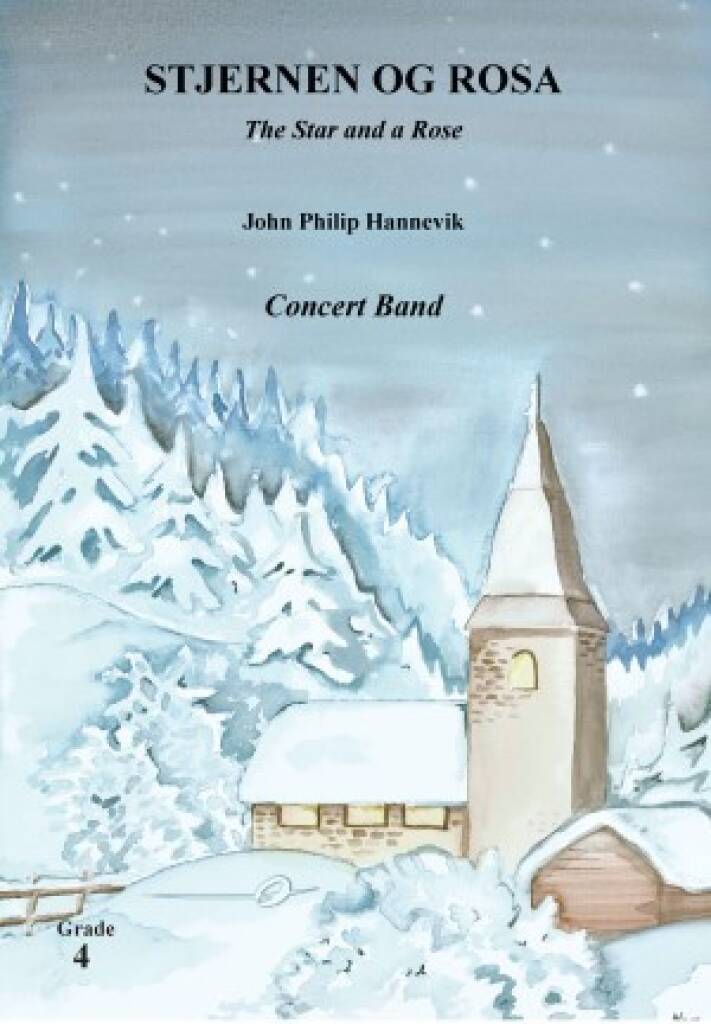
Stjernen og Rosa - John Philip Hannevik
The Star and a Rose is a big-scale Christmas piece for band, featuring four seasonal chorales.The first is a Gregorian-like chant Hodie Christus natus est.In this section of the piece, a soloist can be placed away from the band, maybe on a gallery. The soloist can be a tenor instrument, maybe trombone, or you can feature a vocal soloist.After this, the music leads us on to the old German Christmas chorale Lo, how a rose e'er blooming. This song is given a fairly rhythmical treatment, but make sure that the melody is presented in a cantabile style.An interlude follows, before the piece presents one of the most used and loved Scandinavian Christmas chorales, Mitt hjerte alltid vanker (My Heart will always wander), composed by the Danish bishop Hans Adolph Brorson around 1732. This song is building towards a climax, before the solo horn brings it all down to the Stable view described in the lyrics.Then comes a transition that brings us in to the final section of the piece, which presents the international Christmas Carol Adeste Fideles. As many will notice, I have borrowed a section from David Wilcocks majestic harmonization towards the end.The title of the piece has its background form the lyrics in My heart will always wander, where the text speaks about the stars in the sky. But also in the latin text for Adeste Fideles:Stella duce, Magi, Christum adorantesThe Rose is of course from the lyrics in the chorale Lo, how a Rose.
Estimated dispatch 7-14 working days
-
 £186.20
Highlights from Chess - Benny Andersson
The composers of the musical Chess, Benny Andersson and Bjrn Ulvaeus, as well as the lyricist Tim Rice had already had a very successful career before they started this huge project. Andersson and Ulvaeus had been the male singers of the popular Swedish group ABBA, whereas Tim Rice had written the lyrics for Lloyd Webber's musicals 'Jesus Christ Superstar' and 'Evita'. The plot of the musical is situated in Merano, a small town in Northern Italy, hosting the Chess World Championships. The protagonists are the American titleholder and his Russian challenger, who are adversaries on both the sports and political level. Nowadays the subject is out of date, as Chess was conceived in 1984 when the political scene was completely different. This might be the reason why this musical did not hold out as long as e. g. 'Les Misrables' or 'Cats'. Anyhow the music remained very popular and songs such as 'Last Night in Bangkok', 'I know him so well' and 'Anthem' belong to the standard repertoire of 'musical classics'. In his 'Chess selection' Johan de Meij used the nice orchestral parts of the soundtrack which gave a kind of symphonic character to this musical.
Estimated dispatch 7-14 working days
 View Music