
Results
-
 £79.95
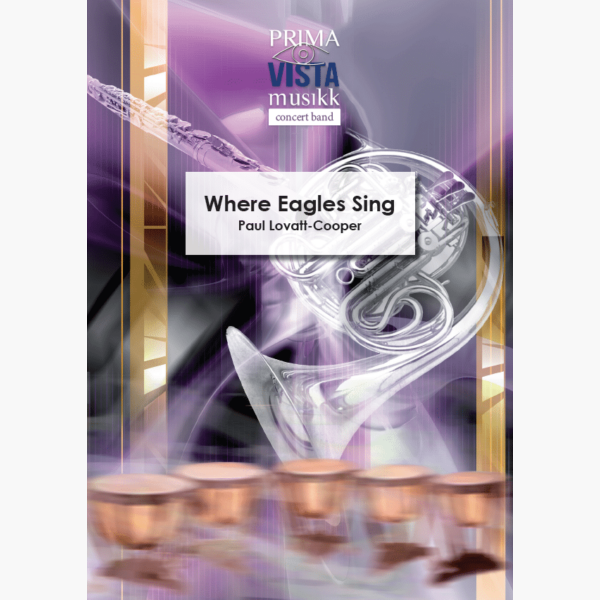
Where Eagles Sing - Paul Lovatt-Cooper
The inspiration for this piece came when the composer visited Florida and the Bird Sanctuary in Walt Disney World's Animal Kingdom. He was in the audience to see the rare bird show where he witnessed some fabulous looking and endangered...
Estimated dispatch 5-7 days
-
 £78.00
Fantasy for Trombone - James Curnow
This popular pieces has become a core part of the trombone repertory and a chance to show both lyrical and bravura styles in an attractive and showy (yet not overly difficult) concert piece, finally available in a version for concert band.
Estimated dispatch 7-14 working days
-
 £8.70
£8.70Alfred's Basic Piano Library: Lesson Book 1B: Piano Book - Willard A. Palmer, Morton Manus, and Amanda Vick Lethco
This easy step-by-step method emphasizes correct playing habits and note reading through interval recognition. Lesson Book 1B begins by reviewing the concepts taught in Lesson Book 1A, then introduces new concepts such as incomplete measures, tempo markings, eighth notes and rests, using the damper pedal, half steps and whole steps. It also introduces the major scale through the concept of tetrachords. Songs Include: Brother John * Carol in G Major * The Carousel * The Clown * Concert Time * A Cowboy's Song * The Cuckoo * French Lullaby * Good King Wenceslas * Good Morning to You! * Good Sounds * Grandpa's Clock * The Greatest Show on Earth! * G's in the "BAG" * Hail to Thee, America! * Harp Song * Happy Birthday to You! * Indians * Join the Fun * The Magic Man * Money Can't Buy Everything * Music Box Rock * Oom-Pa-Pa! * Ping Pong * The Planets * The Rainbow * Sonatina * Step Right Up! * Waltz Time * When Our Band Goes Marching By! * When the Saints Go Marching In * The Whirlwind * The Windmill * Yankee Doodle
Estimated dispatch 3-5 working days
-
 £75.00
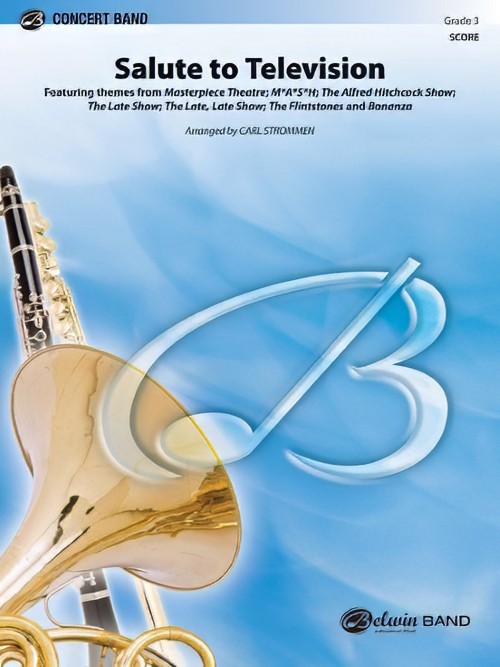
Salute to Television (Concert Band - Score and Parts) - Strommen, Carl
This jam-packed medley containing the gems of television themes from yesteryear. Including themes from Masterpiece Theatre, M*A*S*H, The Alfred Hitchcock Show, The Late Show, The Late, Late Show, The Flintstones, and Bonanza, this is one yabba-dabba-delicious medley!Duration: 7.30
Estimated dispatch 7-14 working days
-
 £101.50
BREEZIN' DOWN BROADWAY (Intermediate Band) - Richards, Goff
Includes: Another Openin', Another Show; There's No Business Like Show business; Get Me to the Church On Time (from My Fair Lady); Oklahoma; That's Entertainment; Seventy Six Trombones. Duration: 5:17 Grade: Medium
Estimated dispatch 7-14 working days
-
 £152.00
ROMA (Advanced Concert Band) - Rota, Nino - Ryant, Jan
Movie: Roma (Aria Di Roma/Toby Dammit's Thoughts/Vitteloni's Bar/Ecclesiastical Fashion Show/Tobby Dammit at the TV Show) Duration:8:06 American Grade 4
Estimated dispatch 7-14 working days
-
 £123.20
3 Letzte Motetten (Concert Band - Score and Parts) - Bruckner, Anton - Doss, Thomas
Anton Bruckner (b. 4.9.1824, Ansfelden, d. 11.10.1896, Vienna) didn't have it easy. Throughout his life, the Austrian composer was plagued by self-doubt. Anton Bruckner came from a simple, rural background. After the death of his father, he was accepted as a choirboy at the monastery of Sankt Florian in 1837. After several years as a school assistant and his own organ and piano studies, he first worked as organist in St. Florian, then from 1855 as cathedral organist in Linz. Introduced to music theory and instrumentation by Simon Sechter and Otto Kitzler, he discovered Richard Wagner as an artistic role model, whom he admired throughout his life and also visited several times in Bayreuth. In 1868 Anton Bruckner became professor of basso continuo, counterpoint and organ at the Vienna Conservatory; ten years later court organist; and in 1891 finally honorary doctor of the University of Vienna. He was considered an important organ virtuoso of his era, but had to wait a long time for recognition as a composer. It was not until Symphony No.7 in E major, composed between 1881 and 1883, with the famous Adagio written under the effects of Wagner's death, that he achieved the recognition he had hoped for, even if he was reluctant to accept it given his inclination towards scepticism and self-criticism. Anton Bruckner was a loner who did not want to follow a particular school or doctrine. He composed numerous sacred vocal works, such as his three masses, the Missa Solemnis in B flat minor (1854), the Te Deum (1881-84) and numerous motets. As a symphonic composer, he wrote a total of nine symphonies and many symphonic studies from 1863 onwards, tending to revise completed versions several times over. Bruckner's orchestral works were long considered unplayable, but in fact were merely exceptionally bold for the tonal language of their time, uniting traditions from Beethoven through Wagner to folk music, on the threshold between late Romanticism and Modernism. Anton Bruckner composed about 40 motets during his lifetime, the earliest a setting of Pange lingua around 1835, and the last, Vexilla regis, in 1892. Thomas Doss has compiled some of these motets in this volume for symphonic wind orchestra. These motets show many characteristics of personal expression, especially Bruckner's colourful harmony in the earlier works, which is in places aligned with Franz Schubert (changes between major and minor; and movements in thirds). Later works are characterised by many components which, in addition to the expanded stature of the movements, include above all a sense of the instrumentation as an outward phenomenon and the harmony as a compositional feature that works more internally. Some aspects of Bruckner's work are the result of his long period of study, which familiarised him not only with the tradition of his craft, but also gave him insights into the "modernity" of his time in such composers as Wagner, Liszt and Berlioz. From this developed his personal standpoint, which always pursues the connection between the old and the new.Duration: 14.00
Estimated dispatch 7-14 working days
-
 £256.00
14 Motetten (Concert Band - Score and Parts) - Bruckner, Anton - Doss, Thomas
Anton Bruckner (b. 4.9.1824, Ansfelden, d. 11.10.1896, Vienna) didn't have it easy. Throughout his life, the Austrian composer was plagued by self-doubt. Anton Bruckner came from a simple, rural background. After the death of his father, he was accepted as a choirboy at the monastery of Sankt Florian in 1837. After several years as a school assistant and his own organ and piano studies, he first worked as organist in St. Florian, then from 1855 as cathedral organist in Linz. Introduced to music theory and instrumentation by Simon Sechter and Otto Kitzler, he discovered Richard Wagner as an artistic role model, whom he admired throughout his life and also visited several times in Bayreuth. In 1868 Anton Bruckner became professor of basso continuo, counterpoint and organ at the Vienna Conservatory; ten years later court organist; and in 1891 finally honorary doctor of the University of Vienna. He was considered an important organ virtuoso of his era, but had to wait a long time for recognition as a composer. It was not until Symphony No.7 in E major, composed between 1881 and 1883, with the famous Adagio written under the effects of Wagner's death, that he achieved the recognition he had hoped for, even if he was reluctant to accept it given his inclination towards scepticism and self-criticism. Anton Bruckner was a loner who did not want to follow a particular school or doctrine. He composed numerous sacred vocal works, such as his three masses, the Missa Solemnis in B flat minor (1854), the Te Deum (1881-84) and numerous motets. As a symphonic composer, he wrote a total of nine symphonies and many symphonic studies from 1863 onwards, tending to revise completed versions several times over. Bruckner's orchestral works were long considered unplayable, but in fact were merely exceptionally bold for the tonal language of their time, uniting traditions from Beethoven through Wagner to folk music, on the threshold between late Romanticism and Modernism. Anton Bruckner composed about 40 motets during his lifetime, the earliest a setting of Pange lingua around 1835, and the last, Vexilla regis, in 1892. Thomas Doss has compiled some of these motets in this volume for symphonic wind orchestra. These motets show many characteristics of personal expression, especially Bruckner's colourful harmony in the earlier works, which is in places aligned with Franz Schubert (changes between major and minor; and movements in thirds). Later works are characterised by many components which, in addition to the expanded stature of the movements, include above all a sense of the instrumentation as an outward phenomenon and the harmony as a compositional feature that works more internally. Some aspects of Bruckner's work are the result of his long period of study, which familiarised him not only with the tradition of his craft, but also gave him insights into the modernity of his time in such composers as Wagner, Liszt and Berlioz. From this developed his personal standpoint, which always pursues the connection between the old and the new.Duration: 39.00
Estimated dispatch 7-14 working days
-
 £205.70
In Nomine (Concert Band - Score and Parts) - Schwarz, Otto M.
How often has something been justified by, declared to be, or blessed as 'in the name of' some cause or other? How can it be that opposing armies and the use of weapons are ever 'in the name of...'? This is a common thread in the history of different faiths. Good was created but evil was committed and all 'in the name of...' This thread is also found in the history of the Premonstratensian Abbey at Wadgassen. The abbey was built in the 12th century on unfertile, desolate moorland, which later evolved into the most powerful religious community in the Saarland. The history of the abbey records quite astounding achievements under the motto desertum florebit quasi lilium ('the desert will bloom like a lily'); but also the harsh treatment of delinquents. The order had its own school, in which children were taught the seven liberal arts (which included music as well as geography and astronomy), but the poor were left to starve outside the abbey walls and were only allowed to eat from the members' leftovers on feast days. The medieval witch trials demanded their pound of flesh, and one group that fell victim were ecstatic dancers who moved wildly to music, which was interpreted as the devil's work. The result: a show trial that sentenced the dancers to death by fire. All in the name of... The year is 1789: Abbot Bordier is in the tenth year of his command. He does not yet know that he is to be the last abbot of an almost 700-year tradition. Not far from the abbey is the French border, which has long been making itself felt with the sound of gunfire, and the brothers continue to keep a nervous eye on it. The first portents of the French Revolution loom, but no one wants to believe it, that is, until the French pound the door down, storm the abbey and come right into the brothers' chambers. In a blind fury, all the pipes of the abbey organ are torn out, icons beheaded with swords and brothers beaten death while numerous buildings are set on fire. The abbey church is in flames. A frantic and desperate escape begins. Abbot Bordier and a handful of brothers make their getaway via the River Saar, adjacent to the abbey, to the neighbouring village of Bous. They survive, but their life, the Premonstratensian abbey, is destroyed. While they flee towards Prague and the sanctuary of the Strahov Monastery, the abbey at Wadgassen is razed to the ground and becomes a stone quarry. The desert blooms once more, however. A few short decades later, a glasswork arises from the foundations of the abbey. As peace returns to the region, it brings jobs and a new vision for its people.Duration: 11.15
Estimated dispatch 7-14 working days
-
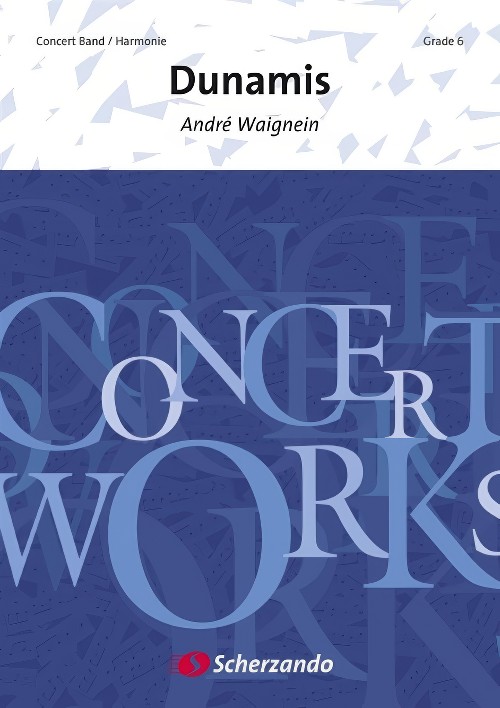 £209.99
Dunamis (Concert Band - Score and Parts) - Waignein, Andre
Major Yvon Ducene wanted a new lush and colourful composition for his Guides military band, with Andr Waignein as its composer. Early in 1979 the composer began his assignment and in October of the same year, the finished full score was on the music stands of this prestigious military band of the Belgian Army.The introduction (Grave) mirrors an atmosphere full of serenity in which the theme, played by the oboes and the English horn is predominant and immediately holds the listener spell-bound. It is taken up again as central element of the slow movement.The Allegro breaks away from the quiet passion of the introduction. Here, the band can really show its capabilities to the full. Based on a very precise rhythm, an idiom of sudden desperation and adversity develops which, fused with a crushing aggression, culminates in a kind of eruption, soon calmed down by a Lento : peace and quiet has returned thanks to a melody by the horns and soon taken over by the clarinets. In the meantime, the saxophone - an instrument full of human emotion - express the main spatial dimension in contemporary psyche. Following a harmonic transition the brass-players take up the theme again in forte whilst the basses and the woodwinds intertwine in technical arabesques.The movings of the mind and the heart get an audible and almost touchable shape in the ensuing Allegro, a movement characterised by a rhythmic dialogue in which the whole orchestra participates and where the exposition contains a wealth of sound and technical contrasts. The Lento finally uses the central theme of the slow movement again, with some occasional references to the two allegros. The last page is of unprecedented grandeur. All the instruments display their most beautiful sound which were named by Jacques Ferschotte, when speaking about Honneger, "harmonies d'intensits" harmonies of the unmeasurable.Duration: 14:30
Estimated dispatch 7-14 working days
 View Music