
Results
-
 £53.95
Return of the Monarchs (Concert Band - Score and Parts) - Lopez, Victor
Musically tracking the fascinating migration paths of these beautiful insects, Return of the Monarchs vividly displays their birth and long journey. On occasion, the work is flamboyant and impulsive in nature to reflect their unpredictable migration path while also graceful and beautiful, demonstrating their flutter movement as they stop along their journey. A vibrant and elegant choice!Duration: 4.30
Estimated dispatch 7-14 working days
-
 £37.95
The Year of the Dragon (Prestige Concert Band - Score only) - Sparke, Philip
The 2017 version of The Year of the Dragon was commissioned by the Siena Wind Orchestra and given its world premiere on June 17th 2017 in Bunkyo Civic Hall, Tokyo, conducted by the composer.The original wind band arrangement of The Year of the Dragon was made in 1985, a year after the composer wrote the brass band version. At that time he was still learning the intricacies of writing for wind band (and still is!) and in the 32 years which have elapsed since then, his approach to scoring for the medium has developed and, hopefully, improved.Here are the main differences between the two versions:In the 1980's, the wind band movement was much less international than it is now. British wind bands were still to some extent based on the military band tradition of the time, which tended to use rather smaller instrumentation than the then-dominant American university model. The new version embraces a much more international instrumentation, including low woodwinds and string bass, as well as an expanded percussion section.In the original version there was a touch of naivety in the way the composer wrote for the woodwinds; much of their articulation was transferred too literally from the brass version, resulting in some unidiomatic writing, which he has tried to improve in the new version.In addition to the above, Philip's own compositional style has matured and developed in the intervening 32 years. There are some passages in the original which he simply would not write today - not because they are 'wrong', but because his way of writing has changed. The new version is perhaps how he would have written it today, rather than simply dressing the original version in new clothes.The work is in three movements:Toccata opens with an arresting side drum figure and snatches of themes from various sections of the band, which try to develop until a broad and powerful theme from the middle of the band asserts itself. A central dance-like section soon gives way to the return of this theme, which subsides until faint echoes of the opening material fade to a close.Interlude takes the form of a sad and languid solo for alto saxophone. A chorale for the whole band introduces a brief spell of optimism but the saxophone solo returns to close the movement quietly.Finale is a real tour-de-force for the band with a stream of rapid semi-quavers running throughout the movement. The main theme is heroic and march-like but this is interspersed with lighter, more playful episodes. A distant fanfare to the sound of bells is introduced and this eventually returns to bring the work to a stirring close.
Estimated dispatch 7-14 working days
-
£199.95
The Year of the Dragon (Prestige Concert Band - Score and Parts) - Sparke, Philip
The 2017 version of The Year of the Dragon was commissioned by the Siena Wind Orchestra and given its world premiere on June 17th 2017 in Bunkyo Civic Hall, Tokyo, conducted by the composer.The original wind band arrangement of The Year of the Dragon was made in 1985, a year after the composer wrote the brass band version. At that time he was still learning the intricacies of writing for wind band (and still is!) and in the 32 years which have elapsed since then, his approach to scoring for the medium has developed and, hopefully, improved.Here are the main differences between the two versions:In the 1980's, the wind band movement was much less international than it is now. British wind bands were still to some extent based on the military band tradition of the time, which tended to use rather smaller instrumentation than the then-dominant American university model. The new version embraces a much more international instrumentation, including low woodwinds and string bass, as well as an expanded percussion section.In the original version there was a touch of naivety in the way the composer wrote for the woodwinds; much of their articulation was transferred too literally from the brass version, resulting in some unidiomatic writing, which he has tried to improve in the new version.In addition to the above, Philip's own compositional style has matured and developed in the intervening 32 years. There are some passages in the original which he simply would not write today - not because they are 'wrong', but because his way of writing has changed. The new version is perhaps how he would have written it today, rather than simply dressing the original version in new clothes.The work is in three movements:Toccata opens with an arresting side drum figure and snatches of themes from various sections of the band, which try to develop until a broad and powerful theme from the middle of the band asserts itself. A central dance-like section soon gives way to the return of this theme, which subsides until faint echoes of the opening material fade to a close.Interlude takes the form of a sad and languid solo for alto saxophone. A chorale for the whole band introduces a brief spell of optimism but the saxophone solo returns to close the movement quietly.Finale is a real tour-de-force for the band with a stream of rapid semi-quavers running throughout the movement. The main theme is heroic and march-like but this is interspersed with lighter, more playful episodes. A distant fanfare to the sound of bells is introduced and this eventually returns to bring the work to a stirring close.
Estimated dispatch 7-14 working days
-
 £79.99
The Phantom of the Opera (Soundtrack Highlights) (Concert Band - Score and Parts) - Lloyd Webber, Andrew - Murtha, Paul
The 2004 movie rekindled interest in this enduring Broadway favorite. This powerful medley features The Phantom of the Opera, Angel of Music, The Music of the Night, All I Ask of You, Masquerade, The Point of No Return and the Grammy-nominated new song Learn to Be Lonely.
Estimated dispatch 7-14 working days
-
 £77.22
The Spirit of the Solitary Defender
This exciting piece depicts the many facets of the once-endangered jaguar. The longing opening statements and animated main theme transition into a soloistic, lonesome melodic section that offers a haunting conversation amongst several key instruments. An energetic pursuit and capture of prey is depicted by several percussion instruments, and is followed by a return to the original theme with a powerful finish. Performers will enjoy working on this mixed-meter adventure, which can easily be incorporated into your project-based learning opportunities.
Estimated dispatch 7-14 working days
-
£109.99
Return to Neverland
Return to Neverland is a selection of melodies from the film of the same name, which was inspired by the timeless book by J J Barrie. This skilful arrangement interweaves fragments of the main melodies to make a fun and exciting work for concert band.
Estimated dispatch 7-14 working days
-
 £75.50
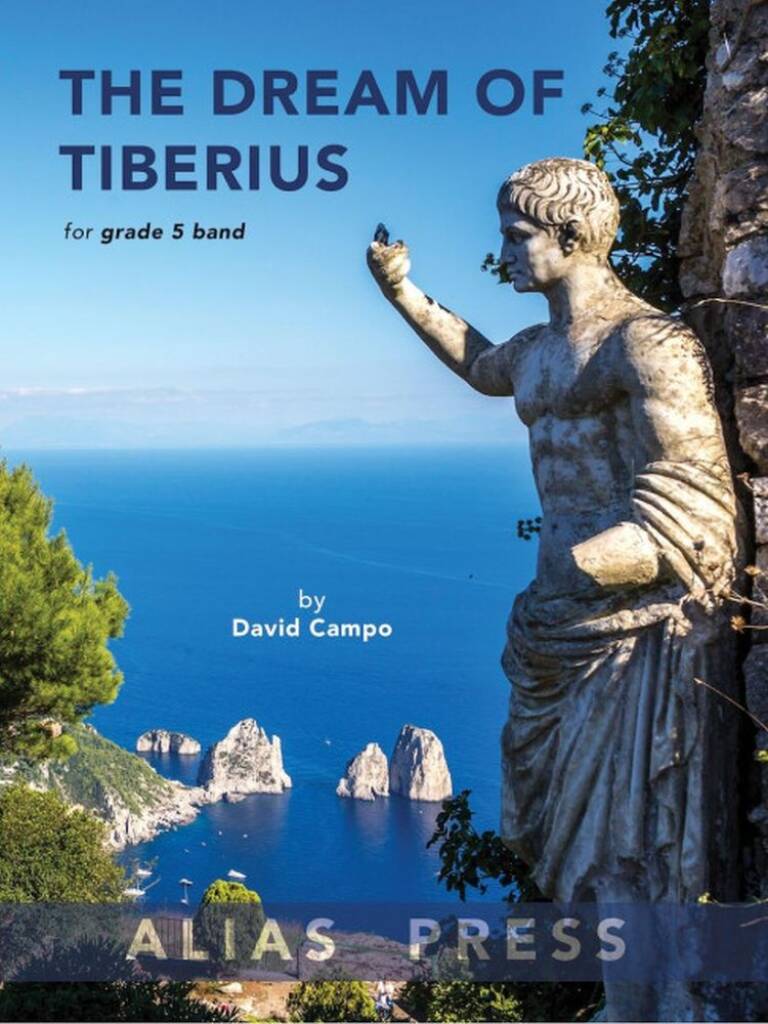
The Dream of Tiberius - David Campo
The Roman Emperor Tiberius was born in 42 BCE to Tiberius Claudius Nero and Livia Drusilla, both descendants of prestigious political families, at a time when Rome was undergoing significant political upheaval. Julius Caesar had begun a brutal civil war in 49 BCE to end Rome's rule as a Republic and consolidate his power as supreme ruler. Following Caeser's assassination in 44 BCE, Tiberius' father backed the forces wishing to return Rome to a Republic, but they were defeated by Caesarian loyalists led by Caeser's heir Octavian. As a result, Tiberius' early life was spent on the run and in political exile with his parents. In 27 BCE, Octavian would become the first Emporer of Rome and assume the name Augustus. Augustus forced Tiberius' parents to divorce and took Tiberius' mother as his new bride, separating the family and forcing Tiberius to live with his father. Upon his father's death, Tiberius went to live with his mother and Emporer Augustus, a situation Tiberius found extremely uncomfortable but one over which he had no control. Having been adopted by the Emperor, Tiberius assumed the military and political life thrust upon him. He proved to be an outstanding military and political leader, and with his marriage to Vipsania Agrippina his life took on a heretofore unknown stability. However, Augustus would intervene in Tiberius' life once more, forcing him to abandon his happy marriage and take Augustus' daughter Julia (Tiberius' step sister) as his new wife. This arrangement, while securing Tiberius' place as Augustus' heir and ensuring he would one day be Emperor of Rome, was disastrous. Julia's drunken licentiousness was a constant source of scandal and embarrassment for Tiberius (and her father, the Emperor) and she was eventually exiled by her father Augustus. Tiberius was named Emperor of Rome upon the death of Augustus in AD 14, assuming his position as the most powerful man on Earth. However, no matter how powerful he had become, Tiberius never felt as if he had ever had any control over his life, having been manipulated from childhood through adulthood by the whims of Augustus. As Emperor, he soon became disgusted with the political intrigue of the Roman Senate and by AD 26 left Rome and took up residence on the island of Capri, where he lived out the rest of his life. History does not regard Tiberius fondly and by all accounts towards the end of his reclusive life on Capri, he had become a miserable, sick and mentally unstable old man reveling in debauchery and cruelty. It is also informative to note that he was Emperor of Rome when Jesus of Nazareth was crucified, and while there is no indication that Tiberius was even aware of the existence of Jesus, as Emperor he was responsible for the appointment of Pontius Pilate as Governor of Judea. Even considering this, it is difficult to look on the life of the Emperor Tiberius and not feel some sympathy and pity. It's in this spirit that I composed "The Dream of Tiberius." I imagine the man sitting in thoughtful seclusion on the beautiful island of Capri imagining what his life might have happily been had not power been thrust upon him: husband, father and humble servant of the people.
Estimated dispatch 7-14 working days
-
 £99.99
Go with the Flow - Jacob de Haan
This work is not only about the flow of the Doubs, Ranceuse and Roide rivers that converge at Pont-de-Roide but also about the flow of life and history of this French town. The composition begins festively and, after the tempo picks up, the music smoothly and rhythmically depicts the happiness and enthusiasm of the inhabitants. The ever-flowing waters of the rivers introduce the slow, melodic middle section, which suddenly turns into traditional march music. After a return to sounds of happiness and enthusiasm, the work closes majestically.The optional Car Horn sound (bar 126) can be downloaded from this website, under 'Attachments'.
Estimated dispatch 7-14 working days
-
 £91.99
Guardians of the Waves - Philip Sparke
Guardians of the Waves was commissioned by the Japan Coast Guard Band to celebrate their 30th anniversary in 2018. They gave the premiere as part of a 30th anniversary concert on November 8th that year. Set in traditional march form, Guardians of the Waves opens with a short introduction, which leads to the main theme, played initially by the brass and then repeated with a florid woodwind descant. The theme is extended and morphs into a second theme, first played tutti and then quietly repeated by bassoon, tenor sax and euphonium. This leads to a conventional 'bass strain', played twice with varying accompaniments. A quieter trio section follows, delicately scored and featuring the tenor instruments of the band. Taken up by the full band, this leads back to a recall of the introduction and a return to the main two themes, which lead to a triumphal close.Recorded by the Kobe College Wind Orchestra and its conductor Osama Matsuura
Estimated dispatch 7-14 working days
-
£72.95
Guardians of the Banner - Joseph Compello
A very nice original march from popular composer Joseph Compello, Guardians of the Banner contains many aspects of a traditional American march but with the developing student in mind. It has an extended introduction, a first strain, second strain, and a break strain followed by a return of the first strain to end the march. There is not the typical modulation to a trio section, making this march much more playable for this level of band. The march is at a more moderate march tempo and contains some really nice melodies, making it a great way to introduce this important style to younger students.
Estimated dispatch 7-14 working days
 View Music