
Results
-
 £64.95
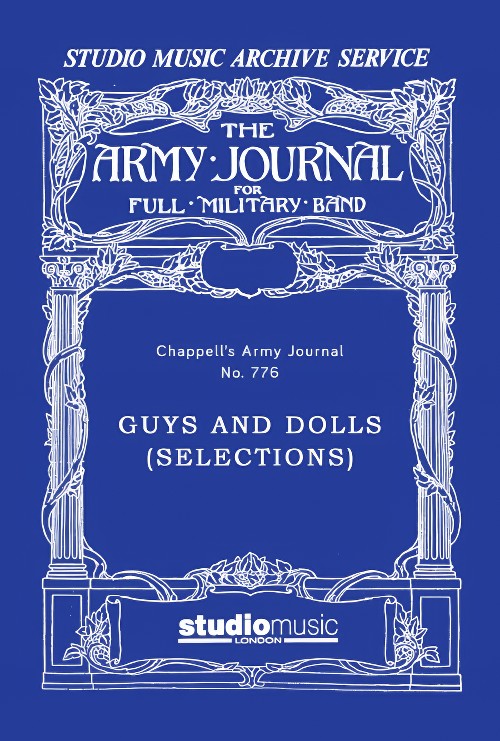
Guys and Dolls (Selection) (Concert Band - Score and Parts) - Loesser, Frank - Duthoit, W. J.
Army Journal No.776Includes:Guys and DollsI'll KnowTake Back Your MinkSue MeA Bushel and a PeckI've Never Been In Love BeforeIf I Were a BellSit Down You're Rocking the BoatMore I Cannot Wish YouLuck be a Lady
Estimated dispatch 7-14 working days
-
 £279.99
Van Gogh (Concert Band - Score and Parts) - Doss, Thomas
This composition is not a work inspired by the life of the famous painter, but rather an attempt at a pictorial immersion into his world. In addition to Van Gogh's character and tragic life, the technique he employed to create his works, the bright colours of his paintings and his view of nature served as inspiration for this musical work. Point by point, stroke by stroke, Van Gogh brought his own world to life on canvas.On the life of Van Gogh: The Dutch artist Vincent van Gogh was one of the most important pioneers of Modernism, despite being relatively unknown during his own lifetime. As an artist, he chose a life of poverty and seclusion. From today's perspective, his important woks were created from 1880 onwards, when he had already more or less succumbed to madness. While his earlier works could still be classed as contemporary, he matured into a pioneer of Expressionism with his later work indicating an increasing self-awareness. He was just 37 years old when he died but he created over 750 paintings and 1600 drawings in the last ten years of his life.The structure of the work:Start: Brushes and Paints: Van Gogh retired to Arles in southern France where he found his artistic home. The colours and flowering gardens of this landscape awakened in him an unbelievably great creative power.A: A Picture Comes into Being: Van Gogh's psychotic episodes and bouts of depression did not stop him from painting wonderful pictures. Hardly anyone recognised his genius during his lifetime, on the contrary, he often felt misunderstood.C: Paris - Arles: In Paris (from 1886), Van Gogh became inspired by the French art scene. His works found few takers, however. He met and befriended the painter Paul Gauguin, but the lack of success made Van Gogh short tempered, and he began to drink. Eventually, he moved from Paris to Arles in the south of France to establish an artists' collective with Gaugin. Within a few weeks, the two got into such a violent argument that Van Gogh attacked his friend with a knife. The friends parted ways and afterwards Van Gogh cut off his right ear. In 1889 he voluntarily admitted himself into a mental hospital at St. Remy, suffering from hallucinations and fearing that he would lose his mind.G: The Starry Night One of his most famous paintings, created in 1898.H: Death and Brotherly Love Vincent van Gogh accepted an invitation to Auver-sur-Oise in 1890. This was one of his most intensive creative periods. He also went there for treatment, but his mental state hardly improved. After an extended walk, he injured himself fatally with a pistol under mysterious circumstances. Not even to his beloved brother Theo, who had supported him all his life, did he reveal on his deathbed how the accident had occurred.J: Art Market Today, Van Gogh's paintings are among the most expensive paintings on the art market. How ironic, given that he could hardly sell a painting during his lifetime. "I put my heart and soul into my work and lost my mind in the process." (Vincent van Gogh)Duration: 13.15
Estimated dispatch 7-14 working days
-
 £145.00
Circius (Concert Band - Score and Parts) - Aagaard-Nilsen, Torstein
The title refers to a description of the wind of the north made by Olaus Magnus who lived in the 16th century. He drew maps describing people, animals, weather, winds, sea monsters etc. The map Carta Marina was unprecise, but the best they had. But he never visited the places himself. In the map over northern parts of Norway, he describes the wind "Circius" as the worst of all winds. The fast sections refers to the wind. In the middle section I borrow a folksong-like tune by Catharinus Elling (1858-1942). The text by Kristoffer Janson, tells about fishermen in small open boats. When they faced the force of nature they could do nothing but put their lives in the hand of God. - Torstein Aagaard-Nilsen
Estimated dispatch 7-14 working days
-
 £75.00
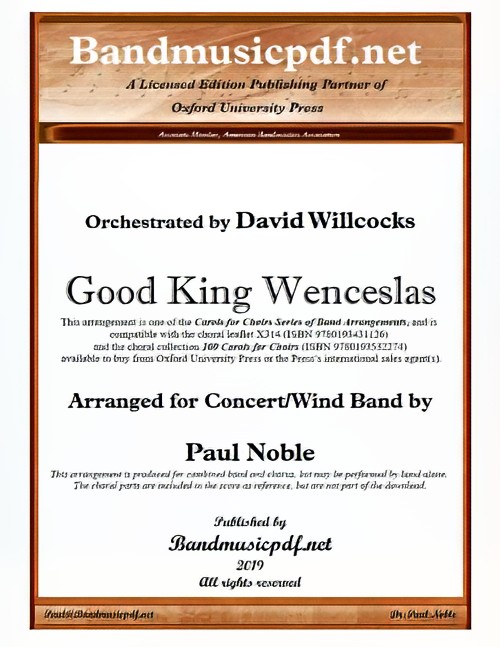
Good King Wenceslas (Concert Band with Optional Choir - Score and Parts) - Noble & Willcocks
Good King Wenceslas is a Christmas carol that tells a story of a Bohemian king going on a journey and braving harsh winter weather to give alms to a poor peasant on the Feast of Stephen (December 26, the Second Day of Christmas). During the journey, his page is about to give up the struggle against the cold weather, but is enabled to continue by following the king's footprints, step for step, through the deep snow. The legend is based on the life of the historical Saint Wenceslaus I, Duke of Bohemia or Svat Vclav in Czech (907-935). The name Wenceslas is a Latinised version of the old Czech language Venceslav. In 1853, English hymnwriter John Mason Neale wrote the Wenceslas lyrics, in collaboration with his music editor Thomas Helmore, and the carol first appeared in Carols for Christmas-Tide, 1853. Neale's lyrics were set to the melody of a 13th-century spring carol Tempus adest floridum (The time is near for flowering) first published in the 1582 Finnish song collection Piae Cantiones. This arrangement represents one in the Series of Band Arrangements compatible with David Willcocks' Carols for Choirs.
Estimated dispatch 7-14 working days
-
 £75.00
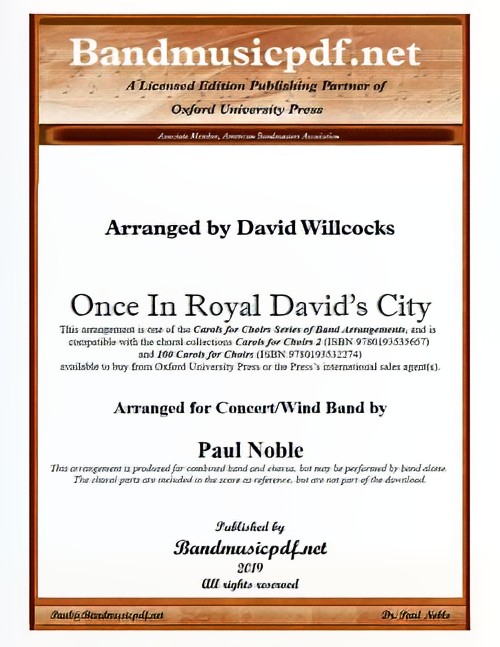
Once in Royal David's City (Concert Band with Optional Choir - Score and Parts) - Noble & Willcocks
Once in Royal David's City is a Christmas carol originally written as a poem by Cecil Frances Alexander. The carol was first published in 1848 in her hymnbook Hymns for Little Children. A year later, the English organist Henry John Gauntlett discovered the poem and set it to music. According to The New Oxford Book of Carols, the text was conceived by Cecil Alexander after overhearing a group of her god children complaining about the dreariness of the catechism. Cecil masterfully took doctrines from the Apostle's Creed and simplified them for her hymns. Cecil wrote about 400 hymns in her lifetime, among which are All things bright and beautiful and There Is a Green Hill Far Away. She used the money for charitable purposes, and was a tireless advocate (and visitor) of the poor and sick. Henry John Gauntlett had spent the first half of his career as a lawyer before abandoning his practice to pursue music. He served as the organist at a number of leading London churches. Gauntlett was a prolific writer and is said to have composed over 1000 hymn tunes. He made tremendous contributions to the world of music, even inventing mechanical improvements to the organ. As a result, he was praised by the famous Felix Mendelssohn and was awarded an honorary doctorate in music from the Archbishop of Canterbury. In 1919, Arthur Henry Mann, organist at King's College (1876-1929), introduced an arrangement of Once in Royal David's City as the processional hymn for the service. In his version, the first stanza is sung unaccompanied by a boy chorister. The choir and then the congregation join in with the organ on succeeding stanzas. This has been the tradition ever since. It is a great honor to be the boy chosen to sing the opening solo--a voice heard literally around the world. In this arrangement for band accompaniment, the first five verses may be performed as directed by the conductor, with different groupings of instruments for each verse, i.e., Vs.1, A cappella; Vs. 2, Fl., Oboe, E.H., Bsns; Vs. 3 Cl., Saxes; Vs. 4, Brass; Vs. 5, All, and Vs. 6 as written with featured descant. This arrangement is one of the Series of Band Arrangements compatible with the David Willcocks Carols for Choir, Book 2 (#31).
Estimated dispatch 7-14 working days
-
 £75.00
Blow, Blow, Thou Winter Wind (from When Icicles Hang) (Concert Band with Optional Choir - Score and Parts) - Rutter, John - Noble, Paul
John Rutter received an early commission for a piece of music that was seasonal for winter, though not necessarily linked to the Christian traditions of Christmas, in the early '70s. The request came from his friend Russell Burgess, a well-known conductor in the English musical scene and head of the Wandsworth School Boys' Choir through the '60s and '70s. Rutter responded with a six-movement work for orchestra, boys' choir, and mixed chorus, called When Icicles Hang. He chose his texts, characteristically, from Elizabethan and other early English poetry, each text dealing with images from the wintery season, be they the cold, ice-bound landscape and its winds; an older man's weariness in the face of the season; or the contrapuntal pleasures of ale and honey love for those safely inside on winter nights. The movements are: I. Icicles; II. Winter Nights; III Good Ale; IV Blow, blow, thou winter winds; V. Winter wakeneth all my care; VI . Hay, ay. With sparkling orchestration which has been faithfully set for Concert/Wind Band, the work may be performed with chorus as originally written, or may be performed effectively by band alone. The work is available as a complete set of six movements, or each movement may be purchased and performed individually.
Estimated dispatch 7-14 working days
-
 £75.00
Good Ale (from When Icicles Hang) (Concert Band with Optional Choir - Score and Parts) - Rutter, John - Noble, Paul
John Rutter received an early commission for a piece of music that was seasonal for winter, though not necessarily linked to the Christian traditions of Christmas, in the early '70s. The request came from his friend Russell Burgess, a well-known conductor in the English musical scene and head of the Wandsworth School Boys' Choir through the '60s and '70s. Rutter responded with a six-movement work for orchestra, boys' choir, and mixed chorus, called When Icicles Hang. He chose his texts, characteristically, from Elizabethan and other early English poetry, each text dealing with images from the wintery season, be they the cold, ice-bound landscape and its winds; an older man's weariness in the face of the season; or the contrapuntal pleasures of ale and honey love for those safely inside on winter nights. The movements are: I. Icicles; II. Winter Nights; III Good Ale; IV Blow, blow, thou winter winds; V. Winter wakeneth all my care; VI . Hay, ay. With sparkling orchestration which has been faithfully set for Concert/Wind Band, the work may be performed with chorus as originally written, or may be performed effectively by band alone. The work is available as a complete set of six movements, or each movement may be purchased and performed individually.
Estimated dispatch 7-14 working days
-
 £75.00
Hay, Ay (from When Icicles Hang) (Concert Band with Optional Choir - Score and Parts) - Rutter, John - Noble, Paul
John Rutter received an early commission for a piece of music that was seasonal for winter, though not necessarily linked to the Christian traditions of Christmas, in the early '70s. The request came from his friend Russell Burgess, a well-known conductor in the English musical scene and head of the Wandsworth School Boys' Choir through the '60s and '70s. Rutter responded with a six-movement work for orchestra, boys' choir, and mixed chorus, called When Icicles Hang. He chose his texts, characteristically, from Elizabethan and other early English poetry, each text dealing with images from the wintery season, be they the cold, ice-bound landscape and its winds; an older man's weariness in the face of the season; or the contrapuntal pleasures of ale and honey love for those safely inside on winter nights. The movements are: I. Icicles; II. Winter Nights; III Good Ale; IV Blow, blow, thou winter winds; V. Winter wakeneth all my care; VI . Hay, ay. With sparkling orchestration which has been faithfully set for Concert/Wind Band, the work may be performed with chorus as originally written, or may be performed effectively by band alone. The work is available as a complete set of six movements, or each movement may be purchased and performed individually.
Estimated dispatch 7-14 working days
-
 £75.00
Icicles (from When Icicles Hang) (Concert Band with Optional Choir - Score and Parts) - Rutter, John - Noble, Paul
John Rutter received an early commission for a piece of music that was seasonal for winter, though not necessarily linked to the Christian traditions of Christmas, in the early '70s. The request came from his friend Russell Burgess, a well-known conductor in the English musical scene and head of the Wandsworth School Boys' Choir through the '60s and '70s. Rutter responded with a six-movement work for orchestra, boys' choir, and mixed chorus, called When Icicles Hang. He chose his texts, characteristically, from Elizabethan and other early English poetry, each text dealing with images from the wintery season, be they the cold, ice-bound landscape and its winds; an older man's weariness in the face of the season; or the contrapuntal pleasures of ale and honey love for those safely inside on winter nights. The movements are: I. Icicles; II. Winter Nights; III Good Ale; IV Blow, blow, thou winter winds; V. Winter wakeneth all my care; VI . Hay, ay. With sparkling orchestration which has been faithfully set for Concert/Wind Band, the work may be performed with chorus as originally written, or may be performed effectively by band alone. The work is available as a complete set of six movements, or each movement may be purchased and performed individually.
Estimated dispatch 7-14 working days
-
 £395.00
When Icicles Hang (Concert Band with Optional Choir - Score and Parts) - Rutter, John - Noble, Paul
John Rutter received an early commission for a piece of music that was seasonal for winter, though not necessarily linked to the Christian traditions of Christmas, in the early '70s. The request came from his friend Russell Burgess, a well-known conductor in the English musical scene and head of the Wandsworth School Boys' Choir through the '60s and '70s. Rutter responded with a six-movement work for orchestra, boys' choir, and mixed chorus, called When Icicles Hang. He chose his texts, characteristically, from Elizabethan and other early English poetry, each text dealing with images from the wintery season, be they the cold, ice-bound landscape and its winds; an older man's weariness in the face of the season; or the contrapuntal pleasures of ale and honey love for those safely inside on winter nights. The movements are: I. Icicles; II. Winter Nights; III Good Ale; IV Blow, blow, thou winter winds; V. Winter wakeneth all my care; VI . Hay, ay. With sparkling orchestration which has been faithfully set for Concert/Wind Band, the work may be performed with chorus as originally written, or may be performed effectively by band alone. The work is available as a complete set of six movements, or each movement may be purchased and performed individually.
Estimated dispatch 7-14 working days
 View Music