
Results
-
 £183.99
Five States of Change - Philip Sparke
Five States of Change was commissioned by Kunstfactor for the 4th section of the Dutch National Brass Band Championships (NBK) 2011. It is dedicated to Jappie Dijkstra and the Music Information Centre (MUI), Arnhem, Holland, in acknowledgement of their outstanding work in developing band repertoire.The composer writes: "The idea for the piece came when I was reading an article about a branch of Chinese philosophy which is abbreviated as Wu Xing*, which has no exact translation but can mean, for example, five elements, five phases or five states of change. It is central to all elements of Chinese thought, including science, philosophy, medicine andastrology, and in simple terms tries to create various cyclic relationships between five elements in all walks of life.An example is: Earth - Metal - Water - Wood - Fire - (Earth) etc. where (in one cycle) earth bears metal, metal changes to liquid (water) when heated, water helps trees grow, wood burns to create fire, fire produces ash (earth) and the cycle continues.I was particularly interested in the cycle of emotions:- Meditation - Sorrow - Fear - Anger - Joy - (Meditation) etc. and thought this cyclic principle would provide an effective emotional journey for a piece of music. So Five States of Change has five equal sections which loosely characterise this emotional cycle. I have tried to make the music grow organically, with minimal repetition, and each movement evolves from the musical elements at the end of the previous one, with the opening material appearing, transformed, at the end of the piece to complete the cycle. *in full Wu zhong liu xing zhi chi or the five types of chi dominating at different times
Estimated dispatch 7-14 working days
-
 £84.99
A Copland Portrait - David Conte
Originally commissioned by maestro Neal Gittleman, A Copland Portrait was premiered by the Dayton Philharmonic Orchestra in January 2000. In March of 2015, First Lieutenant Ryan Nowlin's transcription of this work for band was premiered by "The President's Own" United States Marine Band under the direction of Lieutenant Colonel Jason Fettig. ECS Publishing is proud to offer both the band and the orchestra version. Conte on the creation of this overture: "I set out quite consciously to evoke various aspects of Copland's work by combining and recombining them within the terms of my own musical personality. For example, the first theme of A Copland Portrait combines the character of a theme from The Red Pony with the rhythmic texture of the scherzo of the Third Symphony. While composing the piece I was conscious of drawing inspiration from many of Copland's works; a melodic shape here, a harmonic gesture there, until I arrived at something that felt fresh and new to me. A Copland Portrait is cast in a traditional Sonata-Allegro form. After a vigorous, syncopated orchestral tutti, the first theme is announced in the solo oboe, accompanied by a steady eighth-note ostinato. Playful interjections are stated in the flute and bassoon. The syncopated tutti returns; the first theme is stated again, this time in the low winds. This theme builds to a colorful climax, leading into a more dissonant transition section, which gradually slows and gives way to a lilting, more lyrical second theme in the clarinet. After some modest development of the second theme, a more plaintive theme stated in the muted trumpet brings the exposition to a close. A scherzando development section follows; the first four notes of the first theme are inverted and subjected to various contrapuntal treatments. This development section ends with a return of the opening syncopated motive, leading into a recapitulation of the first theme, this time in canon, and the second theme and closing theme, broadly sung. A brilliant toccata-style coda brings A Copland Portrait to a brisk conclusion."
Estimated dispatch 7-14 working days
-
 £134.99
Gulliver's Travels - Bert Appermont
The book Gullivers Travels (1726) by author Jonathan Swift formed the provocation for writing this composition. Even though this composition isnt a literal representation of the original story, a number of elements were still retained. The shipsdoctor Gulliver finds himself in 4 (fictive) areas, each with their own inhabitants and customs. Each part of this suite also received the name of one of these areas:I. Lilliput The enterprising Lilliputians are represented by a playful, common themein the first part.II. BrobdingnagIn the land of "Brobdingnag" Gulliver is carried off by gigantic giants, which you hear approaching with the sounds of the bassinstruments. The same theme is constantly repeated and quickened in order to increase thetension.III. LaputaLaputa is an island that floats in the air; its inhabitants are strange people with slanting heads. The dreamy, special atmosphere is especially well conveyed here.IV. The HouyhnhnmsFinally Gulliver finds himself in the land of theHouyhnhnms, where intelligent and noble horses rule over the primitive, undeveloped people (yahoos). The trumpets in the brilliant opening express the galloping horses; the gallant theme that follows (horns and trombones) symbolises the primitiveyahoos. The whole composition ends with a big finale.I intentionally tried to limit the degree of difficulty of Gullivers Travels. Despite this I think that this work can appeal to many orchestras due to the colourful orchestration (cues areprovided where needed), the simple and clear theme and the highly imaginative breeding ground of a beautiful story around which this composition is built."
Estimated dispatch 7-14 working days
-
 £228.70
Montain Songs and Arias - Stig Nordhagen
I have always had a love for both classical and folk music.It is in between these expressions I thrive while composing.This piece contains both fast and lingering alternations between these expressions, complementing each other and creating a whole. This whole creates something larger than just the two individual constituents, a new entity. So with the classic (Arias) and folk music (Mountain songs), I want to create something new where the expressions enhances each other, and merges into an elevated state.- Stig Nordhagen
Estimated dispatch 7-14 working days
-
 £84.99
Axis - Naoya Wada
I composed Axis as a dedication to my friend Shinya Nakamitsu. He is a wonderful graphic designer who loves wind band music. Some years ago, I made a demo CD to hand out to a number of people. He oversaw the jacket design for that project and I composed this traditional march to thank him. Shinya Nakamitsu runs a design company called AXIS: hence the name of the composition.
Estimated dispatch 7-14 working days
-
 £76.99
Tribute to Whitney Houston
As the world mourns the loss of Whitney Houston, we also celebrate her legacy of marvelous music. Here is a well-paced and effective medley of hits that includes: How Will I Know, Saving All My Love for You, I Wanna Dance WithSomebody, and I Will Always Love You.
Estimated dispatch 7-14 working days
-
 £89.99
Highlights from George and Ira Gershwin's - George Gershwin
Strike Up the Band is a 1927 Broadway musical by George and Ira Gershwin, based on a book by George S. Kaufman. Surprisingly, the show proved to be an early failure for the talented Gershwin brothers, closing while the out-of-town tryouts were still underway. Despite this setback, it was revised in 1930 with a somewhat similar plot by Morrie Ryskind, and the show enjoyed a respectable run of 191 performances. This arrangement by James Barnes includes four of the best tunes from Strike Up the Band: Mademoiselle in New Rochelle (composed for the 1930 revival), Soon (also composed in 1930), The Man I Love, and Strike Up the Band. Curiously, The Man I Love, which is now considered to be one of the most popular George and Ira Gershwin standards, was NOT included in the 1930 run of the show.
Estimated dispatch 7-14 working days
-
 £127.30
Takk - Edvard Grieg
"Gratitude" is one of Grieg's beautiful lyrical pieces, Op. 62 No. 2.Eva Knardahl made a beautiful recording that I well remember was used as background for a picture cavalcade by the Norwegian Broadcasting Corporation during the passing of His Majesty King Olav V of Norway in 1991.In this arrangement for band, I have tried to vary the instrumentation, both for the sake of more colours and to emphasize the drama.This piece should be played rubato with elastic phrasing. The form can be described as AABACoda. The most dramatic section is the B part from measure 25, which peaks just before measure 38. The last four measures (from measure 53) can be done a bit 'meno' in tempo.Reid Gilje
Estimated dispatch 7-14 working days
-
 £126.00
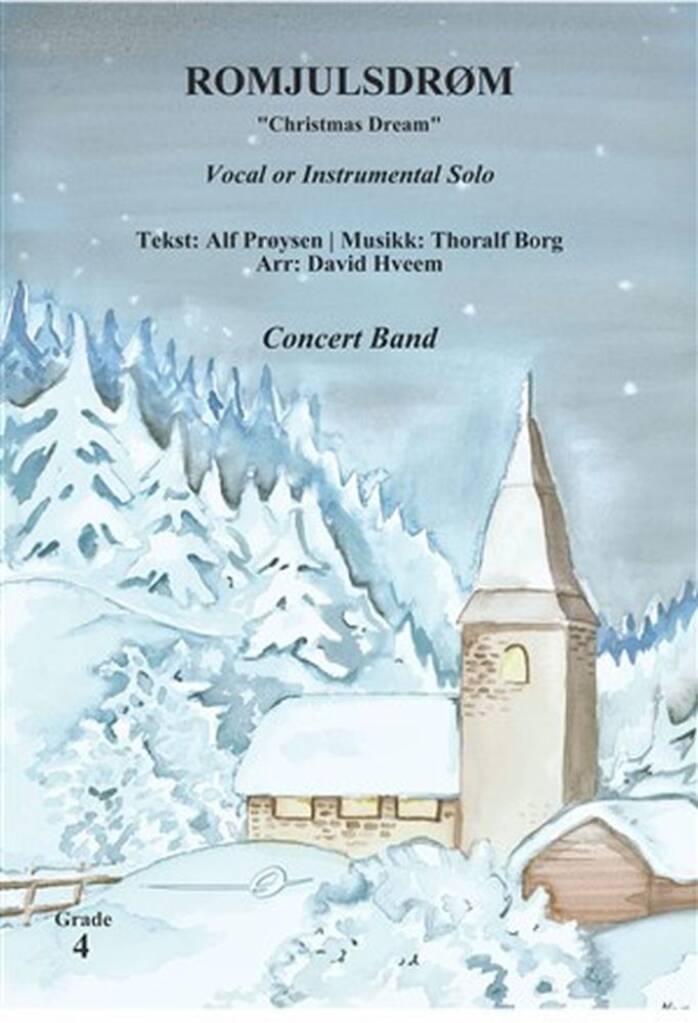
Romjulsdrm - Thoralf Borg
The poem Romjulsdrm ("Christmas Dream") was first published in Arbeiderbladet on January 3rd 1959, and became known when Thoralf Borg set a melody to it in 1968. Up until this, Alf Prysen had used a melody quite similar to the song Lijan uti dalen, when he sang the song in the TV program Ei vise vil jeg synge in 1964. At the same time that Borg's melody was written, the last four lines of text were also added to the poem, and the song took on the form we know today.The form and structure of this arrangement originates from a version for big band and vocals commissioned by stre Toten Storband, written in 2018 for one of their traditional midnight concerts on the day before Christmas. In an attempt to give the arrangement a nice calm and the text a lot of room, as is often the case in songs like this, it ended up in a relatively narrative style where the variation in tempo and the shifts between swing and straight eighth notes are particularly central.The song is about family, friendship and the quiet days of the Christmas holidays, which hopefully is something most people can recognise. The arrangement for the aforementioned midnight concert was ordered because my sister was to be the soloist for the concert, and since my father also played lead trombone - as he has done in this big band for as long as I can remember - it was natural to add a small trombone solo as well. It's always special to write and arrange music for people I know and appreciate, but it's extra special when it's also for two of my great role models.- David Stre Hveem -
Estimated dispatch 7-14 working days
-
 £118.99
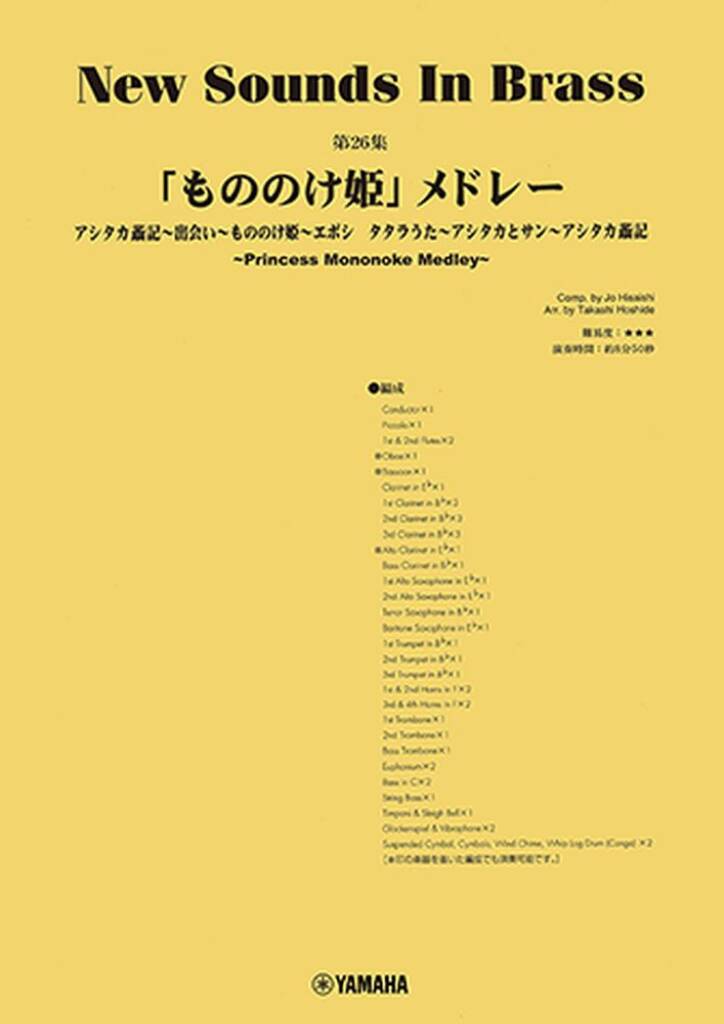
Princess Mononoke, Medley - Joe Hisaishi
Series: New Sounds in Brass (NSB); Duration: approx.8'50"; Composed by Joe Hisaishi; Arranged by Takashi Hoshide. Arranger Takashi Hoshide says, "I have selected beautiful melodies from the soundtrack of 'Princess Mononoke' (1997, directed by Hayao Miyazaki) and arranged them into a medley. What can be said about these songs as a whole is that they combine a grand continental scale with the delicacy that reflects Japanese emotions. Since there are no upbeat songs in this selection, I had to work hard on the arrangement, but this allowed for creating contrasts and transitions between each scene in the performance. 'Ashitaka Sekki (English title: The Legend of Ashitaka)' - 'Sekki' means a story that is not recorded but passed down orally. In this anime, this can be considered a sub-main theme. The song starts with a feeling that the story is about to begin and, once the theme kicks in, aim for a grand performance to convey its scale. 'Encounter' - This is the music that plays during the scene where the protagonist Ashitaka meets San. Interestingly, the motif of the main theme 'Princess Mononoke' is used in this melody. Here, let's pursue the shifts in the timbre of individual phrases, creating a beautiful and aesthetic soundscape. 'Princess Mononoke' - This is the main title of the anime. The melody line is carried by horns and trumpets."
Estimated dispatch 7-14 working days
 View Music