
Results
-
£134.99
Recalls - Ben Haemhouts
Recalls obviously refers to memories. This piece of music is in fact a series of flashbacks, however, it does not highlight the actual memories of specific thoughts, people or events.The composition evolves around the late Frans Steurs, who for manyyears was the inspirational artist behind the brass band that is currently commissioning this work. The main theme of the work is based on the name STEURS". E = mi, U = do, R = re and S = "si" which is Dutch for the note "ti". This idea forms themusical theme for the entire composition and different variations are used throughout. The structure of the work is based on the concept of a story which father Steurs is telling his two daughters, who play the flute and the clarinet. Each part ofthe work has a story-like character:1. Introduction: following a short ominous intro, the main theme is presented for the first time.2. The Story: father Steurs has both his daughters on his knee and he tells them stories from the old days. Trumpetsand trombones play variations of the theme. The story gets very exciting (accelerande, poco a poco agitato) until the tale takes a dramatic turn when the father tells an exciting story at the time of the Second World War. He tells of being hunteddown by the occupying army and these adventurous episodes are related to us musically in part3. Danger, with its skilful references to "vor dem Sturm" from "Eine Alpensinfonie" by Richard Strauss.4. called Fugitives, is about how he fled in the nightfrom the enemy and this is reflected in the bass tones of a new theme. The aggression of the war is illustrated from bar 117 onwards, by a harsh brass section. The main theme is repeated once again and this time up-tempo. The second theme is broughtonce again from bar 149 onwards.5. Dialogues, depicts the conversations between the two daughters and their father. Father speaks (bar 155); the daughters answer (bar 164 - flute, bar 166 - clarinet); bar 178: father answers with the tune of the maintheme to the two daughters. The discussions gradually intensify but ultimately end in peace in the last part called Conclusion.The piece of music "Recalls" is a free interpretation by the composer who consulted the letters between the two daughtersof Steurs and their father and in this respect it is not really music for a programme."
Estimated dispatch 7-14 working days
-
 £139.99
Le Cortge du Roi Renaud - Franco Cesarini
Le cortge du roi Renaud is a suite in five parts. It is based on tales that originated in southern European folk songs, dating back as far as the 16th century. A large portion of these songs are of the genre "Complaintes" songs in which the text gives a detailed description of events having a generally criminal or macabre character. The most familiar song to feature the tales of Roi Renaud is "Fualdes", consisting of 48 verses.The first part of the suite is based on the song "La Porcheronne" (The Swineherd). It telis the story of a young woman forced by her mother-in-law to tend pigs while her husband is away fighting in the war. She is freed only when her husband returns sevenyears later.The next part tells the story of "La mrquise Empoisonne" (The Poisoned Marquise). A marquise is coerced by her king to become his mistress. The jealous queen poisons her by means of a bouquet of deadly scented fiowers.Despite having the character of a merry dance, the third part, "La maumarie vengee" (The Avenged Wedding), expresses the touching story of Queen Clotilde, persecuted for her refusal to live according to the Aryan beliefs."La belle engloutie" (The Swallowed Beauty) relates the tale of the young wife of King Renaud. She cannot imagine a life without her husband, who was mortally wounded in the war, and begs the earth to open and swallow her up so thst she may rejoin her love.The gruesome content of the final part,"Le tueur de femmes" (The Wife Killer), bears a strong resembiance to the tale of Bluebeard. The story is about a young wife in danger of being drowned in a pond by her husband, which is what happened to her 13 predecessors. Thanks to her cunning, she manages to turn the tables and contrive her husband's demise.
Estimated dispatch 7-14 working days
-
 £53.95
French Chanson - P. Certon
French Chanson, arranged by Steven J. Pyter, is a rousing arrangement of a famous 16th-century choral work. The tuneful Renaissance art song tells a light-hearted story of gossip and rumor, with lyrics roughly translating to "I will tell you!" The story centers around a jealous husband suspicious of his beautiful wife. Like opera, the piece employs dramatic and whimsical characteristics to tell a passionate story. This arrangement alternates between tutti statements and short interludes to feature each instrument family in the band---woodwinds, brass, and percussion. The intensity and playfulness make for a great concert opener! (1:40)
Estimated dispatch 7-14 working days
-
 £59.95
Antagonist - Larry Clark
In every great story there is always an antagonist, the character of opposing force who is central to the success of the story. Larry Clark has applied this concept to music in a new beginning band piece, fascinating in sound and an excellent cross-curricular tie with English classes, musically illustrating the structure of a good story. This piece is aggressive and at times, purposely antagonizing. Designed with the youngest of players in mind, it works on simple repeated eighth note patterns as the foundation for the melodic material. As is typical in a Larry Clark piece, interesting parts are provided for all instruments, and everyone gets to play the melody.
Estimated dispatch 7-14 working days
-
£102.99
The Fairy Tale King - Jacob de Haan
This work is inspired on the dramatic life story of Ludwig II, former king of Bavaria. He was given the nickname Fairy Tale King because of his eccentric lifestyle, his love for medieval sagas, and the building of extravagant fantasy palaces, such as the world famous Neuschwanstein Castle. Ludwig II grew up in a strict environment but found support through his friendships, love for romantic fairytales, and the music of the German 19th century composer Richard Wagner. After Ludwig's sudden accession to the throne followed a cancelled wedding and a tragic ending, after which he became a national icon of Bavaria. The music reflects his eventful life with fairy-tale-like, romantic and dramatic sounds. Two themes from Wagner's famous opera Lohengrin form a returning homage to his tragic life story.
Estimated dispatch 7-14 working days
-
 £134.99
Talisman - Thierry Deleruyelle
Talisman tells the story of the "Pierre du Serment", an event that took place in 1639 in the village of Fontenotte, on the border between France and Switzerland. Composed of three brothers and their parents, the Billod family lived peacefully on their farm despite the Thirty Years' War raging around them. When their father was captured by the Swedish mercenaries who plundered the farm, the three brothers vowed to save him, carving their pact in stone according to a Celtic and Viking tradition.Commissioned by the Orchestre d'Harmonie de Montlebon for its centenary, this work pays tribute to a local story that has become a legend. The conductor, Jean-Pierre Frigo, wanted this commission to mark the orchestra's presence within the region.
Estimated dispatch 7-14 working days
-
 £118.99
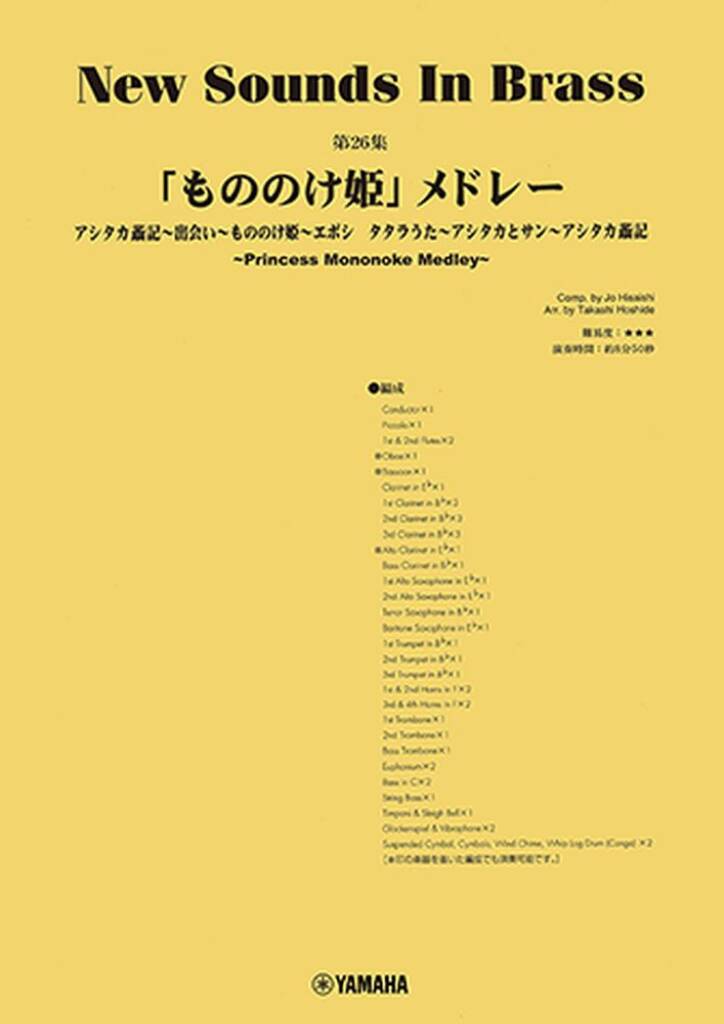
Princess Mononoke, Medley - Joe Hisaishi
Series: New Sounds in Brass (NSB); Duration: approx.8'50"; Composed by Joe Hisaishi; Arranged by Takashi Hoshide. Arranger Takashi Hoshide says, "I have selected beautiful melodies from the soundtrack of 'Princess Mononoke' (1997, directed by Hayao Miyazaki) and arranged them into a medley. What can be said about these songs as a whole is that they combine a grand continental scale with the delicacy that reflects Japanese emotions. Since there are no upbeat songs in this selection, I had to work hard on the arrangement, but this allowed for creating contrasts and transitions between each scene in the performance. 'Ashitaka Sekki (English title: The Legend of Ashitaka)' - 'Sekki' means a story that is not recorded but passed down orally. In this anime, this can be considered a sub-main theme. The song starts with a feeling that the story is about to begin and, once the theme kicks in, aim for a grand performance to convey its scale. 'Encounter' - This is the music that plays during the scene where the protagonist Ashitaka meets San. Interestingly, the motif of the main theme 'Princess Mononoke' is used in this melody. Here, let's pursue the shifts in the timbre of individual phrases, creating a beautiful and aesthetic soundscape. 'Princess Mononoke' - This is the main title of the anime. The melody line is carried by horns and trumpets."
Estimated dispatch 7-14 working days
-
 £159.99
Guardian Angels - Kevin Houben
Guardian Angels gives a musical expression to the legend of Reverend Louis Henri Bhler referring to the use of Psalm 34.North-west Veluwe and in particular Oldebroek (The Netherlands) has a very rich religious tradition which is demonstrated by its monumental churches. They tell the story of a stirring history in which Reverend Bhler played a crucial role. Inspired by his arrival as a pastor in 1870 in the neighbouring Oosterwolde, two big religious communities came into existence with their characteristic churches but this rivalry also resulted in great social unrest.This composition reflects on this striking personality and in particular on the story of the Angel Guard.'One evening Reverend Bhler has given a sermon in Oldebroek and he walks over the Church path through the pastures to Oosterwolde. On this dark and stormy evening Bhler's opponents are waiting for the pastor in ambush. They want to drown him in a watercourse near the Church path but abandon their plan because Bhler is accompanied by two men. The next day it comes to an encounter between Bhler and his opponents. They repent their, fortunately unexecuted , plan. Bhler firmly believes that on the previous night he walked alone over the Church path, and was not accompanied by two men. It was concluded that it must have been the angels who had protected Bhler.'Psalm 34 is central to this composition and this because of its powerful melody but also because the lyrics of verse 4 of the rhymed version fit in well with the special legend of Reverend Bhler:The Lord's angel gathered round himAn invincible heavenly guard,Who tries God's will, around himSo he's well guard(ed)A second melodious and harmonic cell is a musical transformation of the name 'Bhler'. This cell is varied in major and minor third chords and sometimes used as the main idea or apotheosis, but also serves as an accompanying cell or as a bridge between other melodic and rhythmic constructions.The composition was made possible by contributions of: Mr Evert van de Poll, owner of the Van Gelder Groep, Het Prins Bernhard Cultuurfonds Gelderland en Het Feteris Oosterbaan Fonds.
Estimated dispatch 7-14 working days
-
 £144.99
M�ngroa - Marc Jeanbourquin
A famous New Zealand legend recounts the story of the white shark 'M�ng roa' who was placed in the heavens by the demi-god Maui to protect Maori tribes on Earth. The composer depicts rituals and several other aspects of the story using an optional didgeridoo, singing and even shouting as special effects in this stunning new piece. A must-play for bands that fancy a nice challenge. Perfectly suited for thematic concerts or contests.
Estimated dispatch 7-14 working days
-
 £104.99
Pilgrims of Wolfryt - Jacob de Haan
The work Pilgrims of Wolfryt tells the story of the legend Walfridus (also known as Wolfryt), a resident of the town of Bedum in the Netherlands who was born in the 11th century. Wilfridus had an eventful life: he introduced Christianity to Bedum and helped the town build its first legal system, but ultimately his story ended in demise murdered alongside his son at the hands of the Vikings. Pilgrims of Wolfryt is a symphonic poem-like masterpiece, full of evocative melodies in a mix of tonalities to make the most of the impressive rhythmic material.
Estimated dispatch 7-14 working days
 View Music