
Results
-
£154.99
Symphonic Variations - Jacob de Haan
This composition is based on a passacaglia theme, in which artistic perfection, symphonic drama and oriental melody lines play a role. The passacaglia is originally a dance made up of a series of variations above a bass line constantly present as an ostinato. It is not in this sense that the "Symphonic Variations" are in the passacaglia form but in the sense of the open form of the variations. Jacob de Haan, himself originally an organist, took his inspiration for this piece from the famous passacaglia for organ in C-minor by J.S. Bach. Following the introduction of the passacaglia theme (in the bass) the entry by the trumpets and trombones forms the majestic start to amusical adventure, in which this theme (often fragmentary) returns in variations. Then there follow two faster movements with dramatic contrasts and virtuose passages. Particularly striking here is the use of two characteristic intervals from the beginning of the theme namely the minor second and the augmented fourth. An apause in the composition comes in the slow bridge where a syncopated bourdon (perfect fifth) is constantly repeated. The tension grows in dynamics and harmony, and the oriental-flavour becomes obvious in the melody. We arrive at a faster movement via an accelerando, in which a perpetuum mobile based on the passacaglia theme is central. Finally the whole flows into a martial theme, in which the ostinato accompaniment n the descant derives from the passacaglia theme.
Estimated dispatch 7-14 working days
-
£204.99
Credentium - Jan Van der Roost
A spectacular dive via an extended chromatic scale immediately submerges us in a charged and somewhat archaic-feeling atmosphere. Trumpets, horns and trombones resound in rhythmic patterns, buttressed by restless motifs in the percussion. A second theme, in the woodwinds, begins much calmer but is quickly pushed aside by that same brass offensive. This introduction is the musical expression of the sometimes tumultuous early history of the town of Peer in Belgium. It closes with a D scale played over two octaves and repeated three times, symbolizing the church steeples that dominate the townscape. Peer has the credentials of a town, and people should know about it.There followsa rhythmic, turbulent passage: in the course of history, Peer has not been spared the ravages of war, arson, occupation, epidemic and other evils. In contrast, a slow, pastoral, lyrical part expresses the periods of peace and prosperity the town has known, as well as the serene geographic setting that still characterizes the place. Various instruments in groups are developed in solo style while the accompaniment displays vast, painterly images of sound. Now and then an exotic intonation is heard: a variety of peoples and cultures have left their mark on the town.This episode of tranquility and peacefulness comes to a sudden end when, via a surprising, almost chaotic transitional passage, we are in effect transported back to our own time. A hopeful, festive march expresses the confidence in the future that the Royal Concert Band of Peer exudes. This confidence is wholly justified: under the direction of conductor Willy Fransen, the 95 members of the concert band have experienced an extended period of good fortune, and the 75 musicians of the youth band - and the 45 little musicians of the mini-band - are involved in thriving operations.
Estimated dispatch 7-14 working days
-
£109.99
Metalla - Jan Van der Roost
Metalla was commissioned by the 'Kreisverband Altenkirchen' of Germany and dedicated to Ottomar Jung. The composer himself conducted the premiere of the piece, which was performed by the 'Jugendorchester Kreisverband Altenkirchen' on 25 March 1999.The region of Altenkirchen is known for its iron mines, which find musical expression in the dark mood of the introduction (andante misterioso). This effect is accomplished with overlapping seventh intervals, orchestral crescendos, a succession of broad chords and the presentation of most themes in the middle register of the band.The dynamic section (allegro energico) that follows the introduction is characterized by concise figures inthe brass and a second motif, a kind of rippling motion depicting the Sieg River, an important element in the landscape of the Altenkirchen region.The work closes with a final theme that returns a number of times, albeit in different guises. After a brief repeat of the seventh intervals from the beginning, a last radiant chord signals the end of the piece.
Estimated dispatch 7-14 working days
-
 £239.99
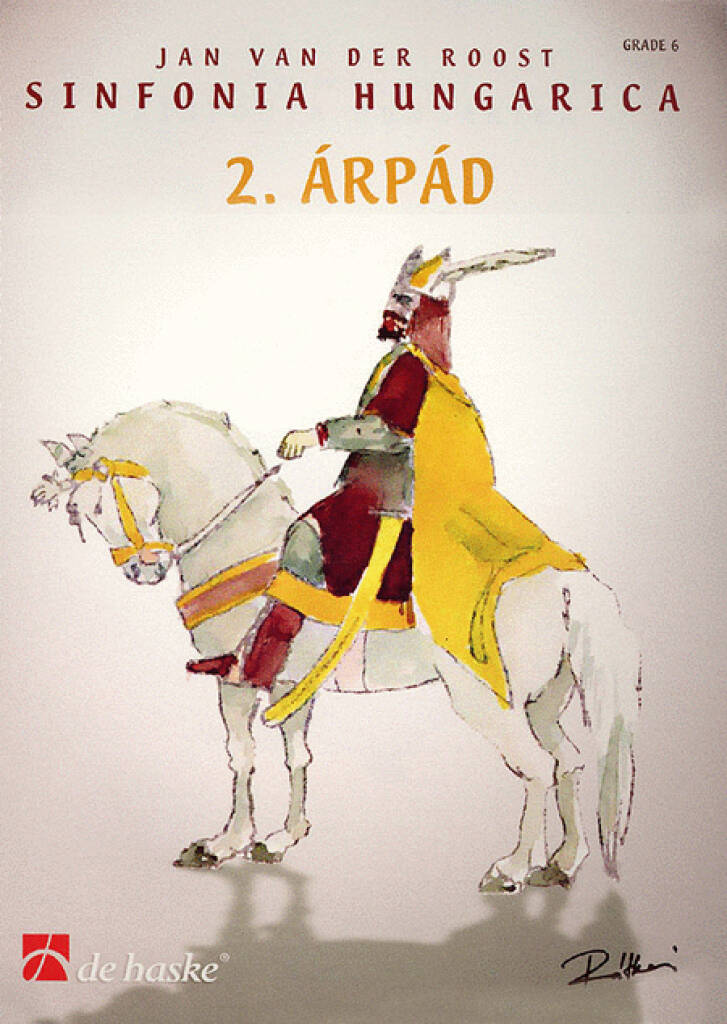
Arpd (part 2 from 'Sinfonia Hungarica') - Jan Van der Roost
Sinfonia Hungarica is a three-movement symphony that depicts the history of Hungary. All three movements were inspired by historical key figures, wars, and other important events from this country. This symphony is a celebration of Hungary's millennium in 2001.The second movement focuses on ARPAD, the actual founder of the Hungarian State. It starts with an atmospherical passage, evoking his grandmother, Emese, who dreamt about his future destination. One of Arpad's opponents, the Bulgarian Prince Zalan, was chased away after a fight. After this, Arpad officially named the territory "Magyarorszag."
Estimated dispatch 7-14 working days
-
£104.99
Partita Piccola - Henk van Belcum
As the title suggests, this work is a partita: it consists of a number of variations on a chorale melody. The partita has been popular for centuries, especially when it comes to organ music. Henk van Belcum, who is active in the choir world, chose for his Partita Piccola the German hymn Wunderbarer Knig as a starting point. Partita Piccola consists of four variations and a choral setting. After a majestic opening fanfare, the second variation follows, based on a canon by Pachelbel. Hndel's Sarabande is the basis of the third variation. Next comes the chorale setting, after which the work ends festively with a dance that has been written in the form of a courante. PartitaPiccola is an asset for church services and for concert platforms.
Estimated dispatch 7-14 working days
-
£154.99
Castellum - Jan Van der Roost
This work, in two movements, was written for the 50th anniversary of "Harmonie St. Cecilia" in Oudenburg, Belgium, and is dedicated to its conductor, Arne Wyntin.The first part is rather quiet and pastoral in character, and is written in a gently rocking 12/8 time. The tranquility of the area around the medieval town of Oudenburg, a rustic region not far from the North Sea, is expressed in a striking fashion. After a beautiful orchestral climax, the second part begins, which is inspired by the Roman past of Oudenburg. A somewhat oppressive and impending introduction leads to the musical reflection of an army parade: Oudenburg was a so-called "castellum," and the remains ofthe fortress are still visible in the current town plan. A more dynamic passage follows featuring the low brass. After that, the solemn rhythm of the parade is recaptured, culminating in a triumphant ending.
Estimated dispatch 7-14 working days
-
£139.99
Singapore Rhapsody - Jacob de Haan
Singapore Rhapsody is an exciting work in two movements based on popular Malaysian folksongs. The songs that occur in the first movement are Rasa Sayang eh (a love song), Gelang Sipaku Gelang (a song about community spirit), Suriram (a song about a girl proclaiming her virtues) and Di-Tanjung Katong (a love song that takes place at the Cape Katong on the southeast coast of Singapore). The second movement features Lenggang Kangkung, which literally means "The swaying of the watercress," Katang Lompat (a moralistic song about the symbolism of the frog) and finally Kenek kenek-lah Udang (a wedding song). Each movement of this enchanting work can be performed separately but acomplete performance will be the crowning moment of any concert.
Estimated dispatch 7-14 working days
-
 £154.99
Evergreen Concerto - Kees Schoonenbeek
This fantastic new work is set to become a classic in the trumpet repertoire. Each of its three contrasting movements can be played alone as shorter pieces or together as a mini concerto. The second movement is particularly interesting in the fact it is a fantasy in theme and variations form, based on a Handel minuet. A must for all trumpet players of an intermediate to advanced level.
Estimated dispatch 7-14 working days
-
£84.99
Bundeslied - Jacob de Haan
The melody of Bundeslied originates from Mozart's' Frimaurerkantate (KV62) from 1791. However research has shown evidence that it was probably composed by Johann Holzer, a freemason brother of his, but there is no definite evidence for this. Following the Second World War this melody was used as the basis for the new Austrian national anthem. Micheal Bilkes has adapted this beautiful, stately hymn for concert band. The result is a captivating work for both performers and audience.
Estimated dispatch 7-14 working days
-
 £69.99
Hectala - Willy Fransen
Hectala is the historical place name of the Belgian-Limburgish village of Hechtel where, during the Second World War, the Welsh Guards were engaged in a five-day battle with the German troops. More than 200 soldiers and 35 inhabitants perished. This classical, steady march in 6/8 time was written as a memorial to these events. It sends a powerful message that in war, there are no winners.
Estimated dispatch 7-14 working days
 View Music