
Results
-
 £179.99
Outback - Thomas Doss
This work was commissioned by the "-sterreichische Blasmusikjugend" (Austrian Brass Band Association - Young Musicians).The Aboriginal indigenous people of Australia are among the oldest surviving human cultures. The arrival of the Europeans markedtheir decline and endangered their existence. The many secrets the Aborigines hold served as inspiration for this work. Aboriginal SpiritOver many centuries, the Aboriginal people have cultivated a unique ability to live in harmony with theworld around them. Maintaining the delicate balance between their trinity - nature, man, and creation - is an important factor for bliss and happiness.Primeval Sound and Dreamtime The tens of thousands-year-old stories from the era calledDreamtime - the Aborigines' creation myth - play an important role in not only their beliefs, but their everyday lives and laws as well. Ancestral worship and various other rituals and ceremonies are still held in high regard to this veryday.Running HunterThe Aborigines are extremely skilful hunters and are able to run for extended periods of time when chasing their prey. Hunting weapons, such as the boomerang, exemplify their abilities.Uluru (Red Rock)Uluru, also knownas Ayers Rock, is a natural sandstone "inselberg" rising 348m above Australia's plains, and is one of the country's most recognisable icons. Uluru is also a sacred place for the local Aborigines. Its history stretches back to Dreamtime, although itdid not exist in its current state at that time.Encounter with the White MenUnfortunately, the "White Men" did not realize the significance and importance of the Aborigines and their culture until the end of the 20th century. Before then, theywere unaware that the Aborigines were quite possibly one of the oldest known cultures on earth, with a seamless history stretching back to creation itself; Dreamtime. BushfireFire has been present on the Australian continent for millions ofyears. Many of the indigenous flora and fauna have needed to adapt to fire, and evolution has led to unique solutions for survival. Over time, a complex symbiotic relationship has grown between life and the continually returning bushfire.
Estimated dispatch 7-14 working days
-
 £84.99
Es ist ein Ros Entsprungen - Michael Praetorius
The many sided and productive Michael Praetorius (1571-1621) is knwon as a composer of dance music, sacred music and music for the advent and Christmas time. He worked as Kapelmeister to the court at Wolffenbuttel, but he was also asked to serve in other places, includin Dresden. Praetorius was valued for the new impulses he gave to music by means of his use of instrumental accompaniment. His main contribution is his theoretical work "Syntagma Musicum", one of the most important musical refernce books, in connection with instruments and instrumentation in the early 17th Century. "Es ist ein ros entsprungen" is a well known ancient melody which has inspired numerous composers andarrangers througout the Centuries. Otto M. Schwarz has made a choral arrangement.
Estimated dispatch 7-14 working days
-
£139.99
Cobra - Jan Bosveld
Shortly after the Second World War, a combative movement of Danish, Belgian and Dutch artists chose the cobra snake - extremely dangerous yet considered sacred - as a symbol of their resistance to strict guideliness of form. The name "Cobra" also happens to contain the first letters of the cities Copenhagen, Brussels ans Amsterdam, from where most of the movement's members came. The Cobra movement, which existed from November 1948 until November 1951, can with some justicication be called the last major avant-garde movement of the 20th century.The source of inspiration for the composition Cobra comes from four paintings: "Obhobning" by the Dane Egill Jacobsen; "La jeune fille et lamort" by the Belgian Pierre Alechinsky; "Orgeldraaier" and "Le rythme joyeux de la ville" by the Dutch artists Karel Appel and Corneille. Obhobning means "pile-up", which is represented musically in the first part by a melodic and harmonic pilling up of perfect fourth's. The first part is also characterized by a rhythmic feeling, which the painting gives through its use of numerous black stripes. In the painting La jeune fille et la mort, Pierre Alechinsky places a young girl opposite Death. The second part features the constantly pulsating motion of live while a creeping, dark, melodic line develops. The tension between life and death is tangible as a battle reveals itself. In part three, one hears the Orgeldraaier by Karel Appel, as cheerful and playful as an organ grinder's music. The painting Le rythme joyeux de la ville by Corneille is busy and extremely dynamic, a perfect source of inspiration for a powerful, rhythmic ending to this composition.
Estimated dispatch 7-14 working days
-
 £154.99
Algona Overture - Jan Van der Roost
This piece is dedicated to all the citizens who live, have lived, and will live in the US town of Algona, who commissioned the work to celebrate it's 150th anniversary. With dark-tinted tones (low drums, heavy brass), this overture begins with a primitive sacred feel, it seems as if centuries-old Indian singing is heard once more. Gradually the sound becomes clearer and brighter as the same theme travels throughout the band in various guises and variants. Imposing tutti passages then give the band the chance to lavishly shine. This bright and catchy overture radiates spontaneous energy and as it features every section of the band all the players as well as the listenersare continually surprised and captivated.
Estimated dispatch 7-14 working days
-
£248.99
Odysseia - Maxime Aulio
Washed up on the Phaeacian shore after a shipwreck, Odysseus is introduced to King Alcinous. As he sits in the palace, he tells the Phaeacians of his wanderings since leaving Troy. Odysseus and his men fi rst landed on the island of the Cicones wherethey sacked the city of Ismarus. From there, great storms swept them to the land of the hospitable Lotus Eaters. Then they sailed to the land of the Cyclopes. Odysseus and twelve of his men entered the cave of Polyphemus. After the single-eyed giantmade handfuls of his men into meals, Odysseus fi nally defeated him. He got him drunk and once he had fallen asleep, he and his men stabbed a glowing spike into the Cyclop's single eye, completely blinding him. They escaped by clinging to the belliesof some sheep. Once aboard, Odysseus taunted the Cyclop by revealing him his true identity. Enraged, Polyphemus hurled rocks at the ship, trying to sink it. After leaving the Cyclopes' island, they arrived at the home of Aeolus, ruler of the winds.Aeolus off ered Odysseus a bag trapping all the strong winds within except one - the one which would take him straight back to Ithaca. As the ship came within sight of Ithaca, the crewmen, curious about the bag, decided to open it. The winds escapedand stirred up a storm. Odysseus and his crew came to the land of the cannibalistic Laestrygonians, who sank all but one of the ships. The survivors went next to Aeaea, the island of the witch-goddess Circe. Odysseus sent out a scouting party butCirce turned them into pigs. With the help of an antidote the god Hermes had given him, Odysseus managed to overpower the goddess and forced her to change his men back to human form. When it was time for Odysseus to leave, Circe told him to sail tothe realm of the dead to speak with the spirit of the seer Tiresias. One day's sailing took them to the land of the Cimmerians. There, he performed sacrifi ces to attract the souls of the dead. Tiresias told him what would happen to him next. He thengot to talk with his mother, Anticleia, and met the spirits of Agamemnon, Achilles, Patroclus, Antilochus, Ajax and others. He then saw the souls of the damned Tityos, Tantalus, and Sisyphus. Odysseus soon found himself mobbed by souls. He becamefrightened, ran back to his ship, and sailed away. While back at Aeaea, Circe told him about the dangers he would have to face on his way back home. She advised him to avoid hearing the song of the Sirens; but if he really felt he had to hear, thenhe should be tied to the mast of the ship, which he did. Odysseus then successfully steered his crew past Charybdis (a violent whirlpool) and Scylla (a multiple-headed monster), but Scylla managed to devour six of his men. Finally, Odysseus and hissurviving crew approached the island where the Sun god kept sacred cattle. Odysseus wanted to sail past, but the crewmen persuaded him to let them rest there. Odysseus passed Circe's counsel on to his men. Once he had fallen asleep, his men impiouslykilled and ate some of the cattle. When the Sun god found out, he asked Zeus to punish them. Shortly after they set sail from the island, Zeus destroyed the ship and all the men died except for Odysseus. After ten days, Odysseus was washed up on theisland of the nymph Calypso.
Estimated dispatch 7-14 working days
-
 £104.99
Call of the Valley - Jacob de Haan
The inspiration for this three-part work goes back to the International European Youth Wind Music Festival, of which the patron has been Jacob de Haan several times. It begins in a festive march tempo, then sacred music, instrumental groups playing off_x005F_x001E_stage and a little march for brass and _x005F_x001D_flutes. The third movement is a parade in which the various sections of the ensemble head towards the stage from different directions. Even without the effective choreography of the musicians, Call of the Valley is an impressive concert band composition.
Estimated dispatch 7-14 working days
-
£86.00
Abendlied (CB) - Josef Rheinberger - Pierre-Antoine Savoyat
Abendlied (Evening song) is a sacred motet by Josef Rheinberger for a six-part mixed choir. He wrote the first version in 1855 at the age of 15. It is perhaps his most famous choral work, which looks backward to the great sacred music of the Renaissance.
Estimated dispatch 7-14 working days
-
£29.99
Meditation on St Clement - David Chaulk
Inevitably, comparisons will be made with Philip Wilby's setting of the same hymn tune so It's interesting to note that this arrangement was done in 1983 - ten years prior to Wilby's very fine arrangement. It's being published now in response to many requests from bands around the world and will make an excellent addition to the sacred repertoire of brass and concert bands.
Estimated dispatch 7-14 working days
-
 £75.00
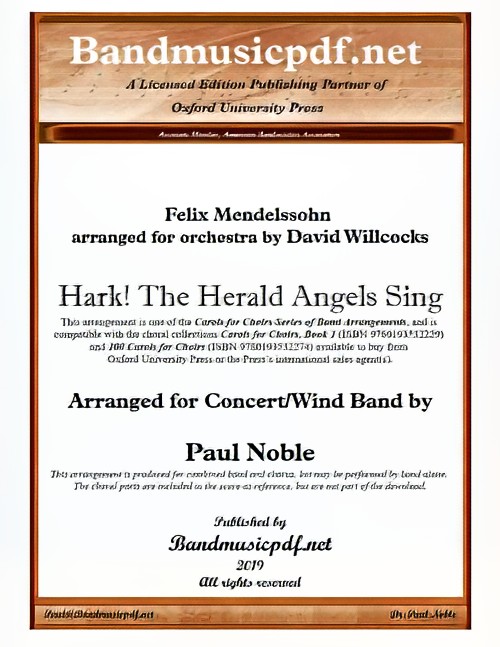
Hark! The Herald Angels Sing (Concert Band with Optional Choir - Score and Parts) - Mendelssohn, Felix - Noble & Willcocks
Hark! The Herald Angels Sing is a Christmas carol that first appeared in 1739 in the collection Hymns and Sacred Poems. Its lyrics had been written by Charles Wesley. Inspired by the sounds of London church bells while walking to church on Christmas Day, he wrote the Hark poem about a year after his conversion to be read on Christmas Day. The popular version is the result of alterations by various hands, notably by Wesley's co-worker George Whitefield who changed the opening couplet to the familiar one, and by Felix Mendelssohn, whose melody was used for the lyrics. In 1840, a hundred years after the publication of Hymns and Sacred Poems, Mendelssohn composed a cantata to commemorate Johann Gutenberg's invention of movable type printing, and it is music from this cantata, adapted by the English musician William H. Cummings to fit the lyrics of Hark! The Herald Angels Sing, that propels the carol known today. This arrangement represents one in the Series of Band Arrangements compatible with David Willcocks' Carols for Choirs.
Estimated dispatch 7-14 working days
-
 £123.20
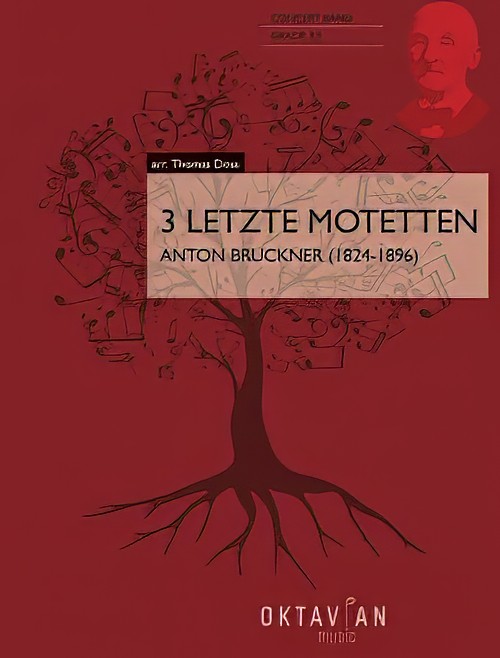
3 Letzte Motetten (Concert Band - Score and Parts) - Bruckner, Anton - Doss, Thomas
Anton Bruckner (b. 4.9.1824, Ansfelden, d. 11.10.1896, Vienna) didn't have it easy. Throughout his life, the Austrian composer was plagued by self-doubt. Anton Bruckner came from a simple, rural background. After the death of his father, he was accepted as a choirboy at the monastery of Sankt Florian in 1837. After several years as a school assistant and his own organ and piano studies, he first worked as organist in St. Florian, then from 1855 as cathedral organist in Linz. Introduced to music theory and instrumentation by Simon Sechter and Otto Kitzler, he discovered Richard Wagner as an artistic role model, whom he admired throughout his life and also visited several times in Bayreuth. In 1868 Anton Bruckner became professor of basso continuo, counterpoint and organ at the Vienna Conservatory; ten years later court organist; and in 1891 finally honorary doctor of the University of Vienna. He was considered an important organ virtuoso of his era, but had to wait a long time for recognition as a composer. It was not until Symphony No.7 in E major, composed between 1881 and 1883, with the famous Adagio written under the effects of Wagner's death, that he achieved the recognition he had hoped for, even if he was reluctant to accept it given his inclination towards scepticism and self-criticism. Anton Bruckner was a loner who did not want to follow a particular school or doctrine. He composed numerous sacred vocal works, such as his three masses, the Missa Solemnis in B flat minor (1854), the Te Deum (1881-84) and numerous motets. As a symphonic composer, he wrote a total of nine symphonies and many symphonic studies from 1863 onwards, tending to revise completed versions several times over. Bruckner's orchestral works were long considered unplayable, but in fact were merely exceptionally bold for the tonal language of their time, uniting traditions from Beethoven through Wagner to folk music, on the threshold between late Romanticism and Modernism. Anton Bruckner composed about 40 motets during his lifetime, the earliest a setting of Pange lingua around 1835, and the last, Vexilla regis, in 1892. Thomas Doss has compiled some of these motets in this volume for symphonic wind orchestra. These motets show many characteristics of personal expression, especially Bruckner's colourful harmony in the earlier works, which is in places aligned with Franz Schubert (changes between major and minor; and movements in thirds). Later works are characterised by many components which, in addition to the expanded stature of the movements, include above all a sense of the instrumentation as an outward phenomenon and the harmony as a compositional feature that works more internally. Some aspects of Bruckner's work are the result of his long period of study, which familiarised him not only with the tradition of his craft, but also gave him insights into the "modernity" of his time in such composers as Wagner, Liszt and Berlioz. From this developed his personal standpoint, which always pursues the connection between the old and the new.Duration: 14.00
Estimated dispatch 7-14 working days
 View Music