
Results
-
 £56.50
Mother Goose Suite (Concert Band - Score and Parts) - Ravel, Maurice - Turner, Jeffrey E.
Ravel wrote the Mother Goose Suite for two children who were very special to him. His fascination with the wonder and imagination of childhood are evident in this piece. This arrangement will take your young band on a journey through the enchanted world of fairy tales - from the reflective Sleeping Beauty Pavane, to the playful Tom Thumb, the exotic Empress of the Pagoda, through the courtship of Beauty and the Beast, and concluding where all fairy tales must, with a happily-ever-after ending in The Fairy Garden. This piece is an excellent vehicle for featuring your soloists, and the well- rafted orchestration will showcase the wealth of sound and colours in any band. Being generously cued, even smaller bands will be able to enjoy Ravel's music. Mother Goose Suite is sure to delight the child in all of us.Duration: 5.15
Estimated dispatch 7-14 working days
-
 £53.50
Three Renaissance Dances (Concert Band - Score and Parts) - Moss, John
John Moss has created a marvelous setting for young players with this carefully researched group of dance pieces from the Renaissance period. With distinctive percussion writing and modal harmonies, the unique flavor of this music will complement any musical program. Includes: I. Basse Danse (Susato), II. Volte (Praetorius), and III. The King's Pavane. Duration: 4.00
Estimated dispatch 7-14 working days
-
 £48.95
Music of the English Renaissance (Concert Band - Score and Parts) - Byrd & Morley - Williams, Mark
This tasteful arrangement of two classics from the English Renaissance will serve as a great stepping-off point for studying music from different historical periods. The Earl of Salisbury Pavane by William Byrd is a beautiful study in sonority and counterpoint. Now Is the Month of Maying by Thomas Morley is a madrigal written for six voices. A great addition to the young band repertoire. Duration: 3.30
Estimated dispatch 7-14 working days
-
 £132.00
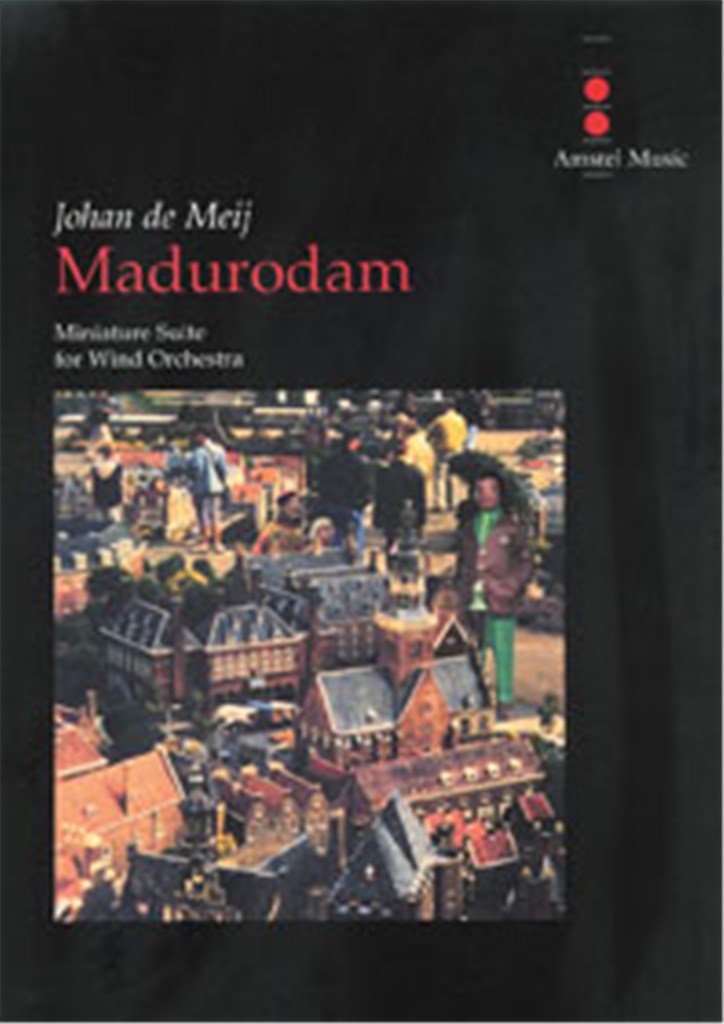
Madurodam (Concert Band - Score and Parts) - De Meij, Johan
Madurodam is a small scale miniature town at Scheveningen (near The Hague) and is since many years one of the most important tourist attractions of the conurbation of Western Holland (called Randstad). On a scale 1:25 a charming picture of The Netherlands is given in bird's eye view: several important buildings, churches and townscapes are reconstructed up to the smallest details. There is also a fine transport system: a network of railroads, harbours and motorways covers the park and Madurodam Airport enables air traffic with all continents. The miniature suite Madurodam consists of eight short parts presenting a musical impression of the smallest town in The Netherlands.Reveille the piccolo flute and the side drum announce a new dayToy Soldiers there is a military parade in front of the George Maduro BarracksBinnenhof/Buitenhof a solemn melody is the main theme of the suite and depicts the state buildings and the nearby lake Hofvijver at The HagueSmall Windmills everything that moves or whirls at Madurodam is described in this barrel organ waltzIntermezzo/Nocturne Madurodam by night is described by a solemn passage played in unison by the lower instrumentsThe Westerkerk Church also the capital Amsterdam is represented with the chimes of the famous Westerkerk churchThe Muiderslot Castle an elegant pavane recalls medieval atmospheresGrande Finale the windmill theme comes back and then the suite comes to an end with the Binnenhof theme, decorated by the first strains of the national hymn, Wilhelmus.Duration: 9.15
Estimated dispatch 7-14 working days
-
 £134.99
Pastorale de Provence (Concert Band - Score and Parts) - Cesarini, Franco
Cesarini composed this work as a tribute to the memory of Darius Milhaud, born a century earlier in Aix-en-Provence, France. The premiere, conducted by the composer, was presented by the Civic Philharmonic of Balerna in December, 1992. The titles of the four-part suite include: La Villageoise (The Village Maiden), Le petit berger (The Little Shepherd), La Princesse (The Princess) and Le Lutin (The Imp). The numerous musical reference themes begin with five folksongs from the Provence region and continue with melodies written by French composers of the seventeenth century. Additional interest is created by the use of old dance forms (Ronde, Musette, Pavane and Farandole) to illustrate each historical character.Duration: 9:30
Estimated dispatch 7-14 working days
-
 £105.00
Danceries (Set I) (Concert Band - Score and Parts) - Hesketh, Kenneth
The term 'Danceries' can be found in a copy of Playford's Dancing Master, an extensive collection of folk and popular tunes of the seventeenth century (and no doubt earlier). This publication was used by master fiddle players to teach the various dance steps of the day to a nobleman's house or a king's court. Whilst this present set of 'Danceries' cannot be said to be an aid to terpsichorean agility, it will at least set feet tapping! The melodies themselves are a mixture of new and old--well, nearly. Where the old occurs it has been adapted in mood and composition and is often interspersed with completely new material. The harmonies and rhythms bring a breath of the new into these themes and add to the drama of the set.Movement 1: Lull me beyond thee. Gentle and lilting, almost a barcarole, this movement is very much a reverie. The original tune had the name 'Poor Robin's Maggot' - a rather disconcerting title; maggot, however, in seventeenth-century parlance meant whim or fancy. This theme can also be found in The Beggar's Opera by John Gay (first performed in 1728) under the title 'Would you have a young lady' (Air 21).Movement 2: Catching of Quails. A colourful, buoyant scherzo on an original melody. The thematic material is shuttled around the band to contrast with full-bodied tuttis. The last few bars fade away to almost nothing before a final surprise!Movement 3: My Lady's Rest. A tender pavane, also on an original theme, with Moorish leanings. Solos for principal winds and brass contrast with warmer tutti passages. The movement culminates with a final presentation of the theme before evaporating in held flute and trumpet chords.Movement 4: Quodling's delight. The final movement to the set combining one of the melodies from Playford's Dancing Master ('Goddesses') with an original contrasting melody. A dramatic and exuberant ending to the set of 'Danceries'.Duration: 12.00
Estimated dispatch 7-14 working days
 View Music