
Results
-
 £84.99
Banana Island (Concert Band - Score and Parts) - Crausaz, Etienne
Banana Island is an extraordinary fictional place: coconut palms, date palms, mango trees, banana trees and mangroves grow in abundance. Animals live there in heavenly harmony. On a Caribbean danse rhythm, the Soca, several themes develop and create a dialogue between the various registers. A central section offers the trumpet and trombone the chance to display their soloist skills. This work is full of energy and brimming over with enthusiasm!Duration: 4.15
Estimated dispatch 7-14 working days
-
 £73.50
Proxima B (Concert Band - Score and Parts) - Pyter, Steven J.
Where in the galaxy, other than Earth, could human life survive? Proxima B may be the answer to this cosmic question. The planet orbits the red dwarf star Proxima Centauri, the closest star to our Sun. First discovered in 2016, NASA says, The exoplanet is at a distance from its star that allows temperatures mild enough for liquid water to pool on its surface. Journey over four light years to the twin star system of Alpha Centauri in Proxima B, by Steven J. Pyter. Hear and feel the excitement and danger of traveling beyond our solar system in this sci-fi-inspired, cinematic-style concert work that is sure to capture the imagination of performers and audiences! This piece was the 2022 winner of the National Band Association Young Band Composition Contest.Duration: 4.00
Estimated dispatch 7-14 working days
-
 £279.99
Van Gogh (Concert Band - Score and Parts) - Doss, Thomas
This composition is not a work inspired by the life of the famous painter, but rather an attempt at a pictorial immersion into his world. In addition to Van Gogh's character and tragic life, the technique he employed to create his works, the bright colours of his paintings and his view of nature served as inspiration for this musical work. Point by point, stroke by stroke, Van Gogh brought his own world to life on canvas.On the life of Van Gogh: The Dutch artist Vincent van Gogh was one of the most important pioneers of Modernism, despite being relatively unknown during his own lifetime. As an artist, he chose a life of poverty and seclusion. From today's perspective, his important woks were created from 1880 onwards, when he had already more or less succumbed to madness. While his earlier works could still be classed as contemporary, he matured into a pioneer of Expressionism with his later work indicating an increasing self-awareness. He was just 37 years old when he died but he created over 750 paintings and 1600 drawings in the last ten years of his life.The structure of the work:Start: Brushes and Paints: Van Gogh retired to Arles in southern France where he found his artistic home. The colours and flowering gardens of this landscape awakened in him an unbelievably great creative power.A: A Picture Comes into Being: Van Gogh's psychotic episodes and bouts of depression did not stop him from painting wonderful pictures. Hardly anyone recognised his genius during his lifetime, on the contrary, he often felt misunderstood.C: Paris - Arles: In Paris (from 1886), Van Gogh became inspired by the French art scene. His works found few takers, however. He met and befriended the painter Paul Gauguin, but the lack of success made Van Gogh short tempered, and he began to drink. Eventually, he moved from Paris to Arles in the south of France to establish an artists' collective with Gaugin. Within a few weeks, the two got into such a violent argument that Van Gogh attacked his friend with a knife. The friends parted ways and afterwards Van Gogh cut off his right ear. In 1889 he voluntarily admitted himself into a mental hospital at St. Remy, suffering from hallucinations and fearing that he would lose his mind.G: The Starry Night One of his most famous paintings, created in 1898.H: Death and Brotherly Love Vincent van Gogh accepted an invitation to Auver-sur-Oise in 1890. This was one of his most intensive creative periods. He also went there for treatment, but his mental state hardly improved. After an extended walk, he injured himself fatally with a pistol under mysterious circumstances. Not even to his beloved brother Theo, who had supported him all his life, did he reveal on his deathbed how the accident had occurred.J: Art Market Today, Van Gogh's paintings are among the most expensive paintings on the art market. How ironic, given that he could hardly sell a painting during his lifetime. "I put my heart and soul into my work and lost my mind in the process." (Vincent van Gogh)Duration: 13.15
Estimated dispatch 7-14 working days
-
 £123.20
3 Letzte Motetten (Concert Band - Score and Parts) - Bruckner, Anton - Doss, Thomas
Anton Bruckner (b. 4.9.1824, Ansfelden, d. 11.10.1896, Vienna) didn't have it easy. Throughout his life, the Austrian composer was plagued by self-doubt. Anton Bruckner came from a simple, rural background. After the death of his father, he was accepted as a choirboy at the monastery of Sankt Florian in 1837. After several years as a school assistant and his own organ and piano studies, he first worked as organist in St. Florian, then from 1855 as cathedral organist in Linz. Introduced to music theory and instrumentation by Simon Sechter and Otto Kitzler, he discovered Richard Wagner as an artistic role model, whom he admired throughout his life and also visited several times in Bayreuth. In 1868 Anton Bruckner became professor of basso continuo, counterpoint and organ at the Vienna Conservatory; ten years later court organist; and in 1891 finally honorary doctor of the University of Vienna. He was considered an important organ virtuoso of his era, but had to wait a long time for recognition as a composer. It was not until Symphony No.7 in E major, composed between 1881 and 1883, with the famous Adagio written under the effects of Wagner's death, that he achieved the recognition he had hoped for, even if he was reluctant to accept it given his inclination towards scepticism and self-criticism. Anton Bruckner was a loner who did not want to follow a particular school or doctrine. He composed numerous sacred vocal works, such as his three masses, the Missa Solemnis in B flat minor (1854), the Te Deum (1881-84) and numerous motets. As a symphonic composer, he wrote a total of nine symphonies and many symphonic studies from 1863 onwards, tending to revise completed versions several times over. Bruckner's orchestral works were long considered unplayable, but in fact were merely exceptionally bold for the tonal language of their time, uniting traditions from Beethoven through Wagner to folk music, on the threshold between late Romanticism and Modernism. Anton Bruckner composed about 40 motets during his lifetime, the earliest a setting of Pange lingua around 1835, and the last, Vexilla regis, in 1892. Thomas Doss has compiled some of these motets in this volume for symphonic wind orchestra. These motets show many characteristics of personal expression, especially Bruckner's colourful harmony in the earlier works, which is in places aligned with Franz Schubert (changes between major and minor; and movements in thirds). Later works are characterised by many components which, in addition to the expanded stature of the movements, include above all a sense of the instrumentation as an outward phenomenon and the harmony as a compositional feature that works more internally. Some aspects of Bruckner's work are the result of his long period of study, which familiarised him not only with the tradition of his craft, but also gave him insights into the "modernity" of his time in such composers as Wagner, Liszt and Berlioz. From this developed his personal standpoint, which always pursues the connection between the old and the new.Duration: 14.00
Estimated dispatch 7-14 working days
-
 £95.99
5 Tantum Ergo (Concert Band - Score and Parts) - Bruckner, Anton - Doss, Thomas
Anton Bruckner (b. 4.9.1824, Ansfelden, d. 11.10.1896, Vienna) didn't have it easy. Throughout his life, the Austrian composer was plagued by self-doubt. Anton Bruckner came from a simple, rural background. After the death of his father, he was accepted as a choirboy at the monastery of Sankt Florian in 1837. After several years as a school assistant and his own organ and piano studies, he first worked as organist in St. Florian, then from 1855 as cathedral organist in Linz. Introduced to music theory and instrumentation by Simon Sechter and Otto Kitzler, he discovered Richard Wagner as an artistic role model, whom he admired throughout his life and also visited several times in Bayreuth. In 1868 Anton Bruckner became professor of basso continuo, counterpoint and organ at the Vienna Conservatory; ten years later court organist; and in 1891 finally honorary doctor of the University of Vienna. He was considered an important organ virtuoso of his era, but had to wait a long time for recognition as a composer. It was not until Symphony No.7 in E major, composed between 1881 and 1883, with the famous Adagio written under the effects of Wagner's death, that he achieved the recognition he had hoped for, even if he was reluctant to accept it given his inclination towards scepticism and self-criticism. Anton Bruckner was a loner who did not want to follow a particular school or doctrine. He composed numerous sacred vocal works, such as his three masses, the Missa Solemnis in B flat minor (1854), the Te Deum (1881-84) and numerous motets. As a symphonic composer, he wrote a total of nine symphonies and many symphonic studies from 1863 onwards, tending to revise completed versions several times over. Bruckner's orchestral works were long considered unplayable, but in fact were merely exceptionally bold for the tonal language of their time, uniting traditions from Beethoven through Wagner to folk music, on the threshold between late Romanticism and Modernism. Hymns for four-part mixed choir a cappella (1846, St. Florian) No. 1 in E flat major (WAB 41/3): Quite Slow No. 2 in C major (WAB 41/4): Andante No. 3 in B flat major (WAB 41/1): Slow No. 4 in A flat major (WAB 41/2): Slow Hymn for five-part (SSATB) mixed choir and organ No. 5 in D major: Solemnly They are simple works, completely subordinate to their liturgical use, which nevertheless already show numerous characteristics of personal expression. These small pieces were able to stand up to the harsh scrutiny of the mature master: in 1888, Bruckner subjected them to a revision in which he made only minor corrections.Duration: 11.00
Estimated dispatch 7-14 working days
-
 £256.00
14 Motetten (Concert Band - Score and Parts) - Bruckner, Anton - Doss, Thomas
Anton Bruckner (b. 4.9.1824, Ansfelden, d. 11.10.1896, Vienna) didn't have it easy. Throughout his life, the Austrian composer was plagued by self-doubt. Anton Bruckner came from a simple, rural background. After the death of his father, he was accepted as a choirboy at the monastery of Sankt Florian in 1837. After several years as a school assistant and his own organ and piano studies, he first worked as organist in St. Florian, then from 1855 as cathedral organist in Linz. Introduced to music theory and instrumentation by Simon Sechter and Otto Kitzler, he discovered Richard Wagner as an artistic role model, whom he admired throughout his life and also visited several times in Bayreuth. In 1868 Anton Bruckner became professor of basso continuo, counterpoint and organ at the Vienna Conservatory; ten years later court organist; and in 1891 finally honorary doctor of the University of Vienna. He was considered an important organ virtuoso of his era, but had to wait a long time for recognition as a composer. It was not until Symphony No.7 in E major, composed between 1881 and 1883, with the famous Adagio written under the effects of Wagner's death, that he achieved the recognition he had hoped for, even if he was reluctant to accept it given his inclination towards scepticism and self-criticism. Anton Bruckner was a loner who did not want to follow a particular school or doctrine. He composed numerous sacred vocal works, such as his three masses, the Missa Solemnis in B flat minor (1854), the Te Deum (1881-84) and numerous motets. As a symphonic composer, he wrote a total of nine symphonies and many symphonic studies from 1863 onwards, tending to revise completed versions several times over. Bruckner's orchestral works were long considered unplayable, but in fact were merely exceptionally bold for the tonal language of their time, uniting traditions from Beethoven through Wagner to folk music, on the threshold between late Romanticism and Modernism. Anton Bruckner composed about 40 motets during his lifetime, the earliest a setting of Pange lingua around 1835, and the last, Vexilla regis, in 1892. Thomas Doss has compiled some of these motets in this volume for symphonic wind orchestra. These motets show many characteristics of personal expression, especially Bruckner's colourful harmony in the earlier works, which is in places aligned with Franz Schubert (changes between major and minor; and movements in thirds). Later works are characterised by many components which, in addition to the expanded stature of the movements, include above all a sense of the instrumentation as an outward phenomenon and the harmony as a compositional feature that works more internally. Some aspects of Bruckner's work are the result of his long period of study, which familiarised him not only with the tradition of his craft, but also gave him insights into the modernity of his time in such composers as Wagner, Liszt and Berlioz. From this developed his personal standpoint, which always pursues the connection between the old and the new.Duration: 39.00
Estimated dispatch 7-14 working days
-
 £102.99
Ed Sheeran EQUALS Smash Hits (Concert Band - Score and Parts) - Sheeran, Ed - Schaars, Peter Kleine
After his successful albums x (Multiply), + (Plus) and (Divide), the English singer-songwriter Ed Sheeran is back with his new album = (Equals), which at its release, towards the end of October 2021, was streamed over ten million times in the first twenty-four hours. Using the smash hits Bad Habits, Shivers, Overpass Graffiti and The Joker And The Queen from this album, Peter Kleine Schaars wrote a fantastic pop medley, an arrangement that will not just give your band members an adrenaline boost, but will also be enjoyed by your audience.Duration: 7.30
Estimated dispatch 7-14 working days
-
 £66.95
On This Day Earth Shall Ring (Concert Band - Score and Parts) - Cantiones, Piae - Watson, Scott
The 14th-century carol, "Personent hodie," is both mysterious and powerful. On This Day Earth Shall Ring, a festive processional on the ancient melody arranged by Scott Watson, explores both aspects. Beginning quietly, the modal tune emerges over a chant drone with rustic, medieval percussion. Before long, the piece takes on the joyous character alluded to in the tune's most familiar English text setting, "On This Day Earth Shall Ring" (written by composer, Jane Joseph, a student of Gustav Holst). As the work draws to an ebullient close, all the stops are pulled with resounding brass and ringing metallic percussion! Whether used as a striking concert opener or a jubilant final selection, On This Day Earth Shall Ring will add festive ?lan to your winter/holiday program! Duration: 3.30
Estimated dispatch 7-14 working days
-
 £60.99
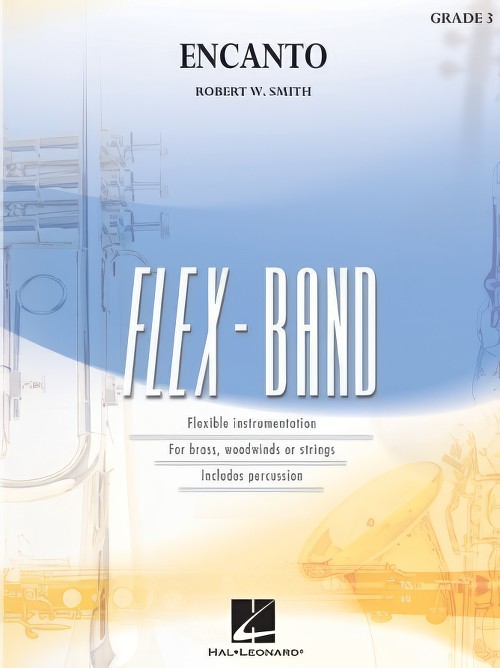
Encanto (Flexible Ensemble - Score and Parts) - Smith, Robert W.
Robert W. Smith's "Encanto" has been a staple of the festival repertoire for young bands for over 30 years! With its dramatic fanfare and rhythmic energy throughout, this version for flexible instrumentation is adapted directly from the original. Duration: 5.00
Estimated dispatch 7-14 working days
-
 £139.99
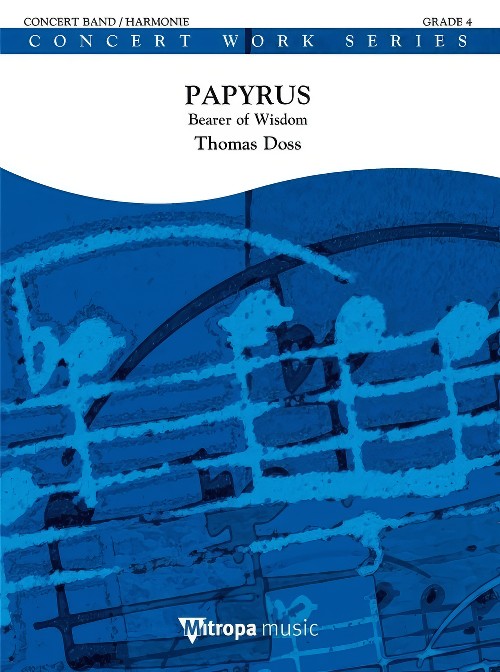
Papyrus (Bearer of Wisdom) (Concert Band - Score and Parts) - Doss, Thomas
The history of paper ranges over more than five thousand years: likely starting around 3500 BC in old Egypt with the use of papyrus. The oldest findings of written paper date from 2700 BC. In China, the first production of paper took place in the year 105 AD. The Arabs acquired their knowledge of the art of making paper around 750 AD, thanks to Chinese prisoners of war. Around the same time, the Celtic Ogham script was created in Ireland and carved into stones or trees. In Europe, the first paper mill was not put into operation until the 12th century! No matter how different the production methods and its historical use, paper was always a way to pass on wisdom, art and knowledge. Even today, in the age of digitalisation, paper still has a somewhat 'sacred' image. With Papyrus, Thomas Doss has written a wonderful composition in which the history of paper is reflected, and listeners can very much hear the various periods of this history represented throughout the piece. Duration: 8.30
Estimated dispatch 7-14 working days
 View Music