
Results
-
 £176.50
Masquerade (Concert Band - Score and Parts) - Sparke, Philip
Masquerade was commissioned by Stadtmusik Willisau from Switzerland (Reto Gdel, conductor) to celebrate their 175th anniversary in 2003 and first performed by them in November that year.1. Overture: The first movement opens with a fanfare-like figure, featuring the brass, before the main them is introduced over staccato chords. After a short, syncopated interlude a legato theme is introduced in the tenor register and material is developed until the music slows temporarily. The opening theme returns and the 'tenor' tune is taken up by the whole band until the opening fanfare returns to close the movement.2. Elegy: The slow movement opens intensely with a bare two-part theme, which leads to a passionate chorale-style melody. A second theme is introduced and leads to a climax, a return of the chorale theme and a pianissimo repeat which again leads to a full-band climax. The two-part theme returns quietly to create a peaceful close.3 Interlude: A short movement which changes the mood to introduce...4 Finale: Three violent chords preface a lively syncopated opening theme. The trumpets introduce a second idea, which is treated fugally, and this in turn leads to the main melodic idea of the movement, over staccato chords. A contrasting subject is then introduced in the middle of the band, followed by echoes of the first movement fanfare. The opening theme returns and material is revisited until the opening fanfare returns in full to end the work triumphantly.Duration: 15:30
Estimated dispatch 7-14 working days
-
 £132.00
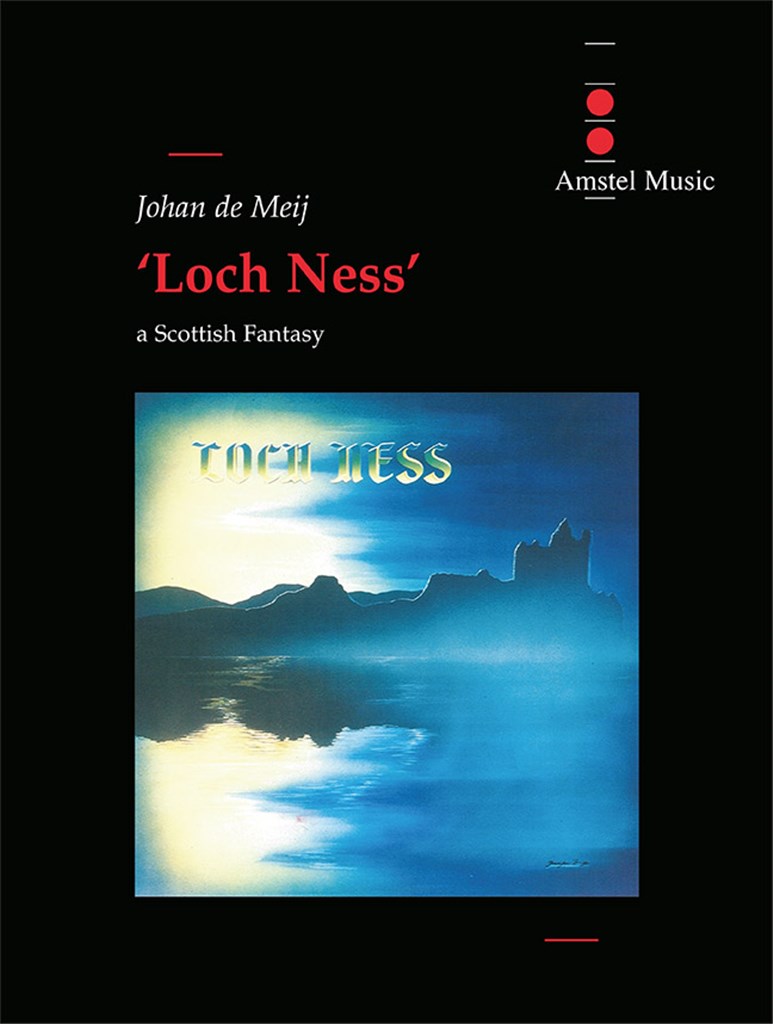
Loch Ness (Concert Band - Score and Parts) - De Meij, Johan
A Scottish Fantasy. The symphonic poem Loch Ness consists of five through-composed impressions of this mysterious Scottish Lake. I) The Lake at Dawn - calm, static, sonorous blocks depict the troubled opaque water surface and the enormous depth of the Lake at daybreak. II) Slowly the rising early-morning mist reveals the distant ruins of Urquhart Castle, represented by a solemn theme in the trombones which is taken over by the full band, thus evoking the illustrious past of this fortress besieged so many times. III) Inverness: Bagpipes and Tourists - the music takes us down to the town of Inverness where the first tourists mark the slow but steady start of a new season to the sound of a Scottishmelody. IV) Storm - suddenly a heavy wheater breaks: fierce gusts of wind and heavy showers transform the erstwhile calm surface into an obscure and whirling mass of water, and clouds rapidly passing over offer an eery scene. V) Conclusion - storm and rain gradually decrease and when everything is quiet again we are granted a last view of the Lake in its full glory. Duration: 12.15
Estimated dispatch 7-14 working days
-
 £43.56
Barrage (Concert Band - Score and Parts)
Beginning band students are known for their boundless energy. "Barrage" by Robert W. Smith captures that energy in a piece your students will want to rehearse and perform over and over again. Each instrument in the wind section has the opportunity to play the melody. Along the way, the teaching of dynamic shaping, contrast and unified ensemble interpretation are the educational goals. Exceptional teaching in an exceptional musical setting!
Estimated dispatch 7-14 working days
-
£43.56
Chillaxin' (Concert Band - Score and Parts)
Let your young musicians kick back a bit and let the trumpet section lay down this cool groove for developing bands. Set in a minor key, "Chillaxin' " provides the spotlight your young trumpeters crave, all while providing interesting accompanying roles for the rest of the band. Your students will ask to play this over and over again!
Estimated dispatch 7-14 working days
-
£43.56
Creature Feature (Concert Band - Score and Parts)
An absolute beginning band showstopper, "Creature Feature" will be the hit of any concert program! Each section of the band has the opportunity to play memorable melodic themes and be inspired to create dynamic contrast. This fun, spooky and catchy novelty tune is designed to be performed in the second semester of study. You will want to save this for the end of rehearsal - your students will want to play this one over and over!! Scary sounds and frightful fun!
Estimated dispatch 7-14 working days
-
£47.52
Crunch Time!
When it's hip to be cool, this is the piece that both you and all your students will want to play over and over again. Crunch Time is the perfect selection for an concert, school assembly, or that occasional athletic pep rally. Your percussionists will delight in the myriad of sounds required for this work and you can be assured that the scoring for brass and woodwinds is extremely solid from top to bottom. You might just want to consider saving this for the end of practice to insure that your young musicians will be exiting rehearsal with huge smiles on their faces.
Estimated dispatch 7-14 working days
-
£41.58
Dueling Dragons (Concert Band - Score and Parts)
Inspired by a rollercoaster ride as enjoyed by composer Robert W. Smith and his children, "Dueling Dragons" features two distinct groups of instruments. The brass and select percussion represent "Fire" with the woodwinds and metallic percussion representing "Ice." The duel between the two includes interacting melodic lines and intense effects leading to a very exciting conclusion. Exciting and educationally rich with teaching opportunities, "Dueling Dragons" will be one of those pieces that your students ask to play over and over. Let the fun begin!
Estimated dispatch 7-14 working days
-
£149.99
Heaven and Earth Wind Band Set (Score & Parts)
An Astrological Composition. Astrology is based on the principle that each sort of time has its own quality. In order to determine the quality of a particular moment, an astrologer looks at the position of the planets in the solar sustem at that moment. Each planet has specific types of energies and its location provides unique information for a certain moment on Earth. Thus: its position in the sky tells something about what happens on Earth. In this composition the types of energies of four planets are musically translated. The four planet were not randomly chosen. There are two pairs, whose influence and energy are opposite. Venus and Mars. Venus represents the feminine principle: harmony, beauty, art, and the ability to make relationships and to keep the peace. Venus connects, and communicates in order to maintain the balance. Mars represent the masculine principle: winning, impulsiveness, enthusiasm, and sexual energy for procreation. He creates war enabling the strongest to triumph. Mars is musically depicted in a stirring march in which enthusiasm characterises the masculine character. Saturn and Jupiter. Saturn represents concentration and withdrawal: the strong notion of responsibility, seriousness, self-discipline and melancholy. Saturn is the hermit who will conquer his fears and worries in minimal conditions and by self-chastisement. This contemplative character is depicted in the music as if it is almost standing still, which also reflects the given character of this planet. Jupiter represents growth and expansion: the positive, self-confidence, the good Samaritan, the healer. Jupiter is the philosopher who will make the world a better place, sees future possibilities, and searches for eternal values. He is the prophet who sometimes rants and raves his doctrine and proclamations, resulting musically in a whirling and upbeat finale. not looking back at what has been but searching for new challenges. "Heaven and Earth" was commisioned by the Music Lending and Information Centre (MUI), a department of the library for the province of Gelderland in Arnhem, The Netherlands.Een astrologische compositie. Astrologie is gebaseerd op het principe dat elke tijd zijn eigen kwaliteit heeft. ""Tijd voor koffie"" of ""het was je tijd nog niet"" als bijvoorbeeld een baan aan je neus voorbij is gegaan. Om de kwaliteit van een moment te lezen kijkt de astroloog naar de stand van de planeten in ons zonnestelsel op dat tijdstip. Elke planeet heeft specifieke energie?n en de plaats aan de hemel geeft unieke informatie over een bepaald moment op aarde. Oftewel: de stand aan de hemel (Ouranos) vertelt iets over wat er op aarde (Gaia) gebeurt. In deze compositie worden de energie?n van vier planeten muzikaal vertaald. De vier planeten zijn niet lukraak gekozen. Het zijn twee paren, die qua invloed en energie tegenovergesteld zijn. Venus en Mars. Venus vertegenwoordigt het vrouwelijke principe: harmonieus, schoonheid, de kunst, het vermogen om verbindingen aan te gaan en de vrede te bewaren. Venus geeft door en verbindt om de balans te bewaren. Mars vertegenwoordigt het mannelijke principe: winnen, anderen aftroeven, impulsief en enthousiast, seksuele energie voor de voortplanting. Mars cre?ert oorlog om de sterkste te laten zegevieren. Venus staat tot Mars als vrede staat tot oorlog, als verbinden staat tot verbreken, als harmonie staat tot competitie. Jupiter en Saturnus. Jupiter vertegenwoordigt groei en expansie: het positieve zelfvertrouwen, de weldoener, de genezer. Jupiter is de filosoof die de wereld wil verbeteren, vooruitkijkend en zoekend naar eeuwige waarden, de profeet die soms al te bombastisch zijn leer verkondigt. Saturnus vertegenwoordigt concentratie en inkrimping: het sterke verantwoordelijkheidsbesef, soberheid, zelfdiscipline en melancholie. Saturnus is de kluizenaar die onder minimale voorwaarden en zelfkastijding zijn angsten wil overwinnen. De harde, serieuze werker die volgens vaste regels stug doorgaat om aan zijn hoge eisen te voldoen. Jupiter staat tot Saturnus als uitbreiding staat tot inkrimping, als zelfvertrouwen staat tot faalangst, als vrijheid staat tot structuur. 11:00
Estimated dispatch 7-14 working days
-
 £29.70
Name Those Tunes (Concert Band - Score and Parts)
An incredibly nice western style march with a big bold sound from the pen of Sammy Nestico. As usual, Sammy's unique style of writing makes "AMARADO'' one that you'll be using over and over for years to come and the contemporary rhythms and harmonic structure make it a perfect choice for either concert or contest use. Full Score. A REAL WINNER!
Estimated dispatch 7-14 working days
-
 £184.95
PARTITA for Concert Band (Darrol Barry) (Prestige Concert Band - Score and Parts) - Barry, Darrol
This work is cast in four movements: Introit; Impromptu; Elegy (31.12.04); Finale. Grade 5. (Recorded on QPRM150D, CHIVALRY, Royal Northern College of Music Wind Orchestra) PARTITA FOR CONCERT BAND is cast in four movements: Introit - begins majestically with brass, saxes and percussion carrying the main theme from which most of the following ideas originate. It is repeated by the woodwinds and moves via a solo side drum into the piu mosso. New ideas are introduced by trombones, the horns and euphoniums leading to the central idea played by oboe. This leads, in turn, via full band to the closing movement. 2. Impromptu -once again the opening theme is the basis of the whole movement, using most of the composer's tricks, augmentation, retrograde, inversion and fugato, it moves along in a very confident style. A muted solo trumpet links into the third movement. Elegy (26/12/04) - this movement was prompted by the devastating events of Boxing Day 2004, the Asian Tsunami. The movement opens bleakly until a solo flute gives us the main theme over a troubled accompaniment. The opening mood returns but timpani and tam-tam herald return of the main theme for the full band. The opening theme is heard again as the music subsides but never settles. Finale - this spirited 6/8 vivo opens up with percussion and horns and trumpets announce the main idea, punctuated with short chords from the lower band. A new four bar theme is heard over a bass tread, the theme overlaps itself and quavers swirl up and down the band. Material from the first movement is heard transformed by the energy of the finale and the music surges towards a sudden close. Performance time: 15:35
Estimated dispatch 7-14 working days
 View Music