
Results
-
 £39.99
Caroling - Timothy Johnson
Fragments of eight different well-known Christmas carols go into this enjoyable arrangement. See if your audience can name them all. The carols are conveniently arranged so that they can be played at one consistent tempo throughout, which helps you make the most out of your young band's limited rehearsal time. A variety of articulations and dynamics help to make the piece a teaching tool as well as an enjoyable performance piece. Interesting Percussion colors, with easy substitution suggestions, also help to make the piece sound harder than it is. Effective!
Estimated dispatch 7-14 working days
-
 £149.99
Musica Helvetica - Jan de Haan
Every year a competition for wind orchestras and brass bands takes place in Wallberg, Switzerland. Apart from a hymn and a solo piece, all orchestras also have a compulsory piece to play. The commission to create a compulsory piece for the 2012 competition fell to Jan de Haan. The composition is entitled Musica Helvetica. It takes the form of a three-part concert work, in which the last two parts flow directly from one to the other. The first part, Musica Prima, is a brisk virtuoso opening with jazz flavours woven in. The following section, Musica Sacra, offers a contrast with an extraordinarily colourful instrumentation for the gorgeous main theme. Thefinal part, Musica Alpina, is inspired by the great variety of scenery in Switzerland. With its witty humour it makes a worthy conclusion to this beautiful tryptich.
Estimated dispatch 7-14 working days
-
 £70.60
Spiral - Marc Jeanbourquin
Marc Jeanbourquin composed 'Spiral' during a music camp, for himself and 9 other fellow musicians. Due to the success of this piece, some years later, he has taken the main theme and developed it, with a kind of tribute to Camille Saint-Saens, one of his favourite composers. The constant changes between the minor and major keys, and between the often changing 2 and 3 feeling, with the occasional 2/4 bar thrown in, do not disrupt the flow of the piece in the slightest; in fact it is what has inspired the title. A percussion interlude, which is broken up by the unregularly occurring meter, brings the piece to a restatement of the original theme, which then ends in a large crescendo. Spiral is perfectly suited to either the opening or the close of any concert.
Estimated dispatch 7-14 working days
-
£59.80
Die Lustigen Dorfschmiede - Julius Fucik
Reading the title of this piece, namely "The Happy Village Smiths" it rather suggests a character piece than a zestful march. However, the saying "Don't let yourself be fooled" also applies in this instance, as "The Happy Village Smiths" belong to Fuc k's most popular marches. In an article that appeared in a Styrian local paper in the 1930s, Christine Fuc k speaks about common vacations with her husband in Gleisdorf. On the occasion of a walk in the vicinity of that city the couple came past a blacksmith's shop. The rhythm of the two blacksmiths hammering away on the anvil allegedly inspired Fuc k to compose this piece. Since the march goes back to the year 1908, and Christine and Fuc k's friendship started - not without frictions - only one year before that date, there are doubts concerning the validity of the story, although this report constitutes the only reference on the birth of this march.
Estimated dispatch 7-14 working days
-
 £137.99
Oregon - Jacob de Haan
This fantasy tells the story of Oregon, one of America's north-western states. Traveling by train on the Northern Pacific Railroad, the listener is taken through the fascinating Oregon landscape. Indians, cowboys, golddiggers and hooded wagons will file past on this adventurous journey. The piece has some similarities with a soundtrack of a movie. Various melodies, which could be the main themes of a movie, pass the review.The piece begins in a slow movement, introducing the first theme in minor. Then we hear in the following fast movement the trombones imitate the train, whistling the steam-flute. We hear the characteristic minor theme again, but now in different variants(also in major). The rythmic structure of "western" stile and rock succeed each other. This is leading to the slow movement, where the signals of horns and trumpets introduce a wonderful vocal melody. After this characteristic melody, the fast movement appears shortly again, the trombones whistling the steam-flute again (now in major). We hear also some musical elements, that plays a part in the following Presto. Barchanges, jazzy chords, interesting rhytmic patterns (with bongo) and an original theme are the characteristics of this Presto. After this, the horns announce the last section of the piece. Interesting is the fact that we hear in this Allegro section a variant of the vocal melody in the slow movement. Also the Presto theme returns shortly, followed by the Allargando, which is a grand characteristic end of a soundtrack. The movie of our travelling fantasy has come to an end.
Estimated dispatch 7-14 working days
-
 £54.99
Binary 0101 - Laura Estes
This new work in C Minor is a great new introductory work for your beginning musicians! Easy use of rests on beat one makes for a truly teachable piece while being fun and accessible. They are going to ask to play this one over and over!
Estimated dispatch 7-14 working days
-
 £193.20
CASTRVM - Lionel Beltrán-Cecilia
CASTRVM is a symphonic episode inspired by four of the main civilizations that have coexisted over time in Ulldecona's Castle. With its melodies and sound effects, the composer tries to transport the listener through a trip to four uninterrupted movements, from the beginnings of this small settlement, creating a natural atmosphere recreated by the voice and the singing of birds to take us into the history with the first inhabitants, the Iberians, giving strength to the introduction of the composition, to move on to the time of the Andalusians, which with a melody in the form of a dance marked by percussion will transport us to take a walk in the surroundings of its circular tower. Next, and with strength, we arrive at the medieval and Christian period, marked in the score by the brass instruments, in this fragment we find moments that take us into the church of "Santa Mara de los ngeles", with melodies that evoke resonance and pomposity, continuing until we find the immense square tower, symbol of the fortress and homage, finally used as a prison and arsenal of those times. Then, there is a small slow march that will move us to some measures of strong stridency to finish with the whole section of low brass having its great moment of prominence, down to we reach the last part, Qna, a name that is recited during the musical piece and one of the names given in the past to the area that could be seen from the castle, where the change of location of the new town is recreated leaving the castle site, but always looking at it with respect and admiration as at the beginning of what is now the current Ulldecona, in this part, the composer plays a bit with a very well-known and significant melody for the inhabitants of Ulldecona, the "Jota Vieja", first making a reflex effect of all its melody and then only with the first six notes of this one, which builds a bridge until reaching the march and, later, the grand finale of this symphonic episode. The work was commissioned by Ulldecona Town Council and the Ulldecona Music Band, led by its conductor Joan Nadal i Girona, to commemorate the 800th anniversary of the donation of the Town Charter of Ulldecona "the old" (1222-2022), as part of the PATRIMONIUM 20.22 programme, "La Banda (Sonora) del Castell" (The soundtrack of the Castle).CASTRVM consists of: I.Iberians: stone and ironII.AndalusiansIII.The square tower: fortress and homageIV.Qna
Estimated dispatch 7-14 working days
-
 £110.40
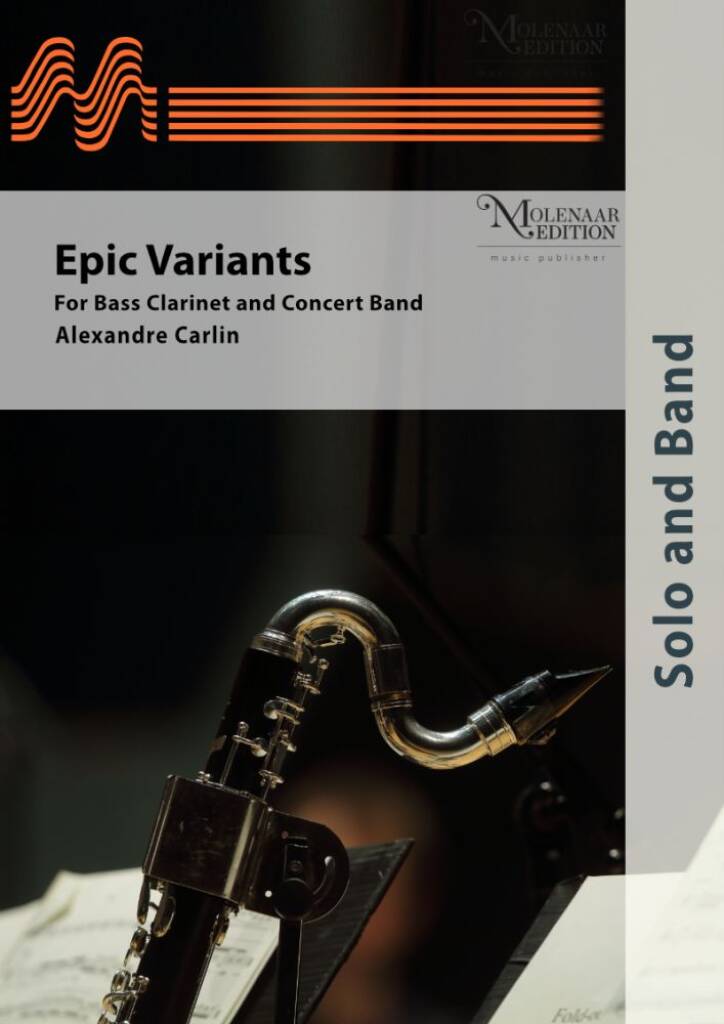
Epic Variants - Alexandre Carlin
Also available for Solo and Piano (060934050)Epic Variants was commissioned for the 1st clarinet day in Anet (France), not far from La Couture-Boussey where the clarinet was first created.The work was premiered in 2022 on may 7th by Didier Pernoit, bass clarinet soloist of the Orchestre Philharmonique de Radio-France, accompanied by the concert Band of B, conducted by the composer.The work is based on a theme harmonized with strong epic chord progressions, exploiting the whole register of the bass clarinet, from dark low sounds to soft higher notes.The piece is in one part, but divided in three different moods, each thematic material being a variation from the first one.
Estimated dispatch 7-14 working days
-
 £244.00
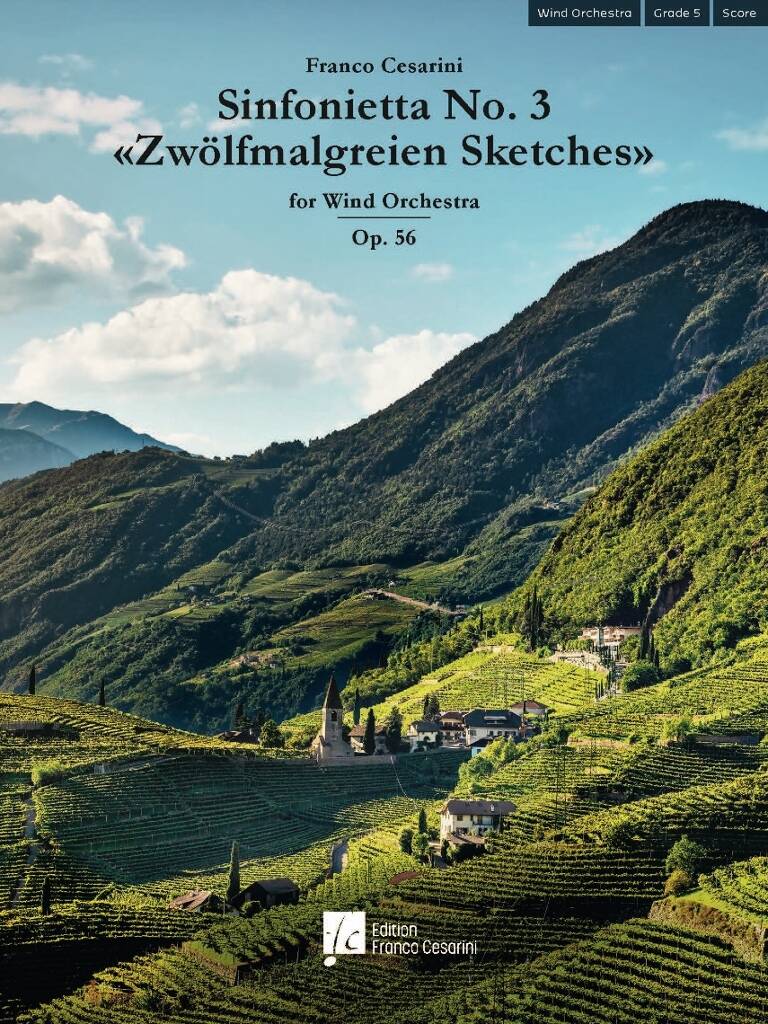
Sinfonietta No. 3 "Zwlfmalgreien Sketches" Op. 56 - Franco Cesarini
In composing the Sinfonietta No. 3 "Zwlfmalgreien Sketches" , Franco Cesarini was inspired by the municipality of Zwlfmalgreien made up of twelve towns, villages and scattered districts which were incorporated into the city of Bolzano (South Tyrol, Italy), over one hundred years ago. The peculiarity of these places, different from each other, but all characterized by rare beauty have contributed to the creation of this 3-movement piece.The first movement - City Life- illustrates activities, tourists and shopping in some of the villages, followed by Mountain Shadowsa slow movement that describes the mountain hamlets where there is little sun in winter. The third and last movement - Classic Vineyards- is lively, in vivid contrast to the previous one. Lots of sun and warmth of the typical wine regions, with echoes of folk dances and Bacchic festivals coming from far away.
Estimated dispatch 7-14 working days
-
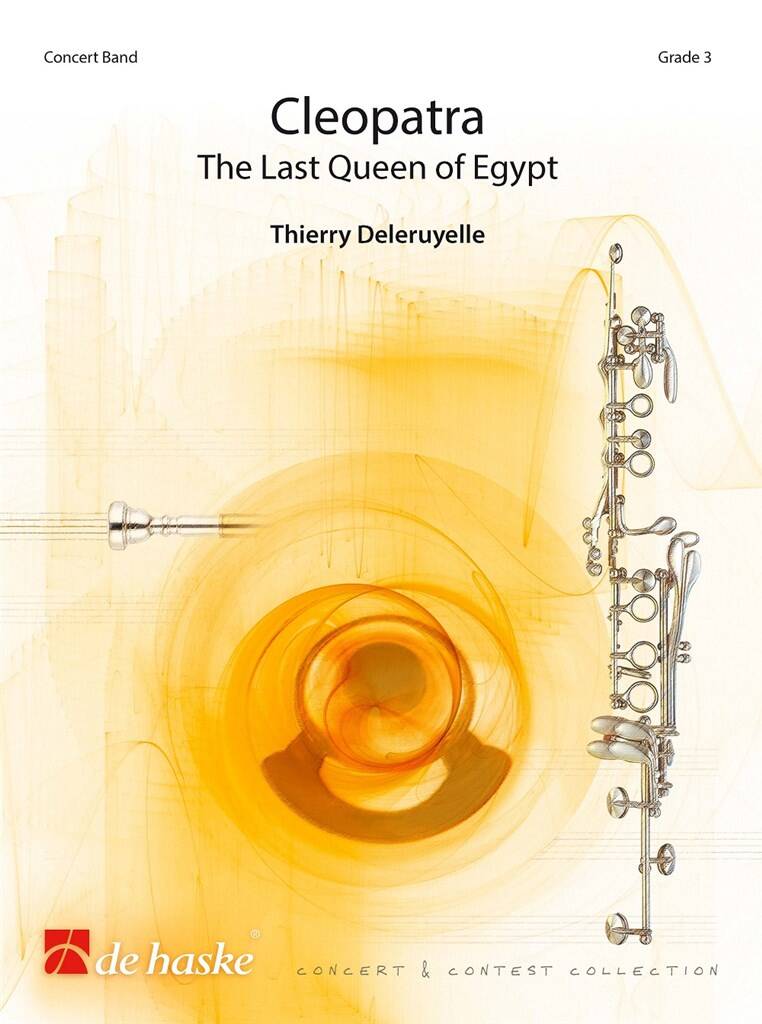 £134.99
Cleopatra - Thierry Deleruyelle
Queen Cleopatra ruled Egypt for over 20 years. She is one of antiquity's best-known women, in particular because of her relationships with Julius Caesar and, above all, Mark-Anthony, but also because the cause of her death remains a mystery. The work is split into three parts and performed without breaks. The first section begins with a bright introduction representing Mark-Anthony. Dynamic in nature and reminiscent of military music, this characterises the Roman general. But soon after, another theme emerges, softer and more melodic, symbolising Cleopatra's femininity. The two characters then combine on a faster tempo. The middle section of the work depicts the love that Mark-Anthony and Cleopatra feel for each other. This passionate relationship lasted ten years and produced three children. This is expressed by a warm and intense theme, just like the beauty of the Egyptian queen. The third and last section opens in a determined and military mood. Mark-Anthony and Cleopatra were often apart, the Roman general was often away on a campaign. They met up in Alexandria to celebrate their triumph. But, as the targets of the jealousy and ambition of Octavius, Julius Caesar's son, the lovers are trapped and await the inevitable conquest of Egypt by the Romans. When Mark-Anthony heard the false news that Cleopatra had committed suicide, he ended his own life. The Queen of Egypt, for her part, was imprisoned shortly afterwards. The two lovers remain one of History's most famous couples. This piece was commissioned by the Wind Orchestra of the town of Antony, near Paris, directed by Philippe Rossignol, to mark its 90th anniversary.
Estimated dispatch 7-14 working days
 View Music