
Results
-
£149.99
Jello, The Colours Of My Soul - Ben Haemhouts
Jello...The Colours of my Soul is an assignment that was written to be a lasting memory of the untimely, dramatic death of a young child. The work came about due to various conversations between the father and the composer whereby the final resultmust be seen as an attempt by the composer to musically translate the feelings of the parents.The first part of the title, "Jello", is a combination of the names of the two children of the commissioner, namely Jelle and Lobcke, and "the Colours of mySoul" are the colours of the soul of the parents who despite the loss of one of their children, continue to cherish their two children. The introduction provides the atmosphere of grieving for the loss, whereby use is made of pure fifths in order toportray the solidarity with nature, as we are familiar with in symphonies by Bruckner. A little later a bit of the first theme is suggested, which develops into a real funeral march.The Dies Irae, as this occurs in Berlioz's Fantastic Symphony (F, E,F, D, E, C, D), forms a leitmotiv through the entire work in order to symbolise the constant battle between life and death.Shortly before the storm-passage, (where a wind machine is used) which announces disaster, fragments from children's songs areplayed to the accompaniment of a rising choir piece from behind the stage, which strengthens the imminent confrontation with death.After the introduction of the two themes in the long introduction, a quick passage follows in which all kinds ofbeautiful memories are recalled. There is story telling, laughing, and dancing. One of the previous children's songs is also cited. The Dies Irea is heard once again, this time short and fast.Bit by bit happy elements are steadily distorted untilseriousness breaks through again, like an unavoidable and unstoppable evil. The entire piece becomes evermore stirring, as if a big climax will follow. At this moment a very long fermata makes a sudden end to the hysterical allegro. The crucialmoment in the work follows...How does one deal with something as tragic as the death of one's own child? Does one mourn for what no longer is and what never will be? Or does one try to cherish the beautiful moments and continue to live with thesecolourful memories?A subdued, dignified choir piece captures the beautiful memories and ends in a positive, hopeful tone.
Estimated dispatch 7-14 working days
-
£69.00
Walking the Dog - George Gershwin
Walking the Dog is one of the many songs George Gershwin wrote for the film "Shall We Dance." George Gershwin at the height of his powers. Instead of the bustling, complex symphonic scores he was now accustomed to writing, it is a simple, elegant little walk, as the title suggests.In the 1937 film, it accompanies a scene of (you guessed it) walking a little dog, aboard the luxurious deck of a cruise ship. Since it was heard in the film, however, the tune has taken on a life of its own and has become a popular piece for clarinetists around the world. In 1960, the song was published as "Promenade." Interestingly, it is also the only part of the film score of "Shall We Dance" that remains - the rest of the film's music unfortunately remains unpublished there are not even any recordings.
Estimated dispatch 7-14 working days
-
£37.95
Rockin Folk Medley
Twinkle, Twinkle Little Star, Lightly Row and Merrily We Roll Along get a fresh new rock treatment in this fun and easily played arrangement by John O'Reilly. Occasional blue notes add a little spice to this special piece which is correlated with the Yamaha Band Student, Book 1, page 12. Your beginners will really rock with this one!
Estimated dispatch 7-14 working days
-
£84.99
Three Holiday Scenes - Timothy Johnson
An imaginative look at a good old-fashioned Christmas! From aromas of family favorites cooking in the kitchen, to the images of decorated trees, snow scenes, and caroling - all are a part of that wonderful celebration.Rather than just taking the same old Public Domain Christmas carols for one more go 'round, Timothy Johnson has composed the majority of THREE HOLIDAY SCENES using fresh and original melodies. The first scene opens with fragments of "Oh Tannenbaum" but quickly moves into a beautiful Christmas waltz. An "effets de neige," or "Snowfall effect," carries the luscious second and contrasting scene. In the 3rd and final scene, the phrases from well-known carols mergewith one another, creating the effect of "caroling." Finally, melodies serve as counterpoint for one another and bring this delightful vignette to a close. This piece presents an excellent opportunity to work with the Art department in creating drawings and paintings of holiday images. Pull your chair a little closer to the fireplace and sit back for a winsome holiday treat!
Estimated dispatch 7-14 working days
-
 £94.99
By the Way - Vladimir Yefremov
Inspiring popular music from the Ukraine. Perhaps one would only expect original folk-music to come out of this part of Europe but nothing could be further from the truth. By the Way is a delightfully swinging little piece which allows you to pull out all stops: a very welcome addition to the popular genre indeed. Your musicians will have great fun in performing this little piece.
Estimated dispatch 7-14 working days
-
 £127.30
Prinsessen p (fj)erten - Haakon Esplo
In this little suite in three movements, your young musicians really can be creative and have fun.Of course, a story must be written about the unfortunate princess who ate pea soup and got to let a small fart. Maybe one or more should dress up and play the princess and other roles? And who will be the lucky one who gets the honourable assignment to be a soloist on a fart cushion - probably for the first time in the history of your band? Maybe all the musicians should have one each?Think what a great finale at the last movement that could be.Good luck!
Estimated dispatch 7-14 working days
-
 £71.50
In The Forest Deep - Barry E. Kopetz
A musical depiction of the sense of mystery and wonder that one experiences while walking deep within the forest. The sky is blocked out by the thickness of the foliage and every shadow seems to have an ominous quality. In short, the forest seems to be alive with a somewhat dark, reserved personality. Silence seems more sinister as every little sound seems to be meaningful and important. The longer one stays, the faster one walks so as to not prolong ones presence "in the forest deep..."
Estimated dispatch 7-14 working days
-
 £76.99
Gilbert & Sullivan (Symphonic Suite)
Symphonic Band - Grade 4 Masters of the operetta, Gilbert and Sullivan left the musical world a legacy of marvelously playful and tuneful songs. This entertaining medley includes We Sail the Ocean Blue and (I'm Called) Little Buttercup from HMS Pinafore, Overture and Three Little Maids from Mikado, and Poor Wand'ring One, I Am the Very Model, and With Cat-Like Tread from Pirates of Penzance. (6:00)
Estimated dispatch 7-14 working days
-
 £244.00
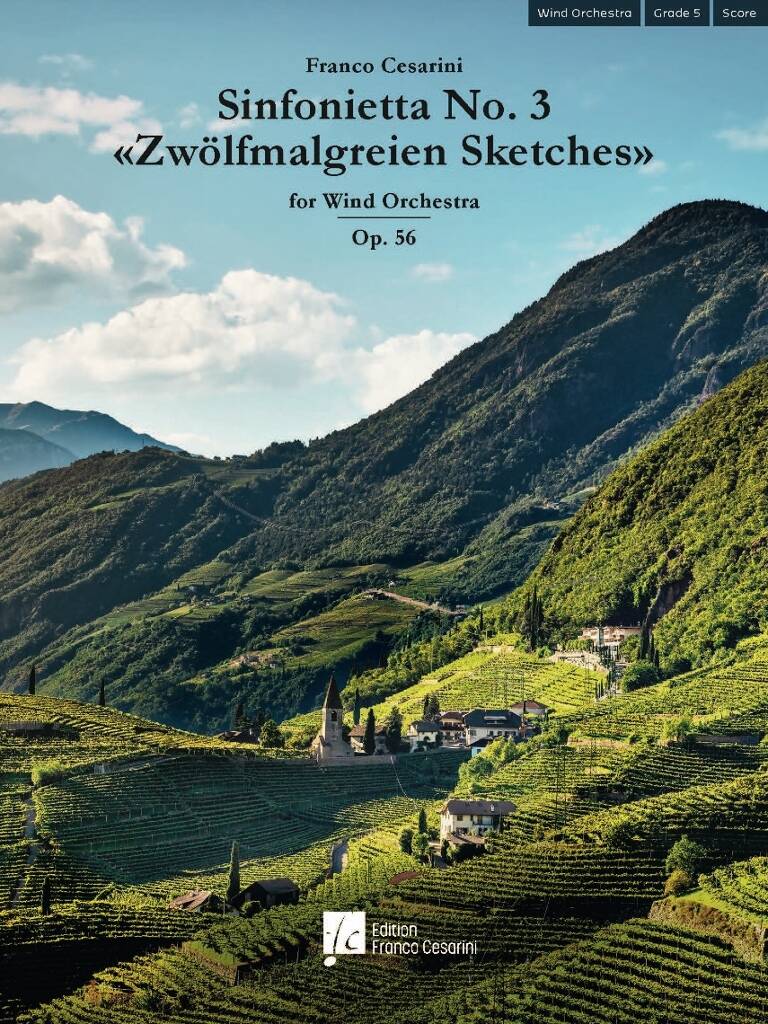
Sinfonietta No. 3 "Zwlfmalgreien Sketches" Op. 56 - Franco Cesarini
In composing the Sinfonietta No. 3 "Zwlfmalgreien Sketches" , Franco Cesarini was inspired by the municipality of Zwlfmalgreien made up of twelve towns, villages and scattered districts which were incorporated into the city of Bolzano (South Tyrol, Italy), over one hundred years ago. The peculiarity of these places, different from each other, but all characterized by rare beauty have contributed to the creation of this 3-movement piece.The first movement - City Life- illustrates activities, tourists and shopping in some of the villages, followed by Mountain Shadowsa slow movement that describes the mountain hamlets where there is little sun in winter. The third and last movement - Classic Vineyards- is lively, in vivid contrast to the previous one. Lots of sun and warmth of the typical wine regions, with echoes of folk dances and Bacchic festivals coming from far away.
Estimated dispatch 7-14 working days
-
 £435.40
Goldberg 2012 - Svein H. Giske
The first time I heard Bach's Goldberg Variations was in the movie Silence of the lambs, in the early 1990s. I noticed the beautiful background music in one of the scenes, but at that time I didn't know what it was. A few years later, when I was studiying at the Grieg Academy, I got to know the entire piece. For me, this is a piece of music which I can listen to countless times. I think it sounds as fresh today as it did more than 15 years ago and it never ceases to inspire me. Both Bach's composition and Glenn Gould's famous 1955 recording (which was the first one I heard) still makes a great impression on me. Before Gould recorded it at age 22, it wasn't a highly ranked piece amongst pianists and Bach was by many viewed as a bit old-fashioned. The young Canadian turned all this around. He managed to portray Bach in a reformed way, producing fine nuances in phrasing and making the many layers in Bach's music more transparent than anyone before him. Thus he plunged both himself and Bach (back) onto the international music scene. When The Norwegian Band Federation (NMF) asked me to write the test piece for NM in 2012, it was only natural for me to use the Goldberg Variations as a starting point and inspiration for my work. Since I was a teenager at NMF's summer courses in the mid eighties I've always listened to many different styles of music. Growing up in Sunnmre with the Brazz Brothers as teachers and mentors, jazz-, pop/rock- and folk music were early on a natural part of my musical background. I also have my classical education from the Grieg Academy on trumpet. As the title of my piece implies, I've wanted to bring Bach to the present and put his music into various modern musical landscapes. I think you can bring about a special kind of energy when music from different genres are mixed and I've tried to do this by mixing Bach with artists and musical styles from the present. In Goldberg 2012, the music is often constructed by several layers, which in a way are living parallel musical lives. They are seemingly moving or floating freely, almost unaware of each other, but bound together by the same basic pulse. The rythms, however, are often notated on a different rythmic subdivision level than the usual 8th- or 16th note levels. By doing this, I hope to achieve transparent sounds that rythmically are perceived as more free and detached from each other. In large sections of the piece, pop/jazz is fusioned with elements from Bach. I guess you could have this little scene as a synopsis for the piece: picture a group of musicians meeting: some are classical performers, some are jazz. They start to improvise together, each in their own voice or musical dialect and I'm sort of in the middle, trying to write down what they are playing. This is what I feel much of Goldberg 2012 is about. The foundation of the piece, in addition to Bach and references from pop/jazz music, lies also in my own material. This material, basically two chords, is heard in it's purest form in the 1st movement. I use these chords to create scales, new chords and different motifs which contribute to blend together the different moods of the piece. It has not been my intention to copy Bach's form (theme and 30 variations), but rather to use the bits and pieces that I like the most as an inspiration for my own variations. The 1st movement, Aria 2, is for my 3rd son, Olav, who was born on the 21st of April 2011, and the 5th movement, From long ago, is dedicated to the memory of my father, Svein J. Giske, who passed away on the 6th of June 2011. -Svein H. Giske, January 2012-
Estimated dispatch 7-14 working days
 View Music