
Results
-
 £89.99
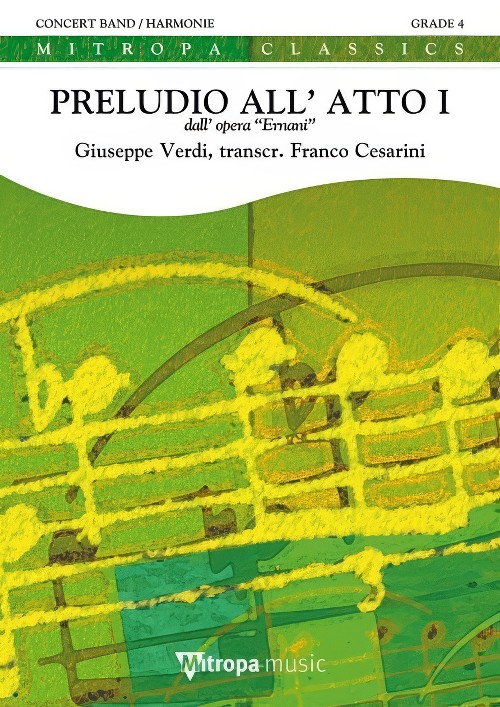
Preludio All' Atto I (Concert Band - Score and Parts) - Verdi, Giuseppe - Cesarini, Franco
Ernani (1844), Giuseppe Verdi's fifth opera, is based on the homonymous tragedy by Victor Hugo. Verdi's success with Ernani, as well as Nabucco and I lombardi alla prima crociata, can be ascribed to two distinct ideas: the melodic idea and the patriotic idea. The melodic idea is very important to move and touch the audience, while the patriotic idea is the source of enthusiasm and emotions. Approximately ten years elapse between two similar stories: the one of the outlaw Ernani and the one of Manrico, the troubadour. In the prelude to Act I, in only three minutes, Verdi has succeeded in skilfully concentrating the main elements of the entire drama. One can clearly observe the themes of love, oath, and death.Duration: 3:00
Estimated dispatch 7-14 working days
-
 £49.95
A Whole New World (From Aladdin) (Concert Band - Score and Parts) - Johnson, Stuart
A number one hit song from a number one movie - ready made for your band by a number one arranger!
Estimated dispatch 7-14 working days
-
£9.95
A Whole New World (From Aladdin) (Concert Band - Score Only) - Johnson, Stuart
A number one hit song from a number one movie - ready made for your band by a number one arranger!
Estimated dispatch 7-14 working days
-
 £84.99
Bread and Games Wind Band Set (Score & Parts)
Panem et Circenses', Bread and Games were essential for keeping the citizens of ancient Rome in check. While the bread was meant for the poorest among the Romans, the Games were Popular Pastime Number One for everybody.There were different kinds of games, such as chariot races (especially popular with female spectators), or wild-beast fights, where lions, tigers, bulls or bears were set on one another or even on human beings. Most popular, however, were the Gladiator fights. In 'Bread and Games' William Vean depicts one of the many fights in the antique Colosseum. 1. Entrance of the Gladiators: By powerful bugle-calls the attention of the people was asked for, after which the Gladiators entered the Arena at the sound of heroic marching-music.2.Swordfight: We can hear that the fights were not mere child's play in this part.On the contrary, they were a matter of life and death and were fought accordingly.3.Mercy of the Emperor: Sometimes a wounded gladiator could be fortunate, depending on the mercy of the audience. Waving one's handkerchief meant mercy, a turned-down thumb meant no pardon. The Emperor had the right to take the final decision, but he usually complied with the wish of the majority of the public. 4.Lap of Honour: Gladiators were mainly selected among slaves, convicted criminals, or prisoners of war. Consequently, winning was very important, as it would mean fame, honour and sometimes even wealth. A lap of honour, therefore, was the winner's due reward. 06:00
Estimated dispatch 7-14 working days
-
 £295.00
Enduring City (Concert Band - Score and Parts) - Glyn, Gareth - Noble, Paul
Enduring City was composed to celebrate the 300th anniversary of the founding of New Bern, the first permanent seat of the colonial government of the state of North Carolina. It was first settled in 1710 by Swiss and German immigrants under the leadership of Christoph von Graffenried and and John Lawson. The 2010 composition was commissioned by the New Bern 300th Anniversary Committee and the City of New Bern, to portray the city in terms of its history, its present and its optimism for the future; the North Carolina Symphony gave its first performances, in venues throughout the state. Its one continuous movement is in well-defined sections. Most of the musical themes derive from names of people and places connected with New Bern, using letters that are also note-names, omitting those which are not. For example, the opening trumpets spell out E-B-E-D for New Bern ('R' standing for Re, which is D in fixed-doh sol-fa notation) and B-C-G for Baron Christoph von Graffenried. They are answered by the orchestra's "John Lawson, Gent.", the name on the cover of the co-founder's A New Voyage to Carolina. Lawson's questing and adventurous character is then suggested, accompanied by a "Carolina" note-name theme; and, after the Graffenried theme on solo horn, the music of both men combines for their voyage, culminating (on trumpets and trombones) in the founding of New Bern. The story of Tryon Palace, central to the city's history, is represented by echoes of the various kinds of music heard at the Governor's residence - fife and drum bands, minuets and the slaves' "Jonkonnu" festivals from Africa, celebratory fanfares and fireworks; the section reaches a climactic ending when all are combined. After a peremptory interruption by the snare drum, the perky fife theme is transformed to portray the conflicts that visited New Bern over the centuries, alternating with a new "grief" theme, which - when sounded by strings alone - leads to music of reconciliation and then of the natural beauty of the city's surroundings. A steady, lively rhythm underpins the final section, confidence - in the present and for the future. Echoes of previous themes are heard, but the closing peroration is reserved for a majestic and joyous statement of the name of New Bern itself.
Estimated dispatch 7-14 working days
-
 £421.99
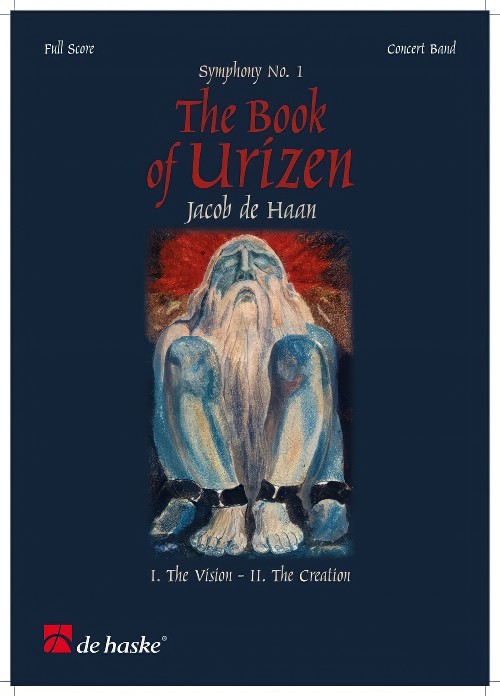
The Book of Urizen (Movements I: The Vision and II: The Creation) (Soprano, Narrator and Concert Band - Score and Parts) - De Haan, Jacob
The Book of Urizen is a work for concert band, solo soprano, and a male narrator in which sound collages of religious expressions are used. The piece is inspired by the compelling visionary poem of the same name (which the poet illustrated himself) by the Englishman William Blake (1757-1827), who occupies a unique position in western literature and the visual arts. He was not just a poet and a writer, but he was also a graphic artist, a painter, an illustrator, a spiritualist, a religious visionary, and a mystic philosopher. For the performance of this work, a professional sound system, including two microphones and a CD player, is needed. The three sound collages are three separate tracks on the enclosed CD and can be played easily at the right moment.The Book of Urizen bears resemblance to Genesis and Exodus, of which the contents form the basis of the Christian, Jewish, and Islamic faith. Blake adhered to the principle that all religions are in fact one, and that deities reside in human beings. In The Book of Urizen this is represented in "The Net of Religion," which is spanned over the earth by Urizen. The sound collages, compiled by Jacob de Haan in the studio, find their origin in Jerusalem, the Holy City, where the afore-mentioned faiths come together.In the first movement of this composition, The Vision, Urizen prepares his vision of the world, and he presents this to the "Eternals." His vision is rejected, and Urizen locks himself up in his own abstract world. When he does emerge again, he is confronted with rage by the gathered Eternals. Urizen flees the wrath of the Eternals, "the flames of eternal fury," and enwombs himself in his own world. When the Eternals see Urizen in his "stony sleep," they wonder if this is death. The blacksmith Los is torn by grief because of the isolation of Urizen. It brings him to rouse his fires, prepare his forge, and to give Urizen's world concrete form.In the second movement, The Creation, Urizen's world, but also man, woman, and child are created. Los is horrified with the appearance of Urizen's body. He mourns and pities Urizen, and from his blood a female form comes into being, with the name Enitharmon. The Eternals, fearful of the female form, decide to erect a tent to obstruct their view to eternity. Enitharmon and Los beget a son, called Orc. Los baptizes him as a child of the "fallen world." Orc is fed at Enitharmon's breast, which makes a girdle of jealousy restrict Los' chest. He takes the child to the top of the mountain and chains him down. The cries of Orc awaken Urizen, who explores his world creating instruments of scientific measurement to do so. Los encircles the face of Enitharmon from the sight of Urizen and Orc. She then populates the earth by giving birth to an enormous race.The Web, the third movement of The Book of Urizen, is available in a separate set.
Estimated dispatch 7-14 working days
-
 £159.99
Guardian Angels (Concert Band - Score and Parts) - Houben, Kevin
Guardian Angels gives a musical expression to the legend of Reverend Louis Henri Bahler referring to the use of Psalm 34. North-west Veluwe and in particular Oldebroek (The Netherlands) has a very rich religious tradition which is demonstrated by its monumental churches. They tell the story of a stirring history in which Reverend Bahler played a crucial role. Inspired by his arrival as a pastor in 1870 in the neighbouring Oosterwolde, two big religious communities came into existence with their characteristic churches but this rivalry also resulted in great social unrest. This composition reflects on this striking personality and in particular on the story of the Angel Guard. 'One evening Reverend Bahler has given a sermon in Oldebroek and he walks over the Church path through the pastures to Oosterwolde. On this dark and stormy evening Bahler's opponents are waiting for the pastor in ambush. They want to drown him in a watercourse near the Church path but abandon their plan because Bahler is accompanied by two men. The next day it comes to an encounter between Bahler and his opponents. They repent their, fortunately unexecuted, plan. Bahler firmly believes that on the previous night he walked alone over the Church path, and was not accompanied by two men. It was concluded that it must have been the angels who had protected Bahler.' Psalm 34 is central to this composition and this because of its powerful melody but also because the lyrics of verse 4 of the rhymed version fit in well with the special legend of Reverend Bahler: The Lord's angel gathered round him An invincible heavenly guard, Who tries God's will, around him So he's well guard(ed) A second melodious and harmonic cell is a musical transformation of the name 'Bahler'. This cell is varied in major and minor third chords and sometimes used as the main idea or apotheosis, but also serves as an accompanying cell or as a bridge between other melodic and rhythmic constructions. The composition was made possible by contributions of: Mr Evert van de Poll, owner of the Van Gelder Groep, Het Prins Bernhard Cultuurfonds Gelderland en Het Feteris Oosterbaan Fonds. Duration: 16.30
Estimated dispatch 7-14 working days
-
 £407.00
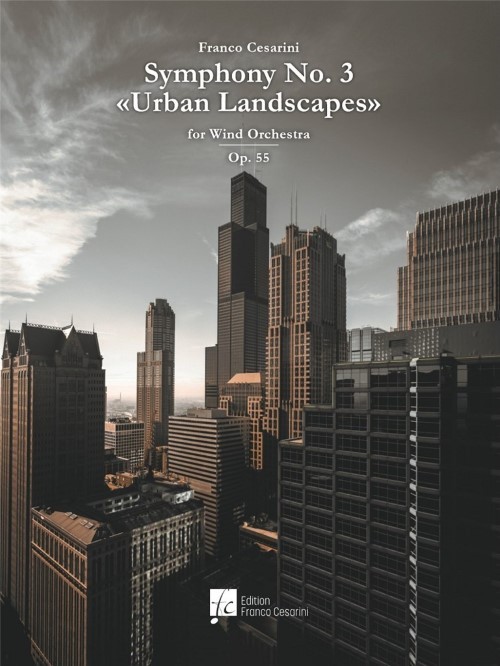
Symphony No.3 (Urban Landscapes) (Concert Band - Score and Parts) - Cesarini, Franco
Fascinated by the beauty of Chicago, Franco Cesarini has translated his emotions into music: this is how Symphony No. 3 "Urban Landscapes" Op. 55, was born, a musical portrait of this metropolis overlooking Lake Michigan. The composition is divided into three movements: The Wrigley Building from Dawn to Noon, Blue Silhouette and Cloud Gates, which by sharing the same thematic material arranged in cyclical form, strengthen the overall cohesion of the piece. The first movement, preceded by a short slow introduction in which the main theme is presented in an almost dreamlike form, metaphorically represents the city at dawn. The sudden change of time symbolizes the start of activities with all its noises and sounds: you can hear the bell that announces the closing of the subway doors, the sound of cars speeding by, the siren of a patrol car. If the first movement represents the day, the second introduces a nocturnal environment: a melancholic melody played by the English horn anticipates a more animated tempo depicting melodies coming from jazz clubs. Powerful fanfares that take up the second theme of the first movement introduce the third movement. In this finale, the role of the two themes is reversed compared to the first movement and one takes the place of the other in a kind of games of mirrors. Symphony No. 3 "Urban Landscapes" Op. 55: a sumptuous musical portrait of the "Windy City". Duration: 27.00
Estimated dispatch 7-14 working days
-
 £224.99
Lux Futura (Concert Band - Score and Parts) - Houben, Kevin
Lux Futura (Light of the Future) was commissioned by the Royal Wind Orchestra Delft and is inspired by the letters 'D-E-L-F-T' using the letter notation system by B?la Bart?k. In this 'Delft' cell, there is referral to the 'Trinitas', the bourdon bell of the Old Church in Delft, that only tolls during a funeral of a member of the Dutch Royal Family. The Delft melody switches to the 'Agneta March', which is a reference to the history of the Royal Wind Orchestra Delft. Further on the love theme, played by the bass instruments represents the love of the inhabitants for their city throughout space and time. In the middle movement, the beauty of the city is depicted by the cor anglais (English horn) solo, as an ode to the lovely city of Delft. When performed, one can choose to use sound city samples recorded in Delft to create a truly magnificent spectacle. Duration: 17.00
Estimated dispatch 7-14 working days
-
 £75.00
As With Gladness Men of Old (Concert Band with Optional Choir - Score and Parts) - Noble & Willcocks
As with Gladness Men of Old is an Epiphany hymn, written by William Chatterton Dix on 6 January 1859 (Epiphany) while he was ill in bed. Though considered by many as a Christmas carol, it is found in the Epiphany section of many hymnals and still used by many churches. The music was adapted by William Henry Monk in 1861 from a tune written by Conrad Kocher in 1838. The hymn is based on the visit of the Biblical magi in the Nativity of Jesus. The hymn used Matthew 2:1-12 as a theme to compare the journey of the Biblical magi to visit the baby Jesus to each Christian's personal pilgrimage and as a reminder that it is not the value of the gifts, it is the value of giving and adoration to Jesus that is what Christians should seek. It is the only well-known Epiphany hymn or carol about the Biblical magi that avoids referring to them as either magi or kings and does not state how many there were. This arrangement represents one in the Series of Band Arrangements compatible with David Willcocks' Carols for Choirs.
Estimated dispatch 7-14 working days
 View Music