
Results
-
 £84.99
Remembrance Day - Jacob de Haan
Remembrance Day (Totengedenken) is a chorale-like piece in memory of those who have died in service. Jacob de Haan composed this work for a concert by the symphonic wind orchestra Symphonic Winds, which he conducted in Germany on Volkstrauertag (national remembrance day). The composition is based on a text from Totengedenken (Commemoration of Those Who Have Died). This narrative text is provided in four languages, and is intended to be spoken (using a microphone) ad libitum during the performance. Choir parts are also available to complement the performance.
Estimated dispatch 7-14 working days
-
 £84.99
Monterosi - Jacob de Haan
Monterosi is a village in the Italian province of Viterbo in the Lazio region. This work is dedicated to the Accademia Musicale Francigena in Monterosi, on the occasion of the third 'Tommaso Albani' a national concert band competition at which the composer is often an adjudicator and guest conductor. It is a solemn piece, with lyrical tendencies, which demonstrates the glorious, full sound of the concert band.
Estimated dispatch 7-14 working days
-
£104.99
Fanfare Legend One - Eiji Suzuki
Following a successful appearance at a national competition a leading Japanese concert band commissioned the composition of this new work. The presentation of the main theme at the beginning of the piece, along with its eventual development and variations in the middle section, represents a very personal message for the band. It symbolises both the joy felt following the success at the competition and looks forward to further successes in the future. An inspiring work which celebrates the success of any band.
Estimated dispatch 7-14 working days
-
 £189.99
Flashback - Jan de Haan
A flashback is an interesting psychological phenomenon: a seemingly random trigger can bring back long-forgotten memories from the subconscious mind. The composer underwent a similar experience before writing this piece. He was asked to write a piece for The National Youth Fanfare Band in the Netherlands, one which he heard perform many years ago. All of a sudden he remembered Deep Harmony, a piece frequently programmed back then. He used his own flashback-experience as an inspiration to weave an old English hymn into his new composition, much like a musical flashback. The right idea at the right moment, as this piece will prove!
Estimated dispatch 7-14 working days
-
 £139.99
Lorraine - Jacob de Haan
This moving symphonic poem is about the French region of Lorraine. Since the time of the Roman Empire, Lorraine has been ruled by either Germany or France with wars redrawing national boundaries many times over the years. While its history has been bloody, folk music from the region breaks up the tension in the piece and offers many uplifting moments. An optimistic conclusion features a mixture of music from the three countries Lorraine sits between: Luxembourg, Germany and France.
Estimated dispatch 7-14 working days
-
 £84.99
River City - Jacob de Haan
Sacramento, in the American state of California, is also known as River City - which is also the name of the concert band that commissioned Jacob de Haan to write this sonorous, lyrical work on the occasion of the 37th Annual ACB National Convention, which took place in 2015 in Rancho Cordova. All of the fun that the musicians will have with the rich melodic material provided for all instrument groups will immediately radiate into the audience!
Estimated dispatch 7-14 working days
-
 £104.99
Hine e hine
E tangi ana cow, Hine e Hine ... Do not cry, girl, do not cry ... Every culture has its own melodies to comfort children to sleep. Jan Gerrit Adema made a beautiful arrangement of this lovely folk melody of the Maori, also called the national anthem of New Zealand.
Estimated dispatch 7-14 working days
-
 £104.99
Ever so samba - Peter Martin
The rhythm of the samba was originally created in Africa and brought to Brazil by the slaves . Here it became the national dance. For every festive occasion and especially the carnival festivities (Rio de Janeiro) samba music is played. The World's Fair in New York (1939) was the reason to the biggest spread of the samba. The trumpet section gets an opportunity to feature in Ever so Samba. Together with the swinging percussion section they let you enjoy a South American party.
Estimated dispatch 7-14 working days
-
 £154.99
The Fever Tree - Rob Goorhuis
The composition ".The Fever Tree". in 2008 was commissioned by the Music Association of Central and Eastern Netherlands St.Willibrord as a gift to all its members on the occasion of the formation of a national music organization and the elimination of the music union for Central and Eastern Netherlands St.Willibrord. The fever tree is a controversial legend about St. Willibrord (658-739). The daughter of a pagan chieftain of Hoemannen that made the area around Heumen unsafe, was seriously ill. They feared for her life. The chief of the gang turned to predatory Willibrord, who same time in this region led mission. Willibrord commanded theman to repent and a headband of the girl to a certain special tree to hang. The desperate captain obeyed, and his daughter was a miraculous heal. Then came the anger of the Hoemannen against their leader, who in their eyes had committed treason by the group to convert. They abused themselves to him and killed him brutally. The daughter remained behind in great sorrow, comforted by Willibrord. The composition has the following scenes: - Andante moderato - the calling of Willibrord - Allegro moderato - Willibrord passes through the province of Brabant and try to people to repent - Vivace - Hoemannen terrorize the inhabitants of the area Heumen - Andante - the healing of the sick girl and the conversion of the centurion - Inquieto - the revenge of the Hoemannen - Adagio - elegy on the death of the chief
Estimated dispatch 7-14 working days
-
 £104.99
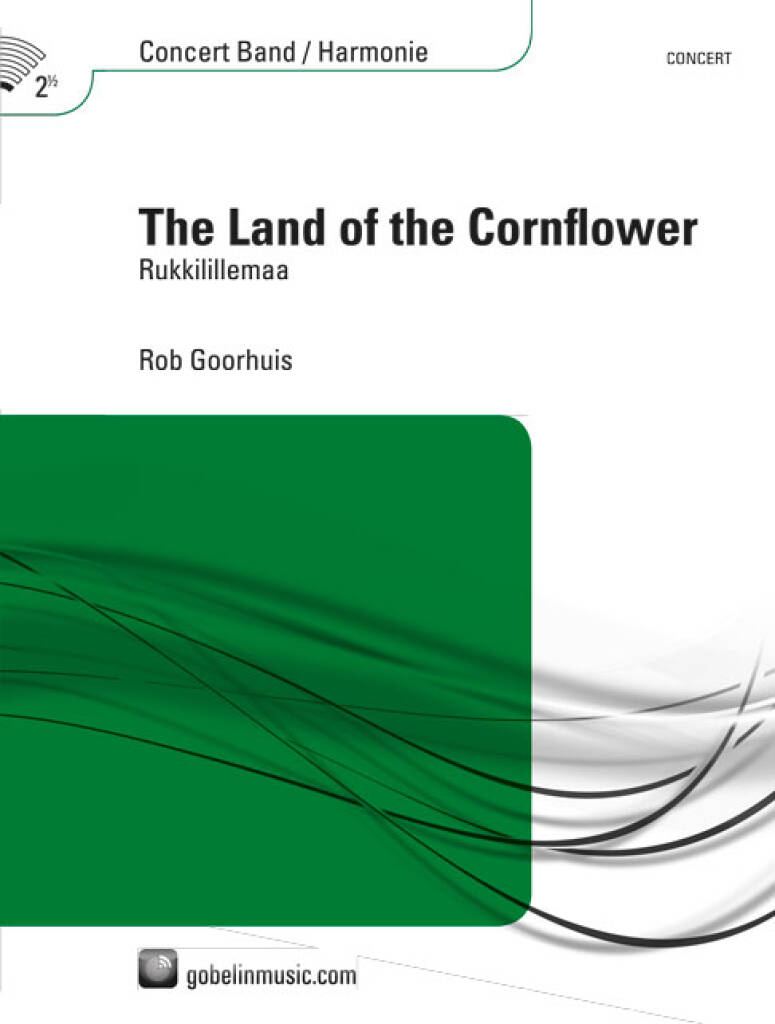
The Land of the Cornflower - Rob Goorhuis
During the Soviet era the national flower served as a symbol of resistance. In The Land of the Cornflower, Rob Goorhuis paints an impression of Estonia and then features the traditional folk song melodies Kohaanuka, Minoorne labajalgand Padespaan.
Estimated dispatch 7-14 working days
 View Music