
Results
-
 £264.99
Panoptikum - Thomas Doss
Armin Schaer commissioned this work in his search for a new piece for the tuba. More specifically, he wanted a work that showed off the versatility of this splendid instrument, written in a musical style that is both fresh and modern, while not banishing the orchestra to a simple supporting role. Taking all these specifications into account, Thomas Doss created a work that allows stylistic leaps and is fun, exciting, romantic, and virtuosic, but does not lose sight of the thread that connects the opening measures to the very last.Armin Schaer describes his Panoptikum as follows:Panoptikum is a show of appreciation for my beautiful home and community at LakeConstance, an eventful life, the people that have enriched this life, and a fascinating instrument: the tuba. This work musically embodies the many different moods found around theBodensee - cheerfulness and melancholy, departures and longing, calm and agitation. The roles of the soloist and the orchestra were consciously crafted in a way that does not follow the usual conventions of the genre. The work should spark emotions, address broad segments of listeners, and persuade them of the tuba's ability to be a solo instrument as well as the richness symphonic wind ensembles have to offer. I hope this work enriches the lives of all the soloists and orchestras that cross its path, as well as everyone in the audience who gets to partake!
Estimated dispatch 7-14 working days
-
 £202.99
Gloriosa - Symphonic Poem for Band Movement 1 - Yasuhide Ito
A new acquisition by Bravo Music, this fresh printing of the 1990 masterwork by Yasuhide Ito features a newly engraved score, improved parts, good availability and value. This stirring and powerful homage to early Christianity in Japan profoundly and eloquently states the case of cross-cultural conflict and resolution.I. OratioThe Gregorian chant "Gloriosa" begins with the words, "O gloriosa Domina excelsa super sidera que te creavit provide lactasti sacro ubere." The first movement Oratio opens with bells sounding the hymn's initial phrases. The movement as a whole evokes the fervent prayers and suffering of the Crypto-Christians.II. CantusIII. Dies FestusCommissioned in 1989 and premiered in 1990 by the Sasebo Band of the Maritime Self-Defense Force of Kyushu, southern Japan.Gloriosa is inspired by the songs of the Kakure-Kirishitan (Crypto-Christians) of Kyushu who continued to practice their faith surreptitiously after the ban of Christianity, which had been introduced to that southern region in the mid-16th century by Roman Catholic missionary Francisco Xavier. The worship brought with it a variety of western music.Though Christianity was proscribed in 1612 by authority of the Tokugawa Shogunate in Edo (today Tokyo), Kakure-Kirishitan continued advocating sermons and disguised songs. Melodies and lyrics such as Gregorian chant were obliged to be "Japanized". For example, the Latin word "Gloriosa" was changed to "Gururiyoza." This adaptation of liturgy for survival inspired Ito to write this piece in order to reveal and solve this unique cultural mystery.The composer explains:"Nagasaki district in Kyushu region continued to accept foreign culture even during the seclusion period, as Japan's only window to the outer world. After the proscription of Christianity, the faith was preserved and handed down in secret in the Nagasaki and Shimabara areas of Kyushu region. My interest was piqued by the way in which the Latin words of Gregorian chants were gradually `Japanized' during the 200 years of hidden practice of the Christian faith. That music forms the basis of Gloriosa."Gloriosa, fusing Gregorian chant and Japanese folk music, displays the most sophisticated counterpoint yet found in any Japanese composition for wind orchestra.
Estimated dispatch 7-14 working days
-
£209.99
Gloriosa - Symphonic Poem for Band Mvt 2 & 3 - Yasuhide Ito
A new acquisition by Bravo Music, this fresh printing of the 1990 masterwork by Yasuhide Ito features a newly engraved score, improved parts, good availability and value. This stirring and powerful homage to early Christianity in Japan profoundly and eloquently states the case of cross-cultural conflict and resolution.I. OratioThe Gregorian chant "Gloriosa" begins with the words, "O gloriosa Domina excelsa super sidera que te creavit provide lactasti sacro ubere." The first movement Oratio opens with bells sounding the hymn's initial phrases. The movement as a whole evokes the fervent prayers and suffering of the Crypto-Christians.II. CantusIII. Dies FestusCommissioned in 1989 and premiered in 1990 by the Sasebo Band of the Maritime Self-Defense Force of Kyushu, southern Japan.Gloriosa is inspired by the songs of the Kakure-Kirishitan (Crypto-Christians) of Kyushu who continued to practice their faith surreptitiously after the ban of Christianity, which had been introduced to that southern region in the mid-16th century by Roman Catholic missionary Francisco Xavier. The worship brought with it a variety of western music.Though Christianity was proscribed in 1612 by authority of the Tokugawa Shogunate in Edo (today Tokyo), Kakure-Kirishitan continued advocating sermons and disguised songs. Melodies and lyrics such as Gregorian chant were obliged to be "Japanized". For example, the Latin word "Gloriosa" was changed to "Gururiyoza." This adaptation of liturgy for survival inspired Ito to write this piece in order to reveal and solve this unique cultural mystery.The composer explains:"Nagasaki district in Kyushu region continued to accept foreign culture even during the seclusion period, as Japan's only window to the outer world. After the proscription of Christianity, the faith was preserved and handed down in secret in the Nagasaki and Shimabara areas of Kyushu region. My interest was piqued by the way in which the Latin words of Gregorian chants were gradually `Japanized' during the 200 years of hidden practice of the Christian faith. That music forms the basis of Gloriosa."Gloriosa, fusing Gregorian chant and Japanese folk music, displays the most sophisticated counterpoint yet found in any Japanese composition for wind orchestra.
Estimated dispatch 7-14 working days
-
 £84.99
A Copland Portrait - David Conte
Originally commissioned by maestro Neal Gittleman, A Copland Portrait was premiered by the Dayton Philharmonic Orchestra in January 2000. In March of 2015, First Lieutenant Ryan Nowlin's transcription of this work for band was premiered by "The President's Own" United States Marine Band under the direction of Lieutenant Colonel Jason Fettig. ECS Publishing is proud to offer both the band and the orchestra version. Conte on the creation of this overture: "I set out quite consciously to evoke various aspects of Copland's work by combining and recombining them within the terms of my own musical personality. For example, the first theme of A Copland Portrait combines the character of a theme from The Red Pony with the rhythmic texture of the scherzo of the Third Symphony. While composing the piece I was conscious of drawing inspiration from many of Copland's works; a melodic shape here, a harmonic gesture there, until I arrived at something that felt fresh and new to me. A Copland Portrait is cast in a traditional Sonata-Allegro form. After a vigorous, syncopated orchestral tutti, the first theme is announced in the solo oboe, accompanied by a steady eighth-note ostinato. Playful interjections are stated in the flute and bassoon. The syncopated tutti returns; the first theme is stated again, this time in the low winds. This theme builds to a colorful climax, leading into a more dissonant transition section, which gradually slows and gives way to a lilting, more lyrical second theme in the clarinet. After some modest development of the second theme, a more plaintive theme stated in the muted trumpet brings the exposition to a close. A scherzando development section follows; the first four notes of the first theme are inverted and subjected to various contrapuntal treatments. This development section ends with a return of the opening syncopated motive, leading into a recapitulation of the first theme, this time in canon, and the second theme and closing theme, broadly sung. A brilliant toccata-style coda brings A Copland Portrait to a brisk conclusion."
Estimated dispatch 7-14 working days
-
 £274.99
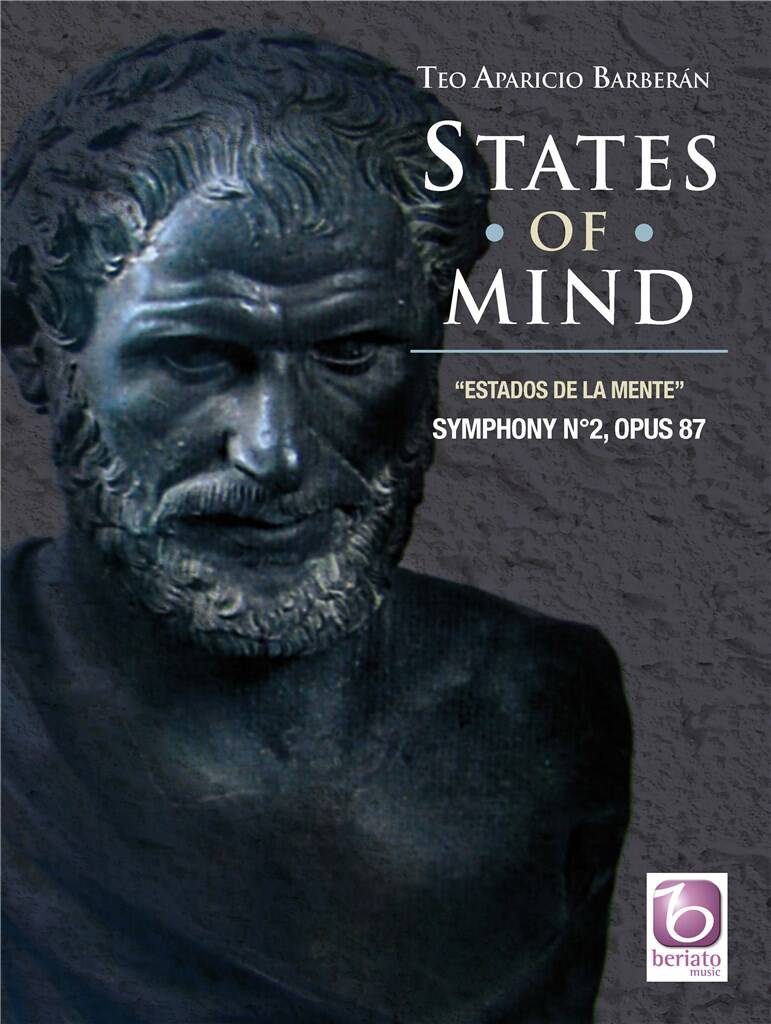
Symphony No. 2: States Of Mind, Opus 87 - Teo Aparicio-Barberán
I- Logos (reason)II- Pathos (emotion)III- Ethos (credibility)The ancient Greeks believed that music shaped the character of man. In Egyptian temples, music was an essential part of the magical rites to alter the course of nature or to treat illness.And today we know that sound can actually alter matter. The secret of music lies in harmony and mathematics, as many great musicians and experts have always known.One of the most important qualities of music is that it enables the listener to focushis attention inwards instead of on what is around him. It is indisputable that music can inspire emotion. Music leads us into a universe of emotions that are difficult to put into words. In short, music reaches into corners of our soul and thoughtsthat words cannot reach and makes it possible to more clearly describe these different States of mind.The composer of this symphony also believes that each "musical argument" must be constructed so that it will induce the desired reaction in thelistener.Music: more than wordsIn recent times, most orchestral symphonies have been based on a story, a text or something similar so that their composition must be structured accordingly.The intention of this work by Teo Aparicio-Barbern is quitedifferent. The composer describes the three elements of the argument as the only formal structure of the work. Since certain philosophers in world history were able to subdivide grammatical argument, why shouldnt that also be possible for the musicalargument?Since ancient times the power of the spoken word has captivated mankind. How can an argument move people and mobilise the masses? Where does the power of words come from today? The answer lays not so much in what people say but in how theysay it.Rhetoric is one of the oldest humanist disciplines in Western civilisation. Aristotle, in the 4th century BC, called it the art of persuasion. Indeed, the terms rhetoric and persuasion are mutually interchangeable.More than 2000 years agoAristotle structured his rhetoric according to the following three elements: the logos, the pathos and the ethos.Logos (words, reason) is the reasoning that gives freedom to the structure of the text by expressing what one wishes to say usingspecialist terms. With logos we create arguments to receive public approval and to defend our ideas.Pathos, the second element, refers to the effective use of public psychology. Pathos can be considered as the capacity to induce the desired emotionalresponse in the public, by creating an emotional connection with the public so that they accept our message.The third element, ethos (credibility), refers to the character of the speaker and is perhaps the most important of the three elements.Aristotle based his concept of ethos upon his belief that truth and justice will always have the upper hand over anger. He believed that what was true and good was easier to prove and was more persuasive.This second orchestral symphony from thecomposer from Enguera follows these three parameters of the argument according to Aristotle. Each movement tries to summon a different state of mind in the listener so that the message itself can be better understood and appreciated. Apart from thesethree general concepts the music is only structured, as Claude Debussy would say, in a "formative way".The first movement, logos, is based on a scherzo melody that undergoes various changes in rhythm and harmony. The arguments are presented by meansof conventional techniques of composition. The second movement, pathos, is characterised by suggestions of sound. It is subdivided into two large parts. The first part is based on a five seven sequence with five sounds that are repeated in differentenvironments, structures and dynamics. The second part, which is largely tonal, brings out more directly the emotional overtones that each argument must have. The third movement, ethos, is a faithful rendition of the composers personality. In thislast part, clear rhythmic sequences stand out, there are large dynamic contrasts and lots of tone variation. In addition, and this is quite in keeping with the composers earlier work, the harmony in States of Mind is handled in a manner that is bothoriginal and efficient, as a result of which Aparicio-Barberns message is well understood by the listener.This second symphony by Teo Aparicio-Barbern is devoted to "my dear Henrie Adams, a guiding light in this eternally dark musical world. Thankyou for everything."
Estimated dispatch 7-14 working days
-
 £349.99
Gloriosa - Symphonic Poem for Band (Complete) - Yasuhide Ito
A new acquisition by Bravo Music, this fresh printing of the 1990 masterwork by Yasuhide Ito features a newly engraved score, improved parts, good availability and value. This stirring and powerful homage to early Christianity in Japan profoundly and eloquently states the case of cross-cultural conflict and resolution.I. OratioThe Gregorian chant "Gloriosa" begins with the words, "O gloriosa Domina excelsa super sidera que te creavit provide lactasti sacro ubere." The first movement Oratio opens with bells sounding the hymn's initial phrases. The movement as a whole evokes the fervent prayers and suffering of the Crypto-Christians.II. CantusIII. Dies FestusCommissioned in 1989 and premiered in 1990 by the Sasebo Band of the Maritime Self-Defense Force of Kyushu, southern Japan.Gloriosa is inspired by the songs of the Kakure-Kirishitan (Crypto-Christians) of Kyushu who continued to practice their faith surreptitiously after the ban of Christianity, which had been introduced to that southern region in the mid-16th century by Roman Catholic missionary Francisco Xavier. The worship brought with it a variety of western music.Though Christianity was proscribed in 1612 by authority of the Tokugawa Shogunate in Edo (today Tokyo), Kakure-Kirishitan continued advocating sermons and disguised songs. Melodies and lyrics such as Gregorian chant were obliged to be "Japanized". For example, the Latin word "Gloriosa" was changed to "Gururiyoza." This adaptation of liturgy for survival inspired Ito to write this piece in order to reveal and solve this unique cultural mystery.The composer explains:"Nagasaki district in Kyushu region continued to accept foreign culture even during the seclusion period, as Japan's only window to the outer world. After the proscription of Christianity, the faith was preserved and handed down in secret in the Nagasaki and Shimabara areas of Kyushu region. My interest was piqued by the way in which the Latin words of Gregorian chants were gradually `Japanized' during the 200 years of hidden practice of the Christian faith. That music forms the basis of Gloriosa."Gloriosa, fusing Gregorian chant and Japanese folk music, displays the most sophisticated counterpoint yet found in any Japanese composition for wind orchestra.
Estimated dispatch 7-14 working days
-
 £64.99
Hot Latin!
Contemporary Latin has hit the pop charts in a big way. Here's a great medley of some of today's hottest tunes. Includes: I Need To Know (Marc Anthony), If You Had My Love (Jennifer Lopez), Mambo No. 5 (Lou Bega) and Smooth (Santana).
Estimated dispatch 7-14 working days
-
 £118.99
The Best of Earth, Wind & Fire
Earth, Wind & Fire was formed by jazz drummer Maurice White, whose aim was to mix various music styles to produce a unique sound. Combined with excellent song writing and fine performances this sound made Earth, Wind & Fire one of the most influential soul groups of the seventies. In subsequent decades they experienced varying success but this medley reflects the heyday of this legendary group. In his job as staff arranger with the Royal Marine Band of the Dutch Navy, Peter Kleine Schaars wrote many top class arrangements. The talent of the musicians in the band made it possible to write in such a way that they closelyresembled the original works. Consequently this medley shines just like the original versions by Earth, Wind & Fire. Four famous songs have been used: 'In the Stone', 'Got to Get You into My Life', 'After the Love Has Gone' and 'September'.
Estimated dispatch 7-14 working days
-
 £73.54
Temperamental (Concert Band) Fendall Hill
This work by Fendall Hill was the set test for the 2021 National Brass Band Championships of New Zealand, B Grade. Here it has been adapted for Concert Band. The composer writes: 'J.S. Bach (1685-1750) is deemed by many to be the 'Ulimate Composer'. He added an incredible proportion to the DNA of western music, and his influence is heard in the music of today. Like many artists, he was not overly recognised as a composer during his lifetime, and it took an 1829 performance of the St Matthew Passion by Mendelssohn to ignite a recognition of his place in the music world, a place he has maintained ever since. This piece starts with a similar spark of rediscovery of the music of Bach. It contains arrangements of various works, interspersed with composition based on Bach's chord structures, sections in the style of Bach, and original sections inspired by the moods created along the way. The first section explores the Toccata, and great organ works. This leads into an exploration of his choral works, and a finale based on the Preludes. The word 'Tempered' has different meanings, and all seem to apply to the music of Bach, and these appeal to the musical, engineering and spiritual aspects of my personal life. His music reaches to the humanity and divinity, it has strength, structure and order that creates frameworks in which incredible complexity reigns; and the complexity leads to a wildness, a kind of craziness that represents a range of human moods, and can change without warning. The same piece of music affects people in very different ways. I don't know if it's Bach's music, or us, but it can seem out of control and under control at the same time - the combination is highly temperamental. To view a follow-the-score video of the work please visit: https://youtu.be/6CtYZmCoWIc Sheet music available from: UK: www.wind-band-music.co.uk USA: www.solidbrassmusic.com Difficulty Level: Advanced Instrumentation: Instrumentation: Piccolo Flute 1-2 Oboe Bassoon Clarinet in Bb 1-3 Bass Clarinet in Bb Alto Saxophone 1-2 Tenor Saxophone Baritone Saxophone Trumpet in Bb 1-3 Horn in F 1-4 Trombone 1-2 Bass Trombone Euphonium Tuba Double Bass Timpani Percussion 1-3
In stock: Estimated dispatch 1-3 days
-
 £118.99
Goodnight Moon (Concert Band - Score and Parts) - Whitacre, Eric - Markowski, Michael
"Over the past few years I must have read Goodnight Moon to my son a thousand times - maybe more. Somewhere around reading number 500, I began hearing little musical fragments as I read, and over time those fragments began to blossom into a simple, sweet lullaby. I knew it was a long shot, but I asked my manager, Claire Long, to contact HarperCollins and see if they would allow the text to be set to music. To my surprise and delight they agreed - the first time they had ever allowed Goodnight Moon to be used in such a way. I composed the piece relatively quickly, originally setting the text for harp, string orchestra, and my son's mother, soprano Hila Plitmann. I later arranged Goodnight Moon for SATB choir and piano. More recently, my dear friend Verena M?senbichler-Bryant arranged the piece for wind ensemble and soloist. The melody of Goodnight Moon will forever make me think of those quiet nights, reading my son to sleep." -Eric Whitacre
Estimated dispatch 7-14 working days
 View Music