
Results
-
 £104.99
Ballabili (Concert Band - Score and Parts) - Verdi, Giuseppe - Van der Beek, Wil
Giuseppe Verdi's opera Macbeth was written in 1846/47 and premiered in Florence. It is based on Shakespeare's Macbeth and, unlike Verdi's other operas, had relatively little broad impact. This may be due to the difficulty of the singing voices, the lack of a love story or the dark mood, without humorous scenes.Musically, however, this opera is not uninteresting. Among other things, all the dramatic highlights culminate in artistically built ensembles. It also contains interesting instrumental effects, such as a wind orchestra under the stage in the witch scenes. This makes the witches and air spirits seem like from another world. In the 19th century opera, such a wind band, a so-called "banda" was not uncommon but an integral part of the scene.The Ballabili comes from Act III of Verdi's opera MacBeth. Ballabili is the plural of the Italian ballabile, meaning "danceable." It can also mean a dance performed by the corps de ballet, or by the chorus in an opera; or the music to accompany this dance.Duration: 2:15
Estimated dispatch 7-14 working days
-
 £84.99
Anitschka (Concert Band - Score and Parts) - Nijs, Johan
The 'czardas' Anitschka depicts the love story of a Hungarian and a gipsy girl called Anitschka. She is not easily seduced by her admirer, but perseverance prevails in this musical tale: all's well that ends well.Duration: 3.00
Estimated dispatch 7-14 working days
-
 £54.95
PRINCE IVAN AND VASELISA (Concert Band) - Lucas, Elena Roussanova
The inspiration for this original work came from the traditional Russian fable based on the romance between Prince Ivan and Vaselisa. With contrasting themes presented for both the handsome Prince Ivan and the lovely Vaselisa, the work musically depicts their love story. A stunning musical choice intertwining the two diverse musical themes. Duration 4:41
Estimated dispatch 7-14 working days
-
 £225.99
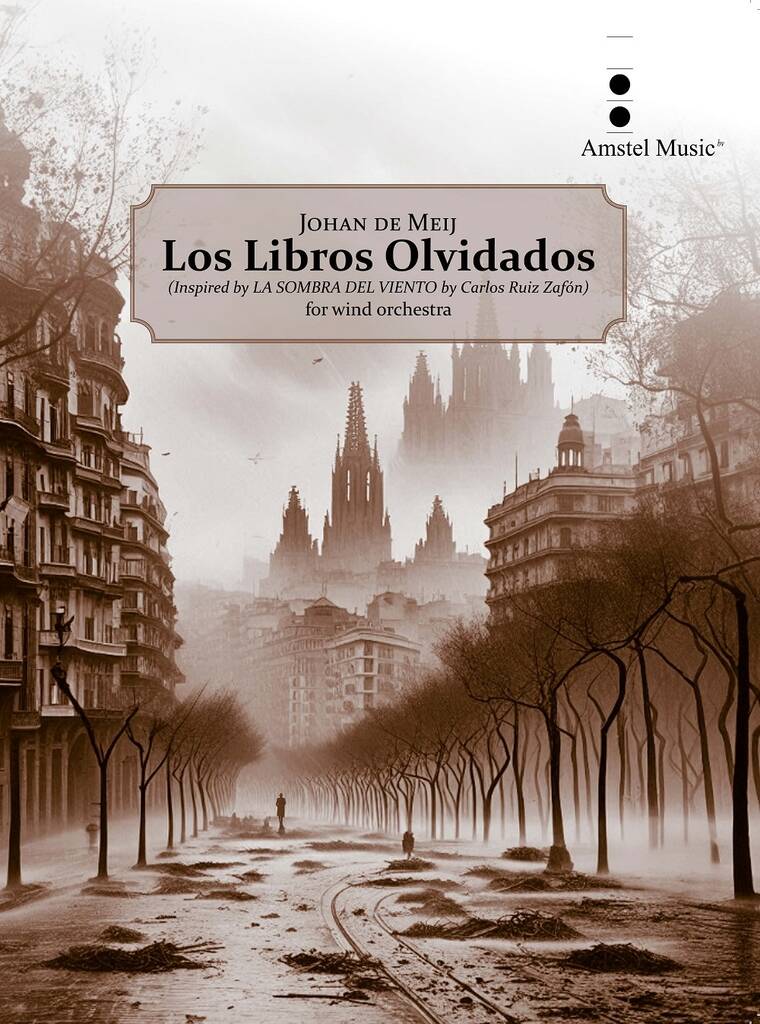
Los Libros Olvidados - Johan de Meij
1. Barcelona 19452. Los Libros Olvidados - El Cementerio3. Las Ramblas - Els Quatre Gats4. Coubert - El Hombre sin Rostro5. Bea (Beatriz)6. El Inspector Fumero7. La Ciudad de las SombrasThis is a story wrapped within a story that unfolds in Barcelona 1945, following World War II. The protagonist, Daniel Sempere, is the teenage son of an antiquarian book dealer, who one day takes him to the Cemetery of Forgotten Books, a mysterious place with labyrinthine corridors where rare and banned books are stacked in massive dusty piles. His father tells Daniel to select a book, but it will be his responsibility to protect it. Daniel picks La Sombra del Viento (The Shadow of the Wind), a novel by a forgotten author Julin Carax. Daniel immediately starts reading the book, and the story unwinds itself into a compelling and complicated plot. As he reads, Daniel finds himself and his own life merging into the story's plot. It transpires that there is a mysterious man named Lan Coubert ('the man without a face') who is determined to destroy all copies of Carax's books. Daniel is threatened by Coubert and is determined to find out what happened to Carax, who fled to Paris and subsequently disappeared. Daniel finds that his own life has much in common with the author's. The book mixes magic realism, page-turning mystery, and Daniel's own real life. Daniel's once ordinary teenage existence is now filled with larger-than-life colorful and at times, terrifying characters. Among them are Fermn Romero de Torres, a beggar who Daniel and his father befriend and employ in the family bookstore; the evil police inspector Javier Fumero, who could be compared to Scarpia in Puccini's opera Tosca or Javert in Les Misrables. The corrupt Fumero uses the war as an excuse to practice his sadism and is widely feared in Barcelona. He is represented in the music by a fascist military march. The city of Barcelona becomes a character in the book and in the music. The Ramblas, the boulevard running through Barcelona's Gothic Quarter and the famous caf Els Quatre Gats (the four cats) come alive in the score through a Cobla, the traditional wind ensemble playing a sardana, typical Catalan folk music. Two parallel love stories turn up the heat: Julin Carax's passionate, forbidden love for Penlope, and Daniel's equally passionate and forbidden love for Beatriz (Bea). Bea's sultry love theme is based on the first three letters of her name, with the ascending intervals B-E-A. Johan de Meij New York, October 17th, 2023
Estimated dispatch 7-14 working days
-
 £102.99
The Fairy Tale King - Jacob de Haan
This work is inspired on the dramatic life story of Ludwig II, former king of Bavaria. He was given the nickname Fairy Tale King because of his eccentric lifestyle, his love for medieval sagas, and the building of extravagant fantasy palaces, such as the world famous Neuschwanstein Castle. Ludwig II grew up in a strict environment but found support through his friendships, love for romantic fairytales, and the music of the German 19th century composer Richard Wagner. After Ludwig's sudden accession to the throne followed a cancelled wedding and a tragic ending, after which he became a national icon of Bavaria. The music reflects his eventful life with fairy-tale-like, romantic and dramatic sounds. Two themes from Wagner's famous opera Lohengrin form a returning homage to his tragic life story.
Estimated dispatch 7-14 working days
-
 £84.99
The Soldier & The Princess - Bert Appermont
This work is based on the story of the soldier and the princess from the film Cinema Paradiso. The story is about a poor soldier who fell in love with a beautiful princess. He had nothing to offer her, but he managed to meet her and declared his love for her. Do you want to know what happens next...?
Estimated dispatch 7-14 working days
-
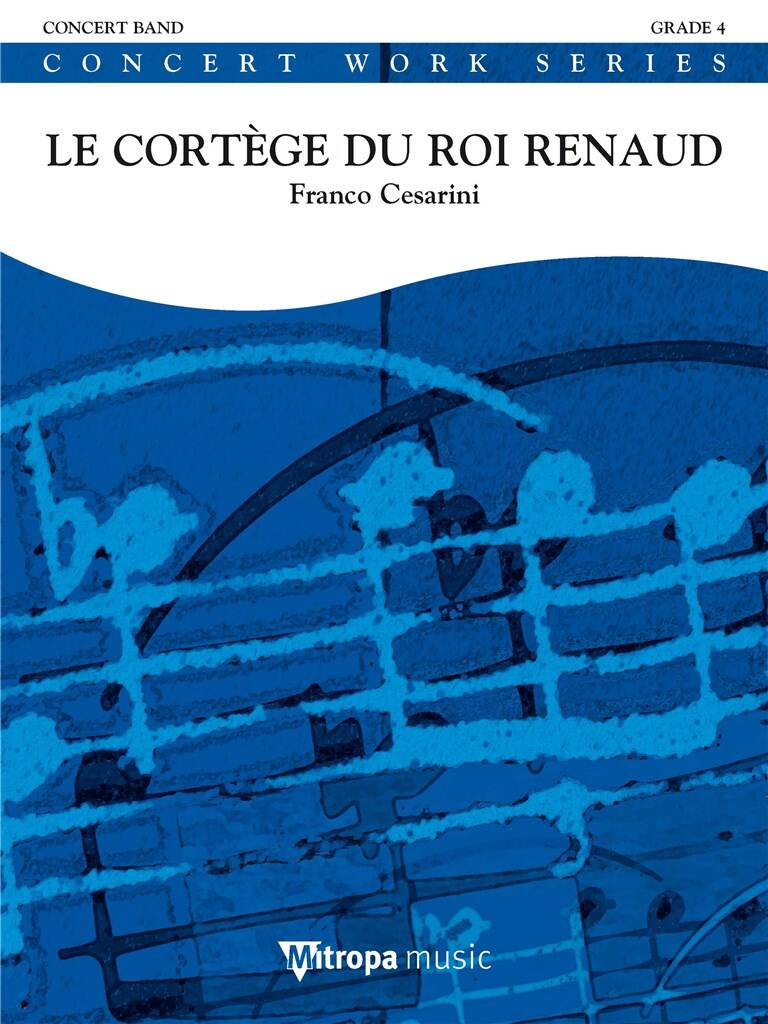 £139.99
Le Cortge du Roi Renaud - Franco Cesarini
Le cortge du roi Renaud is a suite in five parts. It is based on tales that originated in southern European folk songs, dating back as far as the 16th century. A large portion of these songs are of the genre "Complaintes" songs in which the text gives a detailed description of events having a generally criminal or macabre character. The most familiar song to feature the tales of Roi Renaud is "Fualdes", consisting of 48 verses.The first part of the suite is based on the song "La Porcheronne" (The Swineherd). It telis the story of a young woman forced by her mother-in-law to tend pigs while her husband is away fighting in the war. She is freed only when her husband returns sevenyears later.The next part tells the story of "La mrquise Empoisonne" (The Poisoned Marquise). A marquise is coerced by her king to become his mistress. The jealous queen poisons her by means of a bouquet of deadly scented fiowers.Despite having the character of a merry dance, the third part, "La maumarie vengee" (The Avenged Wedding), expresses the touching story of Queen Clotilde, persecuted for her refusal to live according to the Aryan beliefs."La belle engloutie" (The Swallowed Beauty) relates the tale of the young wife of King Renaud. She cannot imagine a life without her husband, who was mortally wounded in the war, and begs the earth to open and swallow her up so thst she may rejoin her love.The gruesome content of the final part,"Le tueur de femmes" (The Wife Killer), bears a strong resembiance to the tale of Bluebeard. The story is about a young wife in danger of being drowned in a pond by her husband, which is what happened to her 13 predecessors. Thanks to her cunning, she manages to turn the tables and contrive her husband's demise.
Estimated dispatch 7-14 working days
-
£68.99
Fairy Tail Suite - Tsutomu Tajima
This work was complete in January 2013 to commemoration the 50th anniversary of the Iwate Prefecture Band Association. Conditions at the request were as follows:1: Does not have to be particularly relating to Iwate. It should be something that would be widely familiar to the whole country. 2: Should suit the contest piece requirements. 3: Must be a song that can be used at a graduation ceremony for student procession and recessional.4: Must include vocal parts with a beautiful melody.5: Must be a march.6: Must be a song that would be loved by many.They are difficult requests. I hope to satisfy at least one of them.We selected Yanagida Kunio's book "Tono Monogatari" as the cornerstone of the work, chose four stories that fit the image, and stuck close to the source of the story. Then, "prelude music" was added, making it a suite consisting of five movements.I. "Prelude" What kind of story will it be? An exciting opening expresses such a feeling.II. "Zashikiwarashi" Spirit that brings good fortune and wealth. It appears at midnight and makes mischief, something silly, not serious. Zashikiwarashi moves quickly, dances, plays its games, hiding and reappearing often. These characteristics are considered cute and the music depicts such a mischievous Zashikiwasi.III. "Oshirasama" A girl and her horse love each other. Her father forbids this, and kills the horse. The beautiful daughter clings to the horse and cries. Eventually, the daughter and the horse rise to heaven, slowly and gradually, remembering former happy days. The music captures this ascension to heaven.IV. "Yamanba (Mountain witch)" Run away, run away, its chasing, still chasing. Run away, and still chasing. The girls hides. Yamanba searches. It keeps chasing, endlessly, following her everywhere. Chasing, chasing, and finally... Seriously and comically depicting the chase situation in fugue style.V. "Kappa" Staring into the distance. It looks gallant. What is it looking at? Staring beyond the mountain? Perhaps it is longing for hope and happiness. This is an homage, a march, and cheering song for Kappa who never gives up and embraces dreams and hope.It is my wish that many people become familiar with this song.(2013.3.31 Tsushima Tashima)
Estimated dispatch 7-14 working days
-
 £116.40
Norma Ouverture - Vincenzo Bellini
The composer of some famous operas such as 'La Sonnambula' and 'The Puritans', Vincenzo Bellini (1801-1835) was largely self-taught. Although he wrote eleven operas, only 'Norma' remained popular, not in the least because of its splendid lyrical arias such as Casta Diva (Chaste Goddess) and Mira, O Norma (Hear me, Norma) familiar to all music lovers. The opera 'Norma' is written to a libretto by Felice Romani, based on a French melodrama by Alexandre Soumet and Louis Belmontet dealing with a story of Druids during the Roman rule. The story is neither accurate historically nor convincing dramatically, but the score is full of brilliant melodies of a type calculated to exhibit a singer's virtuosity to the utmost. The Gods order the priestess and fortune-teller Norma to give the signal of revolt against the Romans in Gaul, but she postpones this because of her relationship with the Roman proconsul Pollione with whom she secretly had two children. In the meantime, Pollione has fallen in love with the young priestess Adalgisa and Norma wants to take revenge. Finally both Norma and Pollione die on the pyre. This tragical opera in two acts was first performed at the Scala of Milan on 26 December 1831.
Estimated dispatch 7-14 working days
-
 £112.20
Pinocchio - Alex Poelman
The composition 'Pinocchio' tells the story of the puppet that can turn into a real little boy on the condition that he can prove he is courageous and remains honest. The different characters and emotions in the story are very well described in music: from the love of Gepetto, via the mean tricks of the cat and the fox, up to the nave Pinocchio and the bloodthirsty shark. This is a real adventure for the musicians as well as for the audience
Estimated dispatch 7-14 working days
 View Music