
Results
-
 £154.99
About Reynard the Fox - Kevin Houben
We find ourselves initially at the court of King Nobel, where all the animals have arrived for a court hearing. Reynard the Fox has plenty to answer for but he seems determined to avoid his punishment... Kevin Houben chose this fable as the theme forhis programmatic work, in which the musical setting of the fox forms the main theme. But King Nobel, Braun the bear, Murner the cat and Grimbart the badger also take a musical turn. About Reynard the Fox promises excitement and adventure rightto the last note!
Estimated dispatch 7-14 working days
-
 £76.99
Summertime Party - Johan Nijs
After a long winter and a rainy spring it's that much lovelier when at last the summer appears! This sunny composition by Johan Nijs in a Caribbean style awakens thoughts of summer parties out in the open and above all creates a great mood! Whether at an open-air concert or indeed indoors, no one will be able to sit still with this snappy piece!
Estimated dispatch 7-14 working days
-
 £94.99
Ready - Steady - Brass! - Otto M. Schwarz
Ready - Steady - Brass! is one of a number of successful works by Otto M. Schwarz such as Last Call, Funky Winds, Glory Fanfare and Groove Machine. Starting with a fanfare-style opening the music takes a journey through melodicsections and technical, soloistic passages to a grandiose finale.
Estimated dispatch 7-14 working days
-
 £64.95
Halo Theme - Michael Salvatori
Kids love video games, so what better way to get them excited about playing music? This Robert Sheldon arrangement will be familiar to all your video-game-playing students. A symphonic sound is ensured with this classic video game overture-style theme. Video Games Live is an interactive experience that drew over 10,000 people to a concert at the Hollywood Bowl last year. Visit videogameslive.com for more information on this ground-breaking music event. (4:15)
Estimated dispatch 7-14 working days
-
 £195.00
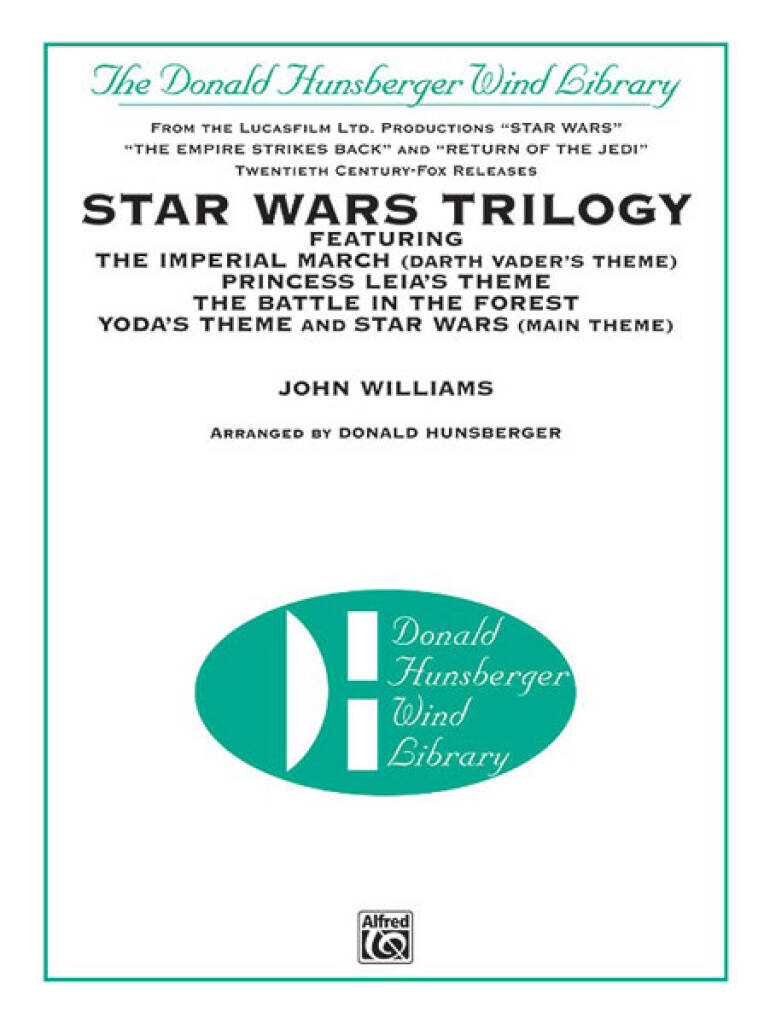
Star Wars Trilogy - John Williams
John Williams has rightfully earned a place in the hearts of all film lovers with his numerous brilliant scores to some of the best movies of the last half century. Capable of writing music ranging from tender, intimate moods to galactic battles,Williams carefully constructs each score as a separate, freestanding entity, not just background snippets. The selections in this exciting collection include "The Imperial March (Darth Vader Theme)," "Princess Leias Theme," "The Battle in theForest," "Yodas Theme," and "Star Wars (Main Theme)."
Estimated dispatch 7-14 working days
-
 £134.99
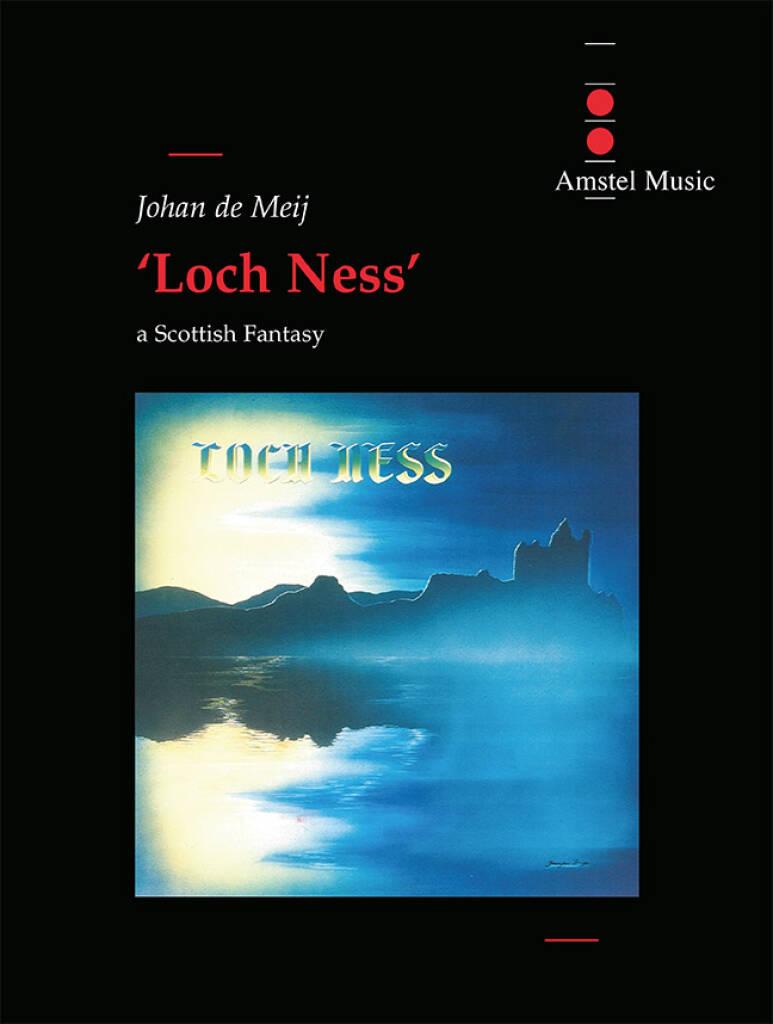
Loch Ness - Johan de Meij
The symphonic poem 'Loch Ness' consists of five through-composed impressions of this mysterious Scottish Lake. I) The Lake At Dawn - calm, static, sonorous blocks depict the troubled opaque water surface and the enormous depth of the Lake at daybreak. II) Slowly the rising early-morning mist reveals the distant ruins of Urquhart Castle, represented by a solemn theme in the trombones which is taken over by the full band, thus evoking the illustrious past of this fortress besieged so many times. III) Inverness: Bagpipes and Tourists - the music takes us down to the town of Inverness where the first tourists mark the slow but steady start of a new season to the sound of a Scottishmelody. IV) Storm - suddenly a heavy wheater breaks: fierce gusts of wind and heavy showers transform the erstwhile calm surface into an obscure and whirling mass of water, and clouds rapidly passing over offer an eery scene... V) Conclusion - storm and rain gradually decrease and when everything is quiet again we are granted a last view of the Lake in its full glory.
Estimated dispatch 7-14 working days
-
 £74.99
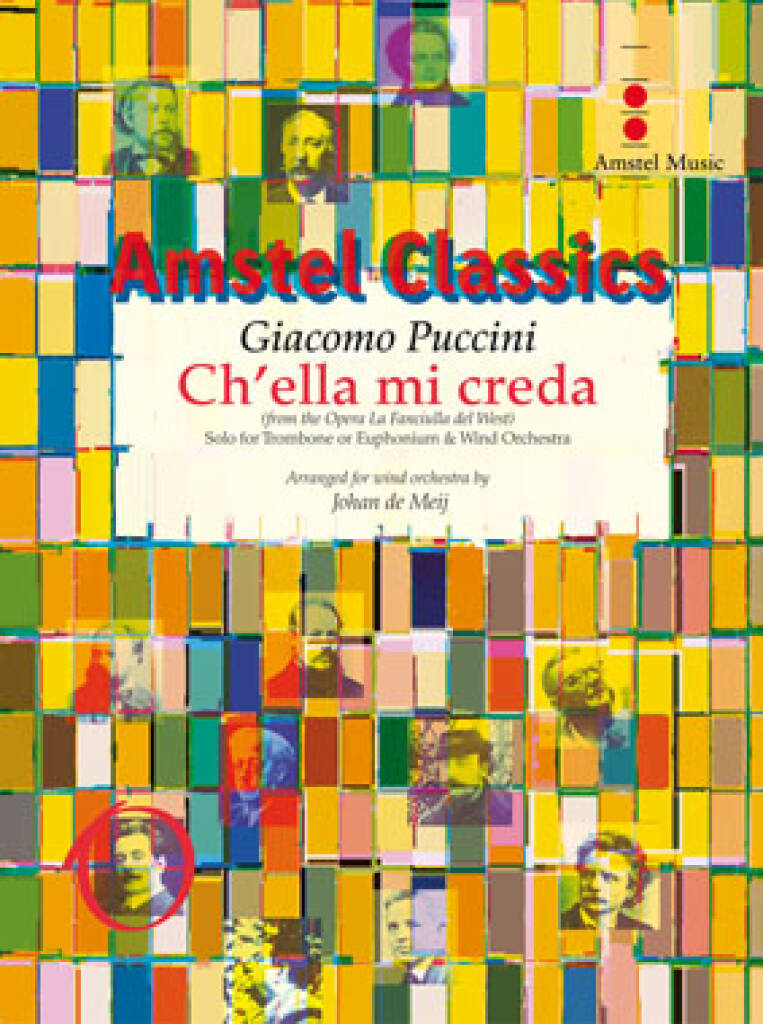
Ch'ella mi creda - Giacomo Puccini
Ch'ella mi creda libero e lontano is the last aria that tenor-role Dick Johnson (the bandit Ramerrez) sings before his death sentence is carried out. Puccini's opera La Fanciulla del West is set in America's Wild West. The impressionistic-inspired opera separates this opera from most of Puccini's other works. Johan de Meij's arrangement uses the solo trombone in the role of the bandit Ramerrez.
Estimated dispatch 7-14 working days
-
£514.99
The Venetian Collection
The Venetian Collection by Johan de Meij consists of four movements which are all a musical reflection of the four paintings of the same names from the Peggy Guggenheim Museum in Venice.Voice of Space is the first movement of The Venetian Collection. The picture on which the music is based on was painted by the Belgian surrealist artist Ren Magritte. Along with Ensor, Permeke and Delvaux he was one of the most important painters of the 20th century.The Red Tower was inspired by the painting of the same name (La Torre Rossa) by the Italian artist Giorgio de Chirico, and was awarded first prize in the International Composition Contest in Oman. One of the towers of the mediaevalwalls of the Italian town of Soncino (home to the band for whom Johan de Meij wrote the work for) shows a remarkable resemblance to the tower in the work of De Chirico. Magic Garden contrasts starkly with the other movements of the cycle. As with the painting, Johan de Meij has tried to reflect the colourful, naive dream world of Paul Klee. The transparent texture, in which the woods play an important role, makes a striking impression throughout this serene movement.Empire of Light is also based on a work by Ren Magritte. He was a versatile and productive artist producing over 1100 paintings and 700 gouaches. Johan de Meij used the painting Empire of Light as his theme for the last movement of his Venetian Collection.
Estimated dispatch 7-14 working days
-
 £122.50
Golden Winds - Philip Sparke
This contrasting work builds up twice from quiet relaxation or meditative calm to a climax for the entire ensemble, before the main section, a rhythmic vivo, begins. Golden Winds ensures truly precious moments in your concert right up to the last note!
Estimated dispatch 7-14 working days
-
 £74.99
Prelude, Op. 3, No. 2 - Sergei Rachmaninov
At last, a full-length transcription of the famous Rachmaninoff prelude that captures all of its dark, gloomy drama and at the same time makes for a dazzling showpiece for the modern concert band.
Estimated dispatch 7-14 working days
 View Music