
Results
-
 £159.60
Sculptures Of An Exhibition - Kees Vlak
This composition was commissioned by the village of Midden-Beemster to commemorate the 375th anniversary of the polder of the same name. It was premiered in august 1987 by the Beemster Fanfare Band. On this occasion some twenty sculptors were invited to create a work of art. Those sculptures were set up at the most picturesque areas of the polder. On a 40 km long bicycle route one can admire the curious statues wile enjoying the beautiful scenery as well. The compostition is based on two themes: a main theme and the promenade theme.1.Introduction: After the grandiose presentation of the main theme, on the dominant, we leave the village to the sound of some pretty music.2.Promenade and Watchman: After some time, we discover a dark statue hidden in the bushes; it is shaped like a square standing on one of its corners. It is called "Watchman". We hear the promenade theme as a solo and all next themes will be variations.3.A Building of Willow-trees: Far away on a dike, we discover the huge skeleton of a kind of house. It is a construction of skilfully interwoven willow-branches. The musical themes are also interwoven. The sculpture is called "Construction of wood used by the farmers".4."Die Flsse, ah die Flsse"and Promenade: We continue our trip and see now a horn of plenty, made of brown ceramics and set up on the green slope of an old fortress. The sun shines on the sheep being at pasture under the willow-trees. No doubt, this scene will have something to do with abundance.5.Cardplayers in front of the Nightingale: A statue in cast iron, representing two carplayers, has been erected in front of the windmill called "The Nightingale". This sculpture suggests a rather animate atmosphere. The opponents with the trumpets and the trombones suggest the cardgame. The trumpets are constantly changing from players. At a certain moment the trumpet gets hold of the decisive trick and starts a victorious blow. The trombone, however, repeats this shout of joy with quite some perverse delight and in a completely wrong pitch. The game continues and after a climax all cards are finally thrown on the table.6.Autumn and Promenade: The trip now brings us a white sculpture in ceramics, decorated with some autumn leaves. Is this a seated man or a chair? Anyway, it looks very nostalgic. This is the time for a moment of reflection with the oboe or the saxophone. It is called "Autumn".7. The Powerlifter: Somewhat hidden in a ditch, we discover a small statue in cast iron, representing a powerlifter who is going to give way under the weight. The music uses the main theme with powerlifting euphoniums, saxophones and clarinets.8.The Bull: Here we have another cast iron sculpture, but this time it is a really powerful figure. This "Bull" statue uses the same theme as that of the powerlifter, but it gets a stronger foundation from the bass insturments.9.Mirror and Promenade: While strolling alongside the channel we suddenly see four mirrors. They not only reflect themselves, but also mirror in the water of the channel. These reflections are suggested by the use of tuned percussion. The promenade theme is also used in mirror image.10.Reflictions or...?: On top of the dike we have a nice view on a farmyard with its orchard. A very big net, coverd with sparkling tin plates, has been stretched between the trees. This sculpture is called "Reflections of ...?. Of what? Yes, of course, reflections of the times when the polder was a lake and the sun was reflecting in the wild waves.11.Willpower: Finally we discover a big statue in cast iron. It is not clear whether it is a man or a woman. Anyway the enormous bundles of muscles in the legs and the thighs are striking. This sculpture is called "Willpower". The idea of determination is musically suggested by a very long preamble to the promenade theme in one great stringendo, leading to the conclusion of the trip.12.The beautiful country: Here we have the most beautiful picture. The magnificent Beemster Polder in bloom. We see a nice windmill with decorated wings. We hear the main theme, now on the tonic.
Estimated dispatch 7-14 working days
-
 £186.20
Wald Sinfonie - Kees Vlak
It was during his stay at Freiburg, Germany, where he was attending a Music Festival, that Kees Vlak found his inspiration for this romantic work. At this festival he was awarded a prize for one of his compostitions, which was played by several bands from different countries. The composer was staying in the small village of Horben, hidden among pine woods on a mountain at the border of the Black Forest. From the balcony of his room he had a splendid view on the Schawinsland Valley, scarcely hidden by the tops of the huge pines. Each morning a blackbird singin in a huge pine next to his window woke him up. This bird song opens the composition.Whenever possible the composer and his wife went for a walk in the Black Rorest. The rediscovery of this wonderful area is expressed by the steadily increasing number of tone colours, used in the orchestration. Each village still boasts its own folk music and dances. More than one hundred bands were playing all around; the Black Forest seemed to be the scene of one huge festival. The image of the Black Forest is also linked to that of hunting scenes, so the next theme is being introduced by hunting horn themes. The second theme paints the lake "Titisee". At first the lake is very calm, but a stiff breeze sets both water and music alike in motion. The small town of Titisee is very popular with tourists and is famous for its woodcutting, its clockworks and musical boxes. It is a popular folk tune, played by a musical box that makes the link with the next theme. The joy and cheerfulness of the dancing village people is expressed by a movement which works out the initial theme.On leaving the little town, one can hear once more the hunting music from the wood as well as the song of the birds. The new theme is againg closely linke d to the hunt and played by the typical German helicon-like euphoniums.this theme interacts with the wecond theme and the word ends with a grnd finale meant as a musical hommage tot this wonderful area.
Estimated dispatch 7-14 working days
-
 £154.99
Achnaton - Jan Bosveld
The Egyptian pharaoh Amenhotep IV, better known as Achnaton, was the second son and successor of Amenhotep III. He reigned the New Kingdom from 1353 until 1336 BC. Achnatons lack of interest in the economic well-being of Egypt ushered ina revolutionary period in Egyptian history. His harsh reign induced much suffering under the population. During this period when it was customary for a pharaoh to have many wives, he had taken his cousin Nefertete to reign as queen at hisside. An elegant and very beautiful woman, she used her influence to ease the turmoil caused by Achnaton. Combined with her grace, her presence at public functions led to a greater popularity among her subjects than the pharaoh enjoyedhimself. Being mostly preoccupied with religious questions, he declared that all the other gods did not exist. There was only one god, the Aten, and it was the sun itself. It was now necessary to change his name: 'Amenhotep' meaning 'the god Amun is satisfied', because he didnt want to be associated with Amun or any of the other deities. He renamed himself 'Achnaton' which means 'servant of the Aten' -- a much more appropriate title! In the sixth year of his reignAchnaton also moved the capital to a brand new city called Achet-Aton ('the Horizon of the Aten') which was where Tel el-Amarna stands today. He did this to further isolate himself from the 'old' religion, since the previous capital Thebes was thecentre of worship of Amun. This new religion created an up rise among the population and high priests. In spite of Nefertetes influence, the falling economy and religious conflict resulted in the decline of the Egyptian empire. Hoping toforget it ever happened, people later tried to eradicate all traces of Achnaton and his successors rule by smashing their statues, mutilating their mummies, and ruining their relief carvings. From that moment on he was remembered as the'heretic king'. This composition was partially funded by the 'Prins Bernhard Cultuurfonds'.
Estimated dispatch 7-14 working days
-
 £168.50
Trois Nuances - Scott L. Hines
TROIS NUANCES is a three movement work composed by Scott L. Hines for the Memphis Ballet Company in 2004. Originally for Piano only,it is a three movement work. The two fast movements surround a blues-like second movement. While it was not the composer's initial intent to write a movement based in the blues, that's what happened and it was very appropriate as Trois Nuances was danced on thestage of W.C. Handy Park on Beale Street, the site of the birth of the blues publishing industry. Hines was given a week to present a draft to the ballet company to be performed as it's opening piece of the 2004 season debut. Once the draft was approved, he had two days to finalize it. The first and third movements reflect the hurried and excited pace at which it was composed. Excellent repertoire from a contemporary American composer! Symphonic Orchestra. Instrument Parts. Grade: 4 Duration: 12:29
Estimated dispatch 7-14 working days
-
 £248.99
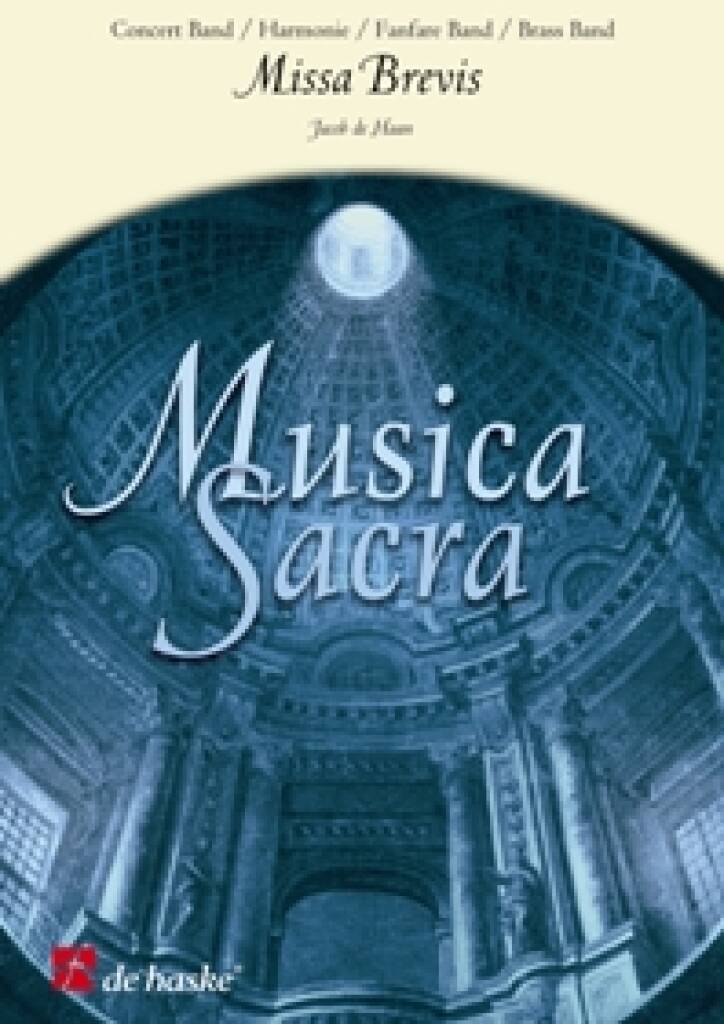
Missa Brevis - Jacob de Haan
Missa Brevis, written for choir and wind band, was commissioned by the Conseil Dpartemental pour la Musique et la Culture de Haute-Alsace (Dir.: Philippe Pfisterer) in Guebwiller (France), in celebration of the millennium of Pope Leon IX'sbirth in guisheim (France). The composer conducted the first performance on June 23, 2002. It was performed live for the French television channel France 2. The mass movements Kyrie, Gloria, Credo, Sanctus, Benedictus, and Agnus Deiare very suitable for the Catholic as well as the Protestant liturgy. For this mass, various ways for performing in diverse variable strengths are possible. An instrumental performance is possible if the brass represents the choir parts. In thisoption, it is desirable for the brass to be positioned separately from the rest of the band (on a gallery, for example), so that the idea of two choirs is approached. In a performance with a large choir, the brass can work very well as a support. Inthat case, the dynamics of the brass should be adapted somewhat, since these are actually intended for an instrumental performance. You can also leave out the brass entirely for the benefit of the choir. For the accompaniment of smaller choirs, youcan opt for a small ensemble from the band. This can also be a quartet, put together as desired. For the performance of this mass, the obvious choice is one of the above options. However, as an alternative, a performance with a combination of theseoptions (vocally/instrumentally) is also possible not just from an artistic point of view (variation), but also from a practical starting point for example in the case that the choir has rehearsed only two movements. With a full strength, theconductor can vary the instrumentation to his or her liking. Then the brass can also play a role in the accompaniment (instead of supporting the choir). The following combinations are possible:1. clarinet choir (from Eb Clarinet to BassClarinet)2. clarinet choir + saxophones3. brass (flugelhorns, horns, euphoniums, bass section)4. brass (2 trumpets / 2 trombones)5. double reeds (optional + flute, optional + string bass)6. tutti7. all winds8. allbrassIn a performance by brass band and choir, it is usually advisable to leave out option 1 (choir + brass + band). The choir sings self-reliantly, accompanied by a full brass band. In an instrumental performance, you can consider a combinedquartet (two cornets and two trombones) + brass band.Choral parts available separately.
Estimated dispatch 7-14 working days
-
 £90.30
Concertino Opus 26 - Carl Maria von Weber
Carl Maria von Weber (1786-1826) was a pupil of Michael Haydn. Before he was fifteen years old he had already composed an opera, a mass and piano music. He was subsequently director of the Prague Opera House and Music Master at the Dresden Court. The overtures to his operas DER FREISCHTZ and OBERON are still often performed by wind bands, though it is often lesser known that von Weber also wrote pieces for 'Harmoniemusik', such as a CONCERTINO IN C for oboe and small wind band.Von Weber wrote most of his clarinet works for the famous German clarinettist Heinrich Brmann (1784-1874). This was the case for his CLARINET CONCERTO No1 in F and his CLARINET CONCERTO No2 in Eb and for the CONCERTINO, all composed in 1811. Von Weber was very impressed by Brmann's virtuosity and the expressiveness of the clarinet. The CONCERTINO is one of the very great works of the classical clarinet repertoire. A slow introduction is followed by a cheerful theme repeated with several contrasting variations. This pre-eminently romantic clarinet piece was scored for symphonic band by the French composer and arranger Charles Lhomme (Hargicourt 1889).
Estimated dispatch 7-14 working days
-
£107.70
Triqui-Traqui - Paul Desenne
Commissioned by Gustavo Dudamel for his 2017 New Year's concert with the Vienna Philharmonic, my Caribbean reinterpretation of Strauss' famous Tritsch-Tratsch Polka was deemed tooosefor the occasion, yet the maestro recorded it that year, not in Vienna but in Caracas, with the fabulous performers of his orchestra, the Orquesta Sinfnica Simn Bolvar, and published it on the web as his musical New Year's greetings card. The gesture was meaningful, and bold. I'm convinced that Johann Strauss, a man immersed in the fashions of his city and his time, would have loved the idea; a musical collage which carries in its banter a very strong aesthetic statement. The lightest and most frivolous things seem to always carry the deepest messages, let us not forget. ... ... Today, this version of my transformed Tritsch- Tratsch Polka forSymphonic Band created by Steve Boehm, will certainly tickle the Viennese in each and every one of us, and we will be very happy!"
Estimated dispatch 7-14 working days
-
£62.95
Through Courageous Eyes - Brian Balmages
This innovative work makes use of an optional piano part that is most likely playable by someone already in the band. It was written in honor of Matt Rhodes, a student at John T. Baker Middle (Damascus, MD), who passed away during a battle with spina bifida. It represents his kindness, courage, and determination despite his confinement to a wheelchair. An opening ethereal section and chorale moves into an exciting portrayal of life which concludes with a humorous ending that was very characteristic of Matt. A very musical new composition which teaches much more than notes.
Estimated dispatch 7-14 working days
-
 £149.40
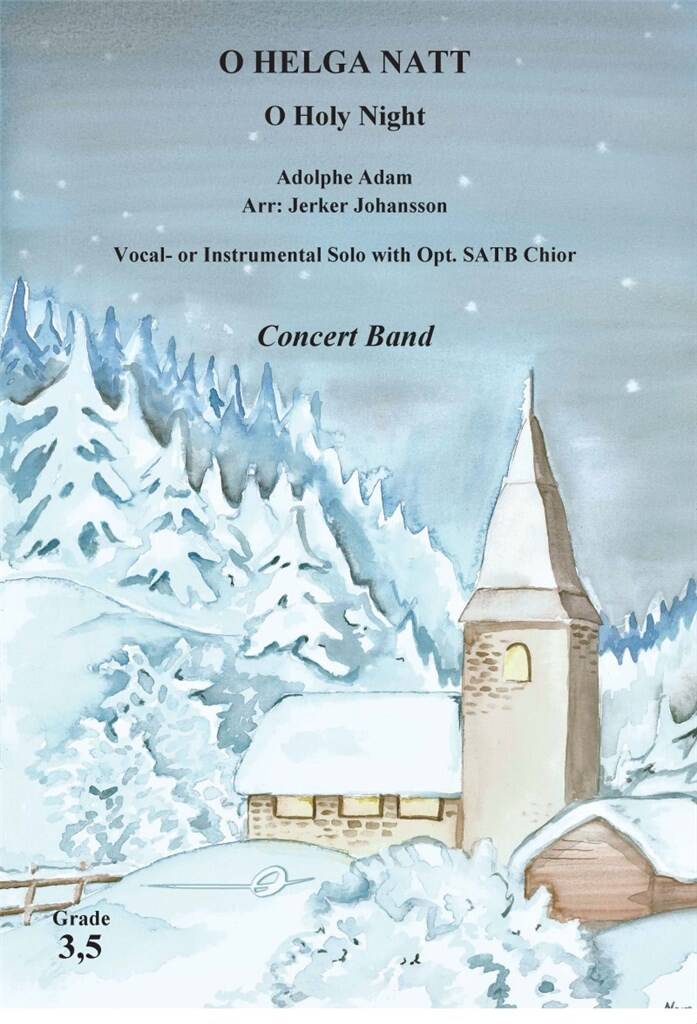
O Helga natt - Adolphe Charles Adam
O Holy Night is a very well-known Christmas carol. The origin of the carol is French beginning with the words: "Minuit! Chrtiens, c'est l'heure solennelle". It is about the birth of Jesus and was written in 1843 by a wine merchant and poet by the name of Placide Cappeau (1808 77). He turned to the composer Adolphe Adam (1803 56) and asked him to write a suitable melody. The result was brilliant and the carol was premiered in Cappeau's home town Roquemaure in 1847 by the opera singer Emily Laurey. Based on Cappeau's French text, the English version was written in 1855 by an American Unitarian (Calvinist) minister by the name of John Sullivan Dwight (1813 93). Adolphe Adamwas the son of the pianist and composer Louis Adam (1758 1848), who did not want his son to follow in his foot-steps as a musician. However, Adolphe wanted otherwise, and already at the age of 17 he was accepted to study at the music conservatoire in Paris. He was a student under Franois Adrien Bo eldieu and composed several comical operas that became successful. After the July-revolution 1830 Adam moved to London. He worked for a couple of years before returning to Paris, where he founded a new opera house in 1847, the Th tre national. After the revolution in 1848 it had to close and Adam was ruined, why he had to go back to composing. In 1856 he concluded the ballet Le Corsaire, which together with the ballet Giselle are his most performed works today.
Estimated dispatch 7-14 working days
-
 £159.99
Guardian Angels - Kevin Houben
Guardian Angels gives a musical expression to the legend of Reverend Louis Henri Bhler referring to the use of Psalm 34.North-west Veluwe and in particular Oldebroek (The Netherlands) has a very rich religious tradition which is demonstrated by its monumental churches. They tell the story of a stirring history in which Reverend Bhler played a crucial role. Inspired by his arrival as a pastor in 1870 in the neighbouring Oosterwolde, two big religious communities came into existence with their characteristic churches but this rivalry also resulted in great social unrest.This composition reflects on this striking personality and in particular on the story of the Angel Guard.'One evening Reverend Bhler has given a sermon in Oldebroek and he walks over the Church path through the pastures to Oosterwolde. On this dark and stormy evening Bhler's opponents are waiting for the pastor in ambush. They want to drown him in a watercourse near the Church path but abandon their plan because Bhler is accompanied by two men. The next day it comes to an encounter between Bhler and his opponents. They repent their, fortunately unexecuted , plan. Bhler firmly believes that on the previous night he walked alone over the Church path, and was not accompanied by two men. It was concluded that it must have been the angels who had protected Bhler.'Psalm 34 is central to this composition and this because of its powerful melody but also because the lyrics of verse 4 of the rhymed version fit in well with the special legend of Reverend Bhler:The Lord's angel gathered round himAn invincible heavenly guard,Who tries God's will, around himSo he's well guard(ed)A second melodious and harmonic cell is a musical transformation of the name 'Bhler'. This cell is varied in major and minor third chords and sometimes used as the main idea or apotheosis, but also serves as an accompanying cell or as a bridge between other melodic and rhythmic constructions.The composition was made possible by contributions of: Mr Evert van de Poll, owner of the Van Gelder Groep, Het Prins Bernhard Cultuurfonds Gelderland en Het Feteris Oosterbaan Fonds.
Estimated dispatch 7-14 working days
 View Music