
Results
-
 £75.00
English Dance Suite - VI. Pavan (Concert Band - Score and Parts) - Gardner, John - Noble, Paul
Arranged for the modern Concert/Wind Band, scored for three trumpets, reasonable doubling of parts where the original musical effect is not altered so that players can have a more responsible and enjoyable experience, more legible parts with less doubling on one staff, etc. The piece is offered either as a complete suite of seven movements, and also as seven individual movements which may be purchased independently. The English Dance Suite was originally composed by John Gardner for Wind Band, and has been re-set for the modern Concert Band instrumentation. Both the original version, edited and type-set by Paul Noble, and this arrangement are first editions now available for purchase to bands around the world. The set of seven Renaissance dances depict John Gardner's love of Scottish music, the Renaissance heritage, and some of his own mischievous approach to music. The first movement, Chacony on a Golden Theme, reminiscent of the Allegro movement of Purcell's Golden Sonata, is much used as a vehicle for variation on a repeated short harmonic progression, often involving a fairly short repetitive bass-line which offered a compositional outline for variation, decoration, figuration and melodic invention. In this it closely resembles the passacaglia. The Alman originated in the 16th century as a duple metere dance of moderate tempo, already considered very old, with a characteristic double-knocking upbeat of one or occasionally three sixteenth notes. It appears to have derived from a German dance but no identifiable dance and no German dance instructions from this era survive. The Hornpipe, usually in 3/2 dance rhythm, is an Irish, Scottish and English dance. It is done in hard shoes, which are used to help keep track of how the dancer keeps in time. There are two variations of the hornpipe dance: fast and slow. Usually, more experienced dancers will do the slow hornpipe but younger dancers will start out with the fast hornpipe and then switch in later years. The Corranto is a 16th-century court dance characterized by short advances and retreats, in quick triple time. The Volta (Italian: the turn or turning) is an anglicised name from the later Renaissance. Its main figure consisted of a turn and lift in a sort of closed position. The Pavan is a slow processional dance common in Europe during the 16th century. The Reel, indigenous to Scotland, consists largely of quaver (eighth note) movement with an accent on the first and third beats of the bar.
Estimated dispatch 7-14 working days
-
 £125.00
English Dance Suite - VII. Reel (Concert Band - Score and Parts) - Gardner, John - Noble, Paul
Arranged for the modern Concert/Wind Band, scored for three trumpets, reasonable doubling of parts where the original musical effect is not altered so that players can have a more responsible and enjoyable experience, more legible parts with less doubling on one staff, etc. The piece is offered either as a complete suite of seven movements, and also as seven individual movements which may be purchased independently. The English Dance Suite was originally composed by John Gardner for Wind Band, and has been re-set for the modern Concert Band instrumentation. Both the original version, edited and type-set by Paul Noble, and this arrangement are first editions now available for purchase to bands around the world. The set of seven Renaissance dances depict John Gardner's love of Scottish music, the Renaissance heritage, and some of his own mischievous approach to music. The first movement, Chacony on a Golden Theme, reminiscent of the Allegro movement of Purcell's Golden Sonata, is much used as a vehicle for variation on a repeated short harmonic progression, often involving a fairly short repetitive bass-line which offered a compositional outline for variation, decoration, figuration and melodic invention. In this it closely resembles the passacaglia. The Alman originated in the 16th century as a duple metere dance of moderate tempo, already considered very old, with a characteristic double-knocking upbeat of one or occasionally three sixteenth notes. It appears to have derived from a German dance but no identifiable dance and no German dance instructions from this era survive. The Hornpipe, usually in 3/2 dance rhythm, is an Irish, Scottish and English dance. It is done in hard shoes, which are used to help keep track of how the dancer keeps in time. There are two variations of the hornpipe dance: fast and slow. Usually, more experienced dancers will do the slow hornpipe but younger dancers will start out with the fast hornpipe and then switch in later years. The Corranto is a 16th-century court dance characterized by short advances and retreats, in quick triple time. The Volta (Italian: the turn or turning) is an anglicised name from the later Renaissance. Its main figure consisted of a turn and lift in a sort of closed position. The Pavan is a slow processional dance common in Europe during the 16th century. The Reel, indigenous to Scotland, consists largely of quaver (eighth note) movement with an accent on the first and third beats of the bar.
Estimated dispatch 7-14 working days
-
 £78.00
Country Gardens (Concert Band - Score and Parts) - Grainger, Percy Aldridge - Karrick, Brant
Grainger's first piano arrangement of this English morris dance tune was completed in 1918 as a birthday gift for his mother. It became extremely popular and was his greatest commercial and financial success. Even this simple tune displays his genius with harmony, counterpoint, and colour. This very playable arrangement is an excellent way to introduce your students to the music of Percy Grainger.Duration: 2:10
Estimated dispatch 7-14 working days
-
 £199.99
Bolero (Concert Band - Score and Parts) - Ravel, Maurice - Sparke, Philip
Bolero was originally written as a ballet for a famous ballerina and achieved great success on the stage. Nowadays the ballet itself is only rarely performed and even though Ravel thought the orchestra would seldom play it, it has become one of the best-loved pieces for the concert stage. This arrangement by Philip Sparke keeps very close to the original score in this melodically and rhythmically unique work.Duration: 15:00
Estimated dispatch 7-14 working days
-
 £60.00
Two Bagatelles (Flexible Ensemble - Score and Parts) - Reed, Alfred - Clark, Andy
Alfred Reed's "Two Bagatelles" was first published as a trombone quartet, then enlarged to a brass choir and finally to a full concert band setting. Andy Clark has taken it back to its beginnings and adapted it for the Barnhouse Build-A-Band Series, so that students in very small bands will get a chance to perform music by this master composer. Sounds great if the four basic parts are covered among the instruments present.Duration: 5.00
Estimated dispatch 7-14 working days
-
 £176.50
Four Norfolk Dances (Concert Band - Score and Parts) - Sparke, Philip
Norfolk is one of the most beautiful counties in England, famous for its charming villages and boundless broads, a popular centre for sailing holidays. It is also the home of one of the best known of all British composers, Sir Malcolm Arnold. The date of the premiere of this piece was to fall close to his 80th birthday, so Philip Sparke decided to write something of a birthday tribute. Some of Arnold's best-loved orchestral works are his sets of dances: there are two sets of English Dances, Four Scottish Dances, Four Cornish Dances etc., most of which have been arranged for concert band at one time or another. Philip Sparke thought it would be appropriate for the concert band to have its own set of dances and wrote Four Norfolk Dances very much in the style of Arnold's suites.Duration: 13:00
Estimated dispatch 7-14 working days
-
 £105.00
Danceries (Set I) (Concert Band - Score and Parts) - Hesketh, Kenneth
The term 'Danceries' can be found in a copy of Playford's Dancing Master, an extensive collection of folk and popular tunes of the seventeenth century (and no doubt earlier). This publication was used by master fiddle players to teach the various dance steps of the day to a nobleman's house or a king's court. Whilst this present set of 'Danceries' cannot be said to be an aid to terpsichorean agility, it will at least set feet tapping! The melodies themselves are a mixture of new and old--well, nearly. Where the old occurs it has been adapted in mood and composition and is often interspersed with completely new material. The harmonies and rhythms bring a breath of the new into these themes and add to the drama of the set.Movement 1: Lull me beyond thee. Gentle and lilting, almost a barcarole, this movement is very much a reverie. The original tune had the name 'Poor Robin's Maggot' - a rather disconcerting title; maggot, however, in seventeenth-century parlance meant whim or fancy. This theme can also be found in The Beggar's Opera by John Gay (first performed in 1728) under the title 'Would you have a young lady' (Air 21).Movement 2: Catching of Quails. A colourful, buoyant scherzo on an original melody. The thematic material is shuttled around the band to contrast with full-bodied tuttis. The last few bars fade away to almost nothing before a final surprise!Movement 3: My Lady's Rest. A tender pavane, also on an original theme, with Moorish leanings. Solos for principal winds and brass contrast with warmer tutti passages. The movement culminates with a final presentation of the theme before evaporating in held flute and trumpet chords.Movement 4: Quodling's delight. The final movement to the set combining one of the melodies from Playford's Dancing Master ('Goddesses') with an original contrasting melody. A dramatic and exuberant ending to the set of 'Danceries'.Duration: 12.00
Estimated dispatch 7-14 working days
-
 £59.99
Maximus Fanfare (Concert Band - Score and Parts) - Deleruyelle, Thierry
Maximus Fanfare is a dazzling, energetic work for wind band, conceived as a short, percussive overture in which brass and percussion impose their power from the outset. From the very first bars, an explosion of sound captures attention before giving way to vibrant orchestral development, leading to a triumphal conclusion.This fanfare was inspired by the majestic golden lion that sits atop the belfry in the Place des Hros in Arras, a town with a rich architectural heritage listed by UNESCO. A symbol of strength and grandeur, the lion finds a musical echo in this brilliant work full of panache.Commissioned by the Orchestre d'Harmonie d'Arras, the piece owes its name to Maxime Lavoine, its conductor since 2011, in tribute to his commitment to and passion for wind band music.With Maximus Fanfare, Thierry Deleruyelle has created an intense and luminous work, a musical tribute to the significance of Arras' heritage and the enthusiasm of the musicians who keep it alive.Duration: 2.00
Estimated dispatch 7-14 working days
-
 £84.99
Mamma Mia!, Selections from (Flexible Ensemble - Score and Parts) - Ceunen, Filip
Some bands and their music are everlasting. A good example of such a group can be found in ABBA! The fact that a popular musical was based on ABBA songs is the best proof you can get. Even today, both young and old sing along to the international hits of this Swedish group! Filip Ceunen took the very best songs and created an excellent and playable medley scored for flexible ensemble. Be prepared for an audience singing or humming along with such classic songs as 'Mamma Mia', 'Dancing Queen', 'Fernando', 'The Winner Takes It All', and of course 'Money, Money, Money'.Duration: 5.00
Estimated dispatch 7-14 working days
-
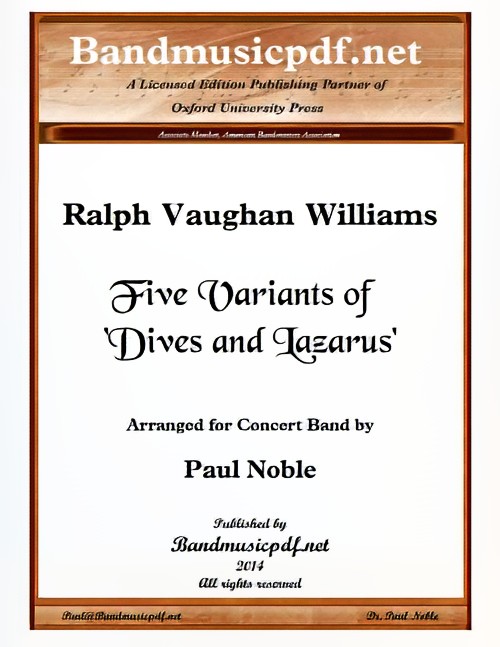 £225.00
Five Variants of Dives and Lazarus (Concert Band - Score and Parts) - Williams, Vaughan - Noble, Paul
Five Variants of Dives and Lazarus is a Concert Band arrangement from the original work for string orchestra and harp by Ralph Vaughan Williams. The composition is based on the folk tune Dives and Lazarus, one of the folk songs quoted in Vaughan Williams' English Folk Song Suite. The ancient theme on which these variations are based goes back to the sixteenth century, and is known by various titles. Dives and Lazarus is a story told by Jesus in the Gospel of Luke. It tells of an unnamed rich man and a poor beggar named Lazarus. In the Latin Bible, the unnamed rich man is referred to as Dives from dives, the Latin word for rich. This work, based on the tune that Vaughan Williams had loved all his life, which came from the very soil of England, ageless and anonymous, was played at the composer's funeral service in Westminster Abbey on 19th September 1958.
Estimated dispatch 7-14 working days
 View Music