
Results
-
 £137.99
Odyssee - Jan Bosveld
The Odyssee tells the story of Odysseus, the undaunted hero. In times long ago the blind poet Homer wrote this famous epic. The "Odyssey" follows the "Iliad", the story of the bloody war between the Greek and the Trojans. This battle endsafter ten years thanks to the Odysseys famous trick. the Trojan Horse. The Odyssey is not a war epic, but a story about perseverance, loyalty, adventure, and the survival instinct of its ingenious hero. In The Odyssey, Homer describes howOdysseus, the king of Ithaca, had to endure another ten years of affliction after the ten years of war in Troy before he could finally return to his home land. During those years, his wife, Penelope, had to try and keep her many admirers away.These men not only wanted het hand but also the kingship. To prove her husbands worth, she played a trick: "As soon as I have finished weaving this shroud for my father-in-law, Laertes, I will choose one of you to become my husband", she promisedthem. But during the night, she secretly loosened what she had woven during the day, prolonging the time until Odysseus would finally return. After twenty long years, when he finally stood at the door, she wondered: Is this really my husband? Ishe an imposter? Cunningly, she asked him to move the bed, because only she and her husband know that the bed was immovable and was build around an old three trunk! Odysseus was deeply moved: this really was his wife, his Penelope! Nearly threethousands years later, the loyalty and strength of this character, and all the dangerous adventures that Odysseus survived thanks to courage and intelligence, still moves us today. Odyssee by Jan Bosveld is not just an adventure story, butrather a characteristic piece in which memories of Homers story can be heard. The composition opens with a firm, stirring theme describing our hero, Odysseus, in detail: This man is not to be taken lightly. The further development of thisshort introduction completes this character sketch: trustworthy, perseverant, and a genius. After that we can picture Odysseus on the lonely beach of Ogygia. Do the trumpets depict his memories of the war of Troy? Does he think of his wife, as werecognise the weaving loom of Penelope in the murmuring eighth? In the solemn, plaintive part that follows, we can imagine Penelope feeling lonely, sitting in the womens room with her servants.One of the girls plays the harp, but that does notclear the sombre atmosphere. Then we can imagine seeing the sorceress Circe, who changed Odysseus men into swine. After she gives a simple magic sign something follows that reminds us of the sound of pigs grunting. Then the Odysseus theme resounds:the hero comes to savi his comrades. Assisted by Hermes, he forces Circe to lift the spell. The piece ends the same way as it began, with an animated theme: Odysseus is still the same, undefeated and not to be taken lighty!
Estimated dispatch 7-14 working days
-
 £119.60
Frankenstein - Kelly Bennette
This tone poem entitled Frankenstein is based on the original novel by Mary Shelley (1797-1851). Victor Frankenstein creates life from pieces of many dead bodies. Soon, his monster comes to life. Though very intelligent, the monster has the maturity of a child. In a fit of rage, the monster kills William, Victor's younger brother. The monster finds Victor in The Alps and asks him to make him a mate. Victor makes him a mate, but kills her. The enraged monster tells Victor, "I will be with you on your wedding night." The monster forces his way into the wedding and kills Victor's fiance, Elizabeth. Victor chases the monster all the way to the Arctis where he dies of exhaustion. The monster finds Victor's body and realizes he has nothing to live for and goes away to die.
Estimated dispatch 7-14 working days
-
 £155.90
Cantina Band - John Williams
Cantina Band (or Mad About Me) was written by John Williams in 1977 for the film Star Wars (later Star Wars IV: A New Hope). Even with quite a bit of the Star Wars music being quite well known, Cantina Band is literally in a style of its own. In the Star Wars-universe this style is called jizz, Williams' take on the more well-known genre jazz. Williams was tasked by Star Wars-creator George Lucas to make music that sounded like several creatures in a future century finding some 1930's Benny Goodman swing band music ... and how they might attempt to interpret it and ended up with Cantina Band #1 and #2. Both numbers are played in the legendary scene taking place in Chalmun's Spaceport Cantina where Luke Skywalker and Obi-Wan Kenobi gets in a fight causing even the band to stop playing.The band, which goes by the name Figrin D'an and the Modal Nodes, comes from the planet Clak'dor VII and specializes in jizz and the nearby, slightly older style of jatz. Performers of this music often go by the name "jizz-wailers", and the Bith people from Clak'dor VII are especially well suited for jizz-wailing since they can hold every note as long as they want thanks to a unique respiratory system - something many perhaps would like to be able to do in the performance of this arrangement as well.The arrangement is relatively faithful to Williams' original version, but with a somewhat different ending. Although the woodwind section undoubtedly has the biggest technical challenges, an understanding of the musical style is the very key to making the arrangement sound good - and here all groups must work together. Playing lightly but quite articulated, and very precise, will be an absolute necessity to get the music drifting off all the way to Tatooine.In measure 113 there is a small improvised solo in either trombone or trumpet, but if you want the real authentic Cantina Band-sound this is of course done on a steel drum.
Estimated dispatch 7-14 working days
-
 £205.30
Mitt hjerte alltid vanker - Fantasi - Hans Adolph Brorson
This arrangement was commissioned by B3 (The Bergen Woodwind Ensemble). B3 is a large woodwind ensemble located in Bergen with a mix of professional and amateur players. My Heart Remains in Wonder is a well-known Christmas hymn in Scandinavia. I wanted my version to be different to the traditional hymn tune style in which it is normally performed. One day I was outside walking and this idea came to me: an ostinato-like, mechanical skeleton of arpeggio semiquavers on which I could 'hang' the melody. However, I also wanted to do the melody line a bit different. The inspiration for this comes from folk music and the way fiddlers hardly ever lift their bow off the strings when they play. Because of this, it is important that the melody is played in a very sostenuto style in this arrangement. The harmonies lie somewhere between jazz and folk music with a little nod towards Grieg (himself heavily influenced by folk music) in the slow middle section.
Estimated dispatch 7-14 working days
-
 £78.95
Unicorn Ranch - Chris Campbell
Full of interesting rhythmic patterns that evoke a horse-like "galloping" feel, this gently dissonant composition is a great way to work on ensemble blend and listening skills. Written at one tempo throughout, it's an easy way to introduce the concept of syncopation while also developing cut-time playing skills. Perfect as a challenging contest, festival or concert selection for younger bands or a lighter selection for more advanced groups.
Estimated dispatch 7-14 working days
-
£69.99
Excursions - James Curnow
A joyous and exuberant sparkler for your next concert! This bright little bijou from James Curnow is a great way to start the show. It's as inviting as they get and will engage every listener from start to finish.The easy excitement will motivate your Grade 2 band to their iridescent best. For groups playing regularly at a Grade 3 level EXCURSIONS also works well in the program following any heavy major work you may have chosen to perform. It's a perfect way to lighten the mood and recapture those listeners who may be new to the art of listening to larger forms.Use it anywhere, anytime of the year. It'll be quick to prepare, effective in concert, and has much more tooffer educationally than the typical "pop/movie tune" type of fare.Take a look!
Estimated dispatch 7-14 working days
-
 £129.50
Goddess of Fire - Steven Reineke
A magnificent programmatic work for symphonic band that is an offering to Pele, the Goddess of Hawaii's volcanoes. The work opens with primordial, mysterious sounds representing the foreboding volcanoes of Hawaii. We are then introduced to Pele as a tall, beautiful young woman. This is one of the forms she can take and it represents her powers of creation and beauty. This gives way to the active and destructive Pele, often taking the form of an old woman, wrinkled and bent with age. The following lyrical section of the piece is the full statement of Pele's theme of creation and beauty. As this theme settles, we begin to hear the ground pop and crack letting us know that new lava is beginning to bubble and flow. Suddenly and violently, one of her volcanoes erupts, creating massive chaos and destruction. After the eruption subsides, Pele's theme of creation and beauty returns again. A wonderful addition to any concert or festival performance by mature bands. Exceptional in every respect!
Estimated dispatch 7-14 working days
-
 £78.20
Caribbean Summer - Luigi di Ghisallo
Most people who live in the Caribbean are of an outspokenly straightforward nature, and always in good mood. "Caribbean Summer", a three-movement piece, captures this very mood: Very early in the morning, a summer day begins with "Guadeloupe", a Caribbean waltz. In this the change from a triple meter to a duple meter counter rhythm is of prime importance. From it, the music draws a particular lilt.At noon there is a happy and lively hustle and bustle on the beach. Vendors ("The Coconut Vendor") sing and offer their sugar-peanuts ("Chou-Cou"). A guest spontaneously begins to drum his fingers on a table, a second one reaches for a calabash or a cowbell - a cha-cha-cha is born. Finally, in "Caribbean Nights" a joyful parade of happy people march down the streets. Based on this very feeling, a special dance developed chiefly in the Dominican Republic: a simple basic two-step pattern in even rhythm becomes a "Merengue" together with the right, so to speak contra rotating motion of the hips! This cheerful dance then marks the close of day in a happy way - and in the morning everything will begin over again...
Estimated dispatch 7-14 working days
-
 £57.50
Steps Ahead - Michael Gandolfi
Steps Ahead is a work by Michael Gandolfi that takes young players on a journey! Along the way, there are musical elements that are intended to educate the performers about basic compositional techniques that are intended to educate the performers about basic compositional techniques. Steps Ahead is a delightful piece with something interesting for every instrument in the ensemble. Each of its three sections addresses a kind of compositional technique - transposition, tutti (a 2-part homophonic section) and developing tutti (parts of the band enter to build to a 2-part homophonic tutti). Less experienced players might enjoy the challenges of easy syncopation and musical lines constructed with larger intervals. -Tom Duffy, series editor. BandQuest, an exciting series of new music and accompanying curricula for band, is a program published by the American Composers Forum. The series was started as a response to feedback from music educators that there is a pressing need for new, fresh band music. The heart of this program is new works written by a diverse group of leading American composers who have created challenging pieces that are a true departure from standard middle school repertoire. Visit www.bandquest.org to learn more about this innovative series, and email [email protected] request a free downloadable audio catalog.
Estimated dispatch 7-14 working days
-
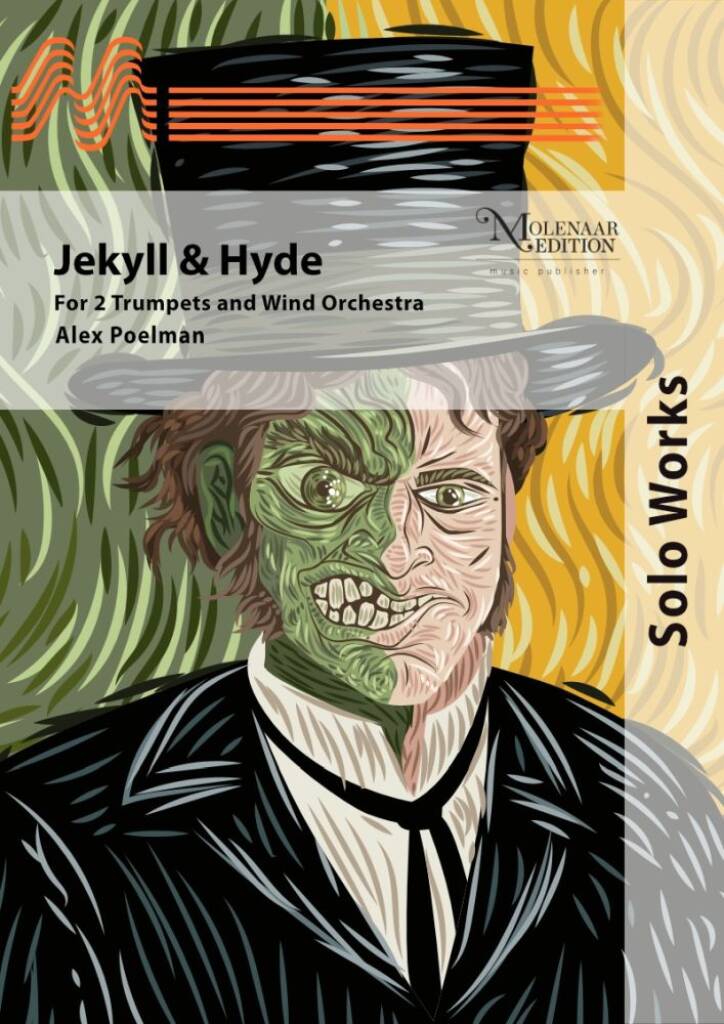 £211.60
Jekyll & Hyde - Alex Poelman
Dr Jekyll researches the evil in man and succeeds in creating a potion that transforms him into his alter ego, Hyde. However, Jekyll loses control and fights an inner battle with Hyde. He loses this battle when Hyde commits murder. Understanding that there is only one way to resolve this, Jekyll kills himself and thus Hyde. In this solo concert the main characters Jekyll and Hyde are played by two solo trumpeters. The different sides of the trumpet are highlighted in this story: from the lyrical passages (Jekyll) to the sharp, mean and dark passages (Hyde). A challenging adventure for orchestra and soloists.This is rental music. Please contact us at [email protected]
Estimated dispatch 7-14 working days
 View Music