
Results
-
 £248.99
Odysseia (Concert Band - Score and Parts) - Aulio, Maxime
Washed up on the Phaeacian shore after a shipwreck, Odysseus is introduced to King Alcinous. As he sits in the palace, he tells the Phaeacians of his wanderings since leaving Troy. Odysseus and his men fi rst landed on the island of the Cicones where they sacked the city of Ismarus. From there, great storms swept them to the land of the hospitable Lotus Eaters. Then they sailed to the land of the Cyclopes. Odysseus and twelve of his men entered the cave of Polyphemus. After the single-eyed giant made handfuls of his men into meals, Odysseus fi nally defeated him. He got him drunk and once he had fallen asleep, he and his men stabbed a glowing spike into the Cyclop's single eye, completely blinding him. They escaped by clinging to the bellies of some sheep. Once aboard, Odysseus taunted the Cyclop by revealing him his true identity. Enraged, Polyphemus hurled rocks at the ship, trying to sink it. After leaving the Cyclopes' island, they arrived at the home of Aeolus, ruler of the winds. Aeolus off ered Odysseus a bag trapping all the strong winds within except one - the one which would take him straight back to Ithaca. As the ship came within sight of Ithaca, the crewmen, curious about the bag, decided to open it. The winds escaped and stirred up a storm. Odysseus and his crew came to the land of the cannibalistic Laestrygonians, who sank all but one of the ships. The survivors went next to Aeaea, the island of the witch-goddess Circe. Odysseus sent out a scouting party but Circe turned them into pigs. With the help of an antidote the god Hermes had given him, Odysseus managed to overpower the goddess and forced her to change his men back to human form. When it was time for Odysseus to leave, Circe told him to sail to the realm of the dead to speak with the spirit of the seer Tiresias. One day's sailing took them to the land of the Cimmerians. There, he performed sacrifi ces to attract the souls of the dead. Tiresias told him what would happen to him next. He then got to talk with his mother, Anticleia, and met the spirits of Agamemnon, Achilles, Patroclus, Antilochus, Ajax and others. He then saw the souls of the damned Tityos, Tantalus, and Sisyphus. Odysseus soon found himself mobbed by souls. He became frightened, ran back to his ship, and sailed away. While back at Aeaea, Circe told him about the dangers he would have to face on his way back home. She advised him to avoid hearing the song of the Sirens; but if he really felt he had to hear, then he should be tied to the mast of the ship, which he did. Odysseus then successfully steered his crew past Charybdis (a violent whirlpool) and Scylla (a multiple-headed monster), but Scylla managed to devour six of his men. Finally, Odysseus and his surviving crew approached the island where the Sun god kept sacred cattle. Odysseus wanted to sail past, but the crewmen persuaded him to let them rest there. Odysseus passed Circe's counsel on to his men. Once he had fallen asleep, his men impiously killed and ate some of the cattle. When the Sun god found out, he asked Zeus to punish them. Shortly after they set sail from the island, Zeus destroyed the ship and all the men died except for Odysseus. After ten days, Odysseus was washed up on the island of the nymph Calypso.
Estimated dispatch 7-14 working days
-
 £79.99
Troja (Troy) (Concert Band - Score and Parts) - Schwarz, Otto M.
The Greek poet Homer wrote about Troy and the Trojan War, which probably took place in what is now Asia Minor, in his Iliad in the 8th century B.C. Nowadays, the term Trojan generally refers to a malware program that is used to gain unauthorised access to computers. This use comes from the legendary Trojan Horse, which saw the turning point in the battle between Greeks and Trojans through the cunning of Odysseus. Let us return to the beginning of the story: Paris, son of the king of Troy, is tasked by Zeus with judging the beauty of the three goddesses Aphrodite, Pallas Athena, and Hera. Aphrodite, the goddess of love, flatters Paris by promising him the most beautiful woman in the world. Soon afterwards, on a journey to Greece, Paris meets the beautiful Helen, who immediately falls in love with him. Since however she is the wife of Spartan king Menelaus, she eventually lets herself be kidnapped by Paris voluntarily. The Greeks then form a large army and go to war against Troy to retrieve Helen, leading to a ten-year siege of the city. The city is eventually conquered not through combat, however, but through Odysseus' cunning ploy. He has the idea of building an enormous wooden horse with warriors hidden inside. The horse is placed at the gates of the city. Thus, the Trojans are tricked into giving up the siege when, despite various warnings, they bring the horse into the city to dedicate it to the goddess Athena. At night, the soldiers climb out of the horse and open the gate for the Greek army. The troops storm the city and burn it to the ground. The royal family and all the Trojan warriors are killed, only Aeneas, the son of Aphrodite, escapes. Later, following many years' wanderings he and his acolytes will become known as the founders of the Roman people. There are various accounts of the fate of the beautiful Helen. She is said to have returned to Sparta with Menelaus and to have ruled there until the end of her life. Or maybe not...Duration: 6.00
Estimated dispatch 7-14 working days
-
 £159.99
In Nomine (Concert Band - Score and Parts) - Schwarz, Otto M.
How often has something been justified by, declared to be, or blessed as 'in the name of' some cause or other? How can it be that opposing armies and the use of weapons are ever 'in the name of...'? This is a common thread in the history of different faiths. Good was created but evil was committed and all 'in the name of...' This thread is also found in the history of the Premonstratensian Abbey at Wadgassen. The abbey was built in the 12th century on unfertile, desolate moorland, which later evolved into the most powerful religious community in the Saarland. The history of the abbey records quite astounding achievements under the motto desertum florebit quasi lilium ('the desert will bloom like a lily'); but also the harsh treatment of delinquents. The order had its own school, in which children were taught the seven liberal arts (which included music as well as geography and astronomy), but the poor were left to starve outside the abbey walls and were only allowed to eat from the members' leftovers on feast days. The medieval witch trials demanded their pound of flesh, and one group that fell victim were ecstatic dancers who moved wildly to music, which was interpreted as the devil's work. The result: a show trial that sentenced the dancers to death by fire. All in the name of... The year is 1789: Abbot Bordier is in the tenth year of his command. He does not yet know that he is to be the last abbot of an almost 700-year tradition. Not far from the abbey is the French border, which has long been making itself felt with the sound of gunfire, and the brothers continue to keep a nervous eye on it. The first portents of the French Revolution loom, but no one wants to believe it, that is, until the French pound the door down, storm the abbey and come right into the brothers' chambers. In a blind fury, all the pipes of the abbey organ are torn out, icons beheaded with swords and brothers beaten death while numerous buildings are set on fire. The abbey church is in flames. A frantic and desperate escape begins. Abbot Bordier and a handful of brothers make their getaway via the River Saar, adjacent to the abbey, to the neighbouring village of Bous. They survive, but their life, the Premonstratensian abbey, is destroyed. While they flee towards Prague and the sanctuary of the Strahov Monastery, the abbey at Wadgassen is razed to the ground and becomes a stone quarry. The desert blooms once more, however. A few short decades later, a glasswork arises from the foundations of the abbey. As peace returns to the region, it brings jobs and a new vision for its people.Duration: 11.15
Estimated dispatch 7-14 working days
-
 £104.95
A Maritime Overture (Concert Band - Score and Parts) - Ireland, John
Cast your self into a storm at sea with this fantastic piece from John Ireland. Turbulent rhythmic motives launch the work to blend into a more lyrical melody contrasting the opening. Don't be fooled though; the first rhythmic motive provides the underlay, a reminder that the calm surface of the sea is only masking the swirling water underneath!
Estimated dispatch 7-14 working days
-
£20.95
A Maritime Overture (Concert Band - Score Only) - Ireland, John
Cast your self into a storm at sea with this fantastic piece from John Ireland. Turbulent rhythmic motives launch the work to blend into a more lyrical melody contrasting the opening. Don't be fooled though; the first rhythmic motive provides the underlay, a reminder that the calm surface of the sea is only masking the swirling water underneath!
Estimated dispatch 7-14 working days
-
 £46.00
Whirlwinds (Concert Band - Score and Parts) - Shaffer, David
Capturing the intense power of the seas, "Whirlwinds" opens with intense rhythms and haunting harmonies building in intensity throughout the composition. A brief lull in the storm divides the piece into 3 separate and contrasting musical moments. Utilizing the power of the percussion section to define the drama, David Shaffer has crafted a festival piece that will intrigue your students and entertain your audiences. "Whirlwinds" is a perfect choice for any concert or festival.Duration: 2.00
Estimated dispatch 7-14 working days
-
 £74.00
Defying Gravity (Concert Band - Score and Parts) - Reineke, Steven
A new programmatic composition that depicts the marvels of modern aviation. The opening represents the take-off and the majesty of the climb into the heavens. But after reaching cruising altitude and soaring peacefully above the clouds, the plane must descend through a strong turbulent storm. All ends well as the pilot regains control of the aircraft and heroically returns the band and your captivated audience safely to the ground. A superior choice for any festival or concert performance. Extraordinary music by an exceptional composer.Duration: 5.15
Estimated dispatch 7-14 working days
-
 £109.99
Boreas Wind Band Set (Score & Parts)
In Greek mythology, Boreas is the God of the North Wind. When thinking of the north wind we particularly think of the bleak wind coming from the freezing cold north, but in Homers' work we see a more varied picture. As shown in the following two stories, Boreas often does play the role of a storm wind that blows forth heavy dark clouds while whipping up the dark waves of the tempestuous sea to mountainous heights. When the stake of the fallen Patroclos refuses to burn, Achilles begs for some wind. When Iris, the swift messenger of the Gods, asks the winds for assistance, they raise themselves up with tremendous roaring and rush to Troy. Upon their arrival they blow the divine fire of Patroclos' stake far up into the sky. When Troy was destroyed, the Greeks returned home. After many wanderings, Odysseus, however, ends up with the beautiful nymph, Calypso, who keeps him as a prisoner. As ordered by Zeus, Calypso frees him and sends him off on a handmade wooden raft. At sea, Odysseus is threatened by the aggressive sea god, Poseidon, who stirs up the winds and thrashes the waves with his trident. The goddess, Athena, stems the violence of all the winds except for the north wind, and thus it is Boreas, who sends Odysseus to the land of the hospitable Phaiakes. Jan Bosveld composed Boreas for OLTO, a music association in Loenen, The Netherlands, for which he had served as conductor for many years. Turbulent movement in both tempo and dynamics characterize this composition. The result is a whirling piece that races by in a positive manner. Boreas is in de Griekse mythologie de god van de noordenwind. Bij noordenwind denken wij vooral aan de gure wind uit het ijskoude noorden, bij Homerus echter zien we een meer gevari?erd beeld. Natuurlijk speelt Boreas, zoals uit de twee onderstaande verhalen blijkt, meestal de rol van de stormwind die de zware zwarte wolken voor zich uit blaast en de donkere golven van de onstuimige zee torenhoog opzwiept. 05:00
Estimated dispatch 7-14 working days
-
 £134.99
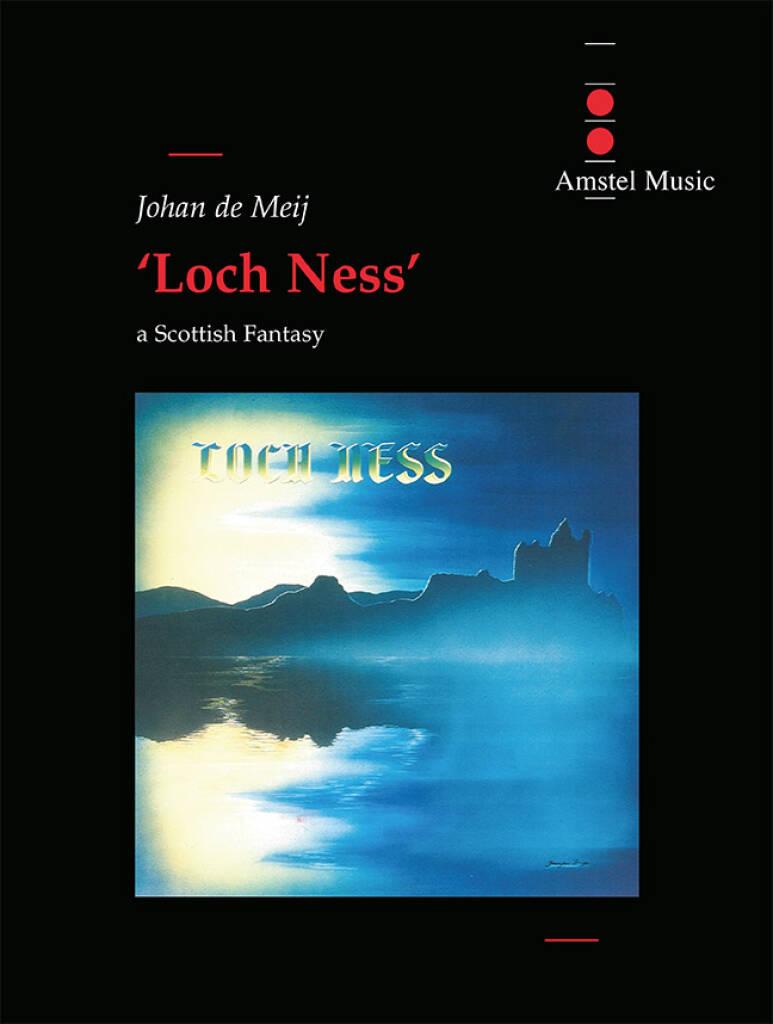
Loch Ness - Johan de Meij
The symphonic poem 'Loch Ness' consists of five through-composed impressions of this mysterious Scottish Lake. I) The Lake At Dawn - calm, static, sonorous blocks depict the troubled opaque water surface and the enormous depth of the Lake at daybreak. II) Slowly the rising early-morning mist reveals the distant ruins of Urquhart Castle, represented by a solemn theme in the trombones which is taken over by the full band, thus evoking the illustrious past of this fortress besieged so many times. III) Inverness: Bagpipes and Tourists - the music takes us down to the town of Inverness where the first tourists mark the slow but steady start of a new season to the sound of a Scottishmelody. IV) Storm - suddenly a heavy wheater breaks: fierce gusts of wind and heavy showers transform the erstwhile calm surface into an obscure and whirling mass of water, and clouds rapidly passing over offer an eery scene... V) Conclusion - storm and rain gradually decrease and when everything is quiet again we are granted a last view of the Lake in its full glory.
Estimated dispatch 7-14 working days
-
£129.99
Weather Report - Shin'ya Takahashi
Weather Report was commissioned by Marunouchi Junior High School in Nagano in 2010 and premiered at the Nagano State Band Contest.One of my new thoughts for composition has been to ask students for titles, images and ideas. For this commission I collected many interesting concepts, and quite a few had to do with weather. So, I constructed the piece based on weather news and report. After the main weather news presentation, the meteorologist presents the daily weather forecast:"The morning will be clear and beautiful becoming cloudy at noon and eventually shower later. Rain intensity will increase turning into a thunderstorm. Towards the evening, rain and storm will leave, and there will be a beautiful sunset. That's the weather for today."(Shin'ya Takahashi)
Estimated dispatch 7-14 working days
 View Music