
Results
-
 £52.70
Mi Conejita - Hans Elzinga
This swinging piece is the solution for those looking for a combination of original music and Caribbean rhythms; it will make your audiences jump up and start dancing. Hans Elzinga got his inspiration during his many trips through Latin-America.
Estimated dispatch 7-14 working days
-
 £86.80
Wild Horses - Geert Schrijvers
This short, descriptive work was composed to commemorate the 10th anniversary of the dutch wind ensemble 'Vakantieorkest Ad Hoc', on their tour to the south of France. The work is a reference to the accommodation where the orchestra has often stayed. 'Wild Horses' is an rip-roaring composition, which brings forth images of the sometimes harsh and exciting world of the Wild West. This work is also a tribute to one of the most influential film score composers of all time: Ennio Morricone. The trampling of the wild stallions, the expansive wasteland and the exquistie beauty of the prairie at sunset form the main inspiration sources for this spectacular work.
Estimated dispatch 7-14 working days
-
 £61.80
Freetime - Ralf Uhl
After the enjoyable 'Prelude For You' , composer Ralf Uhl follows up with the very worthy 'Freetime'. The inspiration for this work was the refreshing feeling at the beginning of a holiday. The trumpets will enjoy playing their hearts out in this 'pop-style' piece, written as a fun rhythmic caprice for symphonic wind band.
Estimated dispatch 7-14 working days
-
£73.50
Where Valor Proudly Sleeps - Robert Longfield
The Civil War has long been a source of inspiration for poets, artists, and composers. Robert Longfield offers an exciting new work as a musical salute to this dramatic time in American history. Based on original material from the 1800s, the piece is scored to include field drums, a 21 cannon volley, and a sensitive brass treatment of Taps featuring solo horn.
Estimated dispatch 7-14 working days
-
£58.50
Irish Festival - Quincy C. Hilliard
Quincy C. Hilliard uses two Irish folksongs as the inspiration for this new festival work. A drone opens the work which quickly moves to a simple, yet creative setting of The Last Rose of Summer. A slow, lyrical treatment of the same folk song serves as the middle section of the piece. The final section is based on The Rake of Mallow and makes use of ample percussion as the piece propels toward a powerful conclusion.
Estimated dispatch 7-14 working days
-
 £127.30
Go Far - Svein Fjermestad
The Title Go Far is a word play referring to what the players are going to (GO FAR!) and the musical inspiration from the TV-series Fargo (Mr. Wrench & Mr. Numbers). The piece is very groovy and especially the drum kit needs to lead the band and preferably sound like good, old John Bonham (drummer in the band Led Zeppelin). The melody is inspired by cool Native Americans and the band really needs to bring their primal roar! The piece was written for Eikanger-Bjrsvik Musikklag and their annual summer band camp Feriespel in 2017.
Estimated dispatch 7-14 working days
-
 £135.80
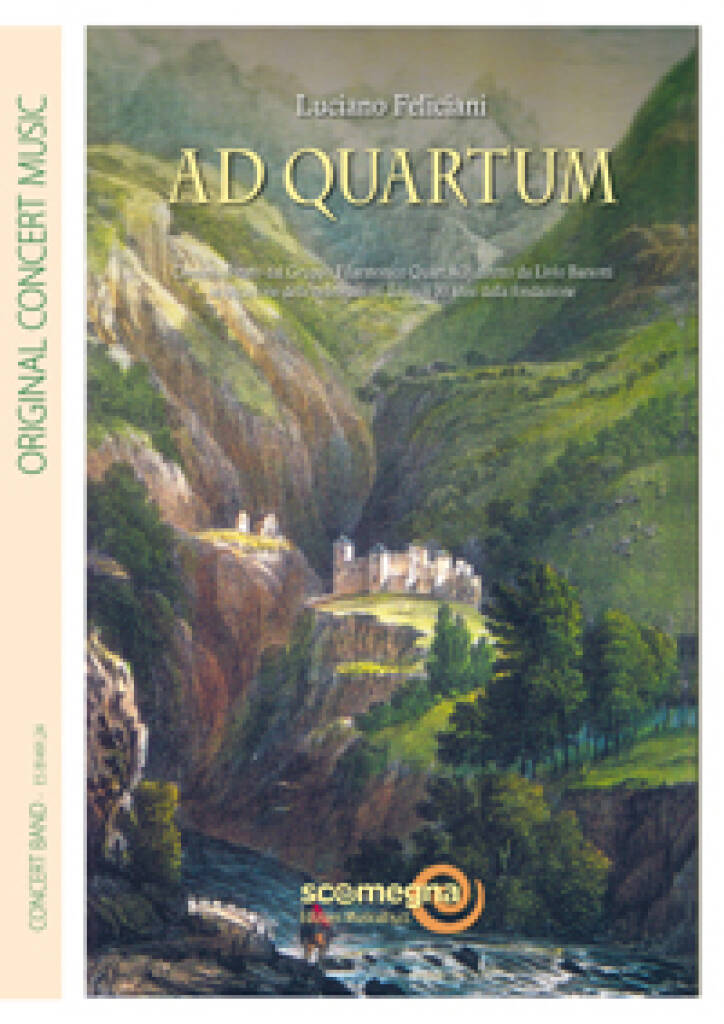
Ad Quartum - Luciano Feliciani
The city of Quart derives its name from the Latin "Ad quartum ab Augusta lapidem", or four Roman miles from Augusta Praetoria, present-day Aosta, along the ancient Roman consular road of the Gauls. The fortress of Quart, whose construction began in 1185, is the main source of inspiration for the composition. The work begins, in fact, as if wrapped in a mysterious, suspended atmosphere, when the fog that envelops the manor suddenly thins out and lets one see the majestic building in all its austerity. A rhythmically exciting episode follows this brief introduction, ideally describing the events that have marked the long history of these places. The music highlights the percussion instruments, which evoke ancient medieval atmospheres in a modern language. The second theme, derived from the previous one, describes instead emotions and feelings of grandeur, beauty, and peace associated with the splendid Valle d'Aosta mountains that surround Quart. A developed melodic idea, supported by wide-ranging harmonies, attempts to musically portray the extraordinary natural beauty of these places. The reprise of the first theme, varied and presented in a lively and energetic movement, guides the final part of the piece: a coda where all the melodic and rhythmic ideas previously exposed are condensed.
Estimated dispatch 7-14 working days
-
 £113.30
Moderate Dances - Angelo Sormani
This piece is a tribute to dance music, especially passionate, intense and meditative dance music. "Moderate Dances" is divided into three movements: a "Tango", a "Slow Waltz" and a "Bossa Nova". Each movement and each dance has its own particular characteristics but, when combined, these different rhythmic beats and times give the piece a feeling of completeness and uniformity. The Tango started to flourish in the suburbs of Buenos Aires in around 1880. There is still some doubt as to its origins, which may be Cuban (Habanera) but are probably African. It was most popular in Argentina and Brazil: here the male protagonist was originally the "gaucho" with his inseparable guitar, later to be replaced by the proud, elegant "compadre". By around 1910 the Tango had spread to Italy and France. New clubs opened, where the upper classes could watch and dance the Tango. Here the dance also underwent some rapid transformations. The exaggerated and extravagant gestures and body movements disappeared. Slow, gliding steps replaced the old rotational movements. The women's red ankle-boots and the partners "staring into each other's eyes" accentuated the erotic nature and sensuality of this dance. So much so that, in 1913, the German government banned soldiers from dancing the Tango. Those who broke the law were immediately discharged from the army. From a strictly musical perspective, the basic instruments were a flute, a harp (the diatonic harp typically played by the Indians of Paraguay) and a violin, or flute, guitar and violin or even clarinet, guitar and violin. These instruments were easy to transport, ideal for playing at parties, in the streets and in courtyards. The musicians played by ear, frequently improvising: there were no scores, no records, which is the main reason why it is impossible to trace the Tango back to its exact origins. However, the Tango's evolution (and growing popularity) was once again fostered by its fundamental ability to absorb "other" cultures, languages and sounds. And it was the arrival of the "bandoneon" (an accordion-like instrument that was invented in Germany and brought to Rio de la Plata by some immigrant), which replaced the flute, that marked the beginning of the Tango's huge success outside Argentina. A number of talented composers, above all the great Astor Piazzola (1921-1992), transformed the bandoneon from a simple accompanying instrument to a solo instrument that was to become the distinguishing feature of the 20th century Tango. The Slow Waltz originated from the Waltz, the typical dance of the Bavarian and Tyrolese peasants in the 1700s. It was composers like Johann Strauss, father and son, who carried the Waltz to its zenith in the 1800s, creating the sensual and melancholy yet joyful and charming dance we are all familiar with. When the Waltz first became popular in Germany, the members of respectable society were shocked at the closeness of the dancing partners, who had always previously danced apart. The main difference between the Waltz and Slow Waltz is that the latter has a slower, more expressive rhythm: the men wear tails and the women wear ball gowns decorated with beads and feathers and couples dance in graceful rotational movements. "Bossa Nova" is the title of the last movement in the piece. Jobim, the great Brazilian musician, described this musical genre as a combination of modern Jazz and Samba. Bossa Nova means "new wave". This was the name of the artistic and musical movement that evolved in Brazil in the late Fifties and was extremely popular throughout the Sixties. The songs are usually about love or social matters, drawing inspiration from the slums of Rio De Janeiro and the lives of their inhabitants. Bossa Nova, with its original compositions and the artistic talent of its musicians, also became hugely popular in the United States and Europe, and top Jazz musicians (Ella Fitzgerald, Stan Getz, Bob Cooper, Charlie Bird, Sonny Rollins, Dexter Gordon, Dizzy Gillespie) started to include Bossa in their repertoires.
Estimated dispatch 7-14 working days
-
 £179.95
Faces (1. From Celestial Dancers) - Eric Ewazen
Ewazen seemingly takes inspiration from an endless array of sights, environments, and events. It would be impossible for him to be exposed to the wonder of Angkor Wat and to not distill his impressions into music. In fact, he created four distinct impressions for wind ensemble. Performance notes are included, which help to describe the settings and the thoughts behind them.
Estimated dispatch 7-14 working days
-
 £347.95
Trees (2. From Celestial Dancers) - Eric Ewazen
Ewazen seemingly takes inspiration from an endless array of sights, environments, and events. It would be impossible for him to be exposed to the wonder of Angkor Wat and to not distill his impressions into music. In fact, he created four distinct impressions for wind ensemble. Performance notes are included, which help to describe the settings and the thoughts behind them.
Estimated dispatch 7-14 working days
 View Music