
Results
-
 £139.99
Aroldo (Concert Band - Score and Parts) - Verdi, Giuseppe - Cesarini, Franco
Aroldo, number 22 of the 32 operas written by Verdi, is certainly not one of the best-known works from "the genius of Busseto." Written in 1857, it is in fact a remake of the 1848 opera Stiffelio, which told a story of adultery and which was censored for its "indecent" content. Verdi found the censorship of Stiffelio unacceptable, and with a performance in Verona approaching at the start of 1851, he wrote to his editor, Ricordi: "If my libretto is censored, it will not be possible to obtain the effect I desire, so I would rather wait until I can rewrite the last scene." But the modifications to Stiffelio did not stop there. The setting, the historical period and the finale were also completely changed. In the process of converting Stiffelio to Aroldo, Verdi no doubt succeeded in strengthening certain moments. However, the fame of the three operas he had written in the meantime - Rigoletto, Il Trovatore and La Traviata - did not allow Aroldo to receive the recognition it deserved. The opera's symphony is indeed a superb work and contains moments of outstanding lyricism. The trumpet solo in the introduction is the longest written by Verdi for this instrument.Duration: 8:45
Estimated dispatch 7-14 working days
-
 £84.95
Perchance To Dream (Concert Band - Score and Parts) - Bourgeois, Derek
In 1969 I was teaching music at Cranleigh School in Surrey. I was asked to write a work for the orchestra and produced a four-movement piece entitled Concerto for School Orchestra. I have now reworked the music for wind band and re-titled it Perchance to Dream. the piece has a slow introduction followed by a loose sonata form movement in which the introductory material is reintroduced.
Estimated dispatch 7-14 working days
-
£16.95
Perchance To Dream (Concert Band - Score Only) - Bourgeois, Derek
In 1969 I was teaching music at Cranleigh School in Surrey. I was asked to write a work for the orchestra and produced a four-movement piece entitled Concerto for School Orchestra. I have now reworked the music for wind band and re-titled it Perchance to Dream. the piece has a slow introduction followed by a loose sonata form movement in which the introductory material is reintroduced.
Estimated dispatch 7-14 working days
-
 £164.95
Euphonium Concerto (Concert Band - Score and Parts) - Ellerby, Martin
This Euphonium Concerto was written between late 1994 and early 1995 in response to a commission from Steven Mead to whom the work is dedicated. It is cast in four movements and lasts a little over 22 mins:I. Fantasy: After the briefest of introductions, the solo euphonium enters with the key melodic phrase of the movement in a fast 'Tempo I'. This idea is developed up to the point where a slower 'Tempo II' breaks the argument - here the mood is reflective but it is only to be a brief interruption as 'Tempo I' returns very quickly. The opening material is then subjected to further transformation with 'Tempo II' making occasional returns en route, the distances between the contrasting tempi becoming ever closer, and the movement closes in a rather soft though definite manner.II. Capriccio: This relatively short presto movement forms a bridge between the first movement and the work's slow movement. The majority of the band parts are bright and muted with the percussion players enhancing the texture with contributions from xylophone, glockenspiel and vibraphone. Again the initial solo euphonium phrase provides the basis for almost all the movement's material. This is extremely virtuosic for the soloist and band alike and makes great play of the rhythmic possibilities of combining simple and compound music either in close proximity or together.III. Rhapsody (for Luis): A Lento movement, sitting between two different but essentially rapid ones, this provides the work's emotional core exploiting the soloist's cantabile qualities in an almost seamless fashion. Again, as will all the work's movements, the initial idea paves the way for subsequent development, eventually culminating in a passionate climax; thereafter it winds down with an affectionate backward glance towards the close of the the slow movement of the Euphonium Concerto of Joseph Horovitz, whose mark had been made indelibly on the euphonium repertoire. This movement is dedicated to Luis Maldonado who set the full score of the brass version before his untimely death.IV. Diversions: The work's variation finale is cast in 3/4 throughout though the barline is often a guideline and was seen by the composer as a challenge of metrical restraint! There is an obvious jazz feel to this movement (both rhythmically and harmonically) with a swaggering ritornello theme first announced by the solo euphonium. Thereafter follows a series of interludes and 'adjusted' returns of the main theme. A lyrical idea is allowed to enter but the underlying momentum is ever present. The band also contributes to the interludes and eventually the tempo increases towards a 'wild' and absolute conclusion.Duration: 22.30Recorded on QPRM143D Dreamscapes, Royal Northern College of Music Wind Orchestra
Estimated dispatch 7-14 working days
-
£32.95
Euphonium Concerto (Concert Band - Score only) - Ellerby, Martin
This Euphonium Concerto was written between late 1994 and early 1995 in response to a commission from Steven Mead to whom the work is dedicated. It is cast in four movements and lasts a little over 22 mins:I. Fantasy: After the briefest of introductions, the solo euphonium enters with the key melodic phrase of the movement in a fast 'Tempo I'. This idea is developed up to the point where a slower 'Tempo II' breaks the argument - here the mood is reflective but it is only to be a brief interruption as 'Tempo I' returns very quickly. The opening material is then subjected to further transformation with 'Tempo II' making occasional returns en route, the distances between the contrasting tempi becoming ever closer, and the movement closes in a rather soft though definite manner.II. Capriccio: This relatively short presto movement forms a bridge between the first movement and the work's slow movement. The majority of the band parts are bright and muted with the percussion players enhancing the texture with contributions from xylophone, glockenspiel and vibraphone. Again the initial solo euphonium phrase provides the basis for almost all the movement's material. This is extremely virtuosic for the soloist and band alike and makes great play of the rhythmic possibilities of combining simple and compound music either in close proximity or together.III. Rhapsody (for Luis): A Lento movement, sitting between two different but essentially rapid ones, this provides the work's emotional core exploiting the soloist's cantabile qualities in an almost seamless fashion. Again, as will all the work's movements, the initial idea paves the way for subsequent development, eventually culminating in a passionate climax; thereafter it winds down with an affectionate backward glance towards the close of the the slow movement of the Euphonium Concerto of Joseph Horovitz, whose mark had been made indelibly on the euphonium repertoire. This movement is dedicated to Luis Maldonado who set the full score of the brass version before his untimely death.IV. Diversions: The work's variation finale is cast in 3/4 throughout though the barline is often a guideline and was seen by the composer as a challenge of metrical restraint! There is an obvious jazz feel to this movement (both rhythmically and harmonically) with a swaggering ritornello theme first announced by the solo euphonium. Thereafter follows a series of interludes and 'adjusted' returns of the main theme. A lyrical idea is allowed to enter but the underlying momentum is ever present. The band also contributes to the interludes and eventually the tempo increases towards a 'wild' and absolute conclusion.Duration: 22.30Recorded on QPRM143D Dreamscapes, Royal Northern College of Music Wind Orchestra
Estimated dispatch 7-14 working days
-
 £115.00
BOHEMIAN DANCES (Concert Band) - Woolfenden, Guy
Includes:1. Shepherds and Shepherdesses2. Florizel and Perdita3. Dance of the SatyrsOne of my favourite Shakespeare plays is The Winter's Tale, and I have written music for three completely different productions during my time as Head of Music to the Royal Shakespeare Company. One, starring Judi Dench as both the mother, Hermione and her daughter, Perdita, had a big band Tribal Love-Rock score; another had a more classical, but timeless feel to it, and the last was an excellent small-scale touring production, for which I was allowed only a handful of instruments. It is from this source that the basic themes for Bohemian Dances, and an earlier version Three Dances for Clarinet Choir, have emerged. Act IV of the play is set in the kingdom of Bohemia - hence the title of the work.Shakespeare calls for "A Dance of Shepherds and Shepherdesses", which gives Florizel, the son of Polixenes, (King of Bohemia) a chance to become better acquainted with the beautiful Perdita, the lost daughter of Leontes, (King of Sicilia). This movement is written in seemingly tricky and ever-changing metres, but is rhythmically quite logical and melodically catchy.The slower second movement 'Florizel and Perdita' is the lovers' pas de deux: a gentle, slow waltz-like tune, initially presented by the principal oboe, is contrasted with a lndler-like double time melody, at the end of which a solo clarinet makes a link to the last movement.'Dance of the Satyrs' is a rip-roaring, foot-stamping dance performed in the play by 'three carters, three shepherds, three neat-herds, and three swine-herds', who enter in outrageous costumes representing the lecherous half-man, half-goat of Greek mythology. This dance is referred to as a "gallimaufry of gambols" - now where have I heard that word before?! - GW
Estimated dispatch 7-14 working days
-
 £140.00
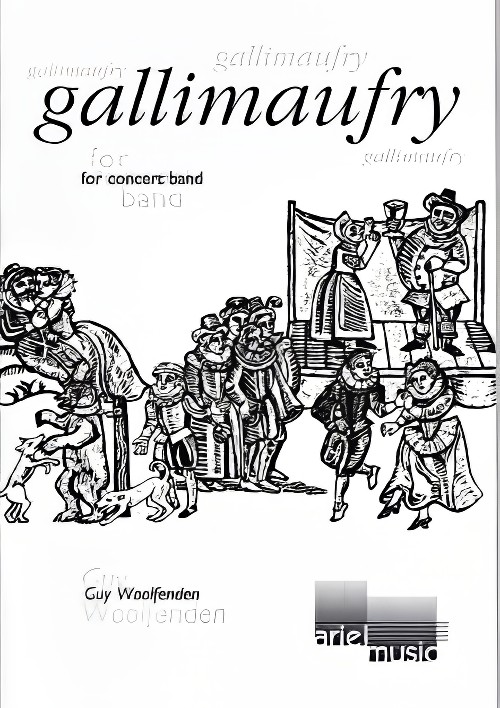
GALLIMAUFRY (Concert Band) - Woolfenden, Guy
Gallimaufry (gali maw'fri): A medley; any confused jumble of things; but strictly speaking, a hotch potch made up of all the scraps of the larder. cf Shakespeare: The Winter's Tale: "a gallimaufry of gambols"I. Church and StateII. Inn and OutIII. Starts and FitsIV. Father and SonV. Advance and RetreatVI. Church and Status QuoGallimaufry was inspired by Shakespeare's Henry IV plays, and derives from music I composed for the Royal Shakespeare Company's production which opened the Barbican Theatre in 1982. The score is dedicated to Trevor Nunn, then Artistic Director of the RSC, with grateful thanks for his suggestion that I should expand and mould the music from these productions into a form suitable for concert performance.My thanks also to Timothy Reynish and the British Association of Symphonic Bands and Wind Ensembles who, with funds provided by North West Arts, commissioned the work and helped to ensure its first performance on September 24th 1983 with the Royal Northern College of Music Wind Orchestra.The work is continuous and the thematic material of each of the six sections closely related. The "establishment" - leadership, temporal and ecclesiastical power - are depicted in the stately march which opens the work. (Church and State)The second section, Inn and Out, in an energetic hemiola rhythm, is concerned with the stews and low-life revels at the Boar's Head Tavern. This is interrupted and finally integrated with the Tavern Brawl and Gadshill Ambush of Starts and Fits.The mood changes and the ambivalence of Prince Hal's relationship with his father and surrogate father, Falstaff, is portrayed in a serene cor anglais solo. (Father and Son)Advance and Retreat is a recruiting march, derived from the Tavern Tune and leads into the last movement, Church and Status Quo, which deals with the rejection of Falstaff and the crowning of Price Hal. Order is restored with a majestic affirmation of the opening material.
Estimated dispatch 7-14 working days
-
 £36.95
Heroic Etude (Trombone Solo with Concert Band - Score and Parts) - Wiffin, Rob
Back in the day I always enjoyed playing the well-known trombone works by Alexandre Guilmant and Ferdinand David and I wanted to return to that type of language and writing in a short concert piece. The music is direct in its expression, mostly exciting but sometimes expressive. The pace of this tude is relentless and requires some deft double tonguing although I stayed away from too many running semiquavers. The last note should ideally be the high D (concert) but a B flat is indicated as a suitable alternative.- Rob WiffinDuration: 3.45
Estimated dispatch 7-14 working days
-
 £79.95
Variations on 'Was Lebet' (Concert Band - Score and Parts) - Wainwright, Andrew
Variations on 'Was Lebet' is based on the German chorale of the same name, the first line of which translates as 'O worship the Lord in the beauty of holiness!' The opening fanfare figure in the Trumpets should be supported by bold, organ-like sostenuto chords in the lower band. Ensure that the fanfare in the Trumpets and Trombones from bars 25 to 28 is given equal articulation and volume in the antiphonal parts. After this majestic introductory section, the first of five contrasting variations is presented, although the tune is never realised in full form until the final variation, with fragments gradually being revealed as the piece progresses.Variation I is somewhat classical in approach, with its energy coming from a regular contrast between cantabile references to the theme, set against lively staccato figures. Ensuring a lightness of touch will be important here; the music should be poised and never sound frantic. As a result, careful attention should be paid to the tempo marking, being no quicker than 136 beats per minute. Snippets of the chorale come and go, with the last phrase of the hymn completing the movement. This final statement, at bar 95, should be an immediate change in tempo and a separate statement to the music that comes before.Variation II is plaintive in mood, giving the listener the chance to reflect on the following words, which form part of the second verse: 'Comfort thy sorrows and answer thy prayerfulness, Guiding thy steps as may best for thee be.' There is opportunity for rubato in this movement, at the discretion of the conductor.Variation III is somewhat quirky and volatile in nature, and takes its inspiration from the 3rd and 4th verses which describe the fearful times in life that we must entrust to the Lord. Driven by the Percussion section in particular, there are references here to Variation I with its chorale-like figures and hurtling scalic figures, and there is a feeling of a lack of resolution. A somewhat abrupt ending suggests that our sense of completeness in Christ is yet to be resolved. It is important that clarity and tempo are maintained in the bass line between sections L and M. Aim for consistency of line in the bass parts, particularly with the trade-offs between players here.There is a French romantic feel to the waltz in Variation IV, with the opportunity for various soloists to display their musicianship. A sense of ironic humour pervades throughout. The Clarinet and Bassoon duet from section U should be playful and display a lightness of touch, with that sense of style continued throughout the movement.Variation V is fugal in nature, with each section of the band being handed the theme at various points. Again it is important that a steady tempo is set at Y in order to maintain control. The sense of momentum gradually increases to a grandiose presentation of the full theme, beginning at section CC, affirming our completeness in the Lord, with the words of the first and last verses reiterated: O worship the Lord in the beauty of holiness! Bow down before him, his glory proclaim; With gold of obedience and incense of lowliness, Kneel and adore him, the Lord is his name.Duration: 11.45
Estimated dispatch 7-14 working days
-
 £15.95
Variations on 'Was Lebet' (Concert Band - Score only) - Wainwright, Andrew
Variations on 'Was Lebet' is based on the German chorale of the same name, the first line of which translates as 'O worship the Lord in the beauty of holiness!' The opening fanfare figure in the Trumpets should be supported by bold, organ-like sostenuto chords in the lower band. Ensure that the fanfare in the Trumpets and Trombones from bars 25 to 28 is given equal articulation and volume in the antiphonal parts. After this majestic introductory section, the first of five contrasting variations is presented, although the tune is never realised in full form until the final variation, with fragments gradually being revealed as the piece progresses.Variation I is somewhat classical in approach, with its energy coming from a regular contrast between cantabile references to the theme, set against lively staccato figures. Ensuring a lightness of touch will be important here; the music should be poised and never sound frantic. As a result, careful attention should be paid to the tempo marking, being no quicker than 136 beats per minute. Snippets of the chorale come and go, with the last phrase of the hymn completing the movement. This final statement, at bar 95, should be an immediate change in tempo and a separate statement to the music that comes before.Variation II is plaintive in mood, giving the listener the chance to reflect on the following words, which form part of the second verse: 'Comfort thy sorrows and answer thy prayerfulness, Guiding thy steps as may best for thee be.' There is opportunity for rubato in this movement, at the discretion of the conductor.Variation III is somewhat quirky and volatile in nature, and takes its inspiration from the 3rd and 4th verses which describe the fearful times in life that we must entrust to the Lord. Driven by the Percussion section in particular, there are references here to Variation I with its chorale-like figures and hurtling scalic figures, and there is a feeling of a lack of resolution. A somewhat abrupt ending suggests that our sense of completeness in Christ is yet to be resolved. It is important that clarity and tempo are maintained in the bass line between sections L and M. Aim for consistency of line in the bass parts, particularly with the trade-offs between players here.There is a French romantic feel to the waltz in Variation IV, with the opportunity for various soloists to display their musicianship. A sense of ironic humour pervades throughout. The Clarinet and Bassoon duet from section U should be playful and display a lightness of touch, with that sense of style continued throughout the movement.Variation V is fugal in nature, with each section of the band being handed the theme at various points. Again it is important that a steady tempo is set at Y in order to maintain control. The sense of momentum gradually increases to a grandiose presentation of the full theme, beginning at section CC, affirming our completeness in the Lord, with the words of the first and last verses reiterated: O worship the Lord in the beauty of holiness! Bow down before him, his glory proclaim; With gold of obedience and incense of lowliness, Kneel and adore him, the Lord is his name.Duration: 11.45
Estimated dispatch 7-14 working days
 View Music