
Results
-
 £73.50
Memor Vita! (Concert Band - Score and Parts) - Karrick, Brant
There is nothing more precious on this Earth than human life, and every day we wake up to start a new day, we choose how to live our own. Memor Vita! is a musical celebration of life, particularly remembering the life of Zachary Joseph Heringer. Zach was diagnosed with cancer when he was 10 years old. He remained positive throughout the many months of treatments and had strong hopes of being cured. He was a vivacious boy who loved sports, the outdoors, and playing the trumpet in band. He was also an excellent student. He was looking forward to joining his high school band with his older sister, Beth, and his friends. However, the cancer continued to spread and at the age of 14, Zach passed away. He fought his cancer with faith, compassion, and an attitude to never give up, and his steadfast optimism left an indelible impression on all who knew him.Duration: 6.00
Estimated dispatch 7-14 working days
-
 £84.99
Bahn Frei (Concert Band - Score and Parts) - Strauss, Eduard - Van der Beek, Wil
Eduard Strauss, the third son of Johann Strauss the Elder, was born on March 15, 1835, in Vienna. Originally, Eduard looked for employment in the diplomatic service, but he also studied music theory. He became a harpist in the Strauss orchestra in 1855. In 1862, he joined his two famous brothers Johann Jr. and Josef as a conductor of the family orchestra. Like that of his two brothers, his musical output was prolific: he wrote over 320 separate dances and marches. Apart from the exuberant Bahn Frei (Track Clear), which he wrote in 1869, and a handful of other fast polkas (he excelled in this particular dance form), his music is not as well known as that of his brothers.Duration: 3:00
Estimated dispatch 7-14 working days
-
 £59.95
Rondo Grottesco (Tuba Solo) (Concert Band - Score and Parts) - Bourgeois, Derek
When Bourgeois, Derek was a schoolboy he played tuba, and as a budding composer he decided he needed a grand vehicle to display his mastery of the instrument. He therefore set out to write a work and completed the opening tune. At that time, however he did not have the expertise to develop the material and after the tune the concerto came to an abrupt end. Many years later the composer was invited to write a piece for tuba and concert band and Rondo Grottesco is the result - the schoolboy composers original tune developed not into a grand concerto but a fine miniature.
Estimated dispatch 7-14 working days
-
£11.95
Rondo Grottesco (Tuba Solo) (Concert Band - Score Only) - Bourgeois, Derek
When Bourgeois, Derek was a schoolboy he played tuba, and as a budding composer he decided he needed a grand vehicle to display his mastery of the instrument. He therefore set out to write a work and completed the opening tune. At that time, however he did not have the expertise to develop the material and after the tune the concerto came to an abrupt end. Many years later the composer was invited to write a piece for tuba and concert band and Rondo Grottesco is the result - the schoolboy composers original tune developed not into a grand concerto but a fine miniature.
Estimated dispatch 7-14 working days
-
 £149.99
Marinarella Wind Band Set (Score & Parts)
Julius Fucik (1872-1916) was born in Prague, Czech Republic. He studied under Antonin Dvor?k and at a young age played in military bands and later became bandmaster, a profession he practiced in various cities with many bands. In 1913 he settled in Berlin where he started his own music publishing house. As a composer Fucik is known for his light entertaining music however he also wrote chamber music, songs, choral works, a mass, a requiem and an unfinished opera. Many of his works have fallen into oblivion but many of his marches such as Einzug der Gladiatoren, Regimentskinder and Florentiner Marsch are still often played. With the concert overture Marinarella, Fucik takes us to an imaginary seaside resort on a beautiful spring day. Marinarella, a girl of the sea, accompanies us on our stroll. Leisurely walking couples on the boulevard, the murmur of the sea, fragments of a waltz melody from a caf? and a concert band performing a promenade concert pass you by. A fantastic opening work for any concert. 0:11:30
Estimated dispatch 7-14 working days
-
 £159.99
Nostradamus (Concert Band - Score and Parts)
Nostradamus is probably the best-known prophet of the last 1000 years. He lived at the time of the Inquisition and his predictions and medical therapies as a physician caused him to face the wrath of the church forcing him to flee many times. Following the loss of his family to the plague he devoted himself to clairvoyancy. He predicted many events in history in coded form and although there are many ways to interpret these, many are believed to be accurate and Nostradamus is still considered to be a unique personality. Whether he is denounced as a charlatan or promoted as a myth he has surely moved humankind with his prophecies.Otto M. Schwarz, soundtrack composer since 2001, wrote a cinematographic work about this man, who is probably the best-known prohet of the last 1000 years. 12:30
Estimated dispatch 7-14 working days
-
£137.99
Odyssee Wind Band Set (Score & Parts)
The Odyssee tells the story of Odysseus, the undaunted hero. In times long ago the blind poet Homer wrote this famous epic. The "Odyssey" follows the "Iliad", the story of the bloody war between the Greek and the Trojans. This battle ends after ten years thanks to the Odysseys famous trick. the Trojan Horse. The Odyssey is not a war epic, but a story about perseverance, loyalty, adventure, and the survival instinct of its ingenious hero. In The Odyssey, Homer describes how Odysseus, the king of Ithaca, had to endure another ten years of affliction after the ten years of war in Troy before he could finally return to his home land. During those years, his wife, Penelope, had to try and keep her many admirers away. These men not only wanted het hand but also the kingship. To prove her husbands worth, she played a trick: "As soon as I have finished weaving this shroud for my father-in-law, Laertes, I will choose one of you to become my husband", she promised them. But during the night, she secretly loosened what she had woven during the day, prolonging the time until Odysseus would finally return. After twenty long years, when he finally stood at the door, she wondered: Is this really my husband? Is he an imposter? Cunningly, she asked him to move the bed, because only she and her husband know that the bed was immovable and was build around an old three trunk! Odysseus was deeply moved: this really was his wife, his Penelope! Nearly three thousands years later, the loyalty and strength of this character, and all the dangerous adventures that Odysseus survived thanks to courage and intelligence, still moves us today. Odyssee by Jan Bosveld is not just an adventure story, but rather a characteristic piece in which memories of Homers story can be heard. The composition opens with a firm, stirring theme describing our hero, Odysseus, in detail: This man is not to be taken lightly. The further development of this short introduction completes this character sketch: trustworthy, perseverant, and a genius. After that we can picture Odysseus on the lonely beach of Ogygia. Do the trumpets depict his memories of the war of Troy? Does he think of his wife, as we recognise the weaving loom of Penelope in the murmuring eighth? In the solemn, plaintive part that follows, we can imagine Penelope feeling lonely, sitting in the womens room with her servants.One of the girls plays the harp, but that does not clear the sombre atmosphere. Then we can imagine seeing the sorceress Circe, who changed Odysseus men into swine. After she gives a simple magic sign something follows that reminds us of the sound of pigs grunting. Then the Odysseus theme resounds: the hero comes to savi his comrades. Assisted by Hermes, he forces Circe to lift the spell. The piece ends the same way as it began, with an animated theme: Odysseus is still the same, undefeated and not to be taken lighty! 07:45
Estimated dispatch 7-14 working days
-
 £47.50
Cowboy Dust (Concert Band - Score and Parts) - Oswald, Gerald
In this work, the composer depicts an adventurous day in the life of a cowboy. As he rides his horse across the plains, clouds of 'cowboy dust' whirl up behind him. He rides over the prairie, faces dangerous snakes, gallops across dusty fields and stumbles upon an ambush of bandits. In the gunfight that follows, he is the victor, and he rides along the prairie a silent hero, on his way to another adventure. Duration: 3.00
Estimated dispatch 7-14 working days
-
 £175.00
60 Warm-Up Chorales (Concert Band - Score and Parts) - Cesarini, Franco
During his experience as a band conductor and teacher of wind orchestra conducting at university, Franco Cesarini has dealt with the topic of warm-ups very frequently. Throughout these long years of conducting he has had the opportunity to try many existing methods, evaluating their advantages and disadvantages. After a long time, he has decided to compile a collection of chorales for warm-ups, which are organised according to the criteria that he considers most effective. While working on his60 Warm-up Chorales for Concert Band, Franco Cesarini has always borne in mind that amateur musicians play for pleasure. He feels that it is extremely important that they have satisfaction at every moment of the rehearsal and not to start the rehearsal with needless "punishing" exercises. Nobody is really motivated to start playing with scales, long notes, or tricky rhythmical exercises. There is often a distinguished absentee in band rehearsals, namely music itself! Although this publication does not foresee a specific tempo for the chorales, they should often be performed rather slowly but without dragging. Dynamics are not indicated, so that the conductor has the opportunity to draw the attention of the musicians to his gestures and to make them react according to his indications. Timpani and bell parts have been added with the aim of not leaving the percussionists completely inactive during the warm-up phase, but can also be omitted. The chorales are written in four parts (SATB) and are also playable in smaller groups. The four voices can be played in different combinations of woodwinds or brass quartets or in mixed combinations. The collection includes ten chorales for the following keys: D flat major, A flat major, E flat major, B flat major, F major and C major. With his 60 Warm-up Chorales Franco Cesarini would like to convey the message to play the chorales in a musical way, thus raising the musicians' awareness of phrasing, the right interpretation of cadences, rubato and agogic. Above all, never do anything without putting the musical aspect in the foreground. 60 Warm-up Chorales for Concert Band: A perfect collection to warm-up and improve tuning of a concert band!
Estimated dispatch 7-14 working days
-
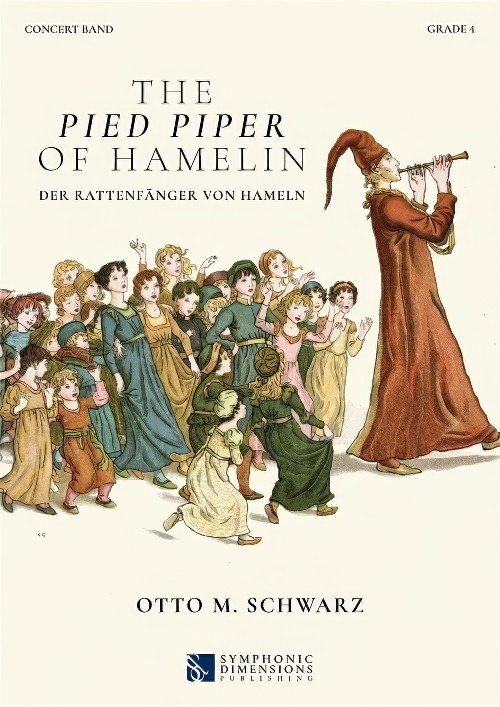 £210.80
The Pied Piper of Hamelin (Concert Band - Score and Parts) - Schwarz, Otto M.
Stories, sagas and legends--who among us don't know them? Always delivered with a tinge of brutality, these cautionary tales are a legacy of moral education from times past: inquisitive children alone in the forest are generally eaten by a witch; the 'Soup-Kasper' of Hoffmann's Struwwelpeter dies from starvation rather than eating his soup; anyone letting in strangers usually gets devoured; anyone who plays with matches gets burned; and thumb-suckers get their thumbs cut off. The list of unfortunate demises is almost endless.In the tale of The Pied Piper of Hamelin, parents lose their children through greed, ridicule, scorn and a failure to appreciate art. There is still a street in the town of Hamelin in which neither drumming nor playing has not been allowed since 130 children disappeared into a mountain, never to be seen again. This composition by Otto M. Schwarz opens with exactly this scene, taking us back to the year 1284. As in many towns at the time, Hamelin in Germany suffered with hygiene problems--rats and mice began to multiply rapidly, and the town was overrun with the plague. There appeared a man dressed in colourful clothes who promised the locals to free them from this burden. They agreed and settled on a fee. Then the man pulled out a pipe and began to play. When the rats and mice heard this, they followed him. He led the animals into the Weser River, where they all drowned. Back in town, the people refused to pay him. They didn't recognise this man's skills and knowledge and were only prepared to pay for simple labour. A pact with the devil was made, which led to the Pied Piper leaving the town in a furious rage. One Sunday, when many people were at church, he returned, took out his flute and began to play. The town's children were so enchanted by his playing that they followed him. He led them out of the town and disappeared with them forever into a mountain forever. Of all the children, only two survived--however one was mute, and one was blind. In the street from which the children left Hamelin, music may no longer be played in memory of this event. The work may be performed in two different versions: 1. Purely instrumental (without narrator)--the GPs (pauses) must be kept short 2. With narrator--he speaks in the GPs but not during the music.Duration: 14.15
Estimated dispatch 7-14 working days
 View Music