
Results
-
 £72.95
Rocky Neck - Roger Cichy
Rocky Neck is one of a three movement work called "Beachscapes." Rocky Neck beach is located in East Lyme, Connecticut. It is a peaceful setting with calm waters and a beautiful flowing melody. The first trumpet's highest note is G.
Estimated dispatch 7-14 working days
-
 £84.50
Slavic Sleigh Ride - Steven L. Rosenhaus
This is an exciting piece to play any time of the year. It moves along at a fast and fun pace, but not too fast. They audience will absolutely love this. 1st trumpet's highest note is G.
Estimated dispatch 7-14 working days
-
 £106.95
Time and Change - Roger Cichy
Majestic, rhythmic, slow, fast - this composition has everything. Syncopation gives this song a very moving feel to it. It could easily be heard in a movie or documentary. All clarinets cross the break. 1st trumpet's highest note is G.
Estimated dispatch 7-14 working days
-
 £78.95
Nauset - Roger Cichy
Nauset is one of three movements of a larger work called "Beachscapes." Nauset beach is located on the ocean side of Cape Cod Massachusetts, where the largest waves can be found on the New England coast. This music is a bit whimsical, portraying a beach scene with surfers falling off their boards, people on the beach, and people going to the food shacks. The music is quite syncopated and gives a jazzy, fun atmosphere. Ranges are mostly within a Grade 3 range, with the 1st trumpet's highest note is G.
Estimated dispatch 7-14 working days
-
 £65.40
Gloria - G. Bigazzi
Estimated dispatch 7-14 working days
-
 £113.30
Visions Of Jericho - Daniele Carnevali
The piece, commissioned by the "Banda Orchestra G. Bovo" from Carmignano di Brenta (Padua), was inspired by two paintings by the artist Galeazzo Vigan, which were in turn commissioned to celebrate the anniversary of the founding of the band. The two paintings, entitled "Gerico 1 and 2", their mirror-like arrangement, the alternation between fullness and fineness and the use of numerical symbols (especially the repetition of the number 7) are used as musical material in the formation and subsequent development of the themes. Similarly, the formal mirror-like arrangement of the allegro vivo and the alternation of the monodic and chordal styles (fineness - fullness) seek to create a bond between the pictorial and musical languages.
Estimated dispatch 7-14 working days
-
 £75.00
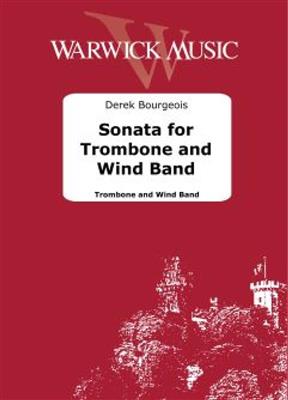
Sonata - Derek Bourgeois
This work, composed in 1998, was commissioned by the American trombonist Don Lucas as a work for trombone and piano and first performed by him in Birmingham on 19th May 2000. Subsequently, I arranged the music for both solo trombone and brass band and solo trombone and wind band so that it now exists in three formats. The first movement, in B flat major, is brisk and energetic, and is cast in sonata form. The second subject is gentler and more lyrical. The second movement, a scherzo in C major, is the most complex of the four. Basically the structure is a rond. For a long time the music remains in the opening 5/8 time until a new theme introduces more broken rhythms in a more jazzy idiom. After a return of the opening theme the following episode is more tonally ambiguous. Finally, the main theme returns to round off the movement. The third movement, a lyrical adagio, is really one long extended melodic flow. The harmonies are lush and the textures simple and direct. The tonal center is A minor, but the music meanders through so many keys, that this key centre is heavily disguised. The finale is a fiery affair. G minor is really its home key, but throughout the movement the music moves about a lot and the second subject is first heard in A flat minor. The movement's underlying sonata structure is masked not only by its loose tonality but also by its frequently changing time signatures. Like the first movement the second subject is more lyrical in nature and for a while it seems that the music will end peacefully, but a final flurry heralds a triple forte unison on the home note of the first movement - B flat. Derek Bourgeois
Estimated dispatch 7-14 working days
-
 £121.00
Ignatian Fanfare - John R. Bourgeois
Written for the centennial of Loyola University, New Orleans and premiered by the Loyola University Band on April 12, 2012 with the composer conducting. This fanfare is based on a motive from the Jesuit motto "Ad Majorem Dei Gloriam" ("to the greater glory of God") and is based on the notes A, D, G. The fanfare opens with timpani, a tintinnabulum of bells and brass, and wolf calls in the horns. A martial hymn tune appears which evokes the soldierly order of Ignatius Loyolas early years. The work closes with a rhythmic ostinato based on the words "Fight, fight, fight, ye men of the South!" The composer is a graduate of Loyola and received an honorary Doctor of Music degree in 2005.
Estimated dispatch 7-14 working days
-
£134.99
-
£60.99
Der Zaubermarsch - Rob Ares
On 30th September 1791, a few months before his death, the opera "Die Zauberflote" (The Magic Flute) by Wolfgang Amadeus Mozart was given its first performance. It was remarkable that despite his ill health and his disastrous financial situation he was able to compose a work of such comic genius. Mozart composed the overture in the two days before the premier of the opera and it is on this overture that this transcription is based. To perform the work 'a la Mozart' only the timpani part should be used, the additional percussion parts have been added by the arranger and are therefore optional.Mozart 40th SymphonyThe Austrian composer Wolfgang Amadeus Mozart lived atragically short life of thirty-five years. Towards the end of his life in the summer of 1788, he wrote three symphonies in the span of a little over six weeks. His Symphony No.40 in G Minor was one of those great works. This setting of the first movement from that Symphony provides ample demonstration of the composer's grace, inventiveness and pervasive sense of humour, which can be found throughout his music.
Estimated dispatch 7-14 working days
 View Music