
Results
-
 £99.95
Purcell Variants (Concert Band - Score and Parts) - Meechan, Peter
Purcell Variants is based on Purcell's Queen Mary's Funeral Music, which consists of four canzonas, two elegies and an anthem.The first movement begins by sounding some of Purcell's original music in the trombones and horns, underpinned by a timpani roll with the woodwind articulating the beginnings and endings of the phrases. This leads into a cadenza for trumpet and alto saxophone before the movement heads in different directions, leading us to its mysterious end, where the original music is sounded this time in the 'stabs' of the clarinets and alto saxophone.Originally composed for the funeral of Queen Mary in 1695, Purcell's original funeral music was used later that same year for Purcell's own funeral - he died aged only 34. The second movement is an elegy, inspired by this story. After an introduction (a disjointed last post), the main melody of the movement is introduced by the solo euphonium, with other solo roles for flute, oboe and alto saxophone. This is then taken over by the trumpets who lead us into the middle section of the movement. This is a quasi funeral march, inspired by the image of Purcell's coffin being taken to its final resting point. The main melody returns in the flute, oboe and alto saxophone, this time more elaborated. The movement ends with a snare drum fading away - perhaps a metaphor.The Finale is a fast and furious movement combining thematic material from the two previous movements with new rhythmical ideas. This takes us through to the final passage - the triumphant return of Purcell's original theme.Duration: 13.00
Estimated dispatch 7-14 working days
-
 £68.00
Requiem Aeternam (from Edgar) (Concert Band - Score and Parts) - Puccini, Giacomo - De Meij, Johan
Giacomo Puccini was commissioned to write a second opera after the resounding success of his first, Le Villi. However, the original four-act, grand opera Edgar, to a libretto by Ferdinando Fontana, received a rather lukewarm reception at its premiere in La Scala in Milan in 1889. Initially, the work was only performed three times. Of all the planned performances in the subsequent two years, only one took place, in Lucca, Puccini's birthplace. There, the work was well received. Nevertheless, the composer decided to make drastic changes to Edgar the most radical being the reduction of the opera to three acts, as well as altering a few arias, characters and instrumental parts. In its revised form, the work was even less popular than before. The discarded fourth act later provided material for Tosca (the duet Amoro sol' per te), but Puccini never felt the need to defend Edgar as he did other less fortunate operas, such as La Rondine and Suor Angelica. On a piano excerpt for his female friend Sybil Seligman he even corrupted the title to 'E Dio ti Guarda da quest' opera' (may God preserve you from this opera). This did not prevent Arturo Toscanini performing the Requiem from the third act at Puccini's funeral in Milan Cathedral on 3 December 1924. The Requiem in the third act is being played when the long funeral procession carries the alleged body of Edgar, the confused young man hesitating between the love of the virtuous Fidelia and the exotic Tigrana. The mass hails Edgar as a hero, but a monk claims that he has betrayed his country for a few gold pieces. When the soldiers try to desecrate the body, they discover that the armor contains none. The monk reveals himself as Edgar. He wants to leave with his faithful Fidelia, but the vengeful Tigrana stabs him and kills Fidelia. Edgar grieves over the lifeless body of his beloved, while Tigrana is arrested and the people submerge into prayer. Duration: 3.30
Estimated dispatch 7-14 working days
-
 £55.00
Ides March (Concert Band - Score and Parts) - Bermel, Derek
Ides March was commissioned by William Brine in 1990, Bermel's first commission. Brine requested that the work be a march suitable for performance at both a wedding and a funeral. Although originally titled Brine's March, when the composer learned that the march was to receive its premiere on 15 March, he changed the title to Ides March in a umorous nod to the Shakespearean admonition 'Beware the Ides of March'; in his youthful view a sentiment appropriate for either a wedding or a funeral. However, a line from Cole Porter was the inspiration behind the major key to minor key interplay of the work: 'What could be any finer? But how strange the change from major to minor, every time we say goodbye', a line that captured the composer's attempt to write a march that did justice to both the melancholy and triumphant. Duration: 5.00
Estimated dispatch 7-14 working days
-
 £78.20
Lux Aeterna (Flexible Ensemble - Score and Parts) - Schwarz, Otto M.
Otto M. Schwarz was asked by a friend to compose a chorale for the funeral of his child. Lux Aeterna (The Eternal Light) is actually part of the requiem mass, but in this composition, there is no reference to the original Latin text. People who recount near-death experiences often report a bright light. The music moves back and forth between passages that are sad, optimistic, and imploring in nature, posing questions that cannot be answered. The end of the piece comes, however, with a conciliatory major chord that reflects the calm and warmth of this light that promises redemption.Duration: 3.45
Estimated dispatch 7-14 working days
-
 £61.95
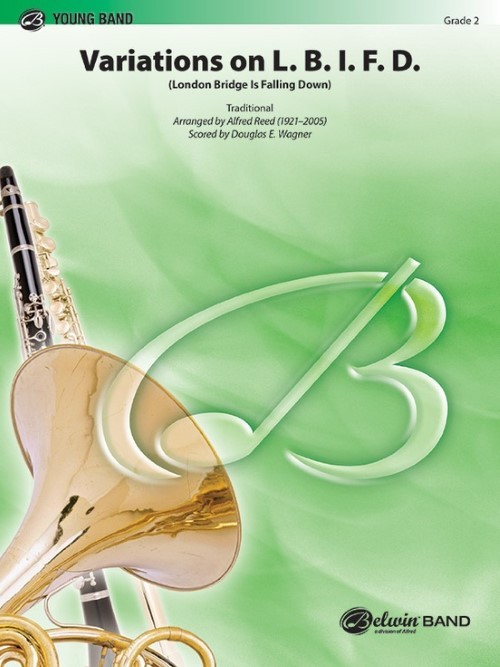
Variations on L.B.I.F.D. (London Bridge is Falling Down) (Concert Band - Score and Parts) - Reed & Wagner
Alfred Reed needs no introduction for those who admire his distinguished concert band works. This arrangement for concert band draws from five movements of his original 28 composed for brass quintet based on "London Bridge Is Falling Down." Included are: "Statement," "Waltz," "March Fo(u)rth!," "A Little Funeral Music, Please (Eine Kleine Trauermusik)," and "Finale." A demonstration of compositional techniques practiced during the past three centuries, the work is filled with captivating and highly musical moments. Even though players will encounter a few changes in tonal centers, meters, and tempo throughout, there is not much that would get in the way of having a fun experience learning and performing. Duration: 2:45
Estimated dispatch 7-14 working days
-
 £224.99
Lux Futura (Concert Band - Score and Parts) - Houben, Kevin
Lux Futura (Light of the Future) was commissioned by the Royal Wind Orchestra Delft and is inspired by the letters 'D-E-L-F-T' using the letter notation system by B?la Bart?k. In this 'Delft' cell, there is referral to the 'Trinitas', the bourdon bell of the Old Church in Delft, that only tolls during a funeral of a member of the Dutch Royal Family. The Delft melody switches to the 'Agneta March', which is a reference to the history of the Royal Wind Orchestra Delft. Further on the love theme, played by the bass instruments represents the love of the inhabitants for their city throughout space and time. In the middle movement, the beauty of the city is depicted by the cor anglais (English horn) solo, as an ode to the lovely city of Delft. When performed, one can choose to use sound city samples recorded in Delft to create a truly magnificent spectacle. Duration: 17.00
Estimated dispatch 7-14 working days
-
 £144.99
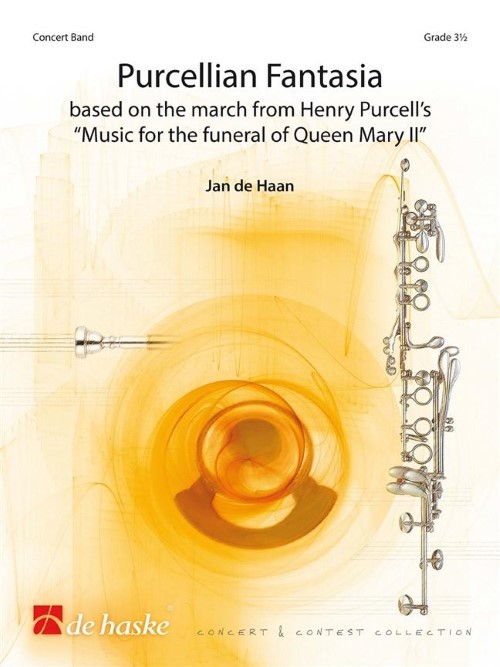
Purcellian Fantasia (Concert Band - Score and Parts) - De Haan, Jan
This composition is based on the march from Henry Purcell's Music for the funeral of Queen Mary II, a work written in 1694. In this fantasia, various movements flow from one to the next following the main theme: these movements not only elaborate on the theme, but also contrast with it. At times, the thematic material diverges so much, that the work acquires a character of its own: however, the composer often refers back to fragments of the theme. Duration: 11.30
Estimated dispatch 7-14 working days
-
 £124.95
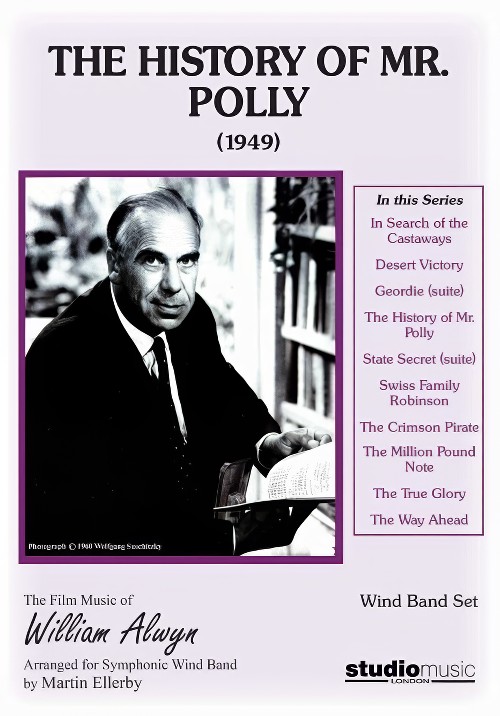
The History of Mr Polly (Concert Band - Score and Parts) - Alwyn, William - Ellerby, Martin
William Alwyn (1905-1985) studied at the Royal Academy of Music where, at the age of 21, he was appointed Professor of Composition - a position he held for nearly thirty years. Apart from his vast output of serious music he contributed nearly 200 scores for the cinema. Starting, mainly with documentaries he wrote his first full feature-length score in 1941.The film, The History of Mr Polly, is based on the novel by H.G. Wells. Mr Polly is a sensitive daydreamer and has a lifestyle leading him into many difficult situations.Alwyn's music portrays many of these calamities and each one is represented as a movement in this suite:The Wedding and Funeral (his father's)FireChristabelPunting SceneUtopian SunsetA truly memorable fulm in every respect.
Estimated dispatch 7-14 working days
-
 £75.00
A Gaelic Blessing (Concert Band with Optional Choir - Score and Parts) - Rutter, John - Noble, Paul
There are Gaelic and old Irish blessings for every occasion whether a funeral, wedding or birthday. While many of these old blessings petition or request the help or intervention of God in some way, it does not always mean that the person saying them regards him or herself as being very religious. These blessings, whether in Gaelic or English, were the way Irish people had of expressing hope, desire for a better future and solidarity with their family, friends and neighbours. This simple arrangement offers the choices of performance with combined band and chorus, band alone, woodwinds alone, or brass alone. It also includes optionally three tolls of chimes at the beginning and ending, which make it a perfect tribute for commemoration.
Estimated dispatch 7-14 working days
-
 £225.00
Five Variants of Dives and Lazarus (Concert Band - Score and Parts) - Williams, Vaughan - Noble, Paul
Five Variants of Dives and Lazarus is a Concert Band arrangement from the original work for string orchestra and harp by Ralph Vaughan Williams. The composition is based on the folk tune Dives and Lazarus, one of the folk songs quoted in Vaughan Williams' English Folk Song Suite. The ancient theme on which these variations are based goes back to the sixteenth century, and is known by various titles. Dives and Lazarus is a story told by Jesus in the Gospel of Luke. It tells of an unnamed rich man and a poor beggar named Lazarus. In the Latin Bible, the unnamed rich man is referred to as Dives from dives, the Latin word for rich. This work, based on the tune that Vaughan Williams had loved all his life, which came from the very soil of England, ageless and anonymous, was played at the composer's funeral service in Westminster Abbey on 19th September 1958.
Estimated dispatch 7-14 working days
 View Music