
Results
-
 £95.99
5 Tantum Ergo (Concert Band - Score and Parts) - Bruckner, Anton - Doss, Thomas
Anton Bruckner (b. 4.9.1824, Ansfelden, d. 11.10.1896, Vienna) didn't have it easy. Throughout his life, the Austrian composer was plagued by self-doubt. Anton Bruckner came from a simple, rural background. After the death of his father, he was accepted as a choirboy at the monastery of Sankt Florian in 1837. After several years as a school assistant and his own organ and piano studies, he first worked as organist in St. Florian, then from 1855 as cathedral organist in Linz. Introduced to music theory and instrumentation by Simon Sechter and Otto Kitzler, he discovered Richard Wagner as an artistic role model, whom he admired throughout his life and also visited several times in Bayreuth. In 1868 Anton Bruckner became professor of basso continuo, counterpoint and organ at the Vienna Conservatory; ten years later court organist; and in 1891 finally honorary doctor of the University of Vienna. He was considered an important organ virtuoso of his era, but had to wait a long time for recognition as a composer. It was not until Symphony No.7 in E major, composed between 1881 and 1883, with the famous Adagio written under the effects of Wagner's death, that he achieved the recognition he had hoped for, even if he was reluctant to accept it given his inclination towards scepticism and self-criticism. Anton Bruckner was a loner who did not want to follow a particular school or doctrine. He composed numerous sacred vocal works, such as his three masses, the Missa Solemnis in B flat minor (1854), the Te Deum (1881-84) and numerous motets. As a symphonic composer, he wrote a total of nine symphonies and many symphonic studies from 1863 onwards, tending to revise completed versions several times over. Bruckner's orchestral works were long considered unplayable, but in fact were merely exceptionally bold for the tonal language of their time, uniting traditions from Beethoven through Wagner to folk music, on the threshold between late Romanticism and Modernism. Hymns for four-part mixed choir a cappella (1846, St. Florian) No. 1 in E flat major (WAB 41/3): Quite Slow No. 2 in C major (WAB 41/4): Andante No. 3 in B flat major (WAB 41/1): Slow No. 4 in A flat major (WAB 41/2): Slow Hymn for five-part (SSATB) mixed choir and organ No. 5 in D major: Solemnly They are simple works, completely subordinate to their liturgical use, which nevertheless already show numerous characteristics of personal expression. These small pieces were able to stand up to the harsh scrutiny of the mature master: in 1888, Bruckner subjected them to a revision in which he made only minor corrections.Duration: 11.00
Estimated dispatch 7-14 working days
-
 £102.99
Noel Wind Band Set (Score & Parts)
Noel" is based on the famous English Carol "The First Noel". The age of this song is not clear.Some scientists argue that tis song is from early thirteenth century, others say that it's from the sixteenth century.The first publication was in 'Christmas Carols, Ancient and Modern', compiled by William B. Sandys. (London, 1833).The exact origin is unknown. By Norman influences on the text, with the result that the spelling of the song is not certified (Noel, Nowell), an individual will sometimes claim that France is the cradle of this song, but in general assumes that "the First Noel 'for the first time somewhere in England sung. 03:45
Estimated dispatch 7-14 working days
-
 £123.20
3 Letzte Motetten (Concert Band - Score and Parts) - Bruckner, Anton - Doss, Thomas
Anton Bruckner (b. 4.9.1824, Ansfelden, d. 11.10.1896, Vienna) didn't have it easy. Throughout his life, the Austrian composer was plagued by self-doubt. Anton Bruckner came from a simple, rural background. After the death of his father, he was accepted as a choirboy at the monastery of Sankt Florian in 1837. After several years as a school assistant and his own organ and piano studies, he first worked as organist in St. Florian, then from 1855 as cathedral organist in Linz. Introduced to music theory and instrumentation by Simon Sechter and Otto Kitzler, he discovered Richard Wagner as an artistic role model, whom he admired throughout his life and also visited several times in Bayreuth. In 1868 Anton Bruckner became professor of basso continuo, counterpoint and organ at the Vienna Conservatory; ten years later court organist; and in 1891 finally honorary doctor of the University of Vienna. He was considered an important organ virtuoso of his era, but had to wait a long time for recognition as a composer. It was not until Symphony No.7 in E major, composed between 1881 and 1883, with the famous Adagio written under the effects of Wagner's death, that he achieved the recognition he had hoped for, even if he was reluctant to accept it given his inclination towards scepticism and self-criticism. Anton Bruckner was a loner who did not want to follow a particular school or doctrine. He composed numerous sacred vocal works, such as his three masses, the Missa Solemnis in B flat minor (1854), the Te Deum (1881-84) and numerous motets. As a symphonic composer, he wrote a total of nine symphonies and many symphonic studies from 1863 onwards, tending to revise completed versions several times over. Bruckner's orchestral works were long considered unplayable, but in fact were merely exceptionally bold for the tonal language of their time, uniting traditions from Beethoven through Wagner to folk music, on the threshold between late Romanticism and Modernism. Anton Bruckner composed about 40 motets during his lifetime, the earliest a setting of Pange lingua around 1835, and the last, Vexilla regis, in 1892. Thomas Doss has compiled some of these motets in this volume for symphonic wind orchestra. These motets show many characteristics of personal expression, especially Bruckner's colourful harmony in the earlier works, which is in places aligned with Franz Schubert (changes between major and minor; and movements in thirds). Later works are characterised by many components which, in addition to the expanded stature of the movements, include above all a sense of the instrumentation as an outward phenomenon and the harmony as a compositional feature that works more internally. Some aspects of Bruckner's work are the result of his long period of study, which familiarised him not only with the tradition of his craft, but also gave him insights into the "modernity" of his time in such composers as Wagner, Liszt and Berlioz. From this developed his personal standpoint, which always pursues the connection between the old and the new.Duration: 14.00
Estimated dispatch 7-14 working days
-
 £256.00
14 Motetten (Concert Band - Score and Parts) - Bruckner, Anton - Doss, Thomas
Anton Bruckner (b. 4.9.1824, Ansfelden, d. 11.10.1896, Vienna) didn't have it easy. Throughout his life, the Austrian composer was plagued by self-doubt. Anton Bruckner came from a simple, rural background. After the death of his father, he was accepted as a choirboy at the monastery of Sankt Florian in 1837. After several years as a school assistant and his own organ and piano studies, he first worked as organist in St. Florian, then from 1855 as cathedral organist in Linz. Introduced to music theory and instrumentation by Simon Sechter and Otto Kitzler, he discovered Richard Wagner as an artistic role model, whom he admired throughout his life and also visited several times in Bayreuth. In 1868 Anton Bruckner became professor of basso continuo, counterpoint and organ at the Vienna Conservatory; ten years later court organist; and in 1891 finally honorary doctor of the University of Vienna. He was considered an important organ virtuoso of his era, but had to wait a long time for recognition as a composer. It was not until Symphony No.7 in E major, composed between 1881 and 1883, with the famous Adagio written under the effects of Wagner's death, that he achieved the recognition he had hoped for, even if he was reluctant to accept it given his inclination towards scepticism and self-criticism. Anton Bruckner was a loner who did not want to follow a particular school or doctrine. He composed numerous sacred vocal works, such as his three masses, the Missa Solemnis in B flat minor (1854), the Te Deum (1881-84) and numerous motets. As a symphonic composer, he wrote a total of nine symphonies and many symphonic studies from 1863 onwards, tending to revise completed versions several times over. Bruckner's orchestral works were long considered unplayable, but in fact were merely exceptionally bold for the tonal language of their time, uniting traditions from Beethoven through Wagner to folk music, on the threshold between late Romanticism and Modernism. Anton Bruckner composed about 40 motets during his lifetime, the earliest a setting of Pange lingua around 1835, and the last, Vexilla regis, in 1892. Thomas Doss has compiled some of these motets in this volume for symphonic wind orchestra. These motets show many characteristics of personal expression, especially Bruckner's colourful harmony in the earlier works, which is in places aligned with Franz Schubert (changes between major and minor; and movements in thirds). Later works are characterised by many components which, in addition to the expanded stature of the movements, include above all a sense of the instrumentation as an outward phenomenon and the harmony as a compositional feature that works more internally. Some aspects of Bruckner's work are the result of his long period of study, which familiarised him not only with the tradition of his craft, but also gave him insights into the modernity of his time in such composers as Wagner, Liszt and Berlioz. From this developed his personal standpoint, which always pursues the connection between the old and the new.Duration: 39.00
Estimated dispatch 7-14 working days
-
 £309.99
Ninth Symphony (Concert Band - Score and Parts) - Barnes, James
Premiered on 21 September, 2018 in Lawrence, Kansas by The University of Kansas Wind Ensemble (Dr. Paul Popiel, conducting), James Barnes' Ninth Symphony was composed between January and late June of that same year. This large work was commissioned by a consortium of twenty-one college bands, community bands, professional bands and individuals to help mark the 70th birthday of the composer (b. 1949). It is an expansive forty-minute work in four movements, of which the composer writes, "This is my last symphony...this work represents a compendium of all that I have learned during the fifty years of composing and scoring for this wonderful new medium: the modern wind band." The first movement, subtitled Elegy, is based around G minor. It is the longest movement of the symphony. Tragic and despondent in character, it is cast in sonata-allegro form. The second movement is entitled Scherzo. Barnes claims that "I have always wanted to write a waltz," and that is how this movement is cast, in a modified rondo form in D minor. In contrast to the mood of the first movement, the scherzo is a delightful posy of expansive melody, splashy color, humor and rhythm. The third movement, which is in a modified tertiary form, is entitled Night Music. In contrast to the scherzo, this movement begins with a mysterious incantation, first displayed by solo Alto Flute. The music becomes even darker and more mysterious, while overall the movement effectively expresses an "otherworldly" mood, ending with a solo soprano offstage which suddenly emerges, eerily singing a modified version of the opening incantation. Cast in sonata-allegro form, the fourth movement is most definitely a rousing Finale, beginning with a brilliant fanfare and undergoing several mood transformations before emerging into the final coda, ending the symphony with an energetic splash of color. Duration: 40.00
Estimated dispatch 7-14 working days
-
 £141.99
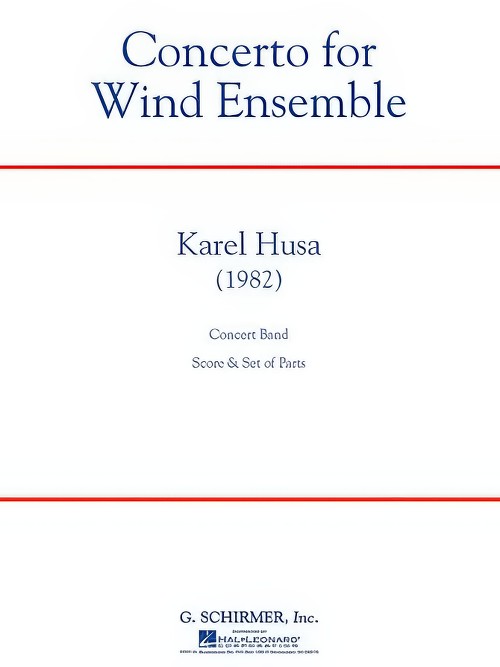
Concerto for Wind Ensemble (Concert Band - Score and Parts) - Husa, Karel
Commissioned by the Michigan State University Alumni Band, this three movement work by Pulitzer Prize-winning composer Karel Husa was the winner of the first Louis Sudler International Wind Band Composition Competition in 1983. Previously available only in rental, this important work is now available for sale.A note from the composer: Divided into three movements, this work is a display of virtuoso passages given to solo instruments as well as to the groups of the ensemble. In the Fanfare of the first movement, the brass section "concertizes" in groups of four brass quintets (2 trumpets, horn, trombone and tuba or baritone), spread from left to right in back. The saxophones (S, A, T, B) are placed in front of the brass quintets, and the woodwinds occupy the front of the stage, with percussion on the left and right side. These groups, like the brass quintets, play in the concertante style, particularly in the first and last movements. At the same time, each movement contains individual solo passages (for example, timpani and flute in Movement I - "Drum Ceremony" and English horn and other low woodwinds in Movement II - "Elegy"). The composition of this piece was prompted by the excellence of wind and percussion players today, and by the incredible growth of wind ensembles, orchestras, and bands in the last 25 years. It is intended for their enjoyment.Duration: 23:00
Estimated dispatch 7-14 working days
-
 £22.00
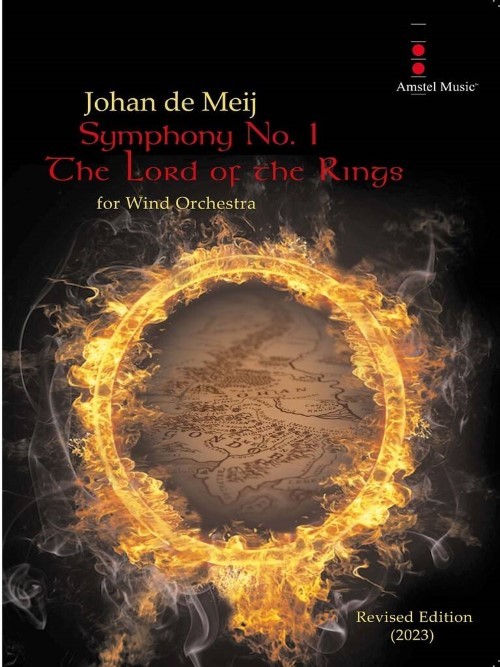
Symphony No.1: The Lord of the Rings (Concert Band - Study Score) - De Meij, Johan
Revised 2023 editionJohan de Meij's first symphony The Lord of the Rings is based on the trilogy of that name by J.R.R. Tolkien. This book has fascinated many millions of readers since its publication in 1955. The symphony consists of five separate movements, each illustrating a personage or an important episode from the book.The movements are:GANDALF (The Wizard)LOTHLORIEN (The Elvenwood)GOLLUM (Smeagol)JOURNEY IN THE DARK a. The Mines of Moria b. The Bridge of Khazad-DumHOBBITSThe symphony was written in the period between March 1984 and December 1987, and had its premiere in Brussels on 15th March 1988, performed by The Royal Band of the Belgian Guides under the baton of Norbert Nozy. In 1989, the Symphony The Lord of the Rings was awarded first prize in the Sudler International Composition Competition in Chicago. In 2001, the orchestral version was premiered by the Rotterdam Philharmonic Orchestra and was recorded by the London Symphony Orchestra.
Estimated dispatch 7-14 working days
-
 £499.00
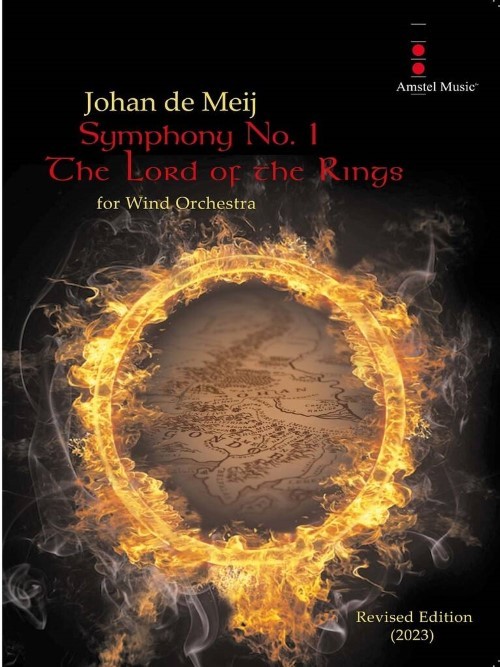
Symphony No.1: The Lord of the Rings (Concert Band - Score and Parts) - De Meij, Johan
Revised 2023 editionJohan de Meij's first symphony The Lord of the Rings is based on the trilogy of that name by J.R.R. Tolkien. This book has fascinated many millions of readers since its publication in 1955. The symphony consists of five separate movements, each illustrating a personage or an important episode from the book.The movements are:GANDALF (The Wizard)LOTHLORIEN (The Elvenwood)GOLLUM (Smeagol)JOURNEY IN THE DARK a. The Mines of Moria b. The Bridge of Khazad-DumHOBBITSThe symphony was written in the period between March 1984 and December 1987, and had its premiere in Brussels on 15th March 1988, performed by The Royal Band of the Belgian Guides under the baton of Norbert Nozy. In 1989, the Symphony The Lord of the Rings was awarded first prize in the Sudler International Composition Competition in Chicago. In 2001, the orchestral version was premiered by the Rotterdam Philharmonic Orchestra and was recorded by the London Symphony Orchestra.
Estimated dispatch 7-14 working days
-
 £45.95
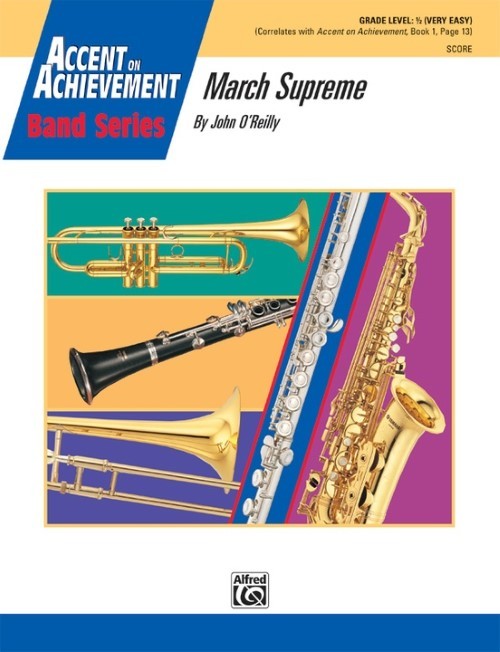
March Supreme (Concert Band - Score and Parts) - O'Reilly, John
Treat your beginners to a fresh sounding original march that will make them shine on their very first concert. All winds play their first six notes taught except for the clarinets who also play their low B. Eighth-notes are carefully presented as pairs of repeating pitches, and the snare drum part is all single strokes playing interesting eighth-note patterns.Duration: 1:50
Estimated dispatch 7-14 working days
-
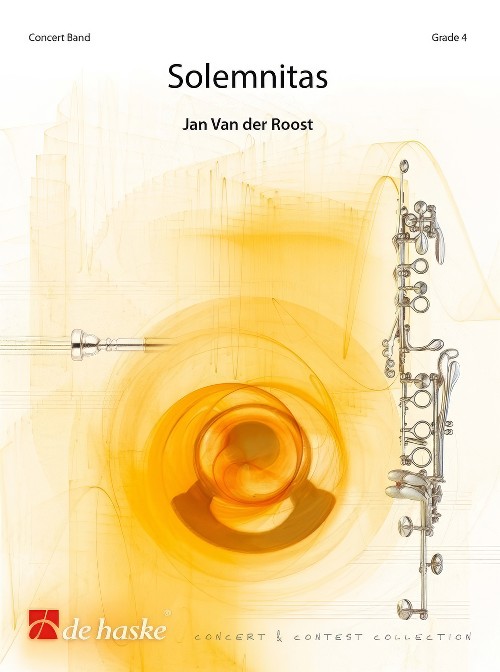 £104.99
Solemnitas (Concert Band - Score and Parts) - Van der Roost, Jan
This short but solemn overture was written on the occasion of the 110th jubilee of Harmonie Hautcharage, Luxembourg. It is an homage to Jean-Paul Frisch and his son Gerard (the present conductor), who each have been conducting the ensemble for many years. Under their leadership, the band has developed and improved remarkably. The very first musical theme, presented during the introduction of this little overture, is based on the letters hidden in the names Jean-Paul and Gerard Frisch (in which h is considered b - as it is in German), thus aiming the spotlight on both key figures in the history of Harmonie Hautcharage. After the rather stately intro, the allegro is more joyful and lighthearted, thus depicting the optimism of the many young players of the band. The end is exciting and energetic: it radiates positivity and belief in the future. Duration: 5.30
Estimated dispatch 7-14 working days
 View Music