
Results
-
 £420.99
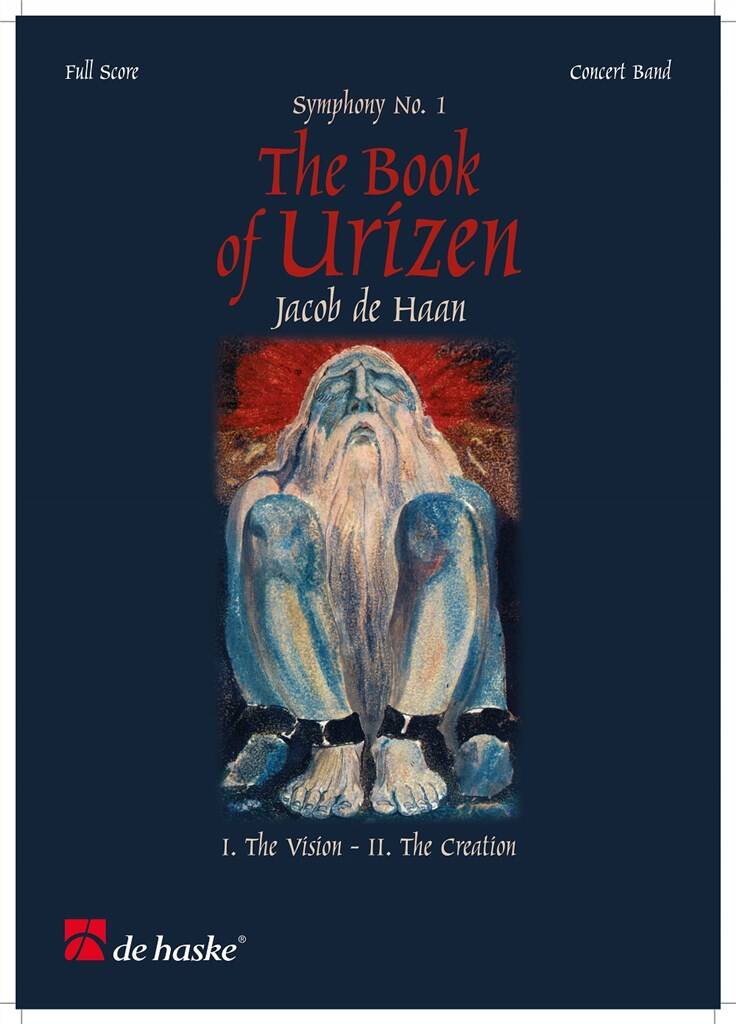
The Book of Urizen I + II - Jacob de Haan
The Book of Urizen is Jacob de Haan his first Symphony for concert band, solo soprano, and a male narrator in which sound collages of expressions are used. The piece is inspired by the compelling visionary poem of the samename (which the poet illustrated himself) by the Englishman William Blake (1757-1827). The Vision, first movement and The Creation, second movement of The Book of Urizen are available by following editionnumber: DHP 1043551. The Web, the third movement of The Book of Urizen is available by the following edition number: DHP 1125252. Download the audio samples from the 'Attachments'.
Estimated dispatch 7-14 working days
-
 £209.99
Liberty - Jan de Haan
This three-movement work is a tribute to French sculptor Frdric Auguste Bartholdi. The first movement depicts what is without a doubt Bartholdi's most famous sculpture, the Statue of Liberty in New York, which also gives this piece its name. Next listeners get to experience the trumpeting angels, which can be seen atop the First Baptist Church in Boston. The final movement takes listeners to France to view the Lion of Belfort in France.
Estimated dispatch 7-14 working days
-
 £84.99
Mixed Bag - Peter Martin
'Mixed Bag' stands midway between a collection and a hotchpotch. It is a colourful compilation of four completely different pieces, each with its own specific character. The first part is called 'Tanguillo' : as its name suggests, this Spanish dance is related to the Tango. In the next part, 'Maybe next time ....' a repeated bass line (Passacaglia) can be heard, first solo, but thereafter gradually the other instruments join in. The third part forms a huge contrast did the former part have a Baroque atmosphere, 'Rock Hard' seems to have come directly from the Rock 'n Roll era, reminding us of stars such as Bill Haley and Elvis Presley. The finale is acheerful, inciting movement called 'Gypsy Dance'.
Estimated dispatch 7-14 working days
-
 £149.99
Columbus - Rob Goorhuis
Christopher Columbus was born in Genoa in 1451. His father was a wool merchant. Originally he seemed destined to follow in his father's footsteps, and thus sailed the oceans to countries as far apart as Iceland and Guinea. In 1476 his ship was sunk during a battle off the coast of Portugal. Columbus saved his own life by swimming to shore. In 1484 he conceived the idea of sailing to the Indies via a westward sea route, but it was only in 1492 that he was able to realize this plan. On this first voyage he was in command of three ships: the flag-ship, called the Santa Maria, the Pinta, and the Ni?a. From Spain Columbus sailed via the Canary Islands to the Bahamas, whichhe sighted on October 12th 1492. Without being aware of it Columbus discovered the 'New World' he thought he had landed in the eastern part of Asia. The motif from Dvok's 9th Symphony 'Aus der neuen Welt' forms a little counterfeit history at this point in the composition. After this first voyage Columbus was to undertake another three long voyages to America. These voyages were certainly not entirely devoid of misfortune. More than once he was faced with shipwreck, mutiny and the destruction of settlements he had founded. After Columbus had left for Spain from Rio Belen in 1503, he beached his ships on the coast of Jamaica. The crew were marooned there and it was only after a year that Columbus succeeded in saving his men and sailing back to Spain with them. In the music the misunderstanding about which continent Columbus discovered in his lifetime resounds, for does this part in the composition not contain Asiatic motifs? Poor Columbus! In 1506 the famous explorer died in Valladolid.
Estimated dispatch 7-14 working days
-
 £144.99
Voyage with the VOC - William Vean
The United East India Company, or Verenigde Oostindische Compagnie (VOC) was one of the first international trading companies in the Netherlands. Voyage With The VOC follows the route of a ship (first movement) on a visit to the Rajah of Yogakarta (second movement) to load up the ship before returning home (third movement). The fourth movement describes the hard life of a sailor before the fifth movement sees the ship safely to harbour once again.
Estimated dispatch 7-14 working days
-
 £134.99
El Caracol Mifasol - Ferrer Ferran
El caracol (snail in Spanish) is the perfect illustration of the long slow process children must undertake when learning music. Ferrer Ferran composed this small musical poem to encourage the first, and sometimes difficult, steps in the fascinating world of music. The vocal part in this work can be performed by children taking their first steps in music. If there is no children's choir available the musicians in your band can sing the vocal part. This is a tremendously innovative piece that will help youngsters get involved in music-making.
Estimated dispatch 7-14 working days
-
 £76.80
Careless Whisper - Michael W. Ridgeley
Careless Whisper was George Michael's first solo single, although he was still performing in Wham! At the time.The song features a prominent saxophone riff, and has been covered by a number of artists since its first release. It was released as a single and became a huge commercial success on both sides of the Atlantic and on both sides of the Pacific. It reached number one in nearly 25 countries, selling about six million copies worldwide. Hans van der Heide did a great job arranging this evergreen for wind band.
Estimated dispatch 7-14 working days
-
 £116.40
Three Pictures for Band - Oliver Waespi
This composition consists of three sound pictures. When writing this work Oliver Waespi did not have any concrete image such as a scenery or a specific form in mind, but rather some typical visual movements. Hence the successive titles of the different parts: Procession, Dialogue and Waves. Numerous associations mutually link those parts as far as motifs and harmony are concerned. The motif of the ascending and descending fourth plays an important role in many a theme. There are many fourth chords by means of which Waespi tries to put a harmonic and unifying stamp on the compostition as a whole. Moreover there are similar or identical, though varied, motifs in the successive parts.The first part, Cortge (Procession), describes the dignified majestic procession by means of simple precise rhythms. At first the music is scarcely audible, as if coming from a distance; it gradually comes nearer until it reaches its climax in large chords, before fading away again. At each quarter note one could imagine a step. The second part, Dialogue, consists of broad outlines of dialogues between the different orchestral groups. Some instruments are asking questions, others are giving answers. After a rather sad passage, the music turns into a climax followed by a second passage that brings comfort and leads to a quiet ending. In the third part, there is a sudden movement coming up in the shape of waves. The principle of the wave, successively swelling and decreasing, dominates the entire musical structure of this part, even in the separate motifs.As far as the instrumentation is concerned there are the following notes: in the brass band version Oliver Waespi has a definite (orchestral) brass band strength in mind. If some parts (e.g. euphonium and flugelhorn) are played by several musicians, the conductor should feel free either to double or to thin those parts, providing the musical contents are not damaged. The same goes for the fanfare band in which the conductor can feel even more free as to the band's orchestral strenght. Anyway, a convincing overall sound is determining and that is to be realised by any kind of wind band.
Estimated dispatch 7-14 working days
-
 £147.10
Nuovo Cinema Paradiso - Ennio Morricone
Arranger Peter Kleine Schaars selected in random order some of the finest tunes from Morricone's soundtrack,such as the main theme Nuovo Cinema Paradiso and First Youth, Cinema on Fire, From American SexAppeal to the first Fellini, Runaway search and return, and Love theme for Nata.
Estimated dispatch 7-14 working days
-
 £42.80
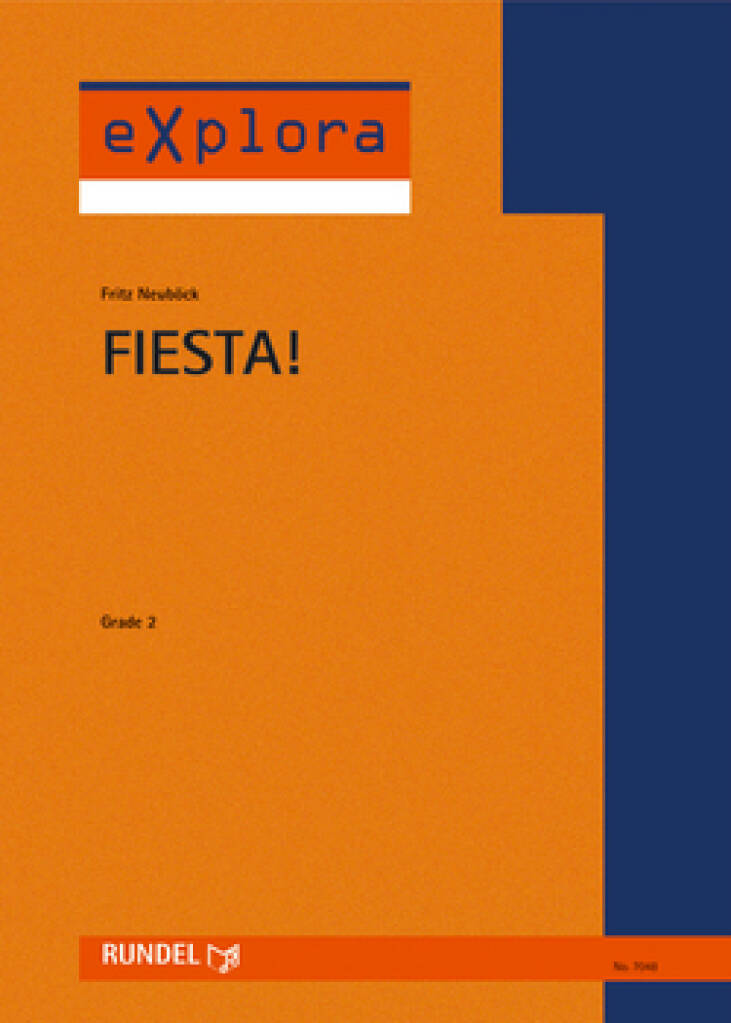
Fiesta! - Fritz Neuböck
FIESTA! is a youthful and happy piece by the Upperaustrian composer Fritz Neubck. The reasoning behind the first free bars (free approx 10 seconds) is that the music develops from kind of a soundscape. This means that the noise flows into the first properly written bars and then fades away slowly. It is up to the conductor how to create this soundscape. Then it is the turn of the "banda", the orchestra proper. The guests of this festival (namely the FIESTA!) are to be thrilled by both infectious and dreamy music.
Estimated dispatch 7-14 working days
 View Music