
Results
-
 £49.95
See Amid The Winters Snow - J. Goss
See Amid the Winter's Snow is the best-know carol by English composer Sir John Goss. The emotional scope of this nativity hymn is mirrored in the dynamics of Scott Watson's musical setting. With its quintessentially English melody, flowing inner voices, and sturdy bass lines, this is the perfect change of pace piece for your winter program. (3:00)
Estimated dispatch 7-14 working days
-
 £82.50
Cameo Suite - Root
The two pieces which comprise "Cameo Suite'' come from diverse backgrounds, one American and the other English. "The Nightingale'' is a traditional English folksong about unrequited love. The "Glendy Burk'' was composed by Stephen Foster and is a riverboat song depicting the life and times of the riverboat "Glendy Burk'' on the Mississippi.
Estimated dispatch 7-14 working days
-
£65.99
Folk Songs From Somerset - Ralph Vaughan Williams
"Folk Songs From Somerset," the third movement from Ralph Vaughan Williams' "English Folk Song Suite" is a classic march incorporating four traditional folk songs: "Blow Away The Morning Dew," "High Germany," "The Tree So High" and "John Barley's Corn." Using both 2/4 and 6/8 meters, Vaughan Williams has created a unique educational opportunity for ensembles to contrast duple and compound meter. Creatively adapted for the Build-A-Band series by master composer/arranger, Ed Huckeby, this masterful work is now available for ensembles with unusual or limited instrumentation. Your students and audiences will love this English band classic!
Estimated dispatch 7-14 working days
-
 £139.99
The Golden Age - Kees Schoonenbeek
The Golden Age is a programmatic composition in four movements. I Overture For the Netherlands, the seventeenth century was a period of great flourishing in the fields of economy, culture and politics; thus it is called the Golden Age. Overseas trade boomed, and the Dutch East India Company (known as the VOC by the Dutch) was founded and expanded to become a powerful -and, at the time - modern enterprise. II Adis espaoles!(Farewell, Spaniards!) In 1567, the Spanish army invaded, led by the Duke of Alva. There was a fierce resistance against the Spanish tyranny; toward the end of the sixteenth century, the Dutch proclaimed theRepublic. However, the Spanish continued the war. Only with the Treaty of Mnster in 1648 did the Dutch get their much sought-after independence. This was also the end of the Eighty Years' War. III Rembrandt's Night WatchThe field of culture, particularly literature, painting, sculpture, architecture, the art of printing, and cartography developed fast. It was in the Golden Age that the celebrated painter Rembrandt van Rijn created his famous Night Watch. IV The Admiral Overseas trade entailed the colonization of large areas in Asia, from where precious products that yielded lots of money were brought in. Surrounding countries were also involved in such practices. Colonizers poached on each other's territories in the literal and figurative sense - in this context the Anglo-Dutch Sea Wars are legendary. The fourth movement starts with the English patriotic song Rule Britannia, after which the Dutch Admiral Michiel de Ruyter makes the English change their tune; one can even hear the roaring of cannons. When the smoke of battle has cleared, a small fragment of a Dutch song about Michiel de Ruyter appears, followed by a fitting closing.
Estimated dispatch 7-14 working days
-
 £82.50
Distant Mirrors - William Ballenger
This stylish, colorful work opens quietly with solo clarinet and crystal clear mallet highlights reminiscent of a lyrical English folksong. The decidedly English flavor is maintained as sections of the band gradually join in, changing the character of the piece to a rollicking dance. Easily playable, with active percussion and evocative melodic lines, this is indeed a musical reflection on our cultural heritage.
Estimated dispatch 7-14 working days
-
 £154.99
Alternances - André Waignein
In 1984 the Corciano (Italy) Tourist Authority initiated a composition competition for wind band. For this event Andr WAignein composed "Alternances for Symphonic Band", a piece which won him the first prize in the competition. The opening of the work is based on a very tonal foundation. The English horn (or alto saxophone) introduces a rich and warm theme which is immediately taken up by the whole orchestra in a grandiose manner. The subsequent development shows off all the elements of the orchestra to the full. In the second movement, the English horn (or alto saxophone) comes to the fore again. A harmonic change gradually takes us back to the allegro of the firstmovement. The musical development is here dominated by exuberance, virtuosity and rhythm.
Estimated dispatch 7-14 working days
-
 £118.99
Portsmouth Point Overture - William Walton
Portsmouth Point is an overture for orchestra by English composer William Walton, composed in 1925. The overture was inspired by a print by Thomas Rowlandson which depicts the colorful life of 18th century sailors at Portsmouth Point. In the work, Walton_x001A_s style has been notably influenced by Stravinsky, jazz rhythms, as well as the rhythm of the Catalan sardana dance. This transcription for symphonic band was written by Donald Patterson for the President's Own U.S. Marine Corps Band.
Estimated dispatch 7-14 working days
-
 £68.95
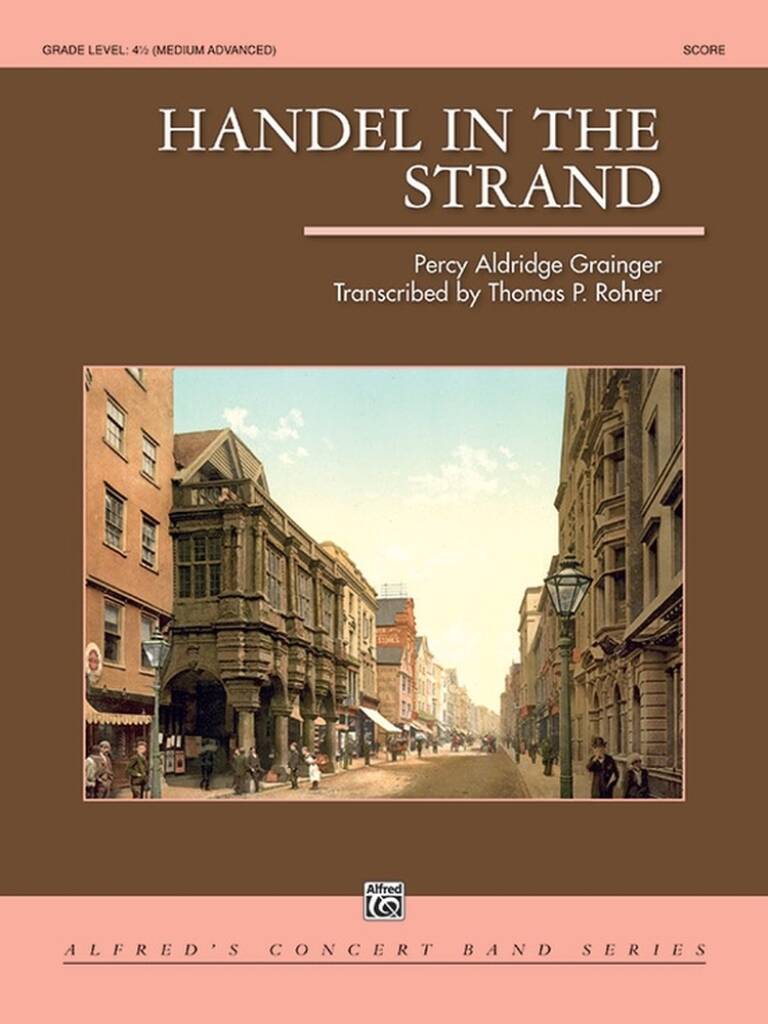
Handel In The Strand - P. Grainger
This delightful Grainger classic was written to depict a jolly old George Friedrich Handel careening down the Strand (the theatre district of London) accompanied by the English popular music of the day. Given the original instrumentation and label as a chamber piece in Grainger's original publication, this transcription is taken directly from Grainger's "four-some" edition of 1912, transposed down a step from G to F major. It is scored to best depict the light (and sometimes percussive) quality of the piano along with the lyrical flow of the strings and the general character of chamber music. Ultimately, the "room music" quality of the original shines through in this skillful transcription while depicting the spirit of the piece in a way that Grainger might have chosen. (3:35)
Estimated dispatch 7-14 working days
-
 £76.99
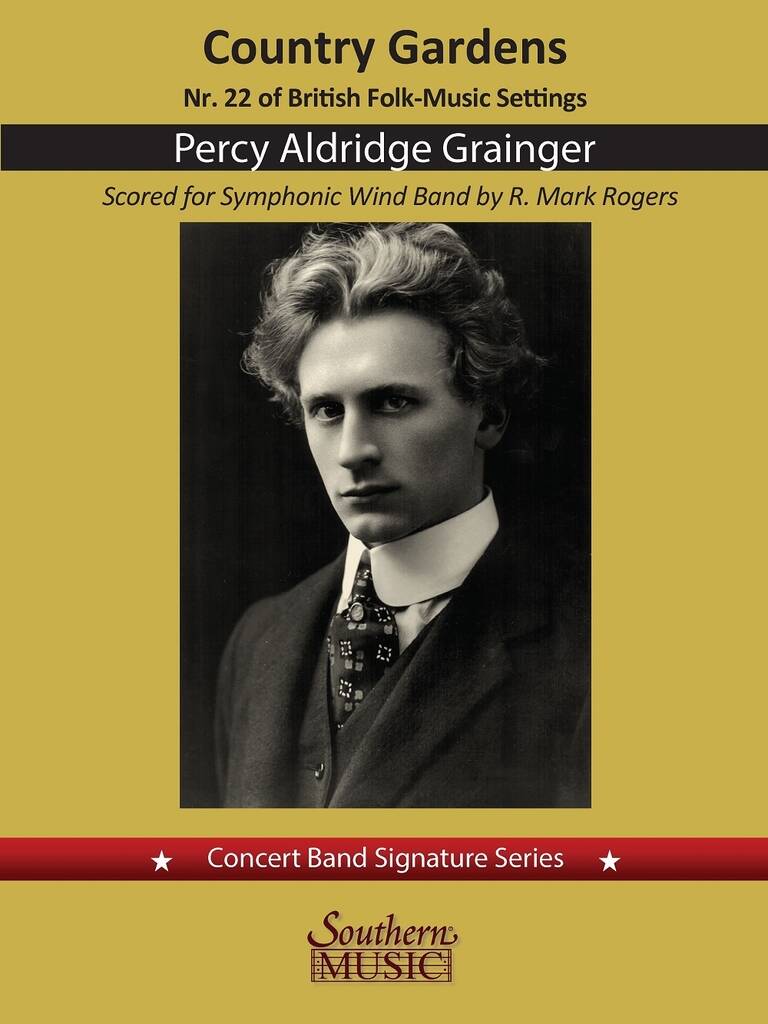
Country Gardens - Percy Grainger
One of Grainger's most popular piano encores was improvisations on English Morris Dance tunes that he programmed as COUNTRY GARDENS.Adolf Schmid's 1925 orchestration displays many features that bear witness to his deep knowledge of Percy Grainger's orchestral palette, making it ideal for symphonic wind band adaptation. Grainger's mature concept of the wind band is seen in CHILDREN'S MARCH, LINCOLNSHIRE POSY, and LADS OF WAMPHRAY. With this knowledge in hand, Mark Rogers has created a wind-band scoring (appearing for the first time with full score) that should delight conductors looking for a concise introduction into the world of Percy Grainger.
Estimated dispatch 7-14 working days
-
 £139.90
Tempo di Marcia from Symphony No. 1 - Einar Englund
Einar Englund (1916-1999) was a major Finnish composer of symphonies, concertos and film music. His first symphony (1946) bears the title "War Symphony", not given by the composer. He preferred to think think of it rather as a euphoric shout of joy at living to survive the hells of war. The first movement Tempo di marcia depicts seemingly never-ending marching through Karelia during the Soviet-Finnish war. Influences from Sibelius and Shostakovich are present.American conductor Robert J. Ambrose's arrangement of Englund's Tempo di Marcia is scored for wind band. The duration is 9 minutes. This product includes the full score and the parts:PiccoloFlute 1-2Oboe 1Oboe 2 doubling English hornBassoon 1-2Clarinet 1-3 B-flatBass Clarinet B-flatSoprano Saxophone (opt.) (part for alto saxophone II provided in lieu of soprano saxophone)Alto SaxophoneTenor SaxophoneBaritone SaxophoneHorn 1-4 FTrumpet 1-3 B-flatTrombone 1-3Euphonium (BC)TubaTimpaniPercussion 1-4Harp (opt.)Double Bass
Estimated dispatch 7-14 working days
 View Music