
Results
-
 £84.99
Variations on a Theme by Elgar - Árpád Balázs
In rpd Balzs's diverse and varied oeuvre, works for wind orchestra play a prominent role alongside choral music. He composed the Elgar Variations in 2022 on the theme of one of Edward Elgar's (1857-1934) short early works (Love's Greetings, 1888). As rpd Balzs writes ''The theme I used as the starting point for my work may already be considered a variation, since I 'peeled off' the dense ornamentation and the tonicisations from it, and what remained was the melody, beautiful in its own place. What come back from time to time from the theme in the variations are: the arched structure, the double peak point, and mostly the major sixth leaping downwards, then upwards. The modest, transparent orchestration, which then is amplified at the repetition of the theme is also a defining feature. There is a personal family secret hidden in the third variation: a late compliment to a loyal spouse for the past half century... The closing variation is calm and quiet - similarly to the chorale-like slow movement in Bla Bartk's 3rd Piano Concerto. It is like a message from an old composer to the Future.'' The Elgar Variations together with the Concertino (1992, Z. 14909) and the Rhapsody (2015-2021, Z. 15167) form an ambitious, emotionally wide-range trilogy for a concert band.
Estimated dispatch 7-14 working days
-
 £164.95
Elgar Variations (Concert Band - Score and Parts) - Ellerby, Martin
The year 2007 marked the 150th anniversary of the birth of the British composer Sir Edward Elgar (1857-1934) and as such I thought it an appropriate moment to write something in tribute to this event. There are quite a few enigmas about this piece and they are all intentional! First and foremost is that the variations are not constructed on any of Elgar's actual themes. Rather I have written a sequence of contrasting sections (all played without a break) on the essence and character of his musical style. I have also written this work with bands, the soloists within, conductors and, not least, their audience firmly in mind. The language is essentially tonal and the test musical rather than overtly technical. There are no tempo indications other than suggested metronome marks. I have deliberately kept things to a minimum as the true test here is to find the style and interpret that aspect over the whole structure. Whereas the faster sections are more or less self explanatory the slower parts require deliberate rubato and much feeling. This is for the conductors to discover and I encourage them to do so. Adjudicators should be fully aware that I sanction this aspect but it requires an insight and understanding to successfully execute so 'any old thing' will not suffice! The 'variation' commencing at rehearsal letter P is the emotional core of the piece and requires a passionate but not saccharine approach to pacing and sensuality. The cadenza type material is built into the process rather than being a separate sequence of entities. There are many allusions to the music of Elgar here without recourse to blatant pastiche - if it is thought of as a series of songs and dances this may help. The final comment is the dedication, after one of Elgar's own but subtly adjusted: to my friend pictured within - never to be revealed - now there's an enigma!- Martin EllerbyDuration: 14.00Recorded on Polyphonic QPRM155D Scenes from Childhood (Great British Music for Wind Band Vol.15), Royal Northern College of Music Wind Orchestra
Estimated dispatch 7-14 working days
-
 £32.95
Elgar Variations (Concert Band - Score only) - Ellerby, Martin
The year 2007 marked the 150th anniversary of the birth of the British composer Sir Edward Elgar (1857-1934) and as such I thought it an appropriate moment to write something in tribute to this event. There are quite a few enigmas about this piece and they are all intentional! First and foremost is that the variations are not constructed on any of Elgar's actual themes. Rather I have written a sequence of contrasting sections (all played without a break) on the essence and character of his musical style. I have also written this work with bands, the soloists within, conductors and, not least, their audience firmly in mind. The language is essentially tonal and the test musical rather than overtly technical. There are no tempo indications other than suggested metronome marks. I have deliberately kept things to a minimum as the true test here is to find the style and interpret that aspect over the whole structure. Whereas the faster sections are more or less self explanatory the slower parts require deliberate rubato and much feeling. This is for the conductors to discover and I encourage them to do so. Adjudicators should be fully aware that I sanction this aspect but it requires an insight and understanding to successfully execute so 'any old thing' will not suffice! The 'variation' commencing at rehearsal letter P is the emotional core of the piece and requires a passionate but not saccharine approach to pacing and sensuality. The cadenza type material is built into the process rather than being a separate sequence of entities. There are many allusions to the music of Elgar here without recourse to blatant pastiche - if it is thought of as a series of songs and dances this may help. The final comment is the dedication, after one of Elgar's own but subtly adjusted: to my friend pictured within - never to be revealed - now there's an enigma!- Martin EllerbyDuration: 14.00Recorded on Polyphonic QPRM155D Scenes from Childhood (Great British Music for Wind Band Vol.15), Royal Northern College of Music Wind Orchestra
Estimated dispatch 7-14 working days
-
 £79.99
Land of Hope and Glory - Edward Elgar
Elgar's five Pomp and Circumstance Marches were written between 1901 and 1930 with number 1 undoubtedly being the most popular of the five. King Edward VII told Elgar that the tune would 'go round the world' if words were fitted to it. Elgar took the hint and included it (with slight rhythmic changes) in his Coronation Ode of 1902, with words by A. C. Benson. Thus was born Land of Hope and Glory which is now, of course, an integral part of the annual Last Night of the Proms, when the audience (with varying degrees of success!) sing the words along to the original march. Now your concert band can enjoy all the pomp and ceremony of the proms with this arrangement by Philip Sparke.
Estimated dispatch 7-14 working days
-
 £74.00
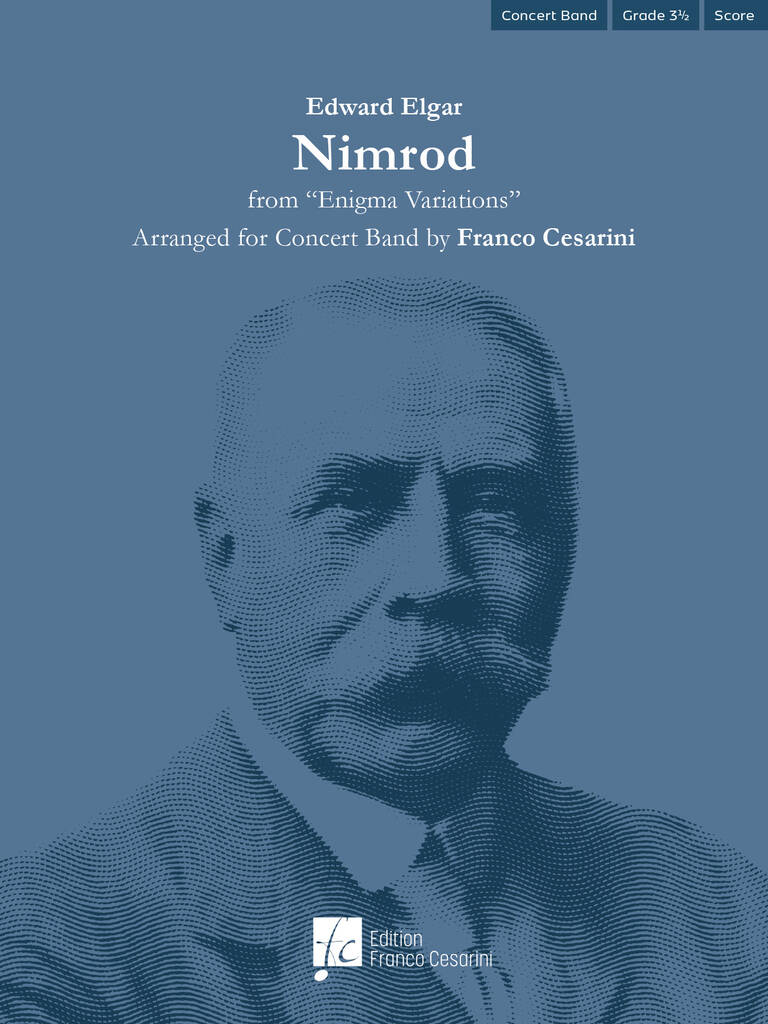
Nimrod - Edward Elgar
Nimrod is the name given to the ninth and best-known variation inEdward Elgar's Enigma Variations, an orchestral work of 14 variations on an original theme composed between 1898 and 1899. Each variation is also a portrait of one of 14 members of Elgar's family and circle of friends. A celebrated work, Nimrod is a portrait of Augustus Johannes Jaeger, who in addition to being his best friend was also Elgar's editor.The variations all represent a series of portraits and as such are entitled with a name or initials that identify the person. Biblically, Nimrod is a great hunter of the Old Testament, thus representing his muse through a play on words: Jger in German means 'hunter'. The melody appears to represent a nocturnal stroll during which the two discuss Ludwig van Beethoven's slow movements; the first eight bars, in fact, recall the beginning of the second movement of the Pathtique Piano Sonata.An arrangement of classical music signed by Franco Cesarini which stands out for its skilful and careful instrumentation.
Estimated dispatch 7-14 working days
-
 £55.20
Salut d'Amour - Edward Elgar
In 1888 a poor music teacher got engaged to a writer, eight years older than him. Caroline Alice Roberts dedicated her poem The Wind At Dawn to her beloved Edward Elgar. And he composed his Liebesgru for her; a short masterwork that would later become better known by its French title Salut d'amour. Salut d'amour is a classic masterpiece arranged for wind band by Jon Molenaar.
Estimated dispatch 7-14 working days
-
 £110.40
Pomp and Circumstance no. 2 - Edward Elgar
Sir Edward Elgar wrote his Pomp and Circumstance March no. 2 in 1901 and dedicated it to the composer Granville Bantock. Although this second march is less known than the first, it is not less beautiful. A loud call for attention by the brass section is followed by a nice staccato theme with the woodwinds, completed by different instruments in a construction leading to the trio. This trio in major key contains a simple melody written in thirds played respectively by the woodwinds and the brass. The work ends with a short but powerful coda.
Estimated dispatch 7-14 working days
-
 £61.10
Andante Nobilmente - Edward Elgar
The British composer Edward Elgar, aside from writing his famous Pomp and Circumstance marches, also wrote two symphonies. This piece is the opening theme of his first symphony. A beautiful late romantic chorale, which transports the listener to early 20th century England.
Estimated dispatch 7-14 working days
-
 £109.99
Pomp and Circumstance Op. 39 - Edward Elgar
The English composer Sir Edward Elgar wrote the five Pomp and Circumstance marches between 1901 and 1930, the time of the British Empire, when the colonial and strategic world power of England was at its peak. March No. 3 in C minor, although less well-known then March No.1, was regarded by the composer as the most successful of the marches in terms of composition technique and musical content. The dark colours of the minor tonality and the hopeful sounding cantabile theme are extremely impressive, giving the march its unique character. This is a great chance to bring British pomp andsplendour to your performance.
Estimated dispatch 7-14 working days
-
£84.99
Ave Verum Corpus - Edward Elgar
Edward Elgar (1857-1934) originally composed this work in 1887, as a Pie Jesu, when he was an organist in the St George's Church in Worcester. Years later, in 1902, he transformed the Pie Jesu into an Ave Verum for soprano and tenor solo, mixed choir and organ. This excellent arrangement was created by Robert van Beringen and skilfully retains the wonderful atmosphere of the original composition.
Estimated dispatch 7-14 working days
 View Music