
Results
-
 £44.55
Captain Video (includes CD) (Concert Band - Score and Parts)
This delightful composition can be played either as a section feature, a duet or as a solo. Right down to the solo cadenza, CLARINETICS provides just the right amount of challenge and interest for your players.
Estimated dispatch 7-14 working days
-
 £76.99
Lost Lake at Seymour Valley - Danny Choi
Based on the exhilarating bike ride on the Seymour Valley Demonstration Forest trail and a detour into the remote, beautiful Lost Lake, I associate this piece with some great memories. Glistening in a quiet peace, Lost Lake_x001A_also known as Rolf Lake_x001A_is calm and warm in the summer. Not many people know about it, so it is easy to find yourself alone, surrounded by beautiful nature, isolated from humanity. Back in high school, I would bike up to Lost Lake with one of my best friends Masanori Miyanabe, we'd have music playing off a bluetooth speaker as we biked against the cool air under the hot sun. Powering through uphill stretches with the reward of gliding downhill, when we would finally make it to the lake, we would put our bikes down by the bushes_x001A_no locks, no security_x001A_and we would make our way down the rough logs towards the tiny strip of land suitable for basking in the sun, snacking, and maybe even swimming. In order to beat the sunset, reluctantly, we would mount our bicycles once again and find our way back to the Seymour Valley trail, where we would enjoy the evening ride home. -D.I.D. Choi
Estimated dispatch 7-14 working days
-
£69.99
Kennesaw Mountain Blues - Stephen Bulla
Blues to the MAX! With lots of drive and down home blues harmonies, KENNESAW MOUNTAIN BLUES will latch on to your audience for keeps.Very accessible to Grade 2 1/2 bands, this is one of the most enjoyable pieces you'll find for any level of ability. If you have a kickin' drumset player, so much the better. Every section has gratifying parts to play, and the easy mixed-meter section sounds so natural but will keep 'em all thinking.The concert band doesn't often get the chance to play in styles like this, which is a shame, because it's so much fun. How about letting your band try a style that's about as far from John Phillip Sousa as you can get! Get down with some Blues! KENNESAW MOUNTAIN BLUES is a winner!
Estimated dispatch 7-14 working days
-
 £127.00
Ray of Light - Kevin Houben
Ray of light was composed for the 75th anniversary of the Royal Wind Band (De Heidegalm Berkenbos). The mining environment of Berkenbos (Heusden-Zolder, B) is a proof of what used to be one of the most flourishing industries inLimburg viz. the Mining Industry. Going down the shaft in the elevator for the first time was a sensational experience for every miner: the noise of the closing doors, the shock experienced when the lift cage started moving tofall down whizzingly into the deep at a speed of 30 km an hour. The opening theme of Ray of Light doesn't only reflect the bravery of the descending miners but also their anxiety, their doubt and insecurity. In the solo passage,the anxiety during the long walk in the dark through the mine corridors with only headlamps and mine lamps is clearly audible. Working in the mines wasn't without any danger. The very flammable and at times explosive mine gasesalways posed a hidden threat. Apart from that there was always the continuous danger of collapse. The beautiful choral movements are therefore an ode to the miners that left their lives in the mine. The eastern scale refers tothe multicultural character of the mining environment of Berkenbos with its many commercial shops and different types of housing inherent in mining architecture. The mining profession is still a very dangerous job, but at the endof the dark corridor the miners still see a beam of light as a sign of hope.
Estimated dispatch 7-14 working days
-
 £193.20
CASTRVM - Lionel Beltrán-Cecilia
CASTRVM is a symphonic episode inspired by four of the main civilizations that have coexisted over time in Ulldecona's Castle. With its melodies and sound effects, the composer tries to transport the listener through a trip to four uninterrupted movements, from the beginnings of this small settlement, creating a natural atmosphere recreated by the voice and the singing of birds to take us into the history with the first inhabitants, the Iberians, giving strength to the introduction of the composition, to move on to the time of the Andalusians, which with a melody in the form of a dance marked by percussion will transport us to take a walk in the surroundings of its circular tower. Next, and with strength, we arrive at the medieval and Christian period, marked in the score by the brass instruments, in this fragment we find moments that take us into the church of "Santa Mara de los ngeles", with melodies that evoke resonance and pomposity, continuing until we find the immense square tower, symbol of the fortress and homage, finally used as a prison and arsenal of those times. Then, there is a small slow march that will move us to some measures of strong stridency to finish with the whole section of low brass having its great moment of prominence, down to we reach the last part, Qna, a name that is recited during the musical piece and one of the names given in the past to the area that could be seen from the castle, where the change of location of the new town is recreated leaving the castle site, but always looking at it with respect and admiration as at the beginning of what is now the current Ulldecona, in this part, the composer plays a bit with a very well-known and significant melody for the inhabitants of Ulldecona, the "Jota Vieja", first making a reflex effect of all its melody and then only with the first six notes of this one, which builds a bridge until reaching the march and, later, the grand finale of this symphonic episode. The work was commissioned by Ulldecona Town Council and the Ulldecona Music Band, led by its conductor Joan Nadal i Girona, to commemorate the 800th anniversary of the donation of the Town Charter of Ulldecona "the old" (1222-2022), as part of the PATRIMONIUM 20.22 programme, "La Banda (Sonora) del Castell" (The soundtrack of the Castle).CASTRVM consists of: I.Iberians: stone and ironII.AndalusiansIII.The square tower: fortress and homageIV.Qna
Estimated dispatch 7-14 working days
-
 £435.40
Goldberg 2012 - Svein H. Giske
The first time I heard Bach's Goldberg Variations was in the movie Silence of the lambs, in the early 1990s. I noticed the beautiful background music in one of the scenes, but at that time I didn't know what it was. A few years later, when I was studiying at the Grieg Academy, I got to know the entire piece. For me, this is a piece of music which I can listen to countless times. I think it sounds as fresh today as it did more than 15 years ago and it never ceases to inspire me. Both Bach's composition and Glenn Gould's famous 1955 recording (which was the first one I heard) still makes a great impression on me. Before Gould recorded it at age 22, it wasn't a highly ranked piece amongst pianists and Bach was by many viewed as a bit old-fashioned. The young Canadian turned all this around. He managed to portray Bach in a reformed way, producing fine nuances in phrasing and making the many layers in Bach's music more transparent than anyone before him. Thus he plunged both himself and Bach (back) onto the international music scene. When The Norwegian Band Federation (NMF) asked me to write the test piece for NM in 2012, it was only natural for me to use the Goldberg Variations as a starting point and inspiration for my work. Since I was a teenager at NMF's summer courses in the mid eighties I've always listened to many different styles of music. Growing up in Sunnmre with the Brazz Brothers as teachers and mentors, jazz-, pop/rock- and folk music were early on a natural part of my musical background. I also have my classical education from the Grieg Academy on trumpet. As the title of my piece implies, I've wanted to bring Bach to the present and put his music into various modern musical landscapes. I think you can bring about a special kind of energy when music from different genres are mixed and I've tried to do this by mixing Bach with artists and musical styles from the present. In Goldberg 2012, the music is often constructed by several layers, which in a way are living parallel musical lives. They are seemingly moving or floating freely, almost unaware of each other, but bound together by the same basic pulse. The rythms, however, are often notated on a different rythmic subdivision level than the usual 8th- or 16th note levels. By doing this, I hope to achieve transparent sounds that rythmically are perceived as more free and detached from each other. In large sections of the piece, pop/jazz is fusioned with elements from Bach. I guess you could have this little scene as a synopsis for the piece: picture a group of musicians meeting: some are classical performers, some are jazz. They start to improvise together, each in their own voice or musical dialect and I'm sort of in the middle, trying to write down what they are playing. This is what I feel much of Goldberg 2012 is about. The foundation of the piece, in addition to Bach and references from pop/jazz music, lies also in my own material. This material, basically two chords, is heard in it's purest form in the 1st movement. I use these chords to create scales, new chords and different motifs which contribute to blend together the different moods of the piece. It has not been my intention to copy Bach's form (theme and 30 variations), but rather to use the bits and pieces that I like the most as an inspiration for my own variations. The 1st movement, Aria 2, is for my 3rd son, Olav, who was born on the 21st of April 2011, and the 5th movement, From long ago, is dedicated to the memory of my father, Svein J. Giske, who passed away on the 6th of June 2011. -Svein H. Giske, January 2012-
Estimated dispatch 7-14 working days
-
 £202.99
Gloriosa - Symphonic Poem for Band Movement 1 - Yasuhide Ito
A new acquisition by Bravo Music, this fresh printing of the 1990 masterwork by Yasuhide Ito features a newly engraved score, improved parts, good availability and value. This stirring and powerful homage to early Christianity in Japan profoundly and eloquently states the case of cross-cultural conflict and resolution.I. OratioThe Gregorian chant "Gloriosa" begins with the words, "O gloriosa Domina excelsa super sidera que te creavit provide lactasti sacro ubere." The first movement Oratio opens with bells sounding the hymn's initial phrases. The movement as a whole evokes the fervent prayers and suffering of the Crypto-Christians.II. CantusIII. Dies FestusCommissioned in 1989 and premiered in 1990 by the Sasebo Band of the Maritime Self-Defense Force of Kyushu, southern Japan.Gloriosa is inspired by the songs of the Kakure-Kirishitan (Crypto-Christians) of Kyushu who continued to practice their faith surreptitiously after the ban of Christianity, which had been introduced to that southern region in the mid-16th century by Roman Catholic missionary Francisco Xavier. The worship brought with it a variety of western music.Though Christianity was proscribed in 1612 by authority of the Tokugawa Shogunate in Edo (today Tokyo), Kakure-Kirishitan continued advocating sermons and disguised songs. Melodies and lyrics such as Gregorian chant were obliged to be "Japanized". For example, the Latin word "Gloriosa" was changed to "Gururiyoza." This adaptation of liturgy for survival inspired Ito to write this piece in order to reveal and solve this unique cultural mystery.The composer explains:"Nagasaki district in Kyushu region continued to accept foreign culture even during the seclusion period, as Japan's only window to the outer world. After the proscription of Christianity, the faith was preserved and handed down in secret in the Nagasaki and Shimabara areas of Kyushu region. My interest was piqued by the way in which the Latin words of Gregorian chants were gradually `Japanized' during the 200 years of hidden practice of the Christian faith. That music forms the basis of Gloriosa."Gloriosa, fusing Gregorian chant and Japanese folk music, displays the most sophisticated counterpoint yet found in any Japanese composition for wind orchestra.
Estimated dispatch 7-14 working days
-
£209.99
Gloriosa - Symphonic Poem for Band Mvt 2 & 3 - Yasuhide Ito
A new acquisition by Bravo Music, this fresh printing of the 1990 masterwork by Yasuhide Ito features a newly engraved score, improved parts, good availability and value. This stirring and powerful homage to early Christianity in Japan profoundly and eloquently states the case of cross-cultural conflict and resolution.I. OratioThe Gregorian chant "Gloriosa" begins with the words, "O gloriosa Domina excelsa super sidera que te creavit provide lactasti sacro ubere." The first movement Oratio opens with bells sounding the hymn's initial phrases. The movement as a whole evokes the fervent prayers and suffering of the Crypto-Christians.II. CantusIII. Dies FestusCommissioned in 1989 and premiered in 1990 by the Sasebo Band of the Maritime Self-Defense Force of Kyushu, southern Japan.Gloriosa is inspired by the songs of the Kakure-Kirishitan (Crypto-Christians) of Kyushu who continued to practice their faith surreptitiously after the ban of Christianity, which had been introduced to that southern region in the mid-16th century by Roman Catholic missionary Francisco Xavier. The worship brought with it a variety of western music.Though Christianity was proscribed in 1612 by authority of the Tokugawa Shogunate in Edo (today Tokyo), Kakure-Kirishitan continued advocating sermons and disguised songs. Melodies and lyrics such as Gregorian chant were obliged to be "Japanized". For example, the Latin word "Gloriosa" was changed to "Gururiyoza." This adaptation of liturgy for survival inspired Ito to write this piece in order to reveal and solve this unique cultural mystery.The composer explains:"Nagasaki district in Kyushu region continued to accept foreign culture even during the seclusion period, as Japan's only window to the outer world. After the proscription of Christianity, the faith was preserved and handed down in secret in the Nagasaki and Shimabara areas of Kyushu region. My interest was piqued by the way in which the Latin words of Gregorian chants were gradually `Japanized' during the 200 years of hidden practice of the Christian faith. That music forms the basis of Gloriosa."Gloriosa, fusing Gregorian chant and Japanese folk music, displays the most sophisticated counterpoint yet found in any Japanese composition for wind orchestra.
Estimated dispatch 7-14 working days
-
 £137.99
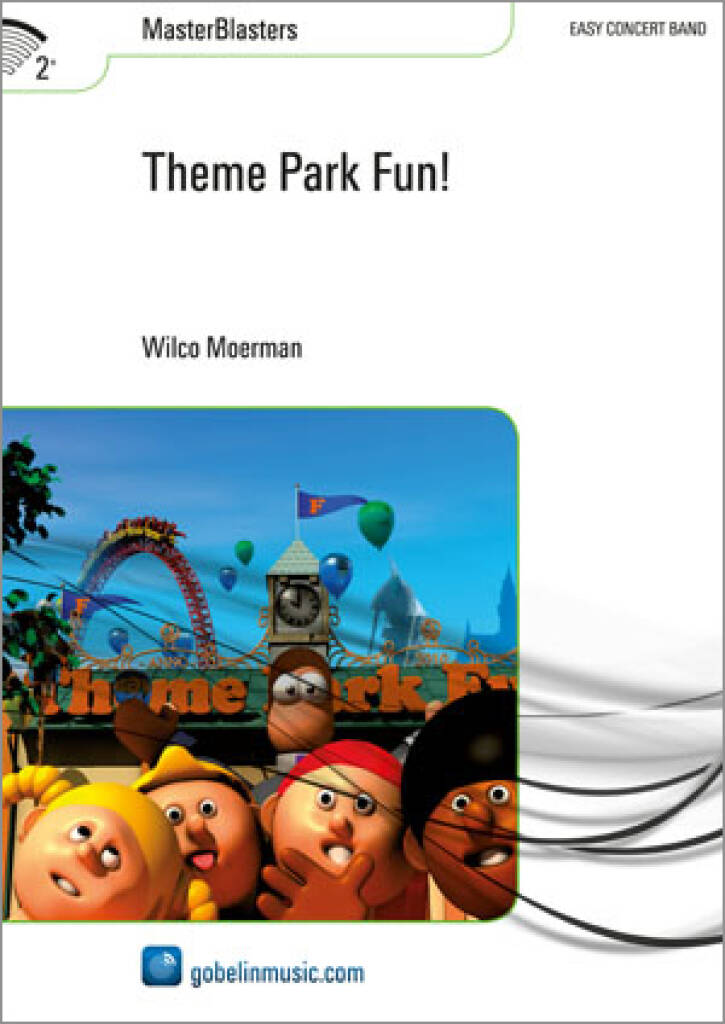
Theme Park Fun! - Wilco Moerman
In Theme Park Fun! your orchestra pays a visit to an amusement park. During your visit, you will experience some spectacular rides and attractions this theme park offers. The uniqueness of Theme Park Fun! is the interplay between music and(moving) images. Animations and illustrations support the visual composition.Part 1: The Entrance & Parade [with animation]The opening of the park is a fact. A day full of fun and pleasure awaits! You and the other visitors willbe confronted with all the rides, attractions and adventures the theme park has to offer. Which ride shall we do first?! There is so much to do and experience on this day in the park! A parade of colorful floats and park figures is passing by.Letthe fun begin!Part 2: The Haunted House [with animation]The only ride in the park that is not related to fun, is the Haunted House. Here visitors will be challenged to visit a house full of ghosts, creepy figures and otherominous things. The clock strikes twelve, there is no turning back. Ghosts are whispering, yelling, screaming... Fortunately it is almost one oclock, so we can leave this creepy place quickly.Part 3: The Swinging Galleon [withillustrations]What a huge pirate ship! Each time you swing back and forth, you will feel that weird feeling in your stomach. When you are thrown completely into the top you will have a fantastic view over the park, but you can not enjoy itfor long. Before you know the ship swings back the other way.Part 4: The Fairy Tale Ride [with illustrations]After all those exciting and spectacular rides and attractions, it is time for a peaceful tour in The Fairy Tale Ride.Surrounded by a fairytale setting, you will discover fable figures, talking animals and colorful designs. Such a beauty and tranquility. Having had this experience, we are ready again for the big rides in the park!Part 5: The Bumper Cars[with illustrations]Now its time to crawl behind the wheel of the Bumper Cars! Shall we all chase the conductor?! Before you know you are hit by another visitor or you will bump against someone else. In this tough ride you can prove yourselfas a real driver, or perhaps as a really bad one.Part 6: The Roller Coaster [with illustrations]The largest, fastest and scariest ride in the park ... we should definitely do the Roller Coaster! All together in the train, theover-the-shoulder restraints are lowering... be ready to ride. The train leaves the station and is heading for the big lift hill. It will be very scary when the train reaches the top and the train will be plunged down the first drop! Loops,corkscrews and other spectacular coaster elements will follow... Before you know it, the ride of your life is over. Shall we ride it again?!Part 7: Leaving the Park [with animation]Unfortunately everything comes to an end. Thisday in the theme park is over, but we have a lot new experiences to talk about! The memories of all the funny and spectacular rides will come up when we walk through the park to the exit. Just one look over the shoulder, the amusement park figuresare waving at us. Hopefully we will come back again soon!
Estimated dispatch 7-14 working days
-
 £57.50
Nonantum Bulgar - Hankus Netsky
Adding to the minuscule number of Klezmer pieces for concert band, Nonantum Bulgar is the 20th piece published in the BandQuest series. The title, Nonantum Bulgar, refers to Nonantum, a district in Newton which is home to the city's oldest synagogue (on the National Register of Historic Places), and bulgar (pronounced 'bull-ghar'), a type of Klezmer dance. When writing the piece, the composer imagined the dedication of the Adams St. Shul, which took place over one hundred years ago and featured a prominent Boston cantor and choir and a klezmer orchestra leading a Grand March down Adams St. This upbeat work is fun to play, features a trumpet solo, and gives every instrument the opportunity to play the melody. Learn more on YouTube! BandQuest, an exciting series of new music and accompanying curricula for band, is a program published by the American Composers Forum. The series was started as a response to feedback from music educators that there is a pressing need for new, fresh band music. The heart of this program is new works written by a diverse group of leading American composers who have created challenging pieces that are a true departure from standard middle school repertoire. Every BandQuest project includes a residency component in which the composer works collaboratively with a middle school as they create their new piece. Many BandQuest pieces are accompanied by an interdisciplinary curriculum designed to assist students as they learn the music and to integrate each piece with non-music studies. Visit www.bandquest.org to learn more about this innovative series, and email [email protected] to request a free downloadable audio catalog.
Estimated dispatch 7-14 working days
 View Music