
Results
-
£124.00
Dark Abyss (CB) - Fredrick Schjelderup
Dark Abyss was written for Eikanger-Bjrsvik Musikklag for their Siddis Brass and Brass in Concert-program, "Tales of the North Sea" in 2017. The piece describes the dark and unknown parts of the North Sea. The thematic material is dark and full of effects trying to imagine whats hiding down at the bottom of the ocean.
Estimated dispatch 7-14 working days
-
 £69.95
Light-Walk (Concert Band - Score and Parts) - Gott, Barrie
A toe-tapping 'big-band' arrangement from the renowned composer and arranger Barrie Gott. A hit wherever it is played, this 'great fun' music allows the band to 'let its hair down' and the Flugel Horn (or Trumpet) the chance to take centre stage.The 'big-band' arrangement that brought the arranging skills of Barrie Gott instantly to the attention of the brass world. Still a hit wherever it is played, this 'great fun' music allows the band to 'let its hair down' and the Flugel Horn the chance to take centre stage.
Estimated dispatch 7-14 working days
-
£13.95
Light-Walk (Concert Band - Score Only) - Gott, Barrie
A toe-tapping 'big-band' arrangement from the renowned composer and arranger Barrie Gott. A hit wherever it is played, this 'great fun' music allows the band to 'let its hair down' and the Flugel Horn (or Trumpet) the chance to take centre stage.The 'big-band' arrangement that brought the arranging skills of Barrie Gott instantly to the attention of the brass world. Still a hit wherever it is played, this 'great fun' music allows the band to 'let its hair down' and the Flugel Horn the chance to take centre stage.
Estimated dispatch 7-14 working days
-
 £27.95
Light Music (Concert Band - Score only) - Wiffin, Rob
The title Light Music alludes to different things. Most of the music in the suite is light in nature, and is in the inherently British tradition of 'light music' - original pieces which are often descriptive but essentially melodic. In another sense the music depicts various aspects of light itself. The title itself is a trick of the light!The first movement, Lightscape, portrays shifting patterns and types of light, highlighting some details and obscuring others. It is sometimes vibrant, dancing and full of movement, and sometimes tranquil.The second movement, At the going down of the sun, considers the light of the sun as it sets. Because of the nature of his career, the composer has written a fair amount of ceremonial music and this movement is close to that genre once again. There is, in the title, a reference to the familiar Remembrance line 'At the going down of the sun and in the morning we will remember them' from the poem For the Fallen by Robert Laurence Binyon (1869-1943) written in September 1914, a few weeks after the outbreak of the First World War. While the music is not a setting of these words - or in any way referential - there is an echo of the words 'We will remember them'.The suite finishes with Set Alight which starts off with a few combustible bars as the flame catches and then the fire is under way.Duration: 11.30
Estimated dispatch 7-14 working days
-
£137.95
Light Music (Concert Band - Score and Parts) - Wiffin, Rob
The title Light Music alludes to different things. Most of the music in the suite is light in nature, and is in the inherently British tradition of 'light music' - original pieces which are often descriptive but essentially melodic. In another sense the music depicts various aspects of light itself. The title itself is a trick of the light!The first movement, Lightscape, portrays shifting patterns and types of light, highlighting some details and obscuring others. It is sometimes vibrant, dancing and full of movement, and sometimes tranquil.The second movement, At the going down of the sun, considers the light of the sun as it sets. Because of the nature of his career, the composer has written a fair amount of ceremonial music and this movement is close to that genre once again. There is, in the title, a reference to the familiar Remembrance line 'At the going down of the sun and in the morning we will remember them' from the poem For the Fallen by Robert Laurence Binyon (1869-1943) written in September 1914, a few weeks after the outbreak of the First World War. While the music is not a setting of these words - or in any way referential - there is an echo of the words 'We will remember them'.The suite finishes with Set Alight which starts off with a few combustible bars as the flame catches and then the fire is under way.Duration: 11.30
Estimated dispatch 7-14 working days
-
 £54.95
PROLOGUE PRAYER AND DREAM (Hansel and Gretel) (Concert Band) - Humperdinck, Engelbert - Erickson, Frank
This arrangement is derived from the music in Act 2 with Hansel and Greta lost and lying down to sleep in the woods. The Prologue begins with the sandman sprinkling sand on to the children's eyes. Hansel and Gretle respond by singing their Evening Prayer. In the Dream Pantomime a ladder reaches down from heaven and 14 angels are seen to surround the sleeping children.
Estimated dispatch 7-14 working days
-
 £205.70
In Nomine (Concert Band - Score and Parts) - Schwarz, Otto M.
How often has something been justified by, declared to be, or blessed as 'in the name of' some cause or other? How can it be that opposing armies and the use of weapons are ever 'in the name of...'? This is a common thread in the history of different faiths. Good was created but evil was committed and all 'in the name of...' This thread is also found in the history of the Premonstratensian Abbey at Wadgassen. The abbey was built in the 12th century on unfertile, desolate moorland, which later evolved into the most powerful religious community in the Saarland. The history of the abbey records quite astounding achievements under the motto desertum florebit quasi lilium ('the desert will bloom like a lily'); but also the harsh treatment of delinquents. The order had its own school, in which children were taught the seven liberal arts (which included music as well as geography and astronomy), but the poor were left to starve outside the abbey walls and were only allowed to eat from the members' leftovers on feast days. The medieval witch trials demanded their pound of flesh, and one group that fell victim were ecstatic dancers who moved wildly to music, which was interpreted as the devil's work. The result: a show trial that sentenced the dancers to death by fire. All in the name of... The year is 1789: Abbot Bordier is in the tenth year of his command. He does not yet know that he is to be the last abbot of an almost 700-year tradition. Not far from the abbey is the French border, which has long been making itself felt with the sound of gunfire, and the brothers continue to keep a nervous eye on it. The first portents of the French Revolution loom, but no one wants to believe it, that is, until the French pound the door down, storm the abbey and come right into the brothers' chambers. In a blind fury, all the pipes of the abbey organ are torn out, icons beheaded with swords and brothers beaten death while numerous buildings are set on fire. The abbey church is in flames. A frantic and desperate escape begins. Abbot Bordier and a handful of brothers make their getaway via the River Saar, adjacent to the abbey, to the neighbouring village of Bous. They survive, but their life, the Premonstratensian abbey, is destroyed. While they flee towards Prague and the sanctuary of the Strahov Monastery, the abbey at Wadgassen is razed to the ground and becomes a stone quarry. The desert blooms once more, however. A few short decades later, a glasswork arises from the foundations of the abbey. As peace returns to the region, it brings jobs and a new vision for its people.Duration: 11.15
Estimated dispatch 7-14 working days
-
 £164.95
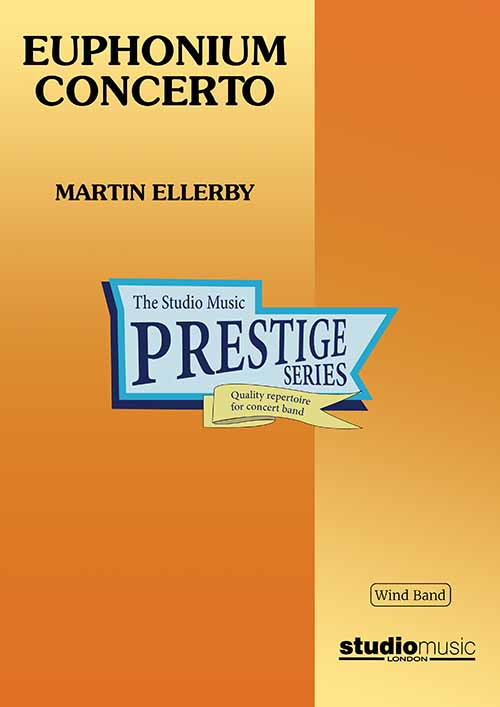
Euphonium Concerto (Concert Band - Score and Parts) - Ellerby, Martin
This Euphonium Concerto was written between late 1994 and early 1995 in response to a commission from Steven Mead to whom the work is dedicated. It is cast in four movements and lasts a little over 22 mins:I. Fantasy: After the briefest of introductions, the solo euphonium enters with the key melodic phrase of the movement in a fast 'Tempo I'. This idea is developed up to the point where a slower 'Tempo II' breaks the argument - here the mood is reflective but it is only to be a brief interruption as 'Tempo I' returns very quickly. The opening material is then subjected to further transformation with 'Tempo II' making occasional returns en route, the distances between the contrasting tempi becoming ever closer, and the movement closes in a rather soft though definite manner.II. Capriccio: This relatively short presto movement forms a bridge between the first movement and the work's slow movement. The majority of the band parts are bright and muted with the percussion players enhancing the texture with contributions from xylophone, glockenspiel and vibraphone. Again the initial solo euphonium phrase provides the basis for almost all the movement's material. This is extremely virtuosic for the soloist and band alike and makes great play of the rhythmic possibilities of combining simple and compound music either in close proximity or together.III. Rhapsody (for Luis): A Lento movement, sitting between two different but essentially rapid ones, this provides the work's emotional core exploiting the soloist's cantabile qualities in an almost seamless fashion. Again, as will all the work's movements, the initial idea paves the way for subsequent development, eventually culminating in a passionate climax; thereafter it winds down with an affectionate backward glance towards the close of the the slow movement of the Euphonium Concerto of Joseph Horovitz, whose mark had been made indelibly on the euphonium repertoire. This movement is dedicated to Luis Maldonado who set the full score of the brass version before his untimely death.IV. Diversions: The work's variation finale is cast in 3/4 throughout though the barline is often a guideline and was seen by the composer as a challenge of metrical restraint! There is an obvious jazz feel to this movement (both rhythmically and harmonically) with a swaggering ritornello theme first announced by the solo euphonium. Thereafter follows a series of interludes and 'adjusted' returns of the main theme. A lyrical idea is allowed to enter but the underlying momentum is ever present. The band also contributes to the interludes and eventually the tempo increases towards a 'wild' and absolute conclusion.Duration: 22.30Recorded on QPRM143D Dreamscapes, Royal Northern College of Music Wind Orchestra
Estimated dispatch 7-14 working days
-
£32.95
Euphonium Concerto (Concert Band - Score only) - Ellerby, Martin
This Euphonium Concerto was written between late 1994 and early 1995 in response to a commission from Steven Mead to whom the work is dedicated. It is cast in four movements and lasts a little over 22 mins:I. Fantasy: After the briefest of introductions, the solo euphonium enters with the key melodic phrase of the movement in a fast 'Tempo I'. This idea is developed up to the point where a slower 'Tempo II' breaks the argument - here the mood is reflective but it is only to be a brief interruption as 'Tempo I' returns very quickly. The opening material is then subjected to further transformation with 'Tempo II' making occasional returns en route, the distances between the contrasting tempi becoming ever closer, and the movement closes in a rather soft though definite manner.II. Capriccio: This relatively short presto movement forms a bridge between the first movement and the work's slow movement. The majority of the band parts are bright and muted with the percussion players enhancing the texture with contributions from xylophone, glockenspiel and vibraphone. Again the initial solo euphonium phrase provides the basis for almost all the movement's material. This is extremely virtuosic for the soloist and band alike and makes great play of the rhythmic possibilities of combining simple and compound music either in close proximity or together.III. Rhapsody (for Luis): A Lento movement, sitting between two different but essentially rapid ones, this provides the work's emotional core exploiting the soloist's cantabile qualities in an almost seamless fashion. Again, as will all the work's movements, the initial idea paves the way for subsequent development, eventually culminating in a passionate climax; thereafter it winds down with an affectionate backward glance towards the close of the the slow movement of the Euphonium Concerto of Joseph Horovitz, whose mark had been made indelibly on the euphonium repertoire. This movement is dedicated to Luis Maldonado who set the full score of the brass version before his untimely death.IV. Diversions: The work's variation finale is cast in 3/4 throughout though the barline is often a guideline and was seen by the composer as a challenge of metrical restraint! There is an obvious jazz feel to this movement (both rhythmically and harmonically) with a swaggering ritornello theme first announced by the solo euphonium. Thereafter follows a series of interludes and 'adjusted' returns of the main theme. A lyrical idea is allowed to enter but the underlying momentum is ever present. The band also contributes to the interludes and eventually the tempo increases towards a 'wild' and absolute conclusion.Duration: 22.30Recorded on QPRM143D Dreamscapes, Royal Northern College of Music Wind Orchestra
Estimated dispatch 7-14 working days
-
 £137.99
Theme Park Fun! Wind Band Set (Score & Parts)
In Theme Park Fun! your orchestra pays a visit to an amusement park. During your visit, you will experience some spectacular rides and attractions this theme park offers. The uniqueness of Theme Park Fun! is the interplay between music and (moving) images. Animations and illustrations support the visual composition.Part 1: The Entrance & Parade [with animation]The opening of the park is a fact. A day full of fun and pleasure awaits! You and the other visitors will be confronted with all the rides, attractions and adventures the theme park has to offer. Which ride shall we do first?! There is so much to do and experience on this day in the park! A parade of colorful floats and park figures is passing by.Let the fun begin!Part 2: The Haunted House [with animation]The only ride in the park that is not related to fun, is the Haunted House. Here visitors will be challenged to visit a house full of ghosts, creepy figures and other ominous things. The clock strikes twelve, there is no turning back. Ghosts are whispering, yelling, screaming... Fortunately it is almost one oclock, so we can leave this creepy place quickly.Part 3: The Swinging Galleon [with illustrations]What a huge pirate ship! Each time you swing back and forth, you will feel that weird feeling in your stomach. When you are thrown completely into the top you will have a fantastic view over the park, but you can not enjoy it for long. Before you know the ship swings back the other way.Part 4: The Fairy Tale Ride [with illustrations]After all those exciting and spectacular rides and attractions, it is time for a peaceful tour in The Fairy Tale Ride. Surrounded by a fairytale setting, you will discover fable figures, talking animals and colorful designs. Such a beauty and tranquility. Having had this experience, we are ready again for the big rides in the park!Part 5: The Bumper Cars [with illustrations]Now its time to crawl behind the wheel of the Bumper Cars! Shall we all chase the conductor?! Before you know you are hit by another visitor or you will bump against someone else. In this tough ride you can prove yourself as a real driver, or perhaps as a really bad one.Part 6: The Roller Coaster [with illustrations]The largest, fastest and scariest ride in the park ... we should definitely do the Roller Coaster! All together in the train, the over-the-shoulder restraints are lowering... be ready to ride. The train leaves the station and is heading for the big lift hill. It will be very scary when the train reaches the top and the train will be plunged down the first drop! Loops, corkscrews and other spectacular coaster elements will follow... Before you know it, the ride of your life is over. Shall we ride it again?!Part 7: Leaving the Park [with animation]Unfortunately everything comes to an end. This day in the theme park is over, but we have a lot new experiences to talk about! The memories of all the funny and spectacular rides will come up when we walk through the park to the exit. Just one look over the shoulder, the amusement park figures are waving at us. Hopefully we will come back again soon! 14:30
Estimated dispatch 7-14 working days

 View Music